A Divine Appointment (2 Kings 8:1-6)

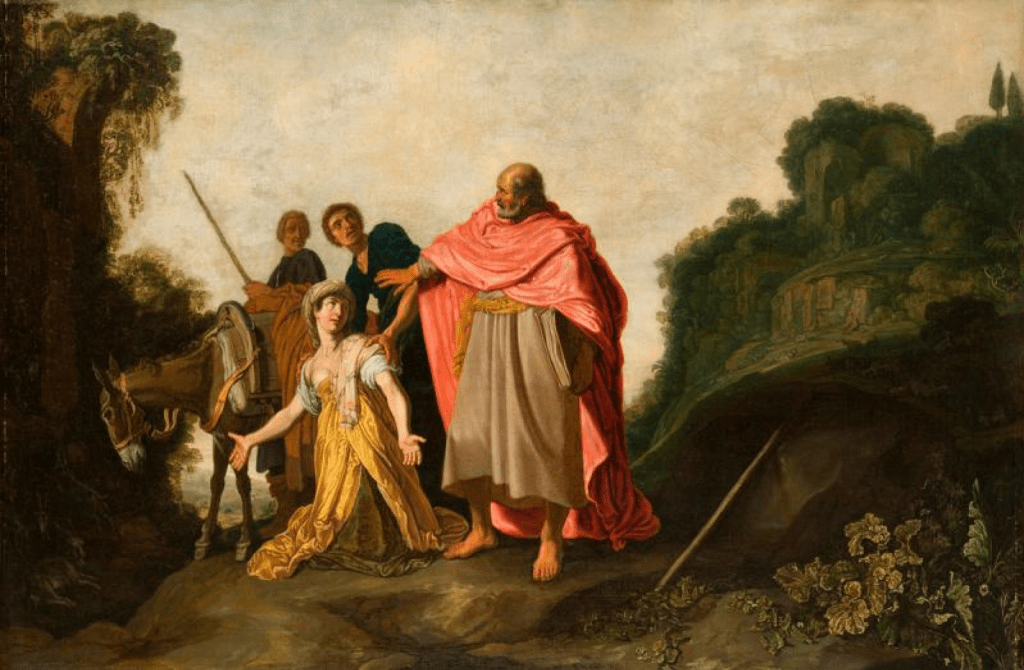
The prophet Elisha and the Shunammite woman, by Pieter Lastman, 1620

Elisha spoke to the woman whose son he had brought back to life: “You and your household must go away and live wherever you can, because the Lord has called for a famine. It is coming to the land and will last seven years.”

So the woman went and did what the man of God asked. She and her household moved away, living in Philistia seven years. When seven years had passed, the woman returned from Philistia. She went to appeal to the king for her house and her farmland. The king was speaking to Gehazi, the man of God’s servant, asking him, “Tell me about all the great things Elisha has done.” So Gehazi was telling the king how Elisha had brought the dead to life. At that very moment, the woman whose son he had brought back to life began to appeal to the king for her house and her farmland.

Gehazi said, “Your Majesty, this is the woman herself! And this is her son, the one Elisha brought to life!”

The king questioned the woman, and she told him her story. Then the king appointed an official to help her, saying, “Return everything that belongs to her, as well as everything that the farmland has produced, starting from the day she left the country until right now.” (Common English Bible)

People of faith typically don’t see divine appointments coming at all; they often show up in the middle of hard mundane days.

The prophecies and actions of the prophet Elisha are covered in the book of 2 Kings with a series of ten incredible narratives (chapters 2-9). Each of them are designed to demonstrate the power of God over (and sometimes against) the power of the king.

This was important because the royal decisions and actions of most of the Israelite kings were quite disconnected from God’s law and justice. Most kings did whatever they wanted, sometimes to the point of completely leading the people away from the worship of Yahweh and toward the worship of other gods.

Today’s Old Testament lesson concerns the ninth story in this series of narratives. A widow, whose son Elisha had restored to life in the second narrative (2 Kings 4:8-37) left for the land of the Philistines when there was a severe famine. Although the woman was simply listening to the prophet and doing what he said, squatters took advantage of the situation and took over her house and property while she was away.

In a clear demonstration of what a “divine appointment” looks like in Holy Scripture, Elisha’s servant and the king were talking together about this very woman and the miracle that took place with her son. The prophet had essentially raised her dead child to life. Then, lo and behold, the woman walked into the conversation to appeal the injustice that had happened to her and her family.

Even the worst of kings would discern the right thing to do in such a situation. After questioning the woman, the king ensured that she would get everything restored to her. Through it all, we are meant to see the power and sovereignty of God over the human authority of political kings.

I hope that you, at some point in your life, have experienced a meeting with another person that you can see was unmistakably arranged by God. And a great need you had was met because of this encounter. The Lord blessed you through it in a way that you didn’t see coming at all.

The fact of the matter is that God is sovereign, all-knowing, and all-powerful, along with being infinitely gracious, good, just, right, and loving. Therefore, God sets about to bless both us and other people. And when God determines to do something, nothing and no one in heaven or on earth can stop it.

Wherever you presently are, and whatever it is you are doing now in your life, is really no accident. And if your life situation is awful and far from any sort of idyllic scene of blessing, then please know that this is a circumstance that is ripe for a divine appointment.

For how could we ever know God as the Great Deliverer unless we were between a rock and a hard place with nowhere to turn? How could we ever experience God as the Divine Healer unless we were broken and/or brokenhearted?

How could we ever realize God as Provider unless we were out of resources and down to our last penny? Or God as Helper unless we were desperate and unable to move? Or God as the One who restores unless we had lost everything?

Just as there cannot be resurrection and new life without a crucifixion and an old life, so our lives will inevitably take a trajectory of suffering and hardship before glory and blessing. In order to allow the good to completely fill us, we must be totally emptied of everything else.

Maybe you will never experience something quite as dramatic as the woman did with gaining her son back to life, and her property restored after a terrible famine, but know this: The great Lord and God of all, the Sovereign of the universe, has your back through all that you’re going through on this earth.

I often get asked by patients and parishioners alike, “Where is God?” It feels to them that God is absent, silent, and far from understanding what they’re going through in the midst of their very challenging adversity.

Really, however, it’s actually an easy question for me to answer: Jesus is our Immanuel, God with us. The Spirit of God is right beside you, walking with you, even holding you up at times, through all the crud and crap of this old fallen sinful world of ours. Seeing only one set of footsteps in the sand, it turns out God is the One that carries the weak and weary in their trouble. The Lord is anything but absent.

If God has authority over earthly rulers, then the Lord most certainly has power to handle your life.

O God, why have you abandoned me? Though you have hidden your face from me, still from this dread and empty place, I cry to you, who have promised me that underneath are your everlasting arms. God, you are my help and comfort; you shelter and surround me in love so tender that I may know your presence with me, now and always. Amen.


Respect Wise Sayings (Proverbs 22:1-9)

Being respected is more important than having great riches.
    To be well thought of is better than silver or gold.

The rich and the poor are alike
    in that the Lord made them all.

The wise see danger ahead and avoid it,
    but fools keep going and get into trouble.

Respecting the Lord and not being proud
    will bring you wealth, honor, and life.

Evil people’s lives are like paths covered with thorns and traps.
    People who guard themselves don’t have such problems.

Train children to live the right way,
    and when they are old, they will not stray from it.

The rich rule over the poor,
    and borrowers are servants to lenders.

Those who plan evil will receive trouble.
    Their cruel anger will come to an end.

Generous people will be blessed,
    because they share their food with the poor. (New Century Version)

The Bible is a big book. In fact, it is more like a compilation of many books – 66 of them, to be precise, contained in the Old and New Testaments. Although the Bible has the grand theme of presenting a redemptive drama, it is not a flat one-dimensional piece of literature. 

Throughout the Bible’s contents, from Genesis to Revelation, it is chocked full of various literary genres. From poetry and narrative stories to apocalyptic accounts and exhortative epistles, Holy Scripture provides a many-sided look at the unfolding drama of God’s redemption toward humanity. 

Included in this big Bible is the book of Proverbs, a collection of wise sayings to help people navigate God’s big world. The chief reason it’s important to know that the Bible contains different types of literature is so that we can read it and interpret it well. 

A proverb is a short pithy statement of experiential truth. 

It’s not the same as commands or law. The individual Hebrew proverbs are designed to point out that, all things being equal, this is how the world works. For example, let’s consider one of the most misunderstood and misused verses in the Bible: Train up a child in the way he should go; even when he is old he will not depart from it. 

Many a parent has been made to feel unrelenting guilt over a wayward son or daughter, believing that somehow they have failed. The reason they have such feelings is that they treat the book of Proverbs as clear promises to claim. But biblical proverbs simply were not meant to be stretched in this manner.

Rather, the proverb is meant to communicate to us that if parents are diligent and faithful in raising kids, that in all likelihood, this training will never leave them; it will always stick with them in some way, shape, or form. 

Furthermore, it’s also true that many a parent has rejoiced over an adult child coming back to their faith after a sojourn in the muck of the world. Important to that return is the foundation laid years ago with faithful parenting that desired to pass on wise and good instruction.

Proverbs, therefore, are meant to encourage us, not with an ironclad promises, but with the hope that all the blood, sweat, and tears that parents, teachers, mentors, and others put into children, and into their diligent work, will someday likely bear much fruit of responsible lives that contribute and benefit the church and the world. 

So, be diligent, patient, and do not give up; keep persevering knowing that your labor in the Lord is not in vain.

And also consider the proverb that honoring, respecting, and fearing God will bring a person wealth, riches, and an abundant life. It might. Perhaps likely. But it’s neither a promise nor a command. And it’s definitely not a math equation; you cannot build an algorithm from it to get rich quick. No, the verse is a proverb.

In other words, if we are careful to pay attention to God, and seek to obey and trust the Lord for all things, then, it is quite likely that you will find yourself with plenty, and not be in want. Thus, we ought never to look at the world with black-and-white glasses that unthinkingly believes that all rich people are hard workers and godly, whereas all poor folk are lazy good-for-nothing’s.

What’s more, many a poor person is rich in faith and good works, whereas many of the rich, care little for God and spend their wealth on self-centered concerns. Understanding a proverb as a proverb helps us to avoid stereotyping people and giving them labels they don’t deserve.

Let’s keep going. I do believe, as the proverb says, that generous people will be blessed. But know this: genuine generosity always costs us something. It will take money, time, energy, and/or resources which become depleted when we give liberally. Some folk never acquire wealth because they are committed to sharing what they have with others. And, in my opinion, these are the persons who are truly blessed.

If we keep an eye toward acquiring wisdom, pursuing experiential knowledge, and trusting God, then we look to places in the Bible like the Proverbs, and seek to live life as it was intended to be lived.

Internalize the biblical proverbs and, all things being equal, you are quite likely to have a good and blessed life.

Blessed and almighty God, the Giver of life, it is from your hand that we have received all we have, and are, and will be. We understand that your divine call upon us is to be the stewards of your abundance, the caretakers of all you have entrusted to us. Help us always to use your gifts wisely; and teach us to share them generously. May our faithful stewardship bear witness to the love of Christ in our lives; we pray with grateful hearts, in the gracious name of Jesus. Amen.

A New Year’s Blessing (Numbers 6:22-27)

The Priestly Blessing, by Yoram Raanan

The Lord spoke to Moses, saying, “Speak to Aaron and his sons, saying: Thus you shall bless the Israelites: You shall say to them:

The Lord bless you and keep you;
the Lord make his face to shine upon you and be gracious to you;
the Lord lift up his countenance upon you and give you peace.

“So they shall put my name on the Israelites, and I will bless them.” (New Revised Standard Version)

Perhaps we are living in a famine of blessing. Maybe so many people are short-tempered, rude, drive their cars recklessly, ignore others’ needs, swear like sailors, and speak enough sarcasm to bury the earth six feet deep in cynicism, because they are not being blessed; and it could be they haven’t been blessed for a very long time, even never.

At the beginning of this New Year, we are reminded of deep longings and hopes for fresh starts. I invite you to consider the value and significance of giving and receiving a blessing.

Life operates by blessing, not cursing.

The world cannot stand up under the curse. The new earth will endure forever with a blessing.

People wither without a blessing. They die when cursed. Not necessarily in body. Most definitely in spirit.

Something must be said about the word “blessing.” It gets used (and misused) a lot, especially by Christians.

As with most words in the Old Testament, “blessing” is a relational word. It means to have God’s stamp of approval on your life. It’s meant to convey that the Lord’s presence is with us.

To be blessed by God is a multi-dimensional experience – receiving promises, enjoying peace, having right relationships with both God and other people, and knowing divine comfort and security.

A blessing isn’t simply having lots of money, plenty of family, or a good job. One could have none of those and still be blessed by God. And being blessed is not getting everything you want. Some people continually get what they want and are cursed, not blessed.

Blessing is tied not to human activity but to divine initiative.

We can’t finagle a blessing out of God. Plenty of folks try to do that, and, like Jacob, they might get away with it in their family – but it will not work with God. The grace of blessing is freely bestowed by a benevolent and merciful Lord.

Everything comes down to God. The Lord is not stingy but generous – not subject to the whimsy of human cajoling but deeply influenced by the unending unity, harmony, and love within the divine godhead.

In other words, divine blessing is a gift – not something earned or cleverly received through trickery or manipulation.

Blessing one another is also a gift. In fact, God clearly communicated to Moses and Aaron how they were to bless the people with powerful words.

I believe we all intuitively know that words and language have the power of life and of death, of blessing and cursing. And withholding words of blessing and keeping silent is to withhold goodness and love from another.

Speaking words of blessing and backing up those words with an active commitment, is vital to humanity’s spiritual and emotional health.

Fathers and mothers everywhere across the world stand in a unique and special position as those who have the power of bestowing a blessing on their children – a blessing of being with them, approving of them, affirming their gifts and abilities, envisioning for them a special future of how God can use them.

Those words of blessing have the power to help children navigate the world with assurance and confidence. Armed with blessing, they can filter-out the choices in front of them and walk in the way of God.

Notice in the New Testament Gospels how the God the Father blessed the Son:

And when Jesus had been baptized, just as he came up from the water, suddenly the heavens were opened to him and he saw the Spirit of God descending like a dove and alighting on him. And a voice from heaven said, “This is my Son, the Beloved, with whom I am well pleased.” (Matthew 3:16-17, NRSV)

God provided a constant presence and an active commitment through the Spirit; God spoke words of approval and affirmation; God the Father had a special future for Jesus the Son, which helped Jesus to repel the words of Satan. Since Jesus needed and received a blessing from his Father, how much more do we?

Jesus passed the blessing to his disciples with a promise of presence and commitment:

Jesus came near and spoke to them, “I’ve received all authority in heaven and on earth. Therefore, go and make disciples of all nations, baptizing them in the name of the Father and of the Son and of the Holy Spirit, teaching them to obey everything that I’ve commanded you. Look, I myself will be with you every day until the end of this present age.” (Matthew 28:18-20, CEB)

Jesus informed the disciples his presence would be with them; communicated an active commitment to give them authority to do the job of disciple-making; pictured for them a special future of reaching the nations; affirmed and approved them. “The Great Commission” is really a statement of God’s blessing.

One reality needs to be recognized and affirmed with all confidence: You and I already possess God’s blessing; there is no need to try and earn it. The words of blessing state what is, in fact, already true.

We have the privilege and the ability to reverse the world’s curse and turn it into blessing.

Those blessed with money can be a blessing by giving it away.

Those blessed by growing up in a loving family can provide love to others who are unloved and need a special blessing.

Those blessed with wisdom can mentor and instruct those who need wisdom.

Those blessed with the mercy of God can be merciful to others.

Those blessed with a wonderful relationship with God can pray people into the kingdom of God.

Parents, it is never too late to bless your children, even if they are adults. Children, it is never too late to bless your parents and your siblings, even if they are prickly and hard. To not bless is to curse.

Bless your family through words that build up, and do not tear down. Use those words to picture a special future of what God can do. Follow through with those words by demonstrating an active commitment to embodying blessing.

I leave you with this blessing for the New Year:

May God answer you when you are in distress; may the name of Jesus protect you. 

May the Lord send help when you need it and give you support when you cry out to him. 

May the God of heaven remember your good deeds done in faith and accept you just as you are. 

May the Lord give you the desire of your heart and make all your plans succeed.

When the Almighty goes out of the way to answer your prayers, then I will be the first to shout with joy!

I know the Lord is God. There is a special future for you beyond what you can even ask or think. And I will be there on the sidelines, encouraging you all the way.

Some people trust in the political process, others trust in the strength of the economy; but we trust in the name of the Lord our God. 

May God answer when you call.

May God bless you with an everlasting love. 

May you know Christ, and him crucified, risen, and coming again. 

May God’s presence and power be with you now and forever. Amen.

Generosity and Thanksgiving (2 Corinthians 9:6-15)

Remember this: Whoever sows sparingly will also reap sparingly, and whoever sows generously will also reap generously. Each of you should give what you have decided in your heart to give, not reluctantly or under compulsion, for God loves a cheerful giver. And God is able to bless you abundantly, so that in all things at all times, having all that you need, you will abound in every good work. As it is written:

“They have freely scattered their gifts to the poor;
    their righteousness endures forever.”

Now he who supplies seed to the sower and bread for food will also supply and increase your store of seed and will enlarge the harvest of your righteousness. You will be enriched in every way so that you can be generous on every occasion, and through us your generosity will result in thanksgiving to God.

This service that you perform is not only supplying the needs of the Lord’s people but is also overflowing in many expressions of thanks to God. Because of the service by which you have proved yourselves, others will praise God for the obedience that accompanies your confession of the gospel of Christ, and for your generosity in sharing with them and with everyone else. And in their prayers for you their hearts will go out to you, because of the surpassing grace God has given you. Thanks be to God for his indescribable gift! (New International Version)

Generosity is at the heart of any good family, neighborhood, workplace, organization, church, and individual. To be generous is to reflect the image of God, who is wildly generous, giving freely and liberally on our behalf.

We often associate being generous with giving a handout or money to someone or some organization in need. It is that, but much more. Generosity doesn’t have to do with the size of our check or the amount of our contribution. 

We can be generous with our time, abilities, words, and with what little or much we have of money, as well. Generosity means to go above expectations – to give with magnanimity, to go out of your way to do good when no one is looking – and experience giving as its own reward.

Jesus, for whom the Apostle Paul learned about the true nature of being generous, embraced generosity as a way of life while he was here on this earth. No one expected Christ to go out of his way to call the least, the lowly, the lost, and the last of society. The people on the margins of respectable culture had no expectations that the Messiah would head their way. But he did. 

Christ the Lord even went so far as to hang out with the despised tax collectors, and freely talk with sexual deviants. The high brows of society couldn’t raise their eyebrows high enough for Jesus. It was just too much for them. Not only was Jesus making them look bad with his generosity as a way of life, but he was also, in their minds, generous to the wrong sort of people.

The follower of Jesus does so by surveying the landscape of human need and giving to people in places where no one expects a handout. 

It’s interesting that Christ lived a simple life with little to no money. He largely depended on the generosity of others. Yes, my friend, generosity is a two-way street. Being generous to others is the easy part for many people; receiving the generosity of other people is often much harder.  Yet, Jesus did both – he gave and received.

Jesus was generous in ways which were consistent with the Father’s will. Christ gave of his time, and of his divine ability to heal and forgive. He was perhaps the most magnanimous person of all-time, due to his generosity of compassion, kindness, love, and humble service to others. 

And the height of Christ’s generosity was in giving his life so that you and I could live a life free from the power of guilt and shame. Such deliverance, through the cross, is offered and given, free of charge. That’s over-the-top generous.

Money is merely a barometer of one’s generosity, that is, of our stance and approach toward money. You don’t need to be rich to be generous. A large and expansive heart always finds ways to have a generosity of spirit wherever it goes.

Jesus warned against using generosity in order to be noticed:

“When you do good deeds, don’t try to show off. If you do, you won’t get a reward from your Father in heaven. When you give to the poor, don’t blow a loud horn. That’s what show-offs do in the meeting places and on the street corners because they are always looking for praise. I can assure you that they already have their reward. When you give to the poor, don’t let anyone know about it. Then your gift will be given in secret. Your Father knows what is done in secret, and he will reward you.” (Matthew 6:1-4, CEV)

A generous heart is a heart of gratitude. Giving thanks is the logical and organic way of expressing generosity.

Consider just a few biblical verses that encourage us toward thanksgiving: 

Let us come before him with thanksgiving and sing joyful songs of praise. (Psalm 95:2, GNT) 

Enter his gates with a song of thanksgiving.
Come into his courtyards with a song of praise.
Give thanks to him; praise his name. (Psalm 100:4, GW)

O give thanks to the Lord, for he is good; his steadfast love endures forever! (Psalm 118:1, NRSV)

In the Gospel of Luke, a story is told of ten men with leprosy who were miraculously healed by Jesus. A Samaritan, the lowliest of the low, was the lone person who came and fell at Christ’s feet with intense gratitude. While the other nine went about their lives free from disease and glad for it, only one guy took the time to thank Jesus. (Luke 17:11-19) 

Indeed, sometimes we must be reminded to give thanks and to show gratitude for the ways in which God has provided for us. Yet, if our hearts are abundantly full of generosity, no reminder is needed; it just comes pouring forth.

Those who have small hearts will only realize small blessings. But those who plant many seeds of generosity and gratitude will see abundant blessings.

May it be so, to the glory of God.