
Genesis 27:30-46 – “Bless Me, Too!”

Isaac Blesses Jacob by Yoram Raanan

After Isaac finished blessing him, and Jacob had scarcely left his father’s presence, his brother Esau came in from hunting. He too prepared some tasty food and brought it to his father. Then he said to him, “My father, please sit up and eat some of my game, so that you may give me your blessing.”

His father Isaac asked him, “Who are you?”

“I am your son,” he answered, “your firstborn, Esau.”

Isaac trembled violently and said, “Who was it, then, that hunted game and brought it to me? I ate it just before you came, and I blessed him—and indeed he will be blessed!”

When Esau heard his father’s words, he burst out with a loud and bitter cry and said to his father, “Bless me—me too, my father!”

But he said, “Your brother came deceitfully and took your blessing.”

Esau said, “Isn’t he rightly named Jacob? This is the second time he has taken advantage of me: He took my birthright, and now he’s taken my blessing!” Then he asked, “Haven’t you reserved any blessing for me?”

Isaac answered Esau, “I have made him lord over you and have made all his relatives his servants, and I have sustained him with grain and new wine. So, what can I possibly do for you, my son?”

Esau said to his father, “Do you have only one blessing, my father? Bless me too, my father!” Then Esau wept aloud.

His father Isaac answered him,

“Your dwelling will be
away from the earth’s richness,
away from the dew of heaven above.
You will live by the sword
and you will serve your brother.
But when you grow restless,
you will throw his yoke
from off your neck.”

Esau held a grudge against Jacob because of the blessing his father had given him. He said to himself, “The days of mourning for my father are near; then I will kill my brother Jacob.”

When Rebekah was told what her older son Esau had said, she sent for her younger son Jacob and said to him, “Your brother Esau is planning to avenge himself by killing you. Now then, my son, do what I say: Flee at once to my brother Laban in Harran. Stay with him for a while until your brother’s fury subsides. When your brother is no longer angry with you and forgets what you did to him, I’ll send word for you to come back from there. Why should I lose both of you in one day?”

Then Rebekah said to Isaac, “I’m disgusted with living because of these Hittite women. If Jacob takes a wife from among the women of this land, from Hittite women like these, my life will not be worth living.” (NIV)

The twins Esau and Jacob are the very definition of sibling rivalry. Even at their birth, they jostled and positioned for their entry into the world. Although brothers, they were different from one another in every way. As their aged father, Isaac, was near the end of his days, he was looking to pass on a family blessing to Esau, the firstborn. And that’s where things got dicey.

Jacob, always the trickster, was still playing out the rivalry. When his brother Esau was out hunting and preparing to receive his father’s blessing, Jacob posed as his brother and deceitfully gained the blessing of Isaac. Both Isaac and Esau were shocked to discover what happened. Esau’s response was one of grief, disappointment, bitterness, with tears and weeping. Despite Esau not being known for his sensitivity to God or family before this event, we can certainly feel his cry: “Do you have only one blessing, my father? Bless me too, my father!”

Blessing with hands

The blessing. As a chaplain who works with behavioral health patients, I have heard many times over the lament of individuals without a blessing from their father. As people created in the image and likeness of God, we were meant to be blessed – to have a loving and enduring stamp of approval from both our heavenly Father and our earthly fathers. And when an earthly father, or father figure, either cannot or will not extend a vital blessing to children, it is a terrible wound – like an invisible open putrid abscess which continually leaves the person emotionally and spiritually sick.

Blessing is needed. Without blessing we flounder in the world, struggling to see hope, wondering if we are loved, and lacking confidence in our faith. To be blessed is to receive a beautiful gift. The term “blessing” in Scripture is a powerful communication of God’s presence and approval. So, when humans bless one another, we offer commitments of love and connection. We provide powerful words of encouragement and picture a special future for those we are close to.

None of this is optional. Blessing is God’s way of building up one another and fortifying each other for the rigors of this world. When blessing is withheld, and even worse, when it is replaced with cursing, then individuals are bereft of support to face stressful situations. Like a ship adrift without any power or wind, so the person trying to live in this world without blessing is dead in the water. Where there is no blessing, like Esau, revenge fills our hearts.

Jesus clearly understood the need and the power of blessing, and he was not deterred in deliberately offering it:

People were bringing little children to Jesus for him to place his hands on them, but the disciples rebuked them. When Jesus saw this, he was indignant. He said to them, “Let the little children come to me, and do not hinder them, for the kingdom of God belongs to such as these. Truly I tell you, anyone who will not receive the kingdom of God like a little child will never enter it.” And he took the children in his arms, placed his hands on them and blessed them. (Mark 10:13-16, NIV)

I wonder how this simple encounter affected the lives of those children on that day in which Jesus blessed them. I am curious in what ways they grew-up and how Christ’s blessing shaped their lives. Because that is what blessing does: it forms us into the kind of people we were meant to be.

Receive today this blessing from Holy Scripture:

The Lord bless you and keep you;
the Lord make his face to shine upon you, and be gracious to you;
the Lord lift up his countenance upon you, and give you peace. Amen. (Numbers 6:24-26, NRSV)

Luke 10:21-24 – Freedom and Blessing

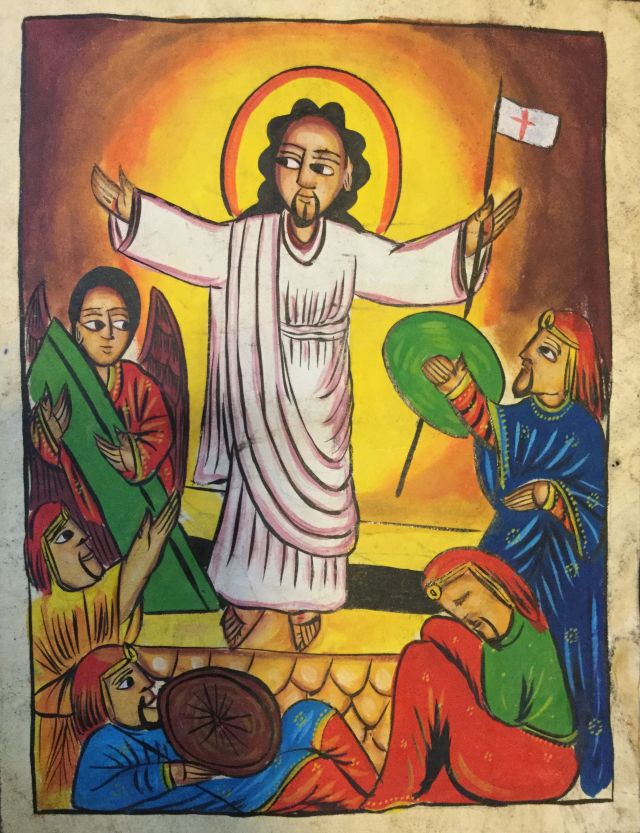
Ethiopian Jesus 2
Ethiopian Orthodox depiction of Jesus teaching

Then Jesus rejoiced in the Holy Spirit and said, “I praise you, Father, Lord of heaven and earth, because you have hidden these things from the people who are wise and smart. But you have shown them to those who are like little children. Yes, Father, this is what you really wanted.

“My Father has given me all things. No one knows who the Son is, except the Father. And no one knows who the Father is, except the Son and those whom the Son chooses to tell.”

Then Jesus turned to his followers and said privately, “You are blessed to see what you now see. I tell you, many prophets and kings wanted to see what you now see, but they did not, and they wanted to hear what you now hear, but they did not.” (NCV)

A healthy view of Holy Scripture is to look at it as an unfolding drama of redemption. Ever since the fall of humanity, God has been on a rescue mission to reclaim, redeem, and restore people. This human project has obviously taken several millennia; and, it still has not reached its fulfillment.

The Christian tradition understands that the climax of victory and final restoration to our true state as humans will occur when Christ returns. By warning us that divine mysteries are hidden to some and revealed to others is Jesus’ way of cautioning us toward triumphalism and self-congratulation. Yes, redemption is a reality; and, it is also not a reality. It is both here and is coming. We are delivered from sin, death, and hell – and, we still labor against the evil machinations of systemic world problems, our own sinful nature, and a demonic realm which is looking for every opportunity to exploit sin’s residue upon the earth.

What this all means on a practical basis is that the good old days for some were the bad old days for others. History is always written by the winners and those in power. The hidden voices are typically squelched. The vision of Jesus is that all kinds of people, not just a certain segment of winners, should enjoy God’s favor.

There were ancient people who longed for spiritual and physical freedom. They looked forward into history and had the hope of Messiah and God’s promises being fulfilled. History is still unfolding. People yet remain locked in personal bondage and large swaths of humanity still experience oppression and a longing to enjoy blessings which others possess and take for granted.

On this Independence Day in the United States it is important that we recognize and hold together both the blessings of realized freedom along with the limits of others’ freedom. And, with this realization, we continue to actively work for all people and keep praying that God’s kingdom come and God’s will be done, here on earth, as it is always done in heaven.

Frederick Douglass
Frederick Douglass, circa 1852

So, today, I am lifting a voice from history which exemplifies the struggle of the black experience in America. The following is a small portion from a speech by the ex-slave Frederick Douglass orated on July 4, 1852, nine years before civil war, with President Millard Fillmore and many congressional politicians in attendance:

“The feeling of the nation must be quickened; the conscience of the nation must be roused; the propriety of the nation must be startled; the hypocrisy of the nation must be exposed; and its crimes against God and man must be proclaimed and denounced. What, to the American slave, is your 4th of July? I answer: a day that reveals to him, more than all other days in the year, the gross injustice and cruelty to which he is the constant victim. To him, your celebration is a sham; your boasted liberty, an unholy license; your national greatness, swelling vanity; your sounds of rejoicing are empty and heartless; your denunciations of tyrants, brass fronted impudence; your shouts of liberty and equality, hollow mockery; your prayers and hymns, your sermons and thanksgivings, with all your religious parade, and solemnity, are, to him, mere bombast, fraud, deception, impiety, and hypocrisy — a thin veil to cover up crimes which would disgrace a nation of savages. There is not a nation on the earth guilty of practices more shocking and bloodier than are the people of these United States, at this very hour.”

Because history is forever unfolding, freedom and blessing develop over time and come more powerfully to some than others. True spiritual discernment, with the awareness to labor on behalf of the common good, does not ultimately come through astute observation and superior intellect; it comes by divine revelation. God will both conceal and reveal according to divine purposes and not human agendas.

Christian spirituality cannot be reduced to praying a sinner’s prayer and then maintaining a holding pattern on earth until heaven. Rather, Jesus remains present in this world through the person of the Holy Spirit and is continually interceding on behalf of those who need freedom and blessing. As Christ’s Body, Christians are to be the hands and feet of Jesus, animated by the Spirit to bring God’s ethical and benevolent regime to those who need it most.

If we are blessed, we are to pass blessing on without prejudice. For the kingdom of God belongs to the poor in spirit.

Dear God, Creator of the universe and all that inhabit it, we come as your Church, and as individuals, in humble submission to your word and your way. God, you are the Alpha and Omega, The Almighty Judge and The Forgiver of All Sins, so we come with humility and contrition on behalf of generations past, present and those yet unborn. We ask that you forgive us and create in us a new spirit. Bind our hearts and send forth the healing power that you and you alone can give to us and this sin-sick world. Bring us into reconciliation with one another and restore us to your righteous and holy path. Amen.

Genesis 22:15-18 – Faith, Obedience, and Blessing

Blessing to Abraham

The angel of the Lord called to Abraham from heaven a second time and said, “I swear by myself, declares the Lord, that because you have done this and have not withheld your son, your only son, I will surely bless you and make your descendants as numerous as the stars in the sky and as the sand on the seashore. Your descendants will take possession of the cities of their enemies, and through your offspring all nations on earth will be blessed, because you have obeyed me.” (NIV)

The biblical character of Abraham is synonymous with faith. And for good reason. God had told Abraham that he would have a son with his wife Sarah. This was especially unusual because the couple were well advanced in age, and Sarah was incapable of having children. Infertility is not just a modern problem; it has always existed.  Yet, despite all the contrary evidence of age and ability, Abraham believed God. Years later and with a mix of patience and impatience from the would-be parents, the promise from God was realized.  Abraham and Sarah had a son, Isaac.

“The child of the promise.” This was Isaac’s moniker – which made the command from God so perplexing: “Take your son, your only son, whom you love—Isaac—and go to the region of Moriah. Sacrifice him there as a burnt offering on a mountain I will show you.” (Genesis 22:2). Huh? I can easily imagine Abraham saying to himself, perhaps not out loud, “What the [insert favorite expletive]!”  But it only seems strange and super-weird to us. We get no reaction from Abraham, no questioning, no talk back.  He just goes about the business of saddling up the donkey, chopping some wood for the sacrifice, and takes his only son with him on the journey to the mountain.

While you and I might try and figure out if we really heard God or not, Abraham had a history of talking with God. He knew God’s voice as well as he knew his own. Abraham was well down the road of relationship with the God he served. We get an insight from the author of Hebrews into Abraham’s thought process, a line of thinking that is consistent with a person who has a regular habit of talking with God:

“Abraham had been promised that Isaac, his only son, would continue his family. But when Abraham was tested, he had faith and was willing to sacrifice Isaac, because he was sure that God could raise people to life. This was just like getting Isaac back from death.” (Hebrews 11:17-18, CEV)

Abraham did not try and figure out God’s mind. He picked no fights and chose not to debate with God about the contradiction of ethics he was being asked to do.

Abraham simply obeyed.

He reasoned that it did not matter if Isaac were killed because God could raise him from death. This, of course, is not what happened. It was all a test of faith. Abraham knew beyond a shadow of a doubt that God is the Lord who provides. After God stepped in and provided a ram for the sacrifice instead of Isaac, Abraham named that place “The Lord Will Provide.” (Genesis 22:14)

You and I most certainly do not always know why we are facing the circumstances we must endure. We very much are rarely privy to know what in the world God is thinking. Yet, like Abraham, if we have a spiritual history of walking with God and hearing his voice, there is no hesitation to respond with obedience. We are convinced that God will provide. Obedience for the follower of Christ is not a burden; it is a privilege, even when we are being tested beyond our seeming emotional ability to do it.

Blessings come through obedience. They are not willy-nilly thrown into a crowd like some cheap stadium trinket between innings of a baseball game. When the Israelites were about to enter the Promised Land, this very connection between obedience and blessing was re-emphasized:

If you fully obey the Lord your God and carefully follow all his commands I give you today, the Lord your God will set you high above all the nations on earth. All these blessings will come on you and accompany you if you obey the Lord your God…. The Lord will establish you as his holy people, as he promised you on oath, if you keep the commands of the Lord your God and walk in obedience to him. (Deuteronomy 28:1-2, 9, NIV)

A simple observation about the blessing of Abraham: It took nearly five-hundred years before that blessing was realized. Furthermore, in the Christian tradition, it then took another fifteen-hundred years before the blessing was fulfilled in the person of Jesus. And, I might add, all the promises of God to his people will be fully consummated at the end of the age when Christ returns. For a contemporary society which prides itself on timeliness and efficiency, taking the much broader scope of all history might seem unacceptable.

So, we come back around again to trust. Just as Abraham trusted God, even when it seemed like nonsense fraught with major moral implications, so we are to exhibit patient and persevering faith. Although the scope of history is massively large, the only moment we have is the now. It is now, today, in which we put one foot in front of the other and toddle forward into the next moment – by faith.

We simply obey.

Then, we obey again… and, again. It is in such continual small steps of faith and obedience that we will discover the blessings of God in the middle of our path.

Sovereign Lord, your ways are sometimes strange.  Yet, I know that everything you do is always right, just, and good.  It is to your gracious and merciful character that I know you will guide and provide. My allegiance is to you as I anticipate your divine blessings in my life through the Name of Jesus Christ, in the power of the Holy Spirit. Amen.

2 Thessalonians 2:13-3:5 – A Life-Giving Message

OakTreeUnknownArtist
“Grow in the grace and knowledge of our Lord and Savior Jesus Christ.” (2 Peter 3:18)

We ought always to thank God for you, brothers and sisters loved by the Lord, because God chose you as first-fruits to be saved through the sanctifying work of the Spirit and through belief in the truth. He called you to this through our gospel, that you might share in the glory of our Lord Jesus Christ.

So then, brothers and sisters, stand firm and hold fast to the teachings we passed on to you, whether by word of mouth or by letter.

May our Lord Jesus Christ himself and God our Father, who loved us and by his grace gave us eternal encouragement and good hope, encourage your hearts, and strengthen you in every good deed and word.

As for other matters brothers and sisters, pray for us that the message of the Lord may spread rapidly and be honored, just as it was with you. And pray that we may be delivered from wicked and evil people, for not everyone has faith. But the Lord is faithful, and he will strengthen you and protect you from the evil one. We have confidence in the Lord that you are doing and will continue to do the things we command. May the Lord direct your hearts into God’s love and Christ’s perseverance. (NIV)

As with most sections of Holy Scripture, if we merely focus on this singular passage from the Bible and seek daily to live into its message, it is likely we would live a consistently rich and full spiritual life. As the Apostle Paul said to the Thessalonians, and indeed to us, standing firm and holding a solid grip on apostolic teaching will mean a daily life of loving words and actions.

Notice the many elements of this Scripture for us to spotlight for our spiritual lives: gratitude; salvation; sanctification; truth; spiritual calling; sharing in God’s glory; love; grace; hope; encouragement; prayer; faithfulness; perseverance; and, deliverance. We could even highlight just one of these words and, if seeking to do a deep dive with it, could spend unending days learning and living into its multi-faceted dimensions.

I want to pause here and do a bit of a check-in with you. How we approach this passage of Scripture, as well as any other verses which encourage us to hold onto sound teaching and living, will likely determine our level of joy, satisfaction, confidence, and success. It all begins with our view of self. If we come at the Christian life and Holy Scripture with a view of self as a mere tool or object for God’s use – then we are truly objectifying ourselves.

The key point of awareness to realizing whether we have such an objectifying view is if we continually “should” ourselves. The word “should,” brings self-hatred. We primarily see only shortcomings and original sin – and are blind to the majesty of being in God’s image. In such a view there is typically boat loads of shame for not living up to the ideal form of a devoted Christian. Belittling ourselves inwardly only transfers outwardly to looking down on others for their failures. Any exhortation from me or anybody else would be seen in this view as a demanding duty.

OakTreeTomBrown
“The gospel is bearing fruit and growing throughout the whole world—just as it has been doing among you since the day you heard it and truly understood God’s grace.” (Colossians 1:6)

Instead, we can come to Scripture’s admonitions, encouragements, and exhortations with the glasses of grace. After all, our text for today says that God loved us and by his grace gave us this teaching. The dense amount of Christian living in such a few verses, when viewed through the lenses of grace, are merciful words communicating support. God wants to strengthen us with grace just because he loves us. God does not objectify us by seeing us as pawns in some twisted divine game for his own cosmic pleasure. Rather, God is looking to direct our hearts toward a delight in his love. Because it is only with love and grace that we can really persevere throughout our Christian lives.

Not everyone has faith, and that saddens the heart of God. It also puts us, at times, in awkward situations. Again, the love of God does not leave us alone. Divine love will strengthen and protect us. The Apostle Paul never wags his finger and levels the “should” on us like some uptight legalist. Paul expresses confidence, knowing that we most certainly have the capacity to live the will of God. The Scriptures are given to engender strengthening of faith and spiritual growth rather than self-hatred, which has a nasty tendency to come out sideways in a lack of compassion and grace toward others.

This letter was written by Paul to the church because they were finding it difficult to endure their hard circumstances. The Thessalonian Christians began longing for heaven to such a degree that they were losing their grip on living presently in the moment of now. This is part of the reason why Paul encouraged them to pray for him and his colleagues. The people needed to put some focus on the now of spreading the message of God’s grace.

To be rather frank, truth be told, the chief reason I write these daily reflections on Scripture is because I need God’s Word. Yes, I do write for the reader. I want to contribute to people’s growth in grace and I have a deep desire to make the message known. Yet, honestly, I write more for myself. This is a way for me to remind myself of God’s love and grace and utilize it every day.

When I hear Paul talking in biblical texts like these, I detect some of the same reason – Paul himself wants to continue growing in grace, and when writing to and for others he is very much writing to himself. The reading of the Bible and the dedication to living its message is meant to be life-giving, or rather, eternally life-giving.

So, today, I leave with this blessing:

May you take refuge in the wondrous grace of God, and all the little miracles of mercy which he bestows each day.

May you always be inclined to rush into God’s Holy Word and discover its life working within you.

May you imitate the flower as it opens to the day’s sunshine in receiving all that God has for you this day.

May you be in solidarity with brother stone, who sits in silence, calm and secure, and be excessively gentle with yourself.

May you wisely steer clear of those vexed in spirit with only God knows what; and, when in that space of others walking all over your boundaries, may your confidence surge and God’s protection deliver you.

May you return to the glory that is yourself, learning a new respect for your heart, and the joy that has always been there, given graciously to you by a God who has invited you to share in Jesus Christ.

Amen.