
It’s a Bad Idea to Try and Handle God (1 Samuel 6:1-18)

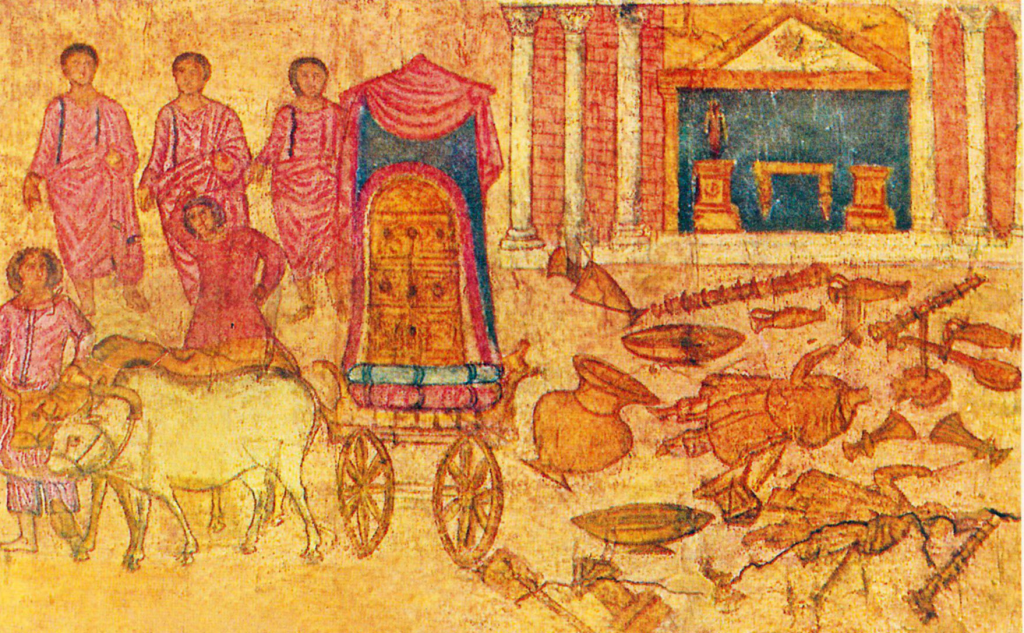
A fresco of the Philistine captivity of the Ark of God, from the ancient Dura-Europos Synagogue, excavated in 1932

The Ark of the Lord remained in Philistine territory seven months in all. Then the Philistines called in their priests and diviners and asked them, “What should we do about the Ark of the Lord? Tell us how to return it to its own country.”

“Send the Ark of the God of Israel back with a gift,” they were told. “Send a guilt offering so the plague will stop. Then, if you are healed, you will know it was his hand that caused the plague.”

“What sort of guilt offering should we send?” they asked.

And they were told, “Since the plague has struck both you and your five rulers, make five gold tumors and five gold rats, just like those that have ravaged your land. Make these things to show honor to the God of Israel. Perhaps then he will stop afflicting you, your gods, and your land. Don’t be stubborn and rebellious as Pharaoh and the Egyptians were. By the time God was finished with them, they were eager to let Israel go.

“Now build a new cart, and find two cows that have just given birth to calves. Make sure the cows have never been yoked to a cart. Hitch the cows to the cart, but shut their calves away from them in a pen. Put the Ark of the Lord on the cart, and beside it place a chest containing the gold rats and gold tumors you are sending as a guilt offering. Then let the cows go wherever they want. If they cross the border of our land and go to Beth-shemesh, we will know it was the Lord who brought this great disaster upon us. If they don’t, we will know it was not his hand that caused the plague. It came simply by chance.”

So these instructions were carried out. Two cows were hitched to the cart, and their newborn calves were shut up in a pen. Then the Ark of the Lord and the chest containing the gold rats and gold tumors were placed on the cart. And sure enough, without veering off in other directions, the cows went straight along the road toward Beth-shemesh, lowing as they went. The Philistine rulers followed them as far as the border of Beth-shemesh.

The people of Beth-shemesh were harvesting wheat in the valley, and when they saw the Ark, they were overjoyed! The cart came into the field of a man named Joshua and stopped beside a large rock. So the people broke up the wood of the cart for a fire and killed the cows and sacrificed them to the Lord as a burnt offering. 

Several men of the tribe of Levi lifted the Ark of the Lord and the chest containing the gold rats and gold tumors from the cart and placed them on the large rock. Many sacrifices and burnt offerings were offered to the Lord that day by the people of Beth-shemesh. The five Philistine rulers watched all this and then returned to Ekron that same day.

The five gold tumors sent by the Philistines as a guilt offering to the Lord were gifts from the rulers of Ashdod, Gaza, Ashkelon, Gath, and Ekron. The five gold rats represented the five Philistine towns and their surrounding villages, which were controlled by the five rulers. The large rock at Beth-shemesh, where they set the Ark of the Lord, still stands in the field of Joshua as a witness to what happened there. (New Living Translation)
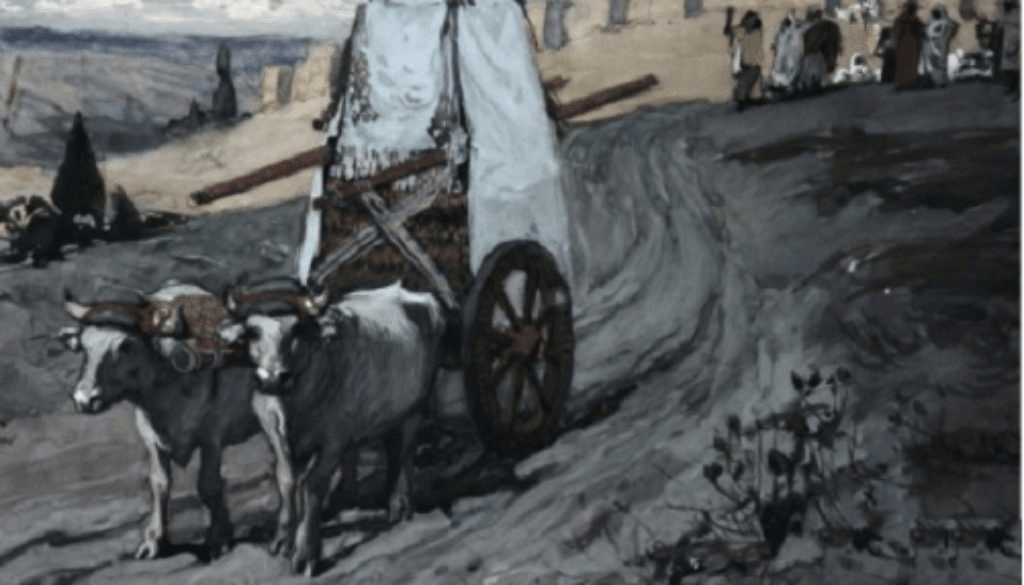
The Ark Sent Away from the Philistines, by James Tissot, 1902

Out of all the stories in the Bible, this is one of them. The Philistines and the Israelites were fighting military battles. The Israelites did not do so well. Therefore, they decided to bring up the Ark of the Covenant of God (the symbol of God’s presence) to the front lines in order to win the battle.

The plan backfired. Israel lost, and the Ark of God (think Raiders of the Lost Ark, and not Noah’s ark) was taken by the Philistines. However, the five cities of Philistia likely regretted ever doing this. Wherever the Ark was, the people were plagued with nasty tumors, so that they suffered grievously. And that’s when the Philistines decided to hatch their own plan for ridding themselves of the Ark, while preserving their cities.

For three chapters (1 Samuel 4-6) we get various humans who made plans for the Ark of the Covenant. Since the Ark is a symbol of God’s presence, engaging in these plans is akin to deciding how things are going to go with God.

Humanity doesn’t get to flip-flop who is in control, God as sovereign over humanity to humanity manipulating God for their own purposes. Trying to leverage the Lord into what we want is a bit like believing we can make the sun spin around the earth. In other words, it’s not going to happen, no matter how much effort and ingenuity you put into it.

It’s a bad idea to try and handle God, instead of letting God handle us.

At least the Philistines quickly figured out it was a fool’s errand in possessing God’s Ark. And they had enough sense to consult somebody before they acted in getting the Ark away. Eventually, we’re all going to either humble ourselves, or just get humiliated; it’s our choice.

Yes, it seems like a weird plan – making gold objects in the shape of tumors – and yet the Lord often cares much more about the humility behind a plan than the actual plan itself. Despite being worshipers of pagan gods, God was picking up what the Philistines were putting down, and graciously received the Ark back into Israel.

Turn anywhere in Holy Scripture, begin reading, and you will quickly find that God will not tolerate any person or group of people trying to use, leverage, or manipulate heaven for it’s own purposes. The Lord has made it clear what is important; it’s up to us to live into it.

Holy and almighty God, help us to walk humbly with You and one another. Let your holy Spirit guide us on the right path to truth and reconciliation with humility. Help us to hear each other, for we do not want to walk by pride or self-sufficiency. Amen.

Never a Dull Moment (Acts 28:1-10)

Miracle of St. Paul on the Island of Malta, by David Teniers, c.1620

Once safely on shore, we found out that the island was called Malta. The islanders showed us unusual kindness. They built a fire and welcomed us all because it was raining and cold. Paul gathered a pile of brushwood and, as he put it on the fire, a viper, driven out by the heat, fastened itself on his hand. When the islanders saw the snake hanging from his hand, they said to each other, “This man must be a murderer; for though he escaped from the sea, the goddess Justice has not allowed him to live.” But Paul shook the snake off into the fire and suffered no ill effects. The people expected him to swell up or suddenly fall dead; but after waiting a long time and seeing nothing unusual happen to him, they changed their minds and said he was a god.

There was an estate nearby that belonged to Publius, the chief official of the island. He welcomed us to his home and showed us generous hospitality for three days. His father was sick in bed, suffering from fever and dysentery. Paul went in to see him and, after prayer, placed his hands on him and healed him. When this had happened, the rest of the sick on the island came and were cured. They honored us in many ways; and when we were ready to sail, they furnished us with the supplies we needed. (New International Version)

There never seemed to be a dull moment in the life of the Apostle Paul. Throughout his life, he experienced all sorts of extreme circumstances, having survived as if he had the nine lives of a cat.

Once, when in the town of Lystra, Paul had such an impact on the people through his gift of healing, that the crowd believed he must be one of the gods; and they tried to worship him. But when Paul resisted, and a rival group from another town came along and turned the crowd, Paul was stoned and left for dead by the very people who tried to venerate him. (Acts 14:8-20)

So, it’s almost as if today’s New Testament lesson was just another day at the office for the Apostle Paul. After a suspenseful sea voyage, and then the wreck of a Roman prison ship, the drama of Paul’s life just kept going.

One minute, the people on the island in which Paul was shipwrecked were convinced that he’s a murderer, and the next minute they’re ready to assign him as a god. Nobody I’ve ever known can elicit such opposite reactions in such a short period of time – more than once. But that’s our Apostle Paul for you.

Circumstances are circumstances. But the way in which we interpret them is another thing. Take, for instance, the word “change.” For some, change is a wonderful word which brings thoughts of healing and hope. For others, change is a dirty word to be resisted, conjuring up feelings of fear and anxiety.

For one group, never-a-dull-moment is exciting and adventurous. For another group, never-a-dull-moment is nerve wracking and to be avoided at all costs.

Opposite reactions of a group of people comes from the different perspectives of change they see. It isn’t helpful to talk about who is right and who is wrong; the real trick is in how we choose to look at a thing.

I had only one grandparent when I was growing up. My Grandma was seventy-nine years old when I was born, and she lived to be ninety-seven. Even though I always knew her as an old lady, she had a lot of spunk in all ninety-five pounds of her. 

She had an old wooden cutting board in her kitchen. I’m not sure how old it was, but it was likely purchased from Methuselah’s Kitchen Outlet. It was cracked and falling apart. The board had deep furrows in it from the thousands of cuts made on it. Grandma liked her cutting board.

For Mother’s Day one year, my Dad bought her a nice brand new cutting board. And what did my Grandma do?  She put the new board in the back of her cupboard and continued using her nasty old cutting board. 

Whenever my Mom or sisters were in her house and helped her in the kitchen, they were not about to touch that old board; the thing was a bacteria trap. But Grandma didn’t care about bacteria or that it was falling apart. 

My Dad asked her why she did not use her new cutting board. She simply answered, “Oh, it’s much too nice to use.” But we all knew that was Grandma’s way of saying that she liked her nasty old cutting board, didn’t think it was all that bad, and wasn’t getting rid of it.

It seems we all have a bit of Grandma in us, bless her stubborn old heart. We like the way they do things, and really don’t see what another person sees. We don’t see that no one else has an emotional attachment to our cutting board. Sometimes we don’t realize how overwhelming and even intimidating our ways can be for someone else. 

Just imagine being in a new place with people you don’t know. Are you nervous? Does it help to have someone you know bring you and introduce you to people? Is it beneficial to have someone let you know what is happening and what is going on? 

Many years ago, I remember walking into a beautiful new church building, sitting down, and seeing a huge old pulpit that was literally falling apart. Since I’ve been around a lot of churches, I quickly discerned it was likely the old pulpit from the old church building. And, I discovered, it was. But, honestly, I had zero emotional attachment to that pulpit, and it was a distraction because it just looked like a big old ratty collar on a new puppy.

The point is thisOur view of change – whether to do it, or not, to embrace or resist – must be motivated by a solid set of values and a worthy purpose.

Paul put up with a lot, experienced a lot, and never had a dull moment. And he did it without bellyaching. That’s because he was continually focused on his ultimate purpose and values.

Our purpose, like Paul’s, is the Great Commission, to make disciples. (Matthew 28:18-20)

Our values, likewise, are the Great Commandment, to love God and neighbor. (Matthew 22:36-40)

Since our purpose is disciple-making, then we are always to make decisions based upon that standard. Since our values are loving others, then we always know how to go about our purpose.

If any faith community is helping people grow spiritually, then there is no need to change. But if a Christian community has not seen a person come to faith in Christ in the last year, that’s a significant reason to change. If a church has not seen anyone come to Christ in the last five years, then that church is eating meat prepared on a cutting board full of bacteria, and it’s making everyone sick.

Have we taken the old cutting board for granted, and just expect other people to use it if they are in our kitchen? Or do we have a vision, a motivation, and a driving desire to see all sorts of people find new life in Jesus Christ? 

If you don’t like empty seats, or the way things are, then the biblical solution is to change – specifically to change practices, speech, and daily behavior to reach others with the good news of grace. Change, or the lack thereof, for any other reason, is a bad reason to change.

Just so you know, after about a year of sitting in my Grandma’s cupboard, my Dad took out the new cutting board, put it on the kitchen counter and threw away the old board. 

It was about time. Never a dull moment with Grandma around.

Gracious God, we thank you that in love and mercy, you reached out to us. When we were dead in our sins, you sent Jesus to die in our place. Thank you that he humbled himself, even to death on a cross. And thank you that you have a heart that seeks the lost. 

Merciful Lord, please give us hearts that care for people in darkness. Teach us to care for them as you do. Thank you for including us in the mission of reaching other people for your name. Grow us to care for humanity, for the people who haven’t yet come to know and trust in you. Amen.

Acts 2:42-47 – A Changed Community

We Are All One in Jesus Christ by Soichi Watanabe, 2009

They devoted themselves to the apostles’ teaching and fellowship, to the breaking of bread and the prayers. Awe came upon everyone because many wonders and signs were being done by the apostles. All who believed were together and had all things in common; they would sell their possessions and goods and distribute the proceeds to all, as any had need. Day by day, as they spent much time together in the temple, they broke bread at home and ate their food with glad and generous hearts, praising God and having the goodwill of all the people. And day by day the Lord added to their number those who were being saved. (NRSV)

You’ve likely heard the old saying, “If it’s not broken, don’t fix it.” It is a wise saying. Yet, what if we don’t know something is broken? What if we keep living our lives with something out of whack and don’t even realize it? Or, worse yet, what if we don’t care?

The ancient church after Christ’s resurrection and ascension was on a mission to live communal life together different from how they lived before Jesus came into their lives. Today’s New Testament lesson gives us a glimpse of what that life together consisted of.

“Yesterday I was clever, so I wanted to change the world. Today I am wise, so I am changing myself.”

Rumi (13th century Persian poet and scholar)

We know something needs to change when it doesn’t quite match up to the life depicted by our ancestors in the faith – a life of fellowship, of glad and sincere hearts, and of concern for the common good of all. We never just change or alter something for change’s sake or because we like or dislike something. No, instead, we adjust our lives according to whether it lines up with the relational dynamics of Holy Scripture.

I had just one grandparent when I was growing up. My Grandma was seventy-nine years old when I was born, and she lived to be ninety-seven. I always knew her as an old lady. Although quite aged, she had a lot of spunk to her, all ninety-five pounds of her. 

I remember Grandma had an old wooden cutting board in her kitchen. I don’t how old it was, but it was probably purchased from Methuselah’s Kitchen Outlet. It was cracked and nearly falling apart. The board had deep furrows in it from the thousands of cuts made on it. Grandma liked her cutting board.

For Mother’s Day one year my Dad bought her a nice brand-new cutting board. After thanking my Dad for the gift, Grandma proceeded to put the new board in the back of her cupboard and continued to use her nasty old cutting board. Whenever my Mom or sisters helped her in the kitchen, they were not about to touch that old board because it was like a bacteria trap with its deep grooves. 

Grandma didn’t care about anyone’s concerns about her cutting board. When my Dad finally asked her why she did not use her new cutting board, she simply answered, “Oh, it is much too nice to use.” We all knew that was Grandma’s way of saying that she liked her nasty old cutting board and nobody was going to tell her she can’t use it.

Sometimes folks, including Christians, can be like my Grandma, bless her stubborn old heart. They just like the way they do things, and really don’t see what others see who aren’t Christ followers. They fail to consider or realize that non-Christians have no emotional attachment to the cutting board. All they see is an antiquated old board they would never use and find it weird anyone would ever want to use it.

Christians may forget or lose sight of how overwhelming and even intimidating they can be with those outside the faith. Because Christianity is familiar to Christians, we don’t see what others see when they view us from the outside. 

I remember once walking into a beautiful new church building and sitting down and seeing a huge old pulpit that was literally falling apart. Since I’ve been around a lot of churches, I quickly discerned it was likely the old pulpit from the old church building. I asked someone, and it was. But as an outsider to that fellowship, I had zero emotional attachment to the pulpit, and it was a distraction because it just looked like a big old ratty collar on a new little puppy.

“Be the change that you wish to see in the world.”

Mahatma Gandhi

The point I am making is this: The decision to change our lives, or not to change, must come from a motivation of biblical and human values. The Christian’s mission and purpose are the Great Commission (make disciples) and the Great Commandment (love God and love neighbor). We express those values through our daily devotion to teaching, fellowship, the breaking of bread, and prayer. Such life together is attractive and winsome to a watching world.

If people matter, including those who don’t think or believe like us as Christians, then we will make decisions based upon that value. Nothing need be fixed or changed if the mission is going forward with biblical values driving it. However, if people stay away, or know nothing about our shared life together, then we have a prime reason to change. If this has gone on for years, even decades, I suggest that the fellowship of people is eating meat prepared from a cutting board full of bacteria and it is making everyone sick.

Whenever a faith community is focused on trying to keep people from leaving, instead of reaching people with an outward focus, then that community has lost its sense of spiritual values.

“Never doubt that a small group of thoughtful, committed, citizens can change the world. Indeed, it is the only thing that ever has.”

Margaret Mead

The main verb contained within the Scripture verses for today is the word “added.” Those who accepted the message of repentance and faith in Jesus were baptized and about three thousand were “added” to their number that day. We then get a string of participles, that is, words connected to the main verb of “added.” The result is this: The Lord “added” to their number daily those who were being saved.  Please understand the text makes it quite clear that the driving force of Christ’s church is to reach people.

It could be we take the old cutting board for granted and simply expect other people to use it if they are in our kitchen. If that is the case, there is to be a driving motivation and desire for outreach. There are people aplenty who need the kind of deliverance Jesus provides.

“Everyone thinks of changing the world, but no one thinks of changing himself.”

Leo Tolstoy

If something is off in our faith community, then the biblical solution is to change our lives, change our practices, change our speech, and change our daily behavior by reaching people for Jesus and adding them to the fellowship.

Whenever Christians break bread together at the Lord’s Table, the communion reminds us of our highest purpose and values. Jesus came to this earth for those estranged and far from God and others. Through Christ’s life, death, resurrection, and ascension we are saved by grace through faith. This reality is made tangible to us in the elements of bread and cup. They are a visible sign and seal of an invisible grace. We are to come to the Table forsaking all personal agendas and embracing God’s agenda of redeeming humanity.

And, by the way, after about a year of sitting in my Grandma’s cupboard, my Dad took out the new cutting board, put it on the kitchen counter and threw away the old board. It was about time.
