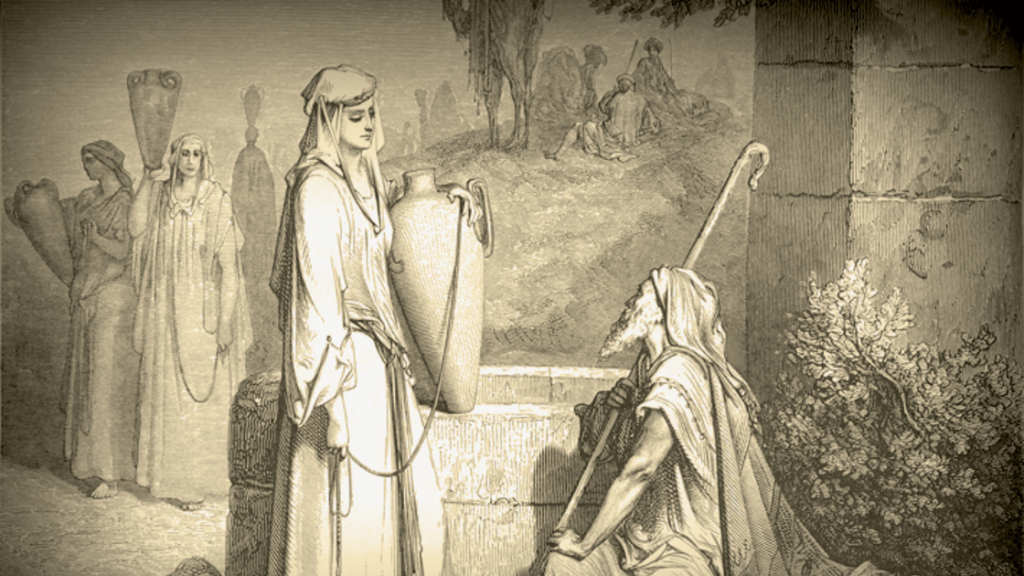
The Plan Comes Together (Genesis 24:10-52)

Rebekah and Abraham’s servant, an engraving by Gustave Dore (1832-1883)

Reading Holy Scripture is important. And the way we read it is significant. For the past several years, I have personally made it a practice to always read from the Bible out loud. There is something deeply powerful and impactful about the experience of reading aloud God’s Word.

I also try and read Scripture carefully and slowly. I deliberately make choices about my tone and inflexion, paying attention to which words are emphasized. I try to communicate as best I can the spirit and intent of the words.

I encourage you today to read aloud (and listen to) today’s Old Testament lesson. Take your time. Read it at your own pace. Notice which words you tend to accent, and what the Spirit may be saying to you in the reading…

Soon after that, the servant loaded ten of Abraham’s camels with valuable gifts. Then he set out for the city in northern Syria, where Abraham’s brother Nahor lived.

When he got there, he let the camels rest near the well outside the city. It was late afternoon, the time when the women came out for water. The servant prayed:

You, Lord, are the God my master Abraham worships. Please keep your promise to him and let me find a wife for Isaac today. The young women of the city will soon come to this well for water, and I’ll ask one of them for a drink. If she gives me a drink and then offers to get some water for my camels, I’ll know she is the one you have chosen and that you have kept your promise to my master.

While he was still praying, a beautiful unmarried young woman came by with a water jar on her shoulder. She was Rebekah, the daughter of Bethuel, the son of Abraham’s brother Nahor and his wife Milcah. Rebekah walked past Abraham’s servant, then went over to the well, and filled her water jar. When she started back, Abraham’s servant ran to her and said, “Please let me have a drink of water.”

“I’ll be glad to,” she answered. Then she quickly took the jar from her shoulder and held it while he drank. After he had finished, she said, “Now I’ll give your camels all the water they want.” She quickly poured out water for them, and she kept going back for more, until his camels had drunk all they wanted. Abraham’s servant did not say a word, but he watched everything Rebekah did, because he wanted to know for certain if this was the woman the Lord had chosen.

The servant had brought along an expensive gold ring and two large gold bracelets. When Rebekah had finished bringing the water, he gave her the ring for her nose and the bracelets for her arms. Then he said, “Please tell me who your father is. Does he have room in his house for me and my men to spend the night?”

She answered, “My father is Bethuel, the son of Nahor and Milcah. We have a place where you and your men can stay, and we also have enough straw and feed for your camels.”

Then the servant bowed his head and prayed, “I thank you, Lord God of my master Abraham! You have led me to his relatives and kept your promise to him.”

Rebekah ran straight home and told her family everything. Her brother Laban heard her tell what the servant had said, and he saw the ring and the bracelets she was wearing. So Laban ran out to Abraham’s servant, who was standing by his camels at the well. Then Laban said, “The Lord has brought you safely here. Come home with me. There’s no need for you to keep on standing outside. I have a room ready for you in our house, and there’s also a place for your camels.”

Abraham’s servant went home with Laban, where Laban’s servants unloaded his camels and gave them straw and feed. Then they brought water into the house, so Abraham’s servant and his men could wash their feet. After that, they brought in food. But the servant said, “Before I eat, I must tell you why I have come.”

“Go ahead and tell us,” Laban answered.

The servant explained:

I am Abraham’s servant. The Lord has been good to my master and has made him very rich. He has given him many sheep, goats, cattle, camels, and donkeys, as well as a lot of silver and gold, and many slaves. Sarah, my master’s wife, didn’t have any children until she was very old. Then she had a son, and my master has given him everything. I solemnly promised my master that I would do what he said. And he told me, “Don’t choose a wife for my son from the women in this land of Canaan. Instead, go back to the land where I was born and find a wife for my son from among my relatives.”

I asked my master, “What if the young woman refuses to come with me?”

My master answered, “I have always obeyed the Lord, and he will send his angel to help you find my son a wife from among my own relatives. But if they refuse to let her come back with you, then you are freed from your promise.”

When I came to the well today, I silently prayed, “You, Lord, are the God my master Abraham worships, so please lead me to a wife for his son while I am here at the well. When a young woman comes out to get water, I’ll ask her to give me a drink. If she gives me a drink and offers to get some water for my camels, I’ll know she is the one you have chosen.”

Even before I had finished praying, Rebekah came by with a water jar on her shoulder. When she had filled the jar, I asked her for a drink. She quickly lowered the jar from her shoulder and said, “Have a drink. Then I’ll get water for your camels.” So I drank, and after that she got some water for my camels. I asked her who her father was, and she answered, “My father is Bethuel the son of Nahor and Milcah.” At once I put the ring in her nose and the bracelets on her arms. Then I bowed my head and gave thanks to the God my master Abraham worships. The Lord had led me straight to my master’s relatives, and I had found a wife for his son.

Now please tell me if you are willing to do the right thing for my master. Will you treat him fairly, or do I have to look for another young woman?

Laban and Bethuel answered, “The Lord has done this. We have no choice in the matter. Take Rebekah with you; she can marry your master’s son, just as the Lord has said.” Abraham’s servant bowed down and thanked the Lord. (Contemporary English Version)

How was your experience in reading this story out loud? What did the Spirit bring to you through it? Will you share your experience with us?…


Delight in God’s Word (Psalm 119:41-48)

Lord, give me your unfailing love,
    the salvation that you promised me.
Then I can answer those who taunt me,
    for I trust in your word.
Do not snatch your word of truth from me,
    for your regulations are my only hope.
I will keep on obeying your instructions
    forever and ever.
I will walk in freedom,
    for I have devoted myself to your commandments.
I will speak to kings about your laws,
    and I will not be ashamed.
How I delight in your commands!
    How I love them!
I honor and love your commands.
    I meditate on your decrees. (New Living Translation)

Christians often refer to the Bible as “God’s Word.” By that reference is meant that God has graciously given a self-revelation to us through the Holy Scriptures. 

The Jewish people refer to the first five books of the Old Testament as the Law of the Lord or the Torah. They understand God as a great, high and holy Being, who graciously accommodates and communicates to us on our level by giving the Law. 

Just as a parent coos and babbles and speaks in a very different way to a baby in a crib, so God speaks to us in a manner that we can understand divine care, concern, and love for us. Just as an infant cannot understand an adult conversation taking place, so God is a divine being well above our comprehension. We have no ability to understand anything God says unless the Lord graciously and lovingly bends down to speak to us on our level.

God’s Law, the Torah, was the curriculum for Israel’s religious instruction. The Law of the Lord is meant to be a behavior pattern, to be embodied in the lives of God’s people through both teachers and parents who learn God’s Word and, in turn, pass it along to others. Both those within the faith, such as children, and those outside of the faith, such as aliens or immigrants, can have a guide for how to live in the world.

God’s Law is an extension of God’s grace. And we can gratefully accept the grace of God expressed in God’s Word. We have the opportunity to ingest it, eat it, reflect on it, and dwell with it, in order to know God and be the sort of people God who can bless the world.

There are several Hebrew language words that come from the root word of Law, or Torah.  A teacher is a “moreh.” A parent is a “horeh.” Parents and teachers are to be living guides in the way of God’s Word. What’s more, the Hebrew word for teaching is “yarah.” 

So, in other words, the moreh’s and the horeh’s are to yarah the Torah. Parents and teachers are to point and lead others into the ways of the Lord. And how do they do this?…

Hear, O Israel: The Lord our God, the Lord is one. Love the Lord your God with all your heart and with all your soul and with all your strength. These commandments that I give you today are to be on your hearts. Impress them on your children. Talk about them when you sit at home and when you walk along the road, when you lie down and when you get up. Tie them as symbols on your hands and bind them on your foreheads. Write them on the doorframes of your houses and on your gates. (Deuteronomy 6:4-9, NIV)

God’s Law (God’s Word) is to be as familiar to us as our back door; it is to be in front of us all the time. We might put a modern spin on the Deuteronomy passage to help us understand our privilege when it comes to God’s Word:

Attention, Church! God, our God! God the one and only! Love God, your God, with your whole heart: love God with all that is in you; love God with all you’ve got! 

Write these commandments that I’ve given you today on your hearts. Get them inside of you and then get them inside your children. 

In order to do this, talk about God’s Word at home when you are eating supper together, and when you are working or playing with each other. 

Start your day with God’s Word when you get up, and end your day with God’s Word when you go to bed at night. Put God’s Word on your refrigerator, and your car’s dashboard; have it on your smartphones, and let it be available to you anywhere, anytime. Use every opportunity you have to incessantly chatter about God’s Holy Word.

Someone may say, “That’s pretty radical – I don’t need to do all that!” Then I would say you are missing out on living a blessed life, because people are blessed when they walk according to God’s Word and keep God’s Law in front of them, seeking God with all their heart. 

Eleanor Turnbull, a veteran missionary to Haiti, collected and translated some simple but powerful prayers of the Christians who live in the Haitian mountains. Here are four prayers that they pray every day – and take note of their high view of God, and their longing to know God’s Word: 

  1. “Our Great Physician, Your word is like alcohol. When poured on an infected wound, it burns and stings, but only then can it kill germs. If it doesn’t burn, it doesn’t do any good.” 
  2. “Father, we are all hungry baby birds this morning. Our heart-mouths are gaping wide, waiting for you to fill us.” 
  3. “Father, a cold wind seems to have chilled us. Wrap us in the blanket of your Word and warm us up.” 
  4. “Lord, we find your Word like cabbage. As we pull down the leaves, we get closer to the heart. And as we get closer to the heart, it is sweeter.”

Let’s not be so busy, pre-occupied, or worried that we push God’s Word to the margins of our lives as only something for our discretionary time. 

Instead, let’s commit ourselves, like the psalmist, to learning and loving God’s commands and decrees.

Let’s be intentional about connecting with the God who has so graciously given us a guide for grateful living. 

Let’s lay solid plans to catechize people into the basics of faith and holy living. 

May your efforts both honor God and build up Christ’s Church. Amen.

It’s All About Jesus (Luke 24:44-53)

“Road to Emmaus” by He Qi

Jesus said to them, “These are my words that I spoke to you while I was still with you—that everything written about me in the Law from Moses, the Prophets, and the Psalms must be fulfilled.” Then he opened their minds to understand the scriptures. He said to them: 

“This is what is written: the Christ will suffer and rise from the dead on the third day, and a change of heart and life for the forgiveness of sins must be preached in his name to all nations, beginning from Jerusalem. You are witnesses of these things. Look, I’m sending to you what my Father promised, but you are to stay in the city until you have been furnished with heavenly power.”

He led them out as far as Bethany, where he lifted his hands and blessed them. As he blessed them, he left them and was taken up to heaven. They worshipped him and returned to Jerusalem overwhelmed with joy. And they were continuously in the temple praising God. (Common English Bible)

Perhaps you are feeling lost, maybe overwhelmed. Likely, you have experienced the feeling, even many times in your life, of being ungrounded, lacking a solid foundation under your feet – not quite knowing what’s up or down.

You sense there needs to be a great unifying force in your life – something to orient yourself around and make sense of the world, others, and especially yourself.

From the standpoint of Christianity, all of Holy Scripture – both Old and New Testaments – are focused upon and have their centrality in the person and work of Jesus the Christ. And it is this same Christ who opens us to understanding the scriptures.

My earliest memories of the Bible are in the church in which I grew up. I remember Bible stories from Sunday School and the pastor talking about particular verses from the Bible while I sat in our regular family pew. 

It wasn’t until my late teen years that I took up the task of reading the Scriptures for myself. And, I have to tell you, it absolutely changed my life. I found that many of the stories I heard as a kid were a lot juicier than I realized. I also discovered that there were simply a lot of things in the Bible I didn’t know even existed. 

However, the most profound breakthrough for me was plowing through all four Gospels and seeing the life and ministry of Jesus. My adoration and appreciation of Christ rose exponentially after watching him in action throughout Matthew, Mark, Luke, and John.

Rowan LeCompte (1925–2014) and Irene Matz LeCompte (1926–1970), The Walk to Emmaus. Resurrection Chapel, National Cathedral, Washington, DC. Photo: Victoria Emily Jones

I was so impressed with reading the Gospels that I moved into the rest of the New Testament. Then, I went back to the Old Testament and read the entire thing. In a matter of months I had read the entire Bible. Yet, I had more questions than when I started. There was just far too much I didn’t understand about it. 

So, I read the whole thing again… then again… and again… somewhere along the line, I’ve lost count of how many times I have read the Bible – I estimate around four-hundred times for the New Testament and the Old Testament about two hundred. And I still have so much more to learn and discover!

I’m not telling you this to impress anyone. In fact, many feel as if all that reading of the Bible is over the top. I assure you that it isn’t. 

After all, how could the living Christ ever open my mind to understanding the scriptures if I never bothered to read them?

And, after having read it once, why in the world would I spend so much of my life in plain straightforward reading of the Bible? I offer several reasons for my practice:

I can only lay hold of God’s promises if I know what they are. 

Living from a place of faith and calm in the midst of uncertainty and unrest doesn’t just happen. It comes from knowing the words of Scripture and allowing Christ to permeate my soul. The promises of Scripture are like an asthmatic’s inhaler, enabling us to slow down and take a deep breath.

I can only be like Jesus if I am getting to intimately know him. 

Reading Scripture about Jesus is like eating food. I have to do it regularly. It nourishes me for the day. Bible reading is stored energy, stockpiled emotional and psychological capital.   can speak and act like Jesus throughout the day by making moment-by-moment withdrawals from that vast reservoir of stored Scripture knowledge.

I can only be wise if I am connected to wisdom literature. 

By nature, we are all ignorant, and have to learn what is wise, just, and good through humility and experience. Over time, we can shed folly and become wise. I need help with becoming wise. I need a word from God each and every day to face life’s challenges, its ups-and-downs, as well as its mediocrity and mundane nature. Every day the Bible tweaks my life and prompts fresh mid-course corrections.

I need to see Jesus for who he is, and not what I think he is. 

Everyone has an idea about Jesus. But I believe the Christian Scriptures tell me who Jesus really is in all of his attributes, character, and sovereignty – which then tells me who God actually is. God is pretty big – so big that I can read the Bible for a lifetime and never exhaust knowing the Lord. I read my Bible in order to sharpen my vision of God and to think more accurately about all that matters most in this life.

I need to see the Church for what it is, and not what I think it is. 

Everybody and their dog have an opinion about how church should be and operate. But I must take my cues from the Bible about what is most important about the church and what it should be doing. I read the Bible in order to better know and understand who God’s people really are, and what they ought to be doing in this world. That’s important because the church is Christ’s Body.

I need Jesus. 

Reading the Bible is a personal experience — an actual encounter with the author. Daily Bible reading requires routine and structure, but it’s not mechanical—just as a body requires a bony skeleton, but it’s not the skeleton that gives it life. We do with the Bible what the Psalms guide us in doing—adore God, thank God, complain to God, wrestle with God, express perplexity to God, etc. Without God I am lost. Which is why, apart from Scripture, I am lost.

Reading the Bible is an investment of time, energy, reflection, meditation, and prayer. Struggling through its contents can change your life. It did mine. 

One of the great tasks you could ever do is to read the entire Bible from Genesis to Revelation, because it is God’s Word that reveals to us Jesus, the center of it all, the way, the truth, and the life.  

Slave or Free? (Galatians 4:21-5:1)

Tell me, you who want to be under the law, are you not aware of what the law says? For it is written that Abraham had two sons, one by the slave woman and the other by the free woman. His son by the slave woman was born according to the flesh, but his son by the free woman was born as the result of a divine promise.

These things are being taken figuratively: The women represent two covenants. One covenant is from Mount Sinai and bears children who are to be slaves: This is Hagar. Now Hagar stands for Mount Sinai in Arabia and corresponds to the present city of Jerusalem, because she is in slavery with her children. But the Jerusalem that is above is free, and she is our mother. For it is written:

“Be glad, barren woman,
    you who never bore a child;
shout for joy and cry aloud,
    you who were never in labor;
because more are the children of the desolate woman
    than of her who has a husband.”

Now you, brothers and sisters, like Isaac, are children of promise. At that time the son born according to the flesh persecuted the son born by the power of the Spirit. It is the same now. But what does Scripture say? “Get rid of the slave woman and her son, for the slave woman’s son will never share in the inheritance with the free woman’s son.” Therefore, brothers and sisters, we are not children of the slave woman, but of the free woman.

It is for freedom that Christ has set us free. Stand firm, then, and do not let yourselves be burdened again by a yoke of slavery. (New International Version)

Get your hermeneutics together, man

First of all, I want to say that I have little tolerance for Bible readers who insist on an exclusive literal interpretation of Scripture – because it’s downright nonsensical.

Today’s New Testament lesson is one of many biblical passages which really ought to put a wooden stake to the heart of such a misguided hermeneutic. The Apostle Paul himself uses an allegorical or figurative approach to interpreting an Old Testament story.

Holy Scripture interprets itself in many ways. It is, at the least, hubris to believe one has the corner on biblical interpretation through a single mode of literal Bible interpretation; and it is, at the worst, damaging to other’s souls to restrict them in their reading and reflection – not to mention destructive whenever a literalist (who is typically also a legalist) brings their judgmentalism forward to condemn the other approaches.

Okay, I feel better now, getting that off my chest. But, unfortunately, we’ve still got to deal with legalism – which is what Paul set out to do with his writing to the churches in the region of Galatia.

Let go of the legalism

There can be something oddly comforting about law. Having clear black-and-white no-nonsense rules can give a sense of security. You always know where you stand. You’re either in or you’re out, either pure or sinful. 

Yet, here’s the score on the law: it is meant for the immature and is designed as a guide to lead us to maturity. 

If we live by law, we are bound by law. Law can only take us so far in our walk with God. A slavish commitment to rules must, at some point, give way to the greater virtues of grace and love. 

The Galatian churches wanted a religion they could see and hold in their hands. But Paul would have none of it; he was dogged about the devotion to a life of grace. Since Christ has set us free, we are truly and really free. So now, we are to embrace the freedom and never go back to being slaves to the law again – which is closely akin to relapsing into spiritual immaturity. 

We (hopefully) expect a kid to be a kid. When the kid grows up and is an adult with adult responsibilities, we expect him to speak and act like an adult, not a kid.

What’s more, we ought also to expect the adults in the room to treat one another like adults. Layering a bunch of rules and regulations on grown-up people is nothing more than handling them like they’re kids. It’s a nonsensical approach to dealing with each other.

Embrace your freedom

Freedom means that we have no obstacles in expressing grace, love, and hope to others. We are free to bask in the forgiveness we possess in Christ. 

If our Christianity is reduced to a point system or following a list of juvenile rules, then we have missed what the law was all about in the first place. The law is meant to lead us to Christ, and it must, at some point, give way to the larger law of love.

The law has its place. Yet, if we are perpetual slaves to it and never outgrow it’s intended purpose for us, then we need to move onto maturity and embrace the freedom we have in Christ. 

To live in freedom doesn’t mean we can simply do whatever we want, as if there’s no consequences to our words and actions. It’s not “anything goes.” Rather, Christian freedom is a life attuned to the Spirit; an awareness of living for Jesus through the fruit of the Spirit. It doesn’t break laws; it fulfills them. 

All Christians must grow up and become spiritual adults. That means leaving childish ways of the law behind and embracing the freedom of the Spirit. 

So, where are you in your Christian life? Are you a slave to Law or a free person to Love?