The Way of Love (Song of Songs 3:1-11)

Song of Songs III, by Marc Chagall, 1960

Night after night on my bed
I looked for the one I love.
I looked for him but did not find him.
I will get up now and roam around the city,
in the streets, and in the squares.
I will look for the one I love.
I looked for him but did not find him.
The watchmen making their rounds in the city found me.
I asked,
“Have you seen the one I love?”
I had just left them when I found the one I love.
I held on to him and would not let him go
until I had brought him into my mother’s house,
into the bedroom of the one who conceived me.

Young women of Jerusalem, swear to me
by the gazelles
or by the does in the field,
that you will not awaken love
or arouse love before its proper time.

Who is this young woman coming up from the wilderness
like clouds of smoke?
She is perfumed with myrrh and incense
made from the merchants’ scented powders.
Look! Solomon’s sedan chair!
Sixty soldiers from the army of Israel surround it.
All of them are skilled in using swords,
experienced in combat.
Each one has his sword at his side
and guards against the terrors of the night.
King Solomon had a carriage made for himself
from the wood of Lebanon.
He had its posts made out of silver,
its top out of gold,
its seat out of purple fabric.
Its inside—with inlaid scenes of love—
was made by the young women of Jerusalem.
Young women of Zion, come out and look at King Solomon!
Look at his crown,
the crown his mother placed on him on his wedding day,
his day of joyful delight. (God’s Word Translation)

Song of Songs III, by Marc Chagall, 1960

Eastertide is a celebration of new life through exploring the implications of living a resurrected life. A significant dimension to that life is a new awakening and awareness of love. Being raised to a new life of love means that we can dispense with old ways of looking at love that were unhealthy for us.

King Solomon’s Song of Songs has been viewed throughout the history of biblical interpretation in various ways. It’s been seen as a celebration of sexual love between a man and a woman. Others view the Song as a description of the mutual love between God and Israel or Christ and the Church.

With whatever approach we examine this unique book of Holy Scripture, I believe it’s helpful for us to avoid looking at it too literally, as if it were a sex manual for spiritually minded newlyweds.

For most of church history, the book has been viewed allegorically and metaphorically, not literally. So, it seems to me, this warrants the interpreter to walk mindfully and wisely through its wonderful prose, and not like some arrogant and supposed Romeo who believes they are God’s gift to scripture interpretation.

The Song of Songs, at its heart, is really an ode to Love itself. Love is the force that binds us together as humans, and comes from the One who is pure Love. As such, Love is perhaps the most potent strength in the universe. Thus, Love needs to be respected. Love must be handled with care, because its power can harm us if we are careless with it.

Longing for love is a universally understood feeling. The need for love is so great that the woman in today’s Old Testament lesson will put herself at considerable risk in order to seek and find her beloved in the middle of the night on the city streets.

“You have to keep breaking your heart until it opens.”

Rumi, 13th century Persian poet

Love, however, is not to be awakened before its proper time. Certainly, to love is to risk, for we choose to put ourselves out there for the sake of giving and receiving love. Yet, there are to be limits on that pursuit. Seeking love can put one in a hazardous situation. It’s best, therefore, to allow some patience with love, to not rouse love with blind desire.

Love will have its way; we need not force it before its true readiness.

The woman longs for her beloved. The pain of separation is almost too much for her to bear. Love hurts. There is, however, good pain and bad pain. The pain of waiting and wondering has a purpose which we need to submit to, and follow. It is an opportunity for careful reflection, mindful contemplation, and healthy introspection.

Without these spiritual disciplines, the problem of fear arises – not love – and begins to gnaw at us, that perhaps we are unloved. Thoughts and feelings of insecurity can creep in and dog us with incessant and obnoxious barking.

But we must trust in Love. Love cannot be domesticated, nor fully defined, and that is a good thing – because Love is much bigger than any of us. And it’s also good that we cannot precisely interpret nor explain all of the contents within the Song of Songs. The book is a good reminder that Holy Scripture stands above us, and not the other way around.

God is Love. And Love is God. True human love serves as a symbol of divine love. We not so much come to understand the ways of God and Love, as we discover it, describe it, and then determine to live it.

People never fully connect to God, at least this side of heaven, in much the same way as the desired rendezvous of the lovers in the Song never explicitly occurs. The God we seek is the God who corresponds to our needs and desires, our loves and our fears.

And yet, God is also wholly other than us; God is revealed to humanity by means of Scripture. God issues decrees and commands that may not seem as if they sync with our perceived needs. From this perspective, people must obey, regardless of any feeling.

God is, therefore, both approachable to us and completely apart from us, at the same time, all the time. God engages with us in intimate personal spiritual experiences; and God also reaches out through Scripture in human/divine encounters. Both ways are approaches of love, initiated by the One who loves us.

No matter what the question is, Love is always the answer. This is the way.

Creator God, by the mercies of your son, our Lord, Jesus, compel us to turn our hearts to the way of Love, so that we may follow Christ as your faithful people. Guide us, we pray, to Love. Amen.

Walk in the Way of Love (Ephesians 5:1-6)

Follow God’s example, therefore, as dearly loved children and walk in the way of love, just as Christ loved us and gave himself up for us as a fragrant offering and sacrifice to God.

But among you there must not be even a hint of sexual immorality, or of any kind of impurity, or of greed, because these are improper for God’s holy people. Nor should there be obscenity, foolish talk or coarse joking, which are out of place, but rather thanksgiving. For of this you can be sure: No immoral, impure or greedy person—such a person is an idolater—has any inheritance in the kingdom of Christ and of God. Let no one deceive you with empty words, for because of such things God’s wrath comes on those who are disobedient. (New International Version)

You are loved. There may not be a lot of things I know, and much of life might be a mystery with few answers, yet the one unshakable truth I have absolutely no doubt about is that you and I are loved by a good and loving God.

Humanity is loved and is therefore meant to love one another as the ultimate rule and guide of life.

Just as God loves, so we are to do the same. We are to mimic divine love in our daily lives. The healthiest of relationships are characterized by a continual dynamic of giving love and receiving love.

Whenever love fails to be the basic rule of life, people are exposed to the gravity of God’s wrath – which exists as the extension of God’s love, in order to put a stop to unloving words and actions in the world.

Unfortunately, as a hospital chaplain and church pastor, I daily see the sad effects of individuals who have experienced a paucity of love and, so, have taken on a false self to try and find love in all the wrong places – with damaging consequences.

Three inappropriate unloving ways of acting are mentioned in today’s New Testament lesson:

  • Sexual immorality is the illegitimate attempt to get the legitimate need for erotic love met without any strings attached. It is a misguided belief that one-night stands and clandestine trysts will protect against being too committed to another and getting hurt.
  • Impurity is any other illicit, illegal, or improper kind of behavior toward others which tries to do the same thing as immorality: Seeking to meet legitimate needs in an illegitimate way – to turn a trick for love, trying to avoid emotional, spiritual, or even physical pain.
  • Greed is an insatiable pursuit of addictive behavior meant to numb or stuff all the unwanted emotions which reside deep in the soul because of engaging in the immoral or impure actions.

Three inappropriate unloving words of speaking are mentioned:

  • Obscenity is filthy speech which is a cover for the agonizing unmet needs of love deep within the human heart. Obscene words are nothing more than verbal sexual immorality. They are a twisted attempt at trying to give and get loving words in an illicit manner.
  • Foolish talk, much like impurity, is any other illicit or improper words crafted to manipulate or cajole another. It is the hustle for love. The original Greek word means literally “to talk like a moron,” that is, a person who lacks sound judgment.
  • Coarse joking is crude and addictive speech, much like greed, envy, and coveting, which verbally trolls for love without unveiling any real feelings.

The antidote to all these baseless actions and distasteful words is to realize the true self, created by God, through receiving the love of God and of others with thanksgiving. Within genuine loving relationships, people can express their legitimate needs to each other and satisfy one another. Yet, with the false self, there is secrecy, hiding, and massive amounts of shame.

Love opens us to all that is good and beautiful. Love also opens us to the possibility of devastating hurt and loss. It is when we try to obtain the good and beautiful, while trying to build walls of protection against potential pain, that we get in trouble. The sinister tools we must use to try and get that impossible job done are manipulation and control with both verbal and physical immorality.

There is no true and authentic love apart from openness and vulnerability. Cheap imitations of love will only lead to hopeless despair.

“To love at all is to be vulnerable. Love anything and your heart will be wrung and possibly broken. If you want to make sure of keeping it intact you must give it to no one, not even an animal. Wrap it carefully round with hobbies and little luxuries; avoid all entanglements. Lock it up safe in the casket or coffin of your selfishness. But in that casket, safe, dark, motionless, airless, it will change. It will not be broken; it will become unbreakable, impenetrable, irredeemable. To love is to be vulnerable.”

C.S. Lewis

The way of love is the way of Christ. Imitating his example of a holy life, compassionate service, helpful speech, and healing actions – with a humble heart of gratitude – is to be our guide, rule, and direction in life. It is to realize our true selves and nudge the world just a bit closer back to Eden.

O Lord, in the name of Jesus Christ your Son our God, give us the love which never ceases so that our hearts will be enlightened and always burning with holy passion for the common good of all.

O Christ, our loving Savior, set our souls aflame so that they may shine brightly with the warmth and glow of unquenchable divine love, and lessen the darkness of the world. Lord Jesus, we pray, give us the light of your love so that we might always see you, desire you, look on you in love, and long after you.

Blessed Holy Spirit, send the fire of your love and empower us for loving service so that we may emulate and follow the example of our loving Lord, for the sake of Jesus Christ. Amen.

The Love of God for You (Song of Songs 8:6-7)

God Is Love, by Voss Creative

Place me like a seal over your heart,
    like a seal on your arm;
for love is as strong as death,
    its jealousy unyielding as the grave.
It burns like blazing fire,
    like a mighty flame.
Many waters cannot quench love;
    rivers cannot sweep it away.
If one were to give
    all the wealth of one’s house for love,
    it would be utterly scorned. (New International Version)

Throughout most of church history, the Old Testament poem of Solomon’s Song of Songs has been interpreted allegorically as the love between God and God’s people.

A more literal hermeneutic views the Song as an actual relationship between a man and woman – which has it’s merits in that it acknowledges and affirms our bodily nature.

Yet, no matter what interpretive grid one uses for the Song, this wondrous and unique biblical book is an Ode to Love, lifting the centrality and power of Love as the greatest force in the world.

As for me, I believe it’s likely that the Song purposely has both the literal and allegorical in view. There are many places throughout Holy Scripture which have intended double and even triple meanings to the text. However one chooses to see the Song, love begins with God, and gives shape to our own human love for God, one another, and one’s lover.

“God carries your picture in his wallet.”

Tony Campolo

We learn a great deal of love from God. The Lord is a jealous God. That doesn’t mean the Lord is some weird stalker deity with insecurities about losing the devotion of worshipers. No, instead, divine jealousy is the positive quality of showing steadfast love and commitment, being completely devoted to following through with divine promises and presence.

The Song is far from the only place in Scripture which likens the relationship between God and God’s people as a marriage of lovers. In fact, God’s covenant relationship with people is at the heart of understanding the whole of Scripture.

In the prophecy of Hosea, God expressed a longing for Israel to remain faithful, because the Lord loves her. Hosea had an unfaithful wife, and throughout the book of Hosea the relationship between him and his wife Gomer mirrored the relationship between God and Israel. Just as Hosea kept showing faithful love to Gomer, even though she was brazenly unfaithful, so too, God looked at Israel with affection and steadfast love, not bearing to give her up.

“If you have never known the power of God’s love, then maybe it is because you have never asked to know it – I mean really asked, expecting an answer.”

Frederick Buechner, The Magnificent Defeat

The love of God shall always win the day, despite our own human love, which can wax and wane according to mood or circumstance. Grace, mercy, and love are deep in the nature of God; Love is who God is, not just what God does.

The one marrying you is the one who made you—
    the Lord of heavenly forces is his name.
The one redeeming you is the holy one of Israel,
    the one called the God of all the earth.
As an abandoned and dejected woman the Lord has summoned you;
    as a young wife when she is rejected,
        says your God.
For a brief moment I abandoned you,
    but with great mercy I will bring you back.
    In an outburst of rage,
    I hid my face from you for a moment,
    but with everlasting love I have consoled you,
    says your redeemer, the Lord.

These are like the days of Noah for me,
    when I promised that Noah’s waters would never again cover the earth.
    Likewise I promise not to rage against you or rebuke you.
The mountains may shift,
    and the hills may be shaken,
    but my faithful love won’t shift from you,
    and my covenant of peace won’t be shaken,
    says the Lord, the one who pities you. (Isaiah 54:5-10, CEB)

As the Old Testament draws toward the end, God’s love remains constant, desiring the people to hold fast to their Lord:

This is what the Lord All-Powerful says: “I have a very strong love for Jerusalem. My strong love for her is like a fire burning in me.” (Zechariah 8:2, NCV) 

Into the New Testament, the love of God continues to burn for God’s people. In the Gospels, Jesus showed committed love to all sorts of people, going so far as to be the ultimate martyr, giving himself as sacrifice of atonement on behalf of a world who mostly rejected him.

“Do you see this woman? I came into your house. You did not give me any water for my feet, but she wet my feet with her tears and wiped them with her hair. You did not give me a kiss, but this woman, from the time I entered, has not stopped kissing my feet. You did not put oil on my head, but she poured perfume on my feet. Therefore, I tell you, her many sins have been forgiven—as her great love has shown. But whoever has been forgiven little loves little.” (Luke 7:44-47, NIV)

One of Christ’s disciples, the Apostle John, learned to channel his passionate anger into passionate love. John knew that people’s needs are supremely and fully met through the Lord who loves them – and not through alternate avenues of love:

Do not love this world nor the things it offers you, for when you love the world, you do not have the love of the Father in you. For the world offers only a craving for physical pleasure, a craving for everything we see, and pride in our achievements and possessions. These are not from the Father, but are from this world. And this world is fading away, along with everything that people crave. But anyone who does what pleases God will live forever. (1 John 2:15-17, NLT)

God knows that going elsewhere to satisfy our needs, ultimately gets us nowhere, especially our need for love. God yearns, passionately, for us to find our pleasure and enjoyment in him. God waits with loving patience to show grace and compassion.

“The Love of God” by Frederick M. Lehman, 1917

The love of God is greater far
than tongue or pen can ever tell;
it goes beyond the highest star,
and reaches to the lowest hell.
The wand’ring child is reconciled
by God’s beloved Son.
The aching soul again made whole,
and priceless pardon won.


O love of God, how rich and pure!
How measureless and strong!
It shall forevermore endure—
the saints’ and angels’ song.

Colossians 2:6-15 – Our Identity in Christ

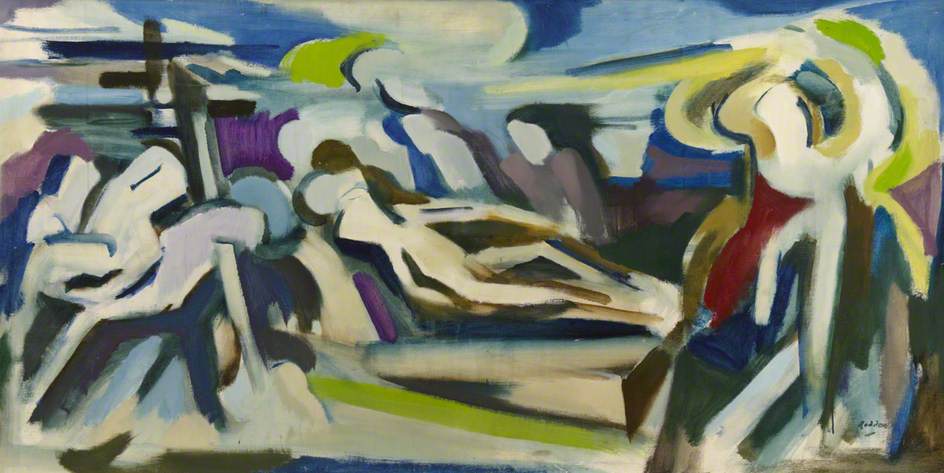
Death, Burial, and Resurrection of Christ by Guy Roddon (1919-2006)

So then, just as you received Christ Jesus as Lord, continue to live your lives in him, rooted and built up in him, strengthened in the faith as you were taught, and overflowing with thankfulness.

See to it that no one takes you captive through hollow and deceptive philosophy, which depends on human tradition and the elemental spiritual forces of this world rather than on Christ.

For in Christ all the fullness of the Deity lives in bodily form, and in Christ you have been brought to fullness. He is the head over every power and authority. In him you were also circumcised with a circumcision not performed by human hands. Your whole self, ruled by the flesh, was put off when you were circumcised by Christ, having been buried with him in baptism, in which you were also raised with him through your faith in the working of God, who raised him from the dead.

When you were dead in your sins and in the uncircumcision of your flesh, God made you alive with Christ. He forgave us all our sins, having canceled the charge of our legal indebtedness, which stood against us and condemned us; he has taken it away, nailing it to the cross. And having disarmed the powers and authorities, he made a public spectacle of them, triumphing over them by the cross. (New International Version)

I like kids. Since I believe them to be closer to God’s kingdom than most adults, I respect them by bending down to talk with them on their level. I take an interest in what they have to say and what’s going on with them. And I pay attention in ways that helps solidify their sense of worth, identity, and belonging. Indeed, how we treat children within the family, the church, and in public can make a significant difference in the trajectory of how they grow up and think of themselves.

One of the most fundamental of all Christian truths is that we belong to Christ. We are God’s children. God has given us everything we need for a solid awareness of our true identity. 

The follower of Jesus is a person who has moved from the realm of being in the world to the sphere of being in Christ. The Christian’s knowledge, understanding, and sense of identity are vitally important because we tend to live up to how we view ourselves.  

Today’s New Testament lesson is dense with the teaching of who we are in Christ. We are to live our lives in Christ. We are rooted and built up in Christ. We have been filled in Christ. We have a spiritual circumcision in Christ. We have been raised in Christ to new life. We are triumphant in Christ.  All this is meant to saturate us with the richness and security of being in the realm of Jesus Christ.

In Jesus Christ:

I am God’s child (John 1:12)

I have been justified (Romans 5:1)

I am Christ’s friend (John 15:15)

I belong to God (1 Corinthians 6:20)

I am a member of Christ’s Body (1 Corinthians 12:27)

I am assured all things work together for good (Romans 8:28)

I am confident that God will perfect the work begun in me (Philippians 1:6)

I am a citizen of heaven (Philippians 3:20)

I am hidden with Christ in God (Colossians 3:3)

I am brave, strong, and self-disciplined (2 Timothy 1:7)

I am born of God and the evil one cannot touch me (1 John 5:18)

I am blessed in the heavenly realms with every spiritual blessing (Ephesians 1:3)

I am chosen before the creation of the world (Ephesians 1:4, 11)

I am holy and blameless (Ephesians 1:4)

I am adopted as God’s child (Ephesians 1:5)

I am lavishly given God’s glorious grace (Ephesians 1:5,8)

I am redeemed (Ephesians 1:8)

I am forgiven (Ephesians 1:8; Colossians 1:14)

I am hopeful (Ephesians 1:12)

I am included (Ephesians 1:13)

I am sealed with the promised Holy Spirit (Ephesians 1:13)

I am a saint (Ephesians 1:18)

I am the salt and light of the earth (Matthew 5:13-14)

I am God’s coworker (2 Corinthians 6:1)

I am a minister of reconciliation (2 Corinthians 5:17-20)

I am alive with Christ (Ephesians 2:5)

I am raised up with Christ (Ephesians 2:6; Colossians 2:12)

I am seated with Christ in the heavenly realms (Ephesians 2:6)

I am rich with God’s grace (Ephesians 2:7)

I am a recipient of God’s kindness (Ephesians 2:7)

I am God’s workmanship (Ephesians 2:10)

I am close to God (Ephesians 2:13)

I am peaceful (Ephesians 2:14)

I am a member of God’s household (Ephesians 2:19)

I am secure (Ephesians 2:20)

I am a holy temple (Ephesians 2:21; 1 Corinthians 6:19)

I am a dwelling for the Holy Spirit (Ephesians 2:22)

I am a friend of God (Ephesians 3:6)

I am free and confident (Ephesians 3:12)

I am joyful in my sufferings (Ephesians 3:13)

I am loved and can love others (Ephesians 3:18)

I am called (Ephesians 4:1; 2 Timothy 1:9)

I am humble, gentle, patient, and tolerant of others (Ephesians 4:2)

I am truthful (Ephesians 4:17)

I am living a new life (Ephesians 4:21-32)

I am kind and compassionate to others (Ephesians 4:32)

I am forgiving of others (Ephesians 4:32)

I am good (Ephesians 5:8-9)

I am grateful (Ephesians 5:20)

I am secure (Ephesians 6:13)

I am dead to sin (Romans 1:12)

I am not alone (Hebrews 13:5)

I am growing (Colossians 2:7)

I am united with other believers (John 17:20-23)

I am victorious (I John 5:4)

I am chosen and dearly loved (Colossians 3:12)

I am blameless (I Corinthians 1:8)

I am more than a conqueror (Romans 8:37)

I am safe (I John 5:18)

I am healed (I Peter 2:24)

I am no longer condemned (Romans 8:1, 2)

I am not helpless (Philippians 4:13)

I am overcoming (I John 4:4)

I am persevering (Philippians 3:14)

I am protected (John 10:28)

I am born again (I Peter 1:23)

I am a new creation (2 Corinthians 5:17)

I am delivered (Colossians 1:13)

I am redeemed from the curse of the Law (Galatians 3:13)

I am qualified to share in Christ’s inheritance (Colossians 1:12)

I am victorious (1 Corinthians 15:57)

Take ten minutes today and focus on one of the phrases or words from these verses. Think about its meaning. Ponder how it makes a difference in your Christian life. Then decide what you will do with the insight God gives you. Finally, share it with a friend. In all these ways we can press the truth of our identity firmly into our souls and live into the reality that we belong to Christ.

Gracious God, you have brought me from death to life, from being of the world to being in Christ. Solidify my sense of identity with Jesus and release that self-knowledge into loving practice toward others. Amen.