The Holy Name of Jesus (Luke 2:15-21)

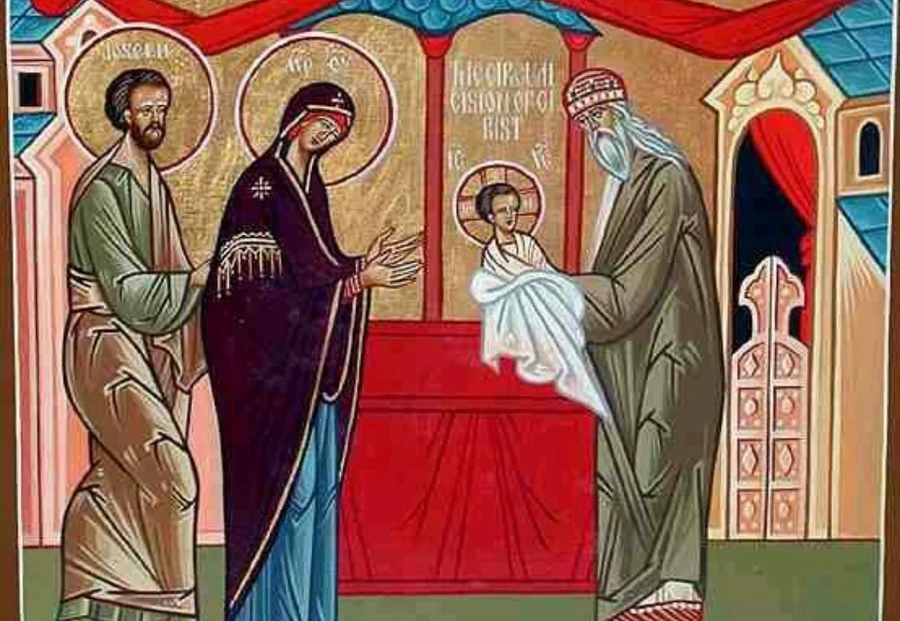
Orthodox depiction of the circumcision and naming of Jesus

When the angels had left them and gone into heaven, the shepherds said to one another, “Let us go now to Bethlehem and see this thing that has taken place, which the Lord has made known to us.” So they went with haste and found Mary and Joseph and the child lying in the manger. When they saw this, they made known what had been told them about this child, and all who heard it were amazed at what the shepherds told them, and Mary treasured all these words and pondered them in her heart. The shepherds returned, glorifying and praising God for all they had heard and seen, just as it had been told them.

When the eighth day came, it was time to circumcise the child, and he was called Jesus, the name given by the angel before he was conceived in the womb. (New Revised Standard Version)

“The Holy Name of Jesus” is a celebration, observed by some Christian traditions, each year on January 1 – which is the eighth day after the birth of Jesus, when he was named and circumcised at the temple in Jerusalem.

An angel of the Lord appeared to him in a dream and said, “Joseph, son of David, do not be afraid to take Mary as your wife, for the child conceived in her is from the Holy Spirit. She will bear a son, and you are to name him Jesus, for he will save his people from their sins.” (Matthew 1:20-21, NRSV)

In the Law of Moses, all male infants are to be circumcised on the eighth day after their birth (Leviticus 12:3). Throughout most of the history of the Christian Church, January 1 has been celebrated as a feast day devoted to the naming of Jesus.

The name “Jesus” comes from the Hebrew Yeshuah (Joshua) which means “Yahweh will save.” It is a name fitting for the person and work of Christ.

Therefore God exalted him even more highly
    and gave him the name
    that is above every other name,
so that at the name given to Jesus
    every knee should bend,
    in heaven and on earth and under the earth,
and every tongue should confess
    that Jesus Christ is Lord,
    to the glory of God the Father. (Philippians 2:9-11, NRSV)

Faith is always followed by obedience. So, the faith of Joseph and Mary in believing the words of the angel Gabriel, translated into the obedient naming of their son as “Jesus.” (Luke 1:31-32)

Jesus, bearing the name of savior, is holy in every way. Not only does the name of Jesus point to his divinity – because of his miraculous conception by the Holy Spirit – but it also directs us toward the special mission for which he entered this world.

Jesus Christ, the Son of God, and Son of Humanity, is God’s agent of deliverance for both Israel and the whole world.

“Do not be afraid, for see, I am bringing you good news of great joy for all the people: to you is born this day in the city of David a Savior, who is the Messiah, the Lord….” (Luke 2:10-11, NRSV)

The Gospel writer Luke provides us with a birth narrative “pregnant” with theological information and importance:

  • Jesus has divine sonship, and possesses the status of king (Luke 1:31-35)
  • Jesus comes from the city of David, which is Bethlehem, not Jerusalem (Luke 2:4, 11)
  • Jesus is described by the angel Gabriel as Son of the Most High, Son of God, Savior, Messiah, and Lord; each of these titles direct us to his identity and mission (Luke 1:32, 35; 2:11)

I like the collective response of the shepherds, after they received heavenly good news from a group of angels.

They could have dismissed the entire thing as having drunk too much brandy on a brisk winter night. They could have kept the whole affair to themselves, reasoning that nobody would believe a bunch of stinky shepherds.

Instead, much like Mary who hurried off to Elizabeth after receiving the angelic message, the shepherds dropped everything to go and see the feeding trough with a newborn baby wrapped in swaddling cloth.

In other words, the shepherds belief in what they heard and experienced, quickly translated into action. It was only appropriate that it was shepherds who discovered the newborn king, the Son of David, himself a shepherd who was anointed by God.

The shepherds went and followed the signs given to them by the angel. And they believed. A motley group of shepherds returned to their fields, kicking up their heels, praising and glorifying God. They knew that things would never be the same again.

The name of Jesus is holy, simply because the Lord Jesus Christ is the Holy One. Christians recognize Jesus as Savior, the fulfillment of all God’s promises. His singular birth, life, death, resurrection, and ascension is exactly, I believe, what this old fallen world is most in need of.

It is never too late to resolve knowing Jesus. At the beginning of this year, there is perhaps no better resolution to make, again and again, of knowing Jesus Christ and honoring his holy name.

Eternal Father, you gave to your incarnate Son the holy name of Jesus to be the sign of our salvation. Plant in our hearts the love of Jesus, truly God and truly human, and grant that we may praise and bless your Holy Name with our whole mind, heart, body, and spirit, that we may know your boundless compassion and mercy. In Christ’s name, we pray. Amen.

It Is Not Yet My Time (John 7:1-9)

Later Jesus was going about his business in Galilee. He didn’t want to travel in Judea because the Jews there were looking for a chance to kill him. It was near the time of Tabernacles, a feast observed annually by the Jews.

His brothers said, “Why don’t you leave here and go up to the Feast so your disciples can get a good look at the works you do? No one who intends to be publicly known does everything behind the scenes. If you’re serious about what you are doing, come out in the open and show the world.” His brothers were pushing him like this because they didn’t believe in him either.

Jesus came back at them, “Don’t pressure me. This isn’t my time. It’s your time—it’s always your time; you have nothing to lose. The world has nothing against you, but it’s up in arms against me. It’s against me because I expose the evil behind its pretensions. You go ahead, go up to the Feast. Don’t wait for me. I’m not ready. It’s not the right time for me.”

He said this and stayed on in Galilee. (The Message)

For some Jews in the ancient world, if the Messiah were to come, it would certainly happen in the most celebrated month of the Jewish year (Tishri, in the Fall season).

The New Year celebration happens on the first and second of the month; the Day of Atonement on the tenth day (Yom Kippur); and leads to the joyous celebration of the fifteenth to twenty-second days in the Festival of Tabernacles (Booths or Shelters, also known as “Sukkot”).

That is the time of year in which faithful followers of God leave their homes and live in temporary shelters. It serves as a powerful reminder of their deliverance and divine preservation in the wilderness. It’s a celebration of the harvest, a time to remember the Israelites’ journey through the Sinai desert and God’s protection throughout that time. 

This festival also symbolizes unity and inclusivity, and looks forward to the Messianic age when all nations will come to Jerusalem to worship God.

The Feast of Tabernacles, by Bible Art

So, it only made sense to the people who knew Jesus, that he would want to make a big splash during the month of Tishri – a time of high celebration where everyone is together, recalling God’s gracious actions.

Christ’s own family were insistent that he take advantage of the festival’s timing and clearly show himself to the world. But Jesus wasn’t having it. Why not?

Jesus responded that it is not yet his time. By that he meant it wasn’t the right festival season. The timing of Christ would be for Passover, not Tabernacles. His role was not as the Divine Warrior who would beat up the Romans and establish an earthly rule in the vein of King David.

Instead, Christ’s purpose was to take on the role of the Suffering Servant, the dying Messiah. A joyous public spectacle during Tabernacles to announce deliverance from Roman oppression was not the reason he came to this earth.

Jesus had no intention of being pressed into something that wasn’t his understanding of God’s will.

Indeed, Christ’s time of glorification would come. But at the time of Tabernacles, when the feelings of the people were drawn to Jesus, and expectations were high for divine deliverance from Gentile rule, a capitulation to the crowd would be akin to the devil’s temptation of throwing himself from the Temple, so that everyone could see the Jewish Superman in action.

Jesus is not that sort of Messiah. Ostentatious displays of power and authority were not his path for the people’s salvation. That is the way of the world, not heaven; it’s the concrete road of the proud, not the dirt path of the humble.

Evil needed to be dealt with, once and for all – and not only for the sake of the Jews, but for all creation. And it had to have to divine effectiveness, not a worldly solution.

It still remains yet to this very day, that those with unbelief demand a strong leader and a powerful sign of authority. They want a take-charge sort of person who looks good and has style.

Such worldly-minded persons insist that the strong leader get out there and have lots of exposure. Pay attention to the optics, and engender supreme confidence in others. Engage and change the situation with all of the proven tactics of the world’s power base.

Yet those who truly believe, discern that life does not consist of grand imperial displays of opulent strength and worldly control. Rather, the heavenly virtues of wisdom, patience, and a settled hope surround them. They pay no attention to bombastic pronouncements and empty promises.

The believer is able to see Jesus for who he truly is, and not for what they want him to be.

In other words, up is down, first is last, suffering before celebration. These are not the ways of the unbelieving world; they are the practices of the faithfully devoted ones.

Even though Christ’s brothers strongly urged him to openly show himself in an ancient version of mass marketing, Jesus patently forsook it. He was not seeking to enhance his own reputation, to get his brand recognition out there and impress the crowd.

Jesus Christ will only act as his heavenly Father commands and wills him to – even if his own family want him to do different.

And that is why the world “hates” Jesus. Because he will neither operate according to, nor submit to, its prevailing cultural, political, and familial standards. Pride mocks humility. Arrogance disdains the meek and gentle. Worldly strength wants nothing to do with any sort of perceived weakness.

Metamorphosis of Narcissus, by Salvador Dali, 1937

Yet, the world does not realize that ultimate power, control, and authority comes not through public shows of toughness, but by private practices which embrace spiritual disciplines and knowing oneself.

I myself have no stomach for the supposed follower of Christ who merely seeks to honor Jesus in order to make the Name of Jesus serve their own name’s purpose.

And I gag every time I observe the self-centered leader try and act as if they care for important things, when in reality their only concern is self. Their worldly actions and attitudes betray their true feelings and purpose.

“It is better to incur the world’s hatred, by testifying against its wickedness, than gain its good will by going down the stream with them.”

Matthew Henry

We live in a world of indecision; there is no real decisive action which champions the common good of all citizens. We stick our finger in the air to see which way the wind is blowing. Our insecurity as a people is profound and palpable.

We seem incapable of sound and just public decision-making, let alone making personal choices which foster and engender spiritual and emotional growth.

This world is in desperate need of good, right, and just people who will faithfully occupy places and positions of trust. For me, that means following the narrow way of Jesus, and not the broad highway of destruction paved by narcissistic leaders.

Do you and I have the courage to take a hard look at ourselves, our relationships, and most of all, Jesus? Will we seek discernment as to what is really the world, and what is truly the words and ways of Jesus? Can we gain a sense of divine timing?

Almighty and ever-living God, ruler of all things in heaven and earth: Strengthen the faithful, arouse the careless, and restore the penitent. Grant us all things necessary for our common life, and bring us all to be of one heart and mind within your holy Church; through Jesus Christ our Lord. Amen.

Don’t Fear, Believe! (Mark 5:21-43)

Jesus heals the daughter of Jairus, by Hyatt Moore

When Jesus had crossed again in the boat to the other side, a great crowd gathered around him, and he was by the sea. Then one of the leaders of the synagogue, named Jairus, came and, when he saw him, fell at his feet and pleaded with him repeatedly, “My little daughter is at the point of death. Come and lay your hands on her, so that she may be made well and live.” So he went with him.

And a large crowd followed him and pressed in on him. Now there was a woman who had been suffering from a flow of blood for twelve years. She had endured much under many physicians and had spent all that she had, and she was no better but rather grew worse. She had heard about Jesus and came up behind him in the crowd and touched his cloak, for she said, “If I but touch his cloak, I will be made well.” Immediately her flow of blood stopped, and she felt in her body that she was healed of her disease. 

Immediately aware that power had gone forth from him, Jesus turned about in the crowd and said, “Who touched my cloak?” And his disciples said to him, “You see the crowd pressing in on you; how can you say, ‘Who touched me?’ ” He looked all around to see who had done it. But the woman, knowing what had happened to her, came in fear and trembling, fell down before him, and told him the whole truth. He said to her, “Daughter, your faith has made you well; go in peace, and be healed of your disease.”

While he was still speaking, some people came from the synagogue leader’s house to say, “Your daughter is dead. Why trouble the teacher any further?” But overhearing what they said, Jesus said to the synagogue leader, “Do not be afraid; only believe.” He allowed no one to follow him except Peter, James, and John, the brother of James. When they came to the synagogue leader’s house, he saw a commotion, people weeping and wailing loudly. When he had entered, he said to them, “Why do you make a commotion and weep? The child is not dead but sleeping.” And they laughed at him.

Then he put them all outside and took the child’s father and mother and those who were with him and went in where the child was. Taking her by the hand, he said to her, “Talitha koum,” which means, “Little girl, get up!” And immediately the girl stood up and began to walk about (she was twelve years of age). At this they were overcome with amazement. He strictly ordered them that no one should know this and told them to give her something to eat. (New Revised Standard Version)

Christ Healing the Hemorrhaging Woman, by Ivan Rutkovych, 1698

Hopeless. That’s how two people felt in today’s story. One of them a woman, and the other the father of a little girl.

To have a sense of hopelessness is perhaps one of the worst feelings a person could ever have; it is to suffer with the despair that your suffering isn’t going to end.

It was still early in Christ’s earthly ministry. Jesus had already performed amazing exorcisms and healed people. His fame was spreading, and crowds began to form everywhere he went.

The Hemorrhaging Woman

The woman had suffered for 12 years with hemorrhaging. She went through a string of doctors with no answers to her malady. Her condition drained her not only bodily, but also emotionally and financially. Despite everything she tried, not only did things not get better, but they got worse.

She likely didn’t get out much because of her situation. But even if she did, the woman would have to literally remain on the margins of the community because of all the blood. In other words, she was unclean, and anyone who touched her would be, as well.

I see many folks in my line of work who have had an adverse health condition for years. Some of them have had a debilitating illness for so long that the sickness is what now defines them. Their daily schedule is ruled by doctor appointments and therapy sessions. Their health maladies have taken over their identity.

Despair and desperation are close cousins. The woman’s desire to gain back her life aroused the courage to seek out Jesus. And she believed that by resolutely getting through the crowd of people, that even if the edge of his cloak could be touched, restoration would happen.

True faith leads us to act in a way that seems irrational to others.

The woman pushed and wormed her way close enough to Jesus to touch just the edge of his cloak… and the effect was immediate. She felt it in her body. The woman was cured with but a simple touch.

Then the woman became afraid, realizing that Jesus was aware that someone touched him. And a woman, no less, who had a hemorrhaging issue. Christ looked around, trying to find out who did it.

The extreme awareness of Jesus contrasts with the blatant unawareness of his disciples. They dismissed their Teacher’s investigation because of all the people who clamored around him. But Jesus was determined to find the person who touched him.

The woman realized she could not hide what she did, and what happened. With her robust faith in Jesus, she was willing to face any consequence for touching the rabbi. She was so scared that she trembled as she talked to Jesus. The woman revealed her story to him of who she is and what brought her to this point.

Genuine faith and healing always brings light, because grace and redemption will have its way in this fallen dark world.

Whereas we might expect a religious leader to respond with disdain or shock, and likely a firm rebuke, Jesus honored the woman by calling her “daughter.” He truly saw her, and publicly bestowed blessing and peace upon her.

Jesus confirmed and affirmed the woman’s healing in front of everyone. She was hopeless no more.

The Sick Young Girl

Christ continued his journey to young girl’s house. Her faither, Jairus the synagogue ruler, appealed to Jesus to come and heal her. She was at the end of life. As the father of three daughters myself, I can easily imagine the despair and desperation of Jairus concerning his precious little girl’s condition.

Somehow he knew there was only one hope for his daughter; Jairus needed Jesus because there was nothing he could do, or anybody could do, to save her. And once he got to Jesus, his poverty of spirit was evident, his humility palpable.

Jairus fell to his knees and became a spiritual beggar. He pleaded with Jesus to come and lay healing hands on his dear girl.

But his hope morphed into hopelessness; while on the way, Jairus received the devastating news that his daughter had died. All is lost… or is it?

Jesus didn’t think so. He simply gave a hopeful reassurance, “Don’t fear. Believe!” To the unbeliever, those words must seem cruel – giving a father whose child has died false hope. But for God, nothing is impossible. In God’s kingdom, death never has the last say on a person’s life.

It’s hard to have faith and hope whenever everyone else is mourning and crying and grieving. Arriving at the house, Jesus said yet another possibly cruel thing: “The child’s not dead but sleeping.” Christ understood that she was not all dead, just mostly dead.

The nervous and stressed laughing of the people in the house did nothing to deter Jesus. He was supremely confident about what would happen – a future that no one else could yet see.

A simple command, just a few words, was all it took. Taking the girl’s mother and father into the room, I imagine Jesus saying with a combination of authority and compassion, “Little girl, get up!”

Since Christ’s authority knows no bounds, the girl immediately got up. She was alive – so alive that it’s as if nothing ever made her ill to begin with.

Only a Story?

You may think this is only a story. Perhaps you believe there’s nothing to this, other than an ancient follower of Jesus trying to make his Teacher look like a healer, a savior.

For me, the story confirms what I know and believe to be true from my own experience as a church pastor, hospital chaplain, and follower of God: The impossible happens with Jesus. Christ is more powerful than anything life throws at us. Jesus is enough.

Amen. Soli Deo Gloria.

To Believe, or Not (Mark 16:9-18)

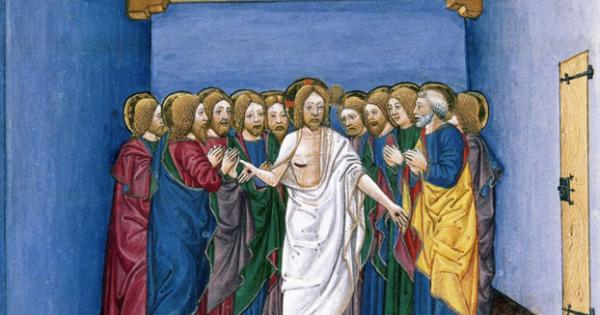
The risen Jesus appears to his disciples, by Unknown Italian artist, 1476

[Note: The earliest manuscripts and some other ancient witnesses do not have verses 9–20.]

When Jesus rose early on the first day of the week, he appeared first to Mary Magdalene, out of whom he had driven seven demons. She went and told those who had been with him and who were mourning and weeping. When they heard that Jesus was alive and that she had seen him, they did not believe it.

Afterward Jesus appeared in a different form to two of them while they were walking in the country. These returned and reported it to the rest; but they did not believe them either.

Later Jesus appeared to the Eleven as they were eating; he rebuked them for their lack of faith and their stubborn refusal to believe those who had seen him after he had risen.

He said to them, “Go into all the world and preach the gospel to all creation. Whoever believes and is baptized will be saved, but whoever does not believe will be condemned. And these signs will accompany those who believe: In my name they will drive out demons; they will speak in new tongues; they will pick up snakes with their hands; and when they drink deadly poison, it will not hurt them at all; they will place their hands on sick people, and they will get well.” (New International Version)

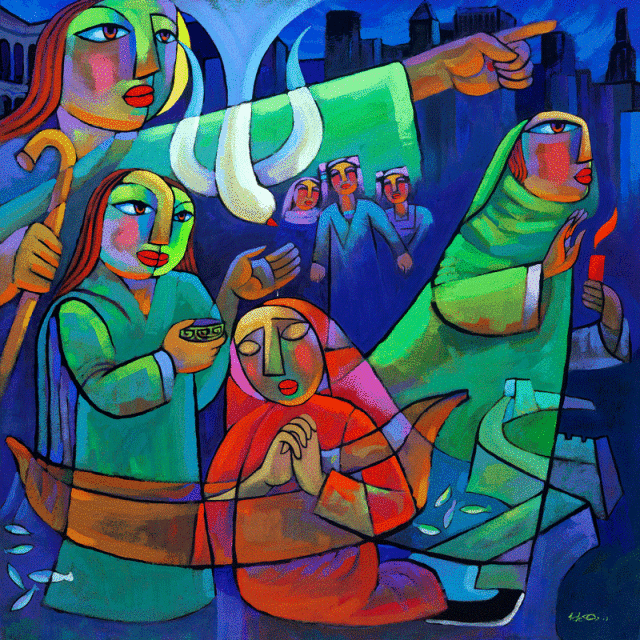
The Great Commission, by He Qi

So, how do you view the Bible? Some view it as a direct communication from God to human authors, as if the Lord actually wrote it all, akin to how Moses received the Ten Commandments. Others see the Bible as a thoroughly human invention of literature about God. And then there are those who are somewhere in-between the two views.

Textual criticism is a branch of study that examines a literary work, and aims to establish the original text. This is important and needed, especially since we have all sorts of ancient pieces of literature. We rely upon learned scholars who are fluent in the original languages, and in the examination of texts, so that we can have reliable translations of those texts.

Therefore, textual criticism of the Bible means thinking critically about manuscripts and variations in the biblical texts found in those manuscripts, in order to identify the original reading of the Bible. Keep in mind that, prior to the invention of the printing press, copies of everything had to be hand written. Scribes were trained scholars who meticulously copied manuscripts; and human error was always a part of the process.

The New Testament was copied by thousands of people in thousands of places in dozens of languages. Though that reality can make textual criticism rather complicated, this diversity is also a blessing; it speaks to the high probability that we have a very close and reliable authentic original Bible – namely because so many people were involved in copying scriptural texts.

Today’s lectionary reading is an entire chunk at the end of Mark’s Gospel that is very difficult to ascertain whether it was original to his writing, or not. If you are of the ilk that the Bible is a God-authored book, you will likely want to resolve this tension. And if you’re not, you just might be rolling your eyes at this point, as if this is all silly stuff that doesn’t matter.

I’m suggesting it is neither as silly nor as serious as some want to make it. It just is. And sometimes we must accept what is, without always having to explain it in objective Enlightenment terms; or relegate it to the realm of the ethereal and mystical.

Instead, we can deal with the text we have in front of us without any wringing of the hands, or ignoring it altogether. And what we have, it seems to me, is this: a text of Scripture that is consistent with the rest of Mark’s Gospel in showing us the nature of both belief and unbelief.

An ancient papyrus fragment of Mark’s Gospel

To believe, or not to believe? That is the question.

Throughout the Gospel of Mark, we are confronted with the choice of believing or disbelieving the acts of Jesus in his earthly ministry. And that issue of faith comes to a head with Christ’s resurrection.

The women exhibited belief. They made the pilgrimage to Christ’s tomb and discovered it empty. It is upon the testimony of women – even though a woman’s testimony was not considered reliable in that day – that believers know Christ is risen from death.

The men, however, are nowhere to be found. One reason for unbelief by people who ought to know better is that they go looking for all the wrong sort of evidence. While on this earth, Jesus refused to be like any sort of worldly ruler; he sought to use his authority by being a servant; and he tapped into the power of humility and love.

If we go limiting our epistemology (the study of how we receive knowledge) then we will likely not discover the truth about much of anything. The male disciples refused to believe the testimony of the female Mary Magdalene. The risen Christ finally showed himself and rebuked the stubborn men.

To see Jesus will take something else, something more, than our standard use of three dimensions and five senses and critical thinking skills. As important and needed as they are, it isn’t enough to truly see the risen Lord. We need to bring in some other epistemic impulses: the conscience and the gut; the spirit and the heart; intuition and experience; and the testimony of witnesses whom we would rather dismiss, than listen to.

Jesus ascends to heaven, but not everyone sees it – for obvious reasons. There are some who may search for evidence their entire lives, never to find it, because they want confirmation by means of their own mentally contrived and culturally conditioned constructs.

The Gospel is neither ant-intellectual nor only understood by the scholarly and learned; the good news of Jesus Christ is both simple and complex, easy to understand and hard to comprehend, compelling and revolting. And there is one thing for sure: the person and work of Jesus will always challenge us, change us, and move us.

The story is still being written, not just with pens and keyboards, with textual criticism and documentary evidence, but with mercy and love upon the tablet of the heart.

Lord, I want to believe. Help me in my unbelief! May I see and hear the risen Savior, through the enablement of the Spirit. Amen.