Dealing with a Clash of Belief (Acts 3:17-4:4)

“And now, friends, I know you had no idea what you were doing when you killed Jesus, and neither did your leaders. But God, who through the preaching of all the prophets had said all along that his Messiah would be killed, knew exactly what you were doing and used it to fulfill his plans.

“Now it’s time to change your ways! Turn to face God so he can wipe away your sins, pour out showers of blessing to refresh you, and send you the Messiah he prepared for you, namely, Jesus. For the time being he must remain out of sight in heaven until everything is restored to order again just the way God, through the preaching of his holy prophets of old, said it would be. Moses, for instance, said, ‘Your God will raise up for you a prophet just like me from your family. Listen to every word he speaks to you. Every last living soul who refuses to listen to that prophet will be wiped out from the people.’

“All the prophets from Samuel on down said the same thing, said most emphatically that these days would come. These prophets, along with the covenant God made with your ancestors, are your family tree. God’s covenant-word to Abraham provides the text: ‘By your offspring all the families of the earth will be blessed.’ But you are first in line: God, having raised up his Son, sent him to bless you as you turn, one by one, from your evil ways.”

While Peter and John were addressing the people, the priests, the chief of the Temple police, and some Sadducees came up, indignant that these upstart apostles were instructing the people and proclaiming that the resurrection from the dead had taken place in Jesus. They arrested them and threw them in jail until morning, for by now it was late in the evening. But many of those who listened had already believed the Message—in round numbers about five thousand! (The Message)

I believe a lack of self-awareness is at the middle of a great many sins in this world. A lot of folks just simply do not realize how they come across to others; what impact their words and actions have upon others; and their illogical and nonsensical forms of thinking.

It’s frustrating and maddening for those who can see the blind spots in another’s life. And, keep in mind, it’s the same for others concerning some area of thought or dogmatic belief we may hold to, as well.

Recently, I had one of those surreal conversations. I had made a statement, quoting a verse from one of the New Testament Gospels about what Jesus said. Later in the day, a person who heard me say it, approached me and emphatically stated, “Jesus never said that.”

Even though I went directly to the verse and read it, the person then stated, “But that’s not from the King James or New King James Version.” So, I went to the New King James and read it. “You have to go to the King James because that’s the most reliable.” And then, after reading it there, the person dogmatically stated, “Well, that was added by a scribe. Jesus didn’t really say that.”

Even after all this, and pointing the person toward the field of textual criticism and how languages get translated, they still refused to consider the evidence right in front of their face. Yes, indeed, it is maddening! (Note: The person went so far as to begin attacking my biblical hermeneutic and my faith, because well, if you cannot accept the evidence, then you must go the ad hominem route of discrediting the person. *Sigh*)

People generally do not like their beliefs challenged nor upended. And some persons will do just about anything to maintain those beliefs – including verbal attacks against someone’s very personhood.
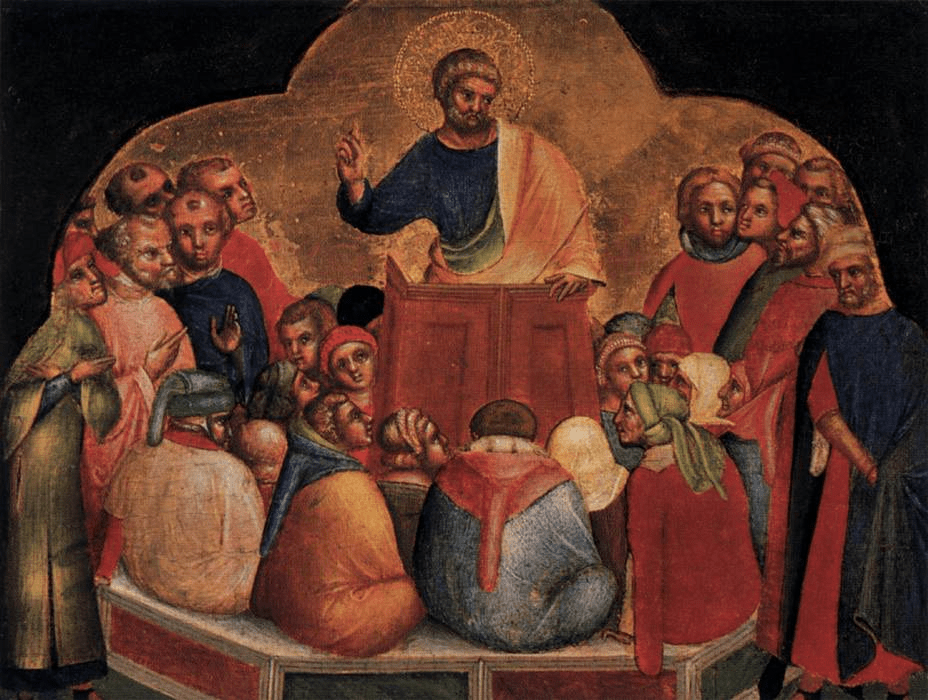
Apostle Peter preaching, by Lorenzo Veneziano, c.1370

And that is exactly what happened with the Apostles Peter and John. Their proclamation of Christ and his resurrection struck a nerve with the Jewish Sadducees who were the keepers of proper worship and liturgy amongst the temple. The Apostles’ teaching was so scandalous and threatening to their own beliefs, that they used their authority to throw Peter and John in jail – just for proclaiming a message the Sadducees didn’t like.

It never feels good getting toasted by those who claim insight and knowledge but are, in reality, a bunch of ignorant simpletons who don’t want to change and will hold onto their sense of power and superiority at all costs.

Yet, the consolation to all of this, is that there are others who are open-minded enough to listen well and adjust their belief systems to match the truthful evidence given to them. And so, despite the efforts of the Sadducees to suppress apostolic preaching, the fledgling group of Christ followers were being added by the thousands.

It turns out that nobody can resist the Holy Spirit of God, no matter how much earthly pull and power they possess.

Today’s New Testament lesson reminds us and teaches us that:

  • Self-awareness of why we hold to our particular beliefs, matters. We ought to hold our dogmatism very loosely.
  • Proclamation of the gospel, that is, the good news of Christ’s crucifixion and resurrection, makes a difference in lot of people’s lives.
  • Opposition is to be expected. There are some who view the good news of grace as the bad news of judgment against themselves; they will oppose it by any means possible.
  • Humility will always serve us well in the spiritual life, whereas condescending arrogance will never help anybody. For God’s sake, please have enough humility to listen and learn, even if (and especially) you don’t like what you’re hearing – no matter which end of the discussion you are on.

If we want the world to be different, then the change begins with you and me. Christians have the opportunity, if they will take up the mantle, of being the most calm, humble, and attentive people in the room. In this time of the year, no other stance and skill can be more important amongst family, friends, and others during the holidays.

O Lord, you have told us what is good, and what you require of us: To do what is right, to love mercy, and to walk humbly. Help us walk together in love and compassion towards the cross, humbly with you and one another. Let your Holy Spirit guide us on the right path to truth and reconciliation with humility; and enable us to hear each other, for we do not want to walk by pride or self-sufficiency, through Jesus Christ our Lord. Amen.


A Great Number of People Believe (Acts 11:19-26)

Now those who had been scattered by the persecution that broke out when Stephen was killed traveled as far as Phoenicia, Cyprus and Antioch, spreading the word only among Jews. Some of them, however, men from Cyprus and Cyrene, went to Antioch and began to speak to Greeks also, telling them the good news about the Lord Jesus. The Lord’s hand was with them, and a great number of people believed and turned to the Lord.

News of this reached the church in Jerusalem, and they sent Barnabas to Antioch. When he arrived and saw what the grace of God had done, he was glad and encouraged them all to remain true to the Lord with all their hearts. He was a good man, full of the Holy Spirit and faith, and a great number of people were brought to the Lord.

Then Barnabas went to Tarsus to look for Saul, and when he found him, he brought him to Antioch. So for a whole year Barnabas and Saul met with the church and taught great numbers of people. The disciples were called Christians first at Antioch. (New International Version)

The earliest of believers in Jesus Christ were Jews. Jewish converts to Christianity were not typically received well amongst their families, communities, and culture. So, when Stephen, one of those converts, retold Jewish history emphasizing a stubborn lack of awareness amongst their ancestors – and then connected it with present day attitudes – a full fledged persecution of Christians broke out.

As a result, the Church – located almost exclusively in Jerusalem – was scattered throughout Judea and across the Roman Empire in a Christian diaspora. In Christ’s ascension, he told the disciples that they would be witnesses beginning at Jerusalem, and then to Judea and outside the Middle East. Little did the small band of believers know, at the time, how that plan would come about.

As it turns out, although life was hard being a Christian refugee in a strange location, the believers spread the good news of Jesus wherever they went. Thus, gospel seeds were planted all across the land.

There is no place we can go where God is not already there.

And so, the displaced Christians discovered God was with them in their sojourning. Their faithful proclamation of good news was the impetus to bringing about many more converts to Jesus Christ.

What was happening in Judea and the Empire came back to the church leaders in Jerusalem. They then, smartly, sent one of their own, Barnabas, to Antioch in order to check out the scene and bring the new believers some encouragement. Since Barnabas was the consummate encourager, the church was emboldened, with even more converts entering into faith in Christ.

Barnabas, as an encourager, had the knack for knowing what he could do and not do; he also knew someone who could supply what he couldn’t do. He was so sure that Saul (Paul) was the right person for the job that he went to Tarsus – which was about 400 miles from Antioch – in order to find him and get him to the new believers as soon as possible. The result was an explosion of fresh converts coming to faith and into the church.

It’s no coincidence that the man with the biggest heart in the church is described in today’s text as a good man who was filled with the Holy Spirit. The Spirit is the One who makes all the difference with the growth of Christianity and the establishment of the Church.

Barnabas could see the evidence of God’s grace in the city of Antioch because he was filled to the full, with God’s own Spirit. He observed people with changed lives; an incredibly diverse and connected international community of believers; and so, encouraged them all in this good work brought about by the Spirit of God.

More and more people were added to the fellowship because of the robust spiritual dynamic that took place. This was not a matter of people using slick marketing strategies to make the name of Jesus Christ known; instead, the adding was all God. The Lord added to the Lord, and not people adding people to the Church. In other words, God is both the subject and the object, the source and the goal, of all good Christian ministry.

Then, when the Lord connected Barnabas together with Saul (Paul) who was also filled with the Holy Spirit and many spiritual gifts from God, the result was nothing less than large numbers of persons coming to faith in Christ and being added to the Church.

The believers in Antioch were so chatty about their faith that the first reference of being called “Christians” were to these converted Jewish believers in Jesus. Even though the moniker of “Christian” was probably a term of derision and meant to mock the Antiochene Church, it stuck, and was held up proudly by the believers. They were completely okay with being called “little Christ’s.”

After all, since they were truly Christ-centered in all they did, it was a fitting title for the fledging and growing Church. It clearly identified them as the people who serve and follow Christ. We, too, these many centuries later, have the very same Spirit of God that they did – and therefore, the same opportunity to speak of Jesus and see the Holy Spirit do the work of adding to the Church.

We pray, almighty God, that all who confess your Name may
be united in your truth, live together in your love, and reveal
your glory in the world.

Guide people everywhere, and of all the nations, in the
ways of justice and peace; that we may honor one another
and serve the common good.

Give us all a reverence for the earth as your own creation,
that we may use its resources rightly in the service of others
and to your honor and glory.

Bless all whose lives are closely linked with ours, and grant
that we may serve Christ in them, and love one another as he
loves us.

Comfort and heal all those who suffer in body, mind, or
spirit; give them courage and hope in their troubles, and
bring them the joy of your salvation.

Lord, in your mercy, hear our prayer. Amen.

Use Your Freedom For Good (Exodus 33:1-6)

Then the Lord said to Moses, “You and the people you brought out of Egypt must leave this place. Go to the land I promised to Abraham, Isaac, and Jacob with an oath, saying, ‘I will give it to your descendants.’ I will send a Messenger ahead of you, and I will force out the Canaanites, Amorites, Hittites, Perizzites, Hivites, and Jebusites. Go to that land flowing with milk and honey. But I will not be with you, because you are impossible to deal with, and I would destroy you on the way.”

When the people heard this bad news, they acted as if someone had died. No one wore any jewelry. The Lord had said to Moses, “Tell the Israelites, ‘You are impossible to deal with. If I were with you, I might destroy you at any time. Now take off your jewelry, and I’ll decide what to do with you.’” After they left Mount Horeb, the Israelites no longer wore their jewelry. (God’s Word Translation)

It took little time for the covenant between God and the Israelites to be violated. The relationship between the Lord and the people was meant to be cemented through a special covenant in which Yahweh makes promises to them and gives them instructions and commandments; and the Israelites pledge their fealty and promise to obey.

But the people quickly reneged on the relationship. While Moses was up on Mount Sinai, receiving the Law from God, the Israelite grumbles and complaints came to full flower. They went their own way and made a calf idol out of gold.

So, the Lord’s judgment broke out amongst them. The Levites, to their credit, rallied around Moses and the Lord, and took out the rabble rousers in the camp. What’s more, God sent a plague that killed many.

In the aftermath of the rebellion against Moses and the Lord, God ordered the people to leave Mount Sinai – the place where everyone was to have a positive experience of Yahweh’s presence. God’s anger and wrath were so aroused that it became impossible for the divine presence to go with the people. Only Moses, as God’s emissary, would be able to guide the Israelites so that they are not completely eradicated.

Mount Sinai, by Sefira Lightstone

Yet, even after all the bad attitudes, rebellious actions, and an idolatrous spirit among the Israelites, Yahweh will still keep the divine promise to Abraham, Isaac, and Jacob to deliver them and bring them to the Promised Land.

Today’s story has the feel of a chastened child sitting in the corner, having to think about what they just did to raise the ire of the parent. The Israelites moved from Sinai in a somber mood, realizing more clearly than ever how much their lives are tied and linked to God’s divine presence.

At God’s command, the people removed their jewelry and took off their party clothes from the celebration that got them into so much trouble. It began to sink in, that the Lord departed from them because of their great sin. They started to realize, albeit too late, that they really screwed up their relationship with God.

The Israelites didn’t know how good they had it with the divine pillar of cloud by day and fire by night to lead them – and how much they actually depended on the God-given manna for their sustenance and existence.

It’s all too typical for us humans that we fail to realize what we have, until it’s gone. The ancient Israelites were freed from a cruel slavery in Egypt. They clearly did not handle their freedom well, at all. Perhaps the people were so used to being in bondage that, when they go their freedom, they just adopted a different sort of slavery – to their sinful passions.

Let’s handle our freedom with some responsibility and accountability, so that we do not go down the same rebellious path as the ancient people of God. You and I are free to choose what we do, what we think, and how we spend our time. It’s easy to blame outside forces when circumstances are hard; and to grumble whenever we don’t like something.

Freedom is a spiritual discipline; we must learn how to intentionally practice it and use it for good. The following are four areas to purposefully work on with our freedom by making good choices:

Choose your words carefully. What comes out of your own mouth is up to you. Let those words reflect who you truly are; and let your speech impact others around you for good, and not evil.

Choose your attitude with some self-awareness. With awareness comes choices. For example, if we are not aware of our own anger, it will eventually come out sideways on another person. Our sullen attitude and jaded perspective will color our relational interactions. But if we are aware of our emotions, we can choose to effectively work through them, and then decide what sort of attitude we’re going to have.

Choose your actions before you do them. Seemingly insignificant choices turn into small actions. The small actions become habits. And habits shape character and create a life. We make choices every day about what we’ll do and not do. In every sort of situation we have choices to act, such as: Will I let go, or will I try and control others? Will I walk, or drive? Will I spend, or save? Shall I prepare, or procrastinate? Be fit, or be fat? Talk or listen?… and a thousand other choices of action.

Choose your beliefs with care. Our beliefs and our faith determines how we act and behave. If we believe in a good God who has our best interests at heart, we will freely trust such a God. But if we believe God to be a capricious Being who is aloof from my concerns, then we will make choices to watch out for number one and view others with suspect.

If you are behaving in ways that aren’t working for you, examine what belief is causing that behavior. Then decide whether that’s a belief you really need to have, or not, then change it, if necessary.

Every choice we make, contributes to the person we want to become, and sets us on the path to where we want to be in life. Maybe if the ancient Israelites had more awareness of this, they might have chosen very differently.

Gracious God, grant me clarity and awareness to make wise decisions. Enlighten my heart and mind, as I seek to follow your divine guidance. In the face of uncertainty, give me the courage to trust your promises. Help me embrace the path set before me, with a spirit of love and grace. Amen.

A Word of Faith (Genesis 15:1-20)

After this, the word of the Lord came to Abram in a vision:

“Do not be afraid, Abram.
    I am your shield,
    your very great reward.”

But Abram said, “Sovereign Lord, what can you give me since I remain childless and the one who will inherit my estate is Eliezer of Damascus?” And Abram said, “You have given me no children; so a servant in my household will be my heir.”

Then the word of the Lord came to him: “This man will not be your heir, but a son who is your own flesh and blood will be your heir.” He took him outside and said, “Look up at the sky and count the stars—if indeed you can count them.” Then he said to him, “So shall your offspring be.”

Abram believed the Lord, and he credited it to him as righteousness.

He also said to him, “I am the Lord, who brought you out of Ur of the Chaldeans to give you this land to take possession of it.”

But Abram said, “Sovereign Lord, how can I know that I will gain possession of it?”

So the Lord said to him, “Bring me a heifer, a goat and a ram, each three years old, along with a dove and a young pigeon.”

Abram brought all these to him, cut them in two and arranged the halves opposite each other; the birds, however, he did not cut them in half. Then birds of prey came down on the carcasses, but Abram drove them away.

As the sun was setting, Abram fell into a deep sleep, and a thick and dreadful darkness came over him. Then the Lord said to him, “Know for certain that for four hundred years your descendants will be strangers in a country not their own and that they will be enslaved and mistreated there. But I will punish the nation they serve as slaves, and afterward they will come out with great possessions. You, however, will go to your ancestors in peace and be buried at a good old age. In the fourth generation your descendants will come back here, for the sin of the Amorites has not yet reached its full measure.”

When the sun had set and darkness had fallen, a smoking firepot with a blazing torch appeared and passed between the pieces. On that day the Lord made a covenant with Abram and said, “To your descendants I give this land, from the Wadi of Egypt to the great river, the Euphrates—the land of the Kenites, Kenizzites, Kadmonites, Hittites, Perizzites, Rephaites, (New International Version)

Abrahamic Covenant II, by Wayne Forte, 2007

A Word about Abram and Sarai

We meet Abram and Sarai (later to be known as Abraham and Sarah) as a non-descript couple from a place called Ur of the Chaldees, a few chapters earlier in the opening biblical book of Genesis. It’s noted that Sarai is barren, or childless. (Genesis 11:30)

The Lord decided to choose a people for God’s own name, a singular people to become a kingdom of priest and a holy nation. The idea was that God would bless all the other nations through this one nation.

So, in what becomes something of a divine pattern, God chooses a most unlikely couple (old and childless) to become father and mother of this new nation to bless all other nations on earth. The Lord called them from their country of origin to leave and go to a new place. (Genesis 12:1-3)

Lo and behold, Abram and Sarai did just that. They left all they ever knew and journeyed to the new land, believing the promise of God, even though it didn’t make much sense. And there, they waited for a child, who would become the first of their many descendants, the child of promise.

And they waited. Time passed. They made a few sojourns into Egypt and back. But still no child. More time went by. Abram and Sarai were old when they came to the new land. Now, they’re really old! And still, no child. Then, finally, the Lord broke the silence.

The Word of the Lord

God’s initial words after all this time were, “Don’t be afraid.” We discover that anytime we hear that phrase spoken by the Lord, something good is about to happen. In fact, it’s great news.

But Abram seems discouraged, even with a fresh heart-to-heart with God. He and Sarai are still without a child. Instead of joy over God’s speech, Abram laments the ache of childlessness. Even though, by this time, Abram was wealthy, prosperous, and of good reputation, he feels the sting of a promise yet unfulfilled. God has still not granted him progeny for blessing the world.

A Word of Lament

Lament is, at its core, a complaint – an expression of grief in losing something or someone, or as in Abram’s case, of never having that something or someone to begin with.

It’s actually important for us to essentially make our problems into God’s problems. To tell God about our deepest hurts and unmet hopes is to implicate God in those hurts and hopes. It is to involve God in our disappointment.

In lament, we cry out to God in the belief that the Lord can and will respond to our painful cries and our deep desires. We believe God has the power and ability to respond. To complain to God is to have faith that God is faithful to divine promises—in spite of any nonsensical present circumstances.

Concerning matters about which God has made a promise, to complain is to remind the Lord of those unmet promises. In his lament, Abram was implying that God had not kept the promise, and had not yet proven faithful.

A Word of Response

Far from feeling perturbed that Abram laments instead of rejoices, God, in fact, responds by doubling-down on the original promise. Not only will there be a child, but that child’s descendants will be too many to even begin counting.

The Lord invited Abram to move his head from looking down at the bare ground to looking up at the magnificent stars. And in gazing upon the heavens, listening to the God whom he serves, Abram believed the Lord. And it was this faith which was credited to him as righteousness.

God is okay with being implicated in our problems. In fact, God welcomes it. Our deep grief, and our prayerful complaints, are a way of speaking which reminds God that God has promised to be faithful to divine promises. God doesn’t at all mind being held accountable to promises made.

Then, the Lord further responds by making a tangible expression of the intangible promise by means of a special sacrifice. God instructed Abram to involve some animal sacrifices and arrange them a certain way. When the sun had gone down and it was dark, a smoking fire pot and a flaming torch passed between the arranged pieces of the sacrifice.

A Covenant Word

On that day, through a ritual observance, God made a covenant with Abram.

To make a covenant in the ancient world, animals were cut in half, and then the persons making the covenantal commitment walked down the middle between the animals.

In Abram’s ritual, however, it was the Lord—in the form of a smoking pot and a flaming torch—who passed down the middle and thus was the one making the promise.

The symbolism of the covenant ritual is this: The one making the promise passes between dead animals as a ritual promise that, if they should be unfaithful to the terms of the covenant, they are to be cut in half just as the sacrificed animal.

In other words, when the Lord passed between the cleaved goat, sheep, ram and birds, God was pledging complete commitment to Abram.

A New Covenant Word

In Christianity, the gospel is a free promise by God that requires the death of God. The promise of God to Abram, Christians believe, ultimately led to the very death of the Son of God, Jesus.

In order to be faithful to the divine promise, to Abraham and Sarah and their descendants, and to David, God took on human flesh, walked between the pieces, and died so that we might have life.

Therefore, the promise comes by faith, so that it may be by grace and may be guaranteed to all Abraham’s offspring—not only to those who are of the law but also to those who have the faith of Abraham. He is the father of us all. As it is written: “I have made you a father of many nations.” He is our father in the sight of God, in whom he believed—the God who gives life to the dead and calls into being things that were not. (Romans 4:16-17, NIV)

Amen.