Learn To Do Good (Isaiah 1:1, 10-20)

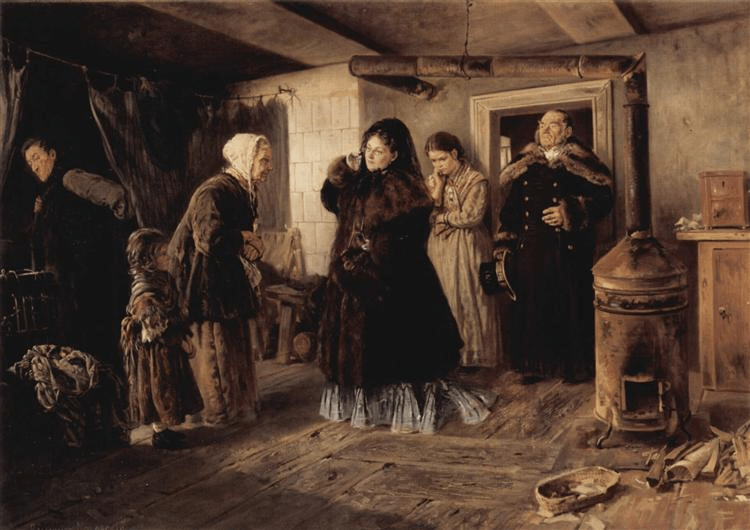
Visiting a Poor People, by Vladimir Makovsky, 1874

The vision of Isaiah son of Amoz, which he saw concerning Judah and Jerusalem in the days of Uzziah, Jotham, Ahaz, and Hezekiah, kings of Judah…

Hear the word of the Lord,
    you rulers of Sodom!
Listen to the teaching of our God,
    you people of Gomorrah!
What to me is the multitude of your sacrifices?
    says the Lord;
I have had enough of burnt offerings of rams
    and the fat of fed beasts;
I do not delight in the blood of bulls
    or of lambs or of goats.

When you come to appear before me,
    who asked this from your hand?
    Trample my courts no more!
Bringing offerings is futile;
    incense is an abomination to me.
New moon and Sabbath and calling of convocation—
    I cannot endure solemn assemblies with iniquity.
Your new moons and your appointed festivals
    my soul hates;
they have become a burden to me;
    I am weary of bearing them.
When you stretch out your hands,
    I will hide my eyes from you;
even though you make many prayers,
    I will not listen;
    your hands are full of blood.
Wash yourselves; make yourselves clean;
    remove your evil deeds
    from before my eyes;
cease to do evil;
    learn to do good;
seek justice;
    rescue the oppressed;
defend the orphan;
    plead for the widow.

Come now, let us argue it out,
    says the Lord:
If your sins are like scarlet,
    will they become like snow?
If they are red like crimson,
    will they become like wool?
If you are willing and obedient,
    you shall eat the good of the land,
but if you refuse and rebel,
    you shall be devoured by the sword,
    for the mouth of the Lord has spoken. (New Revised Standard Version)

Today’s Old Testament lesson is a stout and ancient warning against an age-old problem: Worshiping properly on a high holy day, yet living an evil and unjust life the rest of the days. It’s the mentality of “I give to God what’s required on the Sabbaths and festivals, so I can therefore do what I want the rest of the time, because that’s my stuff and my time.”

Just to be clear: That sort of evil thinking and behavior will raise the ire of the Lord every time. It’s dichotomous messed-up thinking. It’s the wrongheaded notion of believing that my financial and professional success is obviously a validation of God’s blessing upon me.

However, motives of gaining more wealth, rather than being motivated by humility, meekness, righteousness, purity, mercy, and peacemaking, will end badly, no matter who we are.

One of the problems here is an arrogant assumption that we’re right in what we are doing. We feel justified in living a duplicitous life. I have power, authority, and wealth; you do not. Thus, I’m right; you’re wrong; and I can do whatever the heck I want because God is on my side, not yours.

In terms of contemporary Christianity, this is the megachurch mentality: Since there are so many church attenders and money being placed in the offering plates, this is an unquestioned sanction from God of our rightness.

Then, when Sunday passes and Monday comes, both parishioner and pastor feel justified in using their wealth in ways that are inconsistent with the ways and words of Jesus.

Indeed, many times the name of Jesus is rarely (if ever) used in justifications of living the rich life. A blind eye is turned away from the poor and needy. When pressed, far too many parishioners admit to the belief that the poor are underprivileged because of their own personal sin.

Such “Christians” get away with their injustice before God, largely because there is a mass of churchgoers who honor the wealthy and give them places of authority and power.

They think God has shown favor by “blessing” particular people and communities with wealth (because God would never bless someone with poverty!). This can even go so far as to elect a leader of a nation because he is exorbitantly rich. Never mind his daily immorality, meanness, and lying; God has blessed him, right?

Wrong! So says the prophet Isaiah. Judah and Jerusalem, in their hubris, claimed special status. They are God’s people; others are not. They believed they had divine immunity from judgment. After all, only the Judeans worshiped the Lord; all other nations were pagan worshipers.

But their worship and sacrifices, in Isaiah’s day, were offered with no concern for justice and righteousness. So, God called them to repent; and gave them a chance to learn how to please the Lord.

And what pleases God is removing evil and learning to do good.

“Good” is defined by God as seeking to meet the needs of the common people; rescuing those who are oppressed; defending the cause of the orphan, and pleading the case of the widow. There’s no mention of wealth as a sign of divine blessing.

In reality, Judah’s situation before God was pitiful. They failed, even refused, to do justice, love mercy, and walk humbly. Therefore, the Lord called them to repentance and reformation.

Just because Jerusalem had the temple, this sacred space didn’t inoculate the people from judgment. The bald fact of the matter is that the people were living with self-destructive habits of stupidity. And God had enough of it.

In essence, the Lord said to Judah, “Let’s get serious about this.” Despite all the disobedience, God was willing to entertain the people’s change of heart and life – that is, if they themselves were willing to do so.

It’s important for all of us to “have it out with God,” to engage the Lord forthrightly, passionately, intelligently, and realistically.

There are really only two choices: Choose life or choose death. Choose to connect in meaningful, right, good, and just ways with God and neighbor; or choose to disconnect from others and do whatever the heck you want.

Each of our choices impacts what will happen tomorrow and into the future.

Decisions consistent with justice, righteousness, and goodness will ultimately go well for us. Decision-making borne of selfishness, a lack of mercy, and callousness toward others will create all sorts of problems.

Judah’s practical and existential decision came down to whether they wanted a just and productive society, or an invading Assyrian army. Which would you rather have?

To have a public daily life of disrespect and disregard for the needs of others (and of God!) is to invite being up a stinking creek without a paddle, and no one around to hear the yells for help.

Nothing can ever replace good old-fashioned turning away from hate, unforgiveness, bitterness, and pride; and turning toward what is good, right, just, and godly – and then ordering our collective public life around caring for the least and the lost among us.

May it be so, to the glory of God.

God of judgment and grace, you ask not for sacrifices but lives of trusting faith that acknowledge Your power and mercy. Give us a deep belief in Your sovereign goodness, so that we may follow You all the days of our lives, as did Jesus Christ our Savior and Lord. Amen.

The Effects of Bad Decisions (2 Samuel 12:15-25)

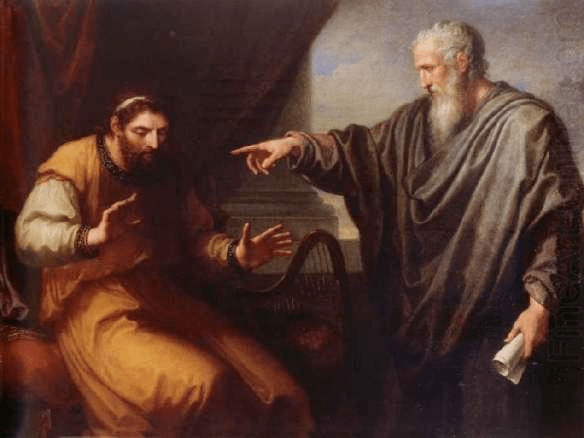
David and Nathan, by Angelika Kauffman (1741-1807)

After Nathan had gone home, the Lord struck the child that Uriah’s wife had borne to David, and he became ill. David pleaded with God for the child. He fasted and spent the nights lying in sackcloth on the ground. The elders of his household stood beside him to get him up from the ground, but he refused, and he would not eat any food with them.

On the seventh day the child died. David’s attendants were afraid to tell him that the child was dead, for they thought, “While the child was still living, he wouldn’t listen to us when we spoke to him. How can we now tell him the child is dead? He may do something desperate.”

David noticed that his attendants were whispering among themselves, and he realized the child was dead. “Is the child dead?” he asked.

“Yes,” they replied, “he is dead.”

Then David got up from the ground. After he had washed, put on lotions and changed his clothes, he went into the house of the Lord and worshiped. Then he went to his own house, and at his request they served him food, and he ate.

His attendants asked him, “Why are you acting this way? While the child was alive, you fasted and wept, but now that the child is dead, you get up and eat!”

He answered, “While the child was still alive, I fasted and wept. I thought, ‘Who knows? The Lord may be gracious to me and let the child live.’ But now that he is dead, why should I go on fasting? Can I bring him back again? I will go to him, but he will not return to me.”

Then David comforted his wife Bathsheba, and he went to her and made love to her. She gave birth to a son, and they named him Solomon. The Lord loved him; and because the Lord loved him, he sent word through Nathan the prophet to name him Jedidiah. (New International Version)

The backstory to today’s Old Testament lesson is that King David not only screwed up, but he also jumped off the diving board into a big nasty pool of immoral excrement.

He saw a woman, Bathsheba, and had to have her. Thinking of only his desire, and not her needs, or that she was a married woman, he used his royal authority to get her. And he slept with her. What’s more, she became pregnant by the king.

At that point, David went to the dark side by covering up his immorality and shame. He eventually went so far as to ensure that Bathsheba’s husband, Uriah (who was both an upright man and an innocent victim) was killed in battle. The king again used his authority to arrange a murder to look like a death in military battle.

With Uriah dead, David brought Bathsheba to his palace as another one of his wives. And no one was the wiser… Except God, who was very displeased with the entire affair. So, the Lord sent Nathan the prophet to David. Through the savvy use of parable, Nathan was successful in helping the king to see his own terrible guilt.

To King David’s credit, he came to the point of recognizing his great faults, and repented of his awful doings. And to God’s credit, David was forgiven.

However, despite the reality of repentance and forgiveness, there are still consequences to our actions. And what is heartbreaking, is that the effects of our bad decisions and bad actions can and do affect others.

As a result of one man’s sin, a woman was violated, a man was murdered, and a baby was conceived, born, and soon died.

Bathsheba attends to her child as David fasts and prays, by W.A. Foster, 1897

King David came to the point of understanding this reality. True repentance, forgiveness, and faith, leads us to a real life which exudes genuineness and authenticity. It won’t undo the past; yet, it will affect the present, and can change the future – that is, if we let mercy and grace have its way.

David’s genuine fatherly love came from his restored place, and was shown by his authentic grieving and mourning. He did not want Bathsheba’s baby son to die. Yet, the child did die. Unfortunately, innocent people often become collateral damage because of another’s unthinking actions.

The king’s behavior, after the child died, shows his pained acceptance of the situation. And his consoling of Bathsheba is the first real evidence we have of David thinking of her instead of himself.

The story reassures us that God loves the next child born from Bathsheba and David. This baby (the future King Solomon) will not pay for his father’s crimes; nor will any other child that David fathers.

The typical trajectory of David’s life was to learn from God’s law and from the experiences God gave him. Yet, in the case of Bathsheba and Uriah, King David ended up learning the hard way that he could not rest on his laurels once he was in a secure and successful place in his life.

Maybe because David spent so much of his adult life facing life-and-death situations, that once he could relax a bit and not have to worry about his life, he let his spiritual and emotional guard down and fell into sin.

After committing adultery, David found himself in a spiritual and emotional place he had never been in before. Yet, instead of confessing his crime to God and making things right with Bathsheba and Uriah, he worked to cover up everything.

Specifically, shame is the place that David had never experienced before, at least to this degree. And when shame gets its poisonous talons into us, it is very hard to be open, real, genuine, and authentic.

In an effort to keep the secrets, the lies morph into more bad decisions, and more bad decisions become ever-increasing bad actions. It becomes a downward spiral of icky guilt which will never be assuaged apart from the divine tools of confession, repentance, faith, and reconciliation.

I trust and hope that it will not take a prophet like Nathan to show you and I how egregious some of our decisions and actions actually are.

Instead, we can make the daily decision to practice our spiritual disciplines, so that when we find ourselves in that good position of no longer having to fight for survival, we will be able to exercise wisdom from the largess of God’s grace which fills us.

Have mercy on me, O God,
    according to your unfailing love;
according to your great compassion
    blot out my transgressions.
Wash away all my iniquity
    and cleanse me from my sin. Amen. (Psalm 51:1-2, NIV)

Who Are We Listening To? (Jeremiah 23:9-22)

My head is reeling,
    my limbs are limp,
I’m staggering like a drunk,
    seeing double from too much wine—
And all because of God,
    because of his holy words.

Now for what God says regarding the lying prophets:

“Can you believe it? A country teeming with adulterers!
    faithless, promiscuous idolater-adulterers!
They’re a curse on the land.
    The land’s a wasteland.
Their unfaithfulness
    is turning the country into a cesspool,
Prophets and priests devoted to desecration.
    They have nothing to do with me as their God.
My very own Temple, mind you—
    mud-spattered with their crimes.” God’s Decree.
“But they won’t get by with it.
    They’ll find themselves on a slippery slope,
Careening into the darkness,
    somersaulting into the pitch-black dark.
I’ll make them pay for their crimes.
    It will be the Year of Doom.” God’s Decree.

“Over in Samaria I saw prophets
    acting like silly fools—shocking!
They preached using that no-god Baal for a text,
    messing with the minds of my people.
And the Jerusalem prophets are even worse—horrible!—
    sex-driven, living a lie,
Subsidizing a culture of wickedness,
    and never giving it a second thought.
They’re as bad as those wretches in old Sodom,
    the degenerates of old Gomorrah.”

So, here’s the Message to the prophets from God-of-the-Angel-Armies:

“I’ll cook them a supper of maggoty meat
    with after-dinner drinks of strychnine.
The Jerusalem prophets are behind all this.
    They’re the cause of the godlessness polluting this country.”

A Message from God-of-the-Angel-Armies:

“Don’t listen to the sermons of the prophets.
    It’s all hot air. Lies, lies, and more lies.
They make it all up.
    Not a word they speak comes from me.
They preach their ‘Everything Will Turn Out Fine’ sermon
    to congregations with no taste for God,
Their ‘Nothing Bad Will Ever Happen to You’ sermon
    to people who are set in their own ways.

“Have any of these prophets bothered to meet with me, the true God?
    bothered to take in what I have to say?
    listened to and then lived out my Word?
Look out! God’s hurricane will be let loose—
    my hurricane blast,
Spinning the heads of the wicked like tops!
    God’s raging anger won’t let up
Until I’ve made a clean sweep,
    completing the job I began.
When the job’s done,
    you’ll see that it’s been well done.

“I never sent these prophets,
    but they ran anyway.
I never spoke to them,
    but they preached away.
If they’d have bothered to sit down and meet with me,
    they’d have preached my Message to my people.
They’d have gotten them back on the right track,
    gotten them out of their evil ruts. (The Message)

Jeremiah had a hard gig as a prophet of the Lord. And what made it especially difficult was the continual stream of false prophets, preaching their “everything will turn out just fine” sermons in the face of economic injustice, social unrighteousness, emotional denial, and spiritual adultery.

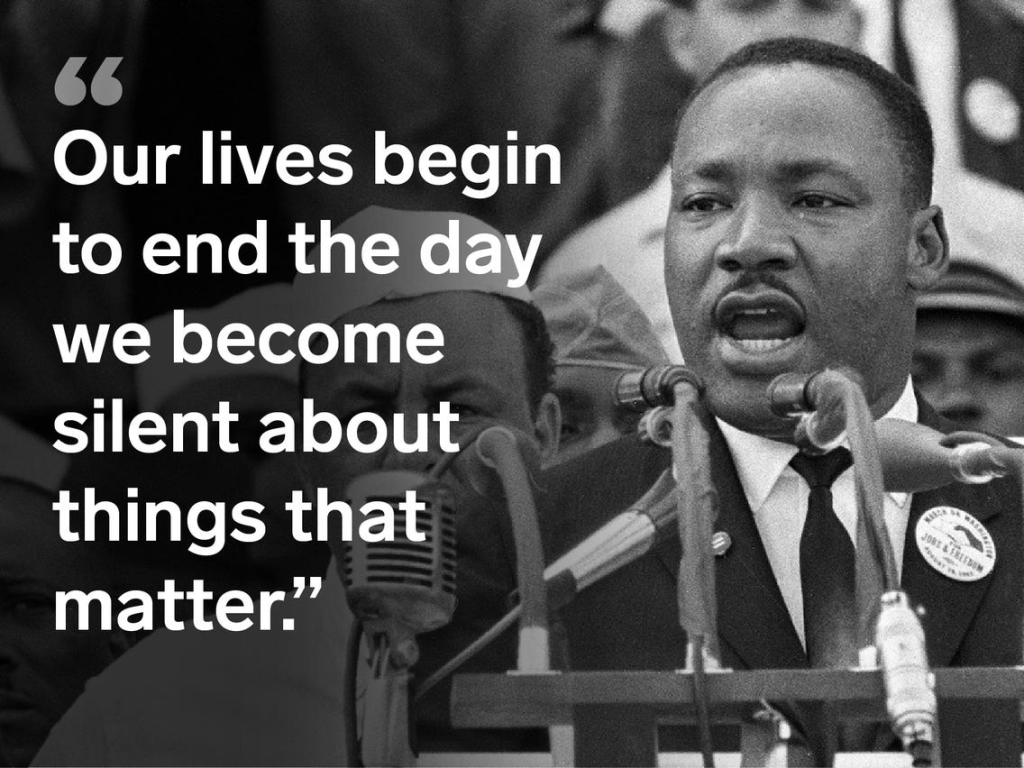
Methinks that Martin Luther King, Jr. must have felt a kinship with the prophet Jeremiah. After all, he was much like a modern-day prophet. In word and deed, he kept asking people to close the distance between the values they espoused and their actual behavior. 

The terrible treatment King and his allies received during the civil rights movement through non-violent marches and demonstrations, brought-out the awful gap between espoused American values of freedom, fairness, and tolerance, and the reality that Blacks really did not possess these in any manner close to the white population. 

Every prophetic ministry compels people to come face-to-face with the disparity between beliefs and behaviors.

Jeremiah knew all about the gulf between expressed values and actual conduct. And he faced a very large chasm between the two. 

Like Reverend King, Jeremiah was imprisoned, had rocks thrown at him, and was jeered for his message of calling people to live up to God’s agenda for humanity. 

White supremacy, or at least white privilege, was taken for granted in much of America before King. In the same way, Israelite privilege was taken for granted in Jerusalem, in Jeremiah’s day. Unfaithful prophets kept proclaiming Jewish supremacy and insisted that the Lord would be on their side of things. 

But the Lord insisted that these supposed prophets have neither attended a meeting of any divine council in heaven nor ever heard God speak to them.

I urge you, brothers and sisters, to keep an eye on those who create dissensions and hindrances, in opposition to the teaching that you have learned; avoid them. For such people do not serve our Lord Christ but their own appetites, and by smooth talk and flattery they deceive the hearts of the simple-minded. (Romans 16:17-18, NRSV)

The spirit of the age simply accepted power, privilege, and pedigree as the norm that ought to always endure. But God thinks differently about it. And so, the Lord sends prophets to call people back to justice, righteousness, and peace for the benefit of all persons.  

The zeitgeist of our own age is one of turmoil, uncertainty – and even chaos, violence, and death. We have our own contemporary self-appointed prophets who proclaim peace where there is no peace; safety, at the expense of others’ protection; militant forms of xenophobia; and an American exceptionalism which places a thin veneer of respectability over the graves of dead people’s bones.

The Lord will not contend with this forever.

An exercise in healthy introspection would be to consider these questions:

  • What are our most cherished values?
  • Where did we get them? Who are we listening to?
  • Are they God’s values? 
  • Who is really in control as the arbiter of values?
  • How might godly values of justice, righteousness, and peace be expressed in our everyday actions and behaviors?
  • Will we seek to engraft such values into our organizations, systems, faith communities, neighborhoods, and governments?
  • Can we work together in humility?
  • Do we have the courage to change, to share power, and to seek the common good of all persons?

Lord, have mercy, and grant us your peace.

All-Seeing God, you know the true state of every heart and every people group. Do your work of making me holy in all I do and say so that your values, and the words and ways of Jesus, might be expressed through me in the power of the Holy Spirit. Amen.

Proverbs 4:1-9 – Pay Attention to Wisdom

Listen, children, to a father’s instruction,
and pay attention so that you may gain discernment.
Because I hereby give you good instruction,
do not forsake my teaching.

When I was a son to my father,
a tender, only child before my mother,
he taught me, and he said to me:
“Let your heart lay hold of my words;
keep my commands so that you will live.
Acquire wisdom, acquire understanding;
do not forget and do not turn aside from the words I speak.
Do not forsake wisdom, and she will protect you;
love her, and she will guard you.
Wisdom is supreme—so acquire wisdom,
and whatever you acquire, acquire understanding!
Esteem her highly and she will exalt you;
she will honor you if you embrace her.
She will place a fair garland on your head;
she will bestow a beautiful crown on you.” (New English Translation)

Pay Attention to Instruction

Once, when I was a kid growing up on the farm, I was playing hide-and-seek with my brother and got lost in a cornfield. The stalks were taller than me, and I couldn’t jump up and try to see over them. I started to panic.

Then, I got my wits about me and looked straight up into the sky. Even though I was only seven or eight years old, I had looked up at the sky a bajillion times in my short lifetime. My dad had taught me how to read the sky and the weather above us. Fortunately, I had listened well and paid attention to all those times we looked up together.

I knew that the position of the sun in the bright blue sky would give me a fixed point of direction. Once I did that, I walked in the direction I was certain would take me out of the cornfield, trying not to let fear take hold of me. In no time at all, I was out. I lost the game of hide-and-seek. But I didn’t care.

Wisdom is personified in the book of Proverbs as a sage woman and a discerning counselor for whom we must hear and heed her advice. 

In the Old Testament, wisdom is the practical daily application of knowledge and understanding. It’s the ability to take the knowledge of God and use it in everyday life in a way that leads to human peace, contentment, and flourishing. There are two important aspects to wisdom. 

Pay Attention to Knowledge

First, the individual must possess some body of knowledge. If we are ignorant (without knowledge) then we have no ability to exercise wisdom. More than once, I rescued cousins and friends from the cornfield while playing hide-and-seek, because they didn’t have the same understanding of the sky that I did.

So, it’s absolutely imperative for us to actively seek understanding. It’s not going to simply drop into our lap. We must purposely strive to look up and see the Son, to view life from God’s perspective, and to put ourselves in another person’s shoes. 

To gain wisdom, we must become readers, listeners, and devoted learners. Why? Because without books to read, without spiritual directors to consult and listen to, and without adopting the humble posture of learning from others, we will never realize wisdom.

The telltale sign of one who fails to read, listen, and learn, is that they continually opine on everything with no evidence to back up their opinions, no insight into the human condition, and no grace in their language. In the book of Proverbs, such as a person is labeled the “fool.”

Pay Attention to Behavior

The second aspect to wisdom is that the individual must use the acquired knowledge to have good behavior and to live well. 

Knowledge by itself, apart from actual practical use, only produces puffed-up pride (1 Corinthians 8:1). The reason for accumulating understanding is to use it for the welfare of others, for the benefit of the common good. 

We have quite enough preening peacocks in this world who have answers for every earthly problem under the sun. This world needs much less of them, and more of those who seek the humility that comes from biblical wisdom. As the Apostle James in the New Testament once put it, we must be doers of the Word and not hearers only (James 1:22).

Wisdom is realized whenever there is learning that has come through both the head and the hands. Proverbs is a very good place to begin constructing a life of wisdom. Reading one chapter a day, for one month, will get you through the entire book. 

Make a wise plan to carefully go through Proverbs sometime this spring or summer. You’ll be glad you did. And so will those around you.

Pay Attention to Prayer

God of all wisdom, save me from pride and arrogance, and take me to the place where Christ’s humility is center stage, where I’m lifting up clean hands and a pure heart to you.

Spirit of discernment, take me to the place where I’m no longer looking with panic or anxiety at the cornfields and situations I face, but look up to you, where I can see clearly, and my decisions are flooded with your bright light, truth, and justice.

Jesus, teacher of all that is right and good, I submit to your instruction and humbly seek to live into your words and ways. I keep my ears open to receive your counsel, my heart open to receive your eternal wisdom, and my eyes open to see your risen and ascended glory.

Just, right, and wise God – Father, Son, and Spirit, the God whom I serve – know that I love wisdom. I desire it more than money, fame, or power. Help me to use biblical common sense, spiritual savvy, and Scriptural discernment so that I might learn the good and the beautiful. Amen.