
The Irony of Christ’s Followers (Mark 10:32-34, 46-52)

A 10th century depiction of Christ healing a blind man

The disciples were confused as Jesus led them toward Jerusalem, and his other followers were afraid. Once again, Jesus took the twelve disciples aside and told them what was going to happen to him. He said:

We are now on our way to Jerusalem where the Son of Man will be handed over to the chief priests and the teachers of the Law of Moses. They will sentence him to death and hand him over to foreigners, who will make fun of him and spit on him. They will beat him and kill him. But three days later he will rise to life….

Jesus and his disciples went to Jericho. And as they were leaving, they were followed by a large crowd. A blind beggar by the name of Bartimaeus son of Timaeus was sitting beside the road. When he heard that it was Jesus from Nazareth, he shouted, “Jesus, Son of David, have pity on me!” Many people told the man to stop, but he shouted even louder, “Son of David, have pity on me!”

Jesus stopped and said, “Call him over!”

They called out to the blind man and said, “Don’t be afraid! Come on! He is calling for you.” The man threw off his coat as he jumped up and ran to Jesus.

Jesus asked, “What do you want me to do for you?”

The blind man answered, “Master, I want to see!”

Jesus told him, “You may go. Your eyes are healed because of your faith.”

At once the man could see, and he went down the road with Jesus. (Contemporary English Version)

“Irony” and “ironic” are terms describing when an outcome of an event is contrary or different from what would be expected.

Here are a few examples of irony: The firehouse burnt down. The police officer got arrested. When I was a kid, my family physician’s name was Dr. Fail (really!). There is an overarching ironic lesson to our Gospel story today:

The people following Jesus with 20/20 vision were spiritually blind.

Their great need is the same as blind Bartimaeus: To have their eyes opened to Jesus and to what God was doing around them. Bartimaeus was marvelously and miraculously given sight by Jesus – the others, however, remained unchanged and in the dark. 

Irony #1: Many followed Jesus, but only a few were his followers.

All kinds of people physically followed Jesus around for various reasons while he was here on this earth. Some wanted to bask in the latest celebrity buzz that Jesus generated. Others wanted to see the cool stuff Jesus did, like healing people. Some were plain curious. And a few were interested in being like Jesus by showing selfless compassion.

Jesus continually sought to press the crowd following him into spiritual seekers who would learn to follow his teaching.

Many people conform to the group and go with the flow. That’s great if the crowd is good, and not so good if they’re going in a bad direction.

In the Old Testament, a few unruly complainers got the Israelites stirred up. The result was making a golden calf and turning away from God. Sometimes it is right and necessary to go against the crowd.

Irony #2: Out of all Christ’s followers, it is a blind man that sees Jesus for who he is: The Son of David.

Bartimaeus discerned it was Messiah who was walking by him. So, he went against the crowd and shouted to Jesus. Blind Bartimaeus didn’t care how he looked to others; it didn’t matter to him that he stuck out like a sore thumb to all the spiritually blind people.

Jesus often avoided crowds. Most of his earthly life occurred away from the centers of power and influence. Jesus swam upstream of the prevailing notions of righteousness. Christ did not cow-tow to the crowd. Instead, he paid attention to the needy and forgotten.
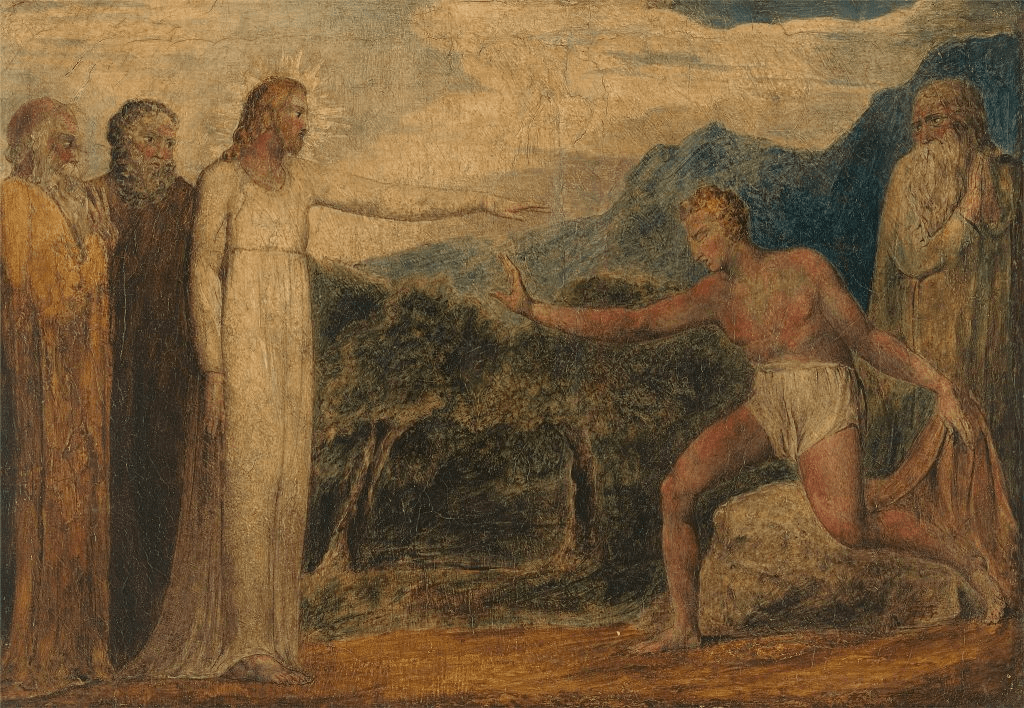
Christ Giving Sight to Bartimaeus, by William Blake (1757-1827)

And while in a large group of people, Jesus did not “work the crowd” to get ahead and further his agenda. He did not cozy-up to the rich and powerful. And Christ deliberately avoided celebrity status. Jesus showed extraordinary love to an overlooked person. He used his immense power for one powerless person.

Irony #3: The ones following Jesus were the ones trying to keep a blind man from Jesus.

One irony of the church is that Christ’s own followers can be the biggest obstacle to others following him.

I can just imagine a group of gossipy church folk shushing Bartimaeus: “Don’t bother Jesus, he is such a busy man! He has important work to do!” I can also picture them standing next to blind Bartimaeus saying, “Just stop, man, you’re embarrassing yourself.” 

But Bartimaeus would not stop. He shouted all the louder. That’s because true and genuine faith is a needy person crying out in desperation for Jesus to help.

Jesus asked a beautiful question: “What do you want me to do for you?”

“I want to see,” Bartimaeus responded. So, Jesus had compassion on him, and gave him his sight. Here we have two men, Jesus and Bartimaeus, ignoring all the people around them, and having a divine encounter.

This encounter raises my curiosity as to why it is so hard for us to simply say what we want.

It could be that we don’t want to buck the crowd, or to look different. Maybe we don’t want to admit our need in front of others. So, we simply stick to superficial conversations and insist that everything is okay, when it isn’t.

Jesus said, concerning the crowd, “Although they see, they don’t really see.” (Matthew 13:13)

If we are concerned about how we are seen by others, we will not be seen by God; we will miss Jesus when he walks by, right in front of us.

Conclusion

How might we raise our ability to see Jesus and truly follow him as he desires us to?

Listen to Jesus

Jesus was headed to Jerusalem and had a lot on his mind and heart with anticipating his passion and death. Christ became attentive to Bartimaeus, out of all the people around him, because he was listening.

If we want to see Jesus and follow him, we must be listeners,  and be attentive to compassion, like Jesus, to the needy and lowly among us. 

I recently read a story from a Christian who lived during Nazi Germany. He said:

“I considered myself a Christian. We heard stories of what was happening to the Jews, but we tried to distance ourselves from it, because what could anyone do to stop it? A railroad track ran behind our small church, and each Sunday morning we could hear the whistle in the distance and then the wheels coming over the tracks.

“We became disturbed when we heard the cries coming from the train as it passed by. We realized it was carrying Jews like cattle in the cars! Week after week the whistle would blow. We dreaded to hear those wheels because we knew we would hear the cries of the Jews in route to a death camp. Their screams tormented us.

“So, when we heard the whistle blow, we began singing hymns. By the time the train came past our church, we were singing at the top of our voices. If we heard the screams, we sang more loudly, and soon we heard them no more.

“Years have passed, and no one talks about it anymore. But I still hear that train whistle in my sleep. God forgive me. Forgive all of us who called ourselves Christians yet did nothing to intervene.” 

Respond to Jesus

Once Jesus listened, he responded by asking a question. Christ took the time to heal Bartimaeus.

Jesus could have simply healed him without even stopping. He could have started a healing factory where everyone with a need just moved through a line and got healed. But Jesus was doing more than giving sight; he was giving a blessing – the blessing of time and relationship.

The gospel is personal, which is why we ought to resist being non-relational in ministry to others.

Christian ministry is about blessing other people with the gift of relationship. It begins with recognizing self as the one who needs Jesus; and it starts with having our own eyes opened to see our own need, and then the great need of people around us.

God of all compassion, I confess that it is natural for me to do things my way. I recognize that I am limited, but that you know all things. I yield my spiritual eyesight to you so that my spiritual vision will be clear. Jesus Christ came to give sight to the blind and to open our eyes. I commit my ways to you so that I can see your ways and not just my own. Amen.

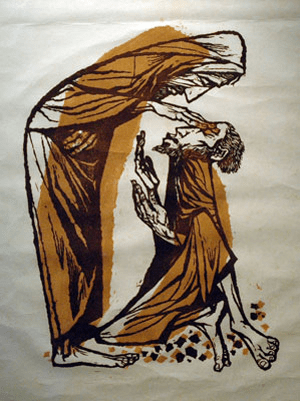
Lord, Have Mercy (Mark 10:46-52)

“Christ Healing the Blind Man” by Robert Hodgell

Then they came to Jericho. As Jesus, his disciples, and many people were leaving Jericho, a blind beggar named Bartimaeus, son of Timaeus, was sitting by the road. When he heard that Jesus from Nazareth was passing by, he began to shout, “Jesus, Son of David, have mercy on me!”

The people told him to be quiet. But he shouted even louder, “Son of David, have mercy on me!”

Jesus stopped and said, “Call him!” They called the blind man and told him, “Cheer up! Get up! He’s calling you.” The blind man threw off his coat, jumped up, and went to Jesus.

Jesus asked him, “What do you want me to do for you?”

The blind man said, “Teacher, I want to see again.”

Jesus told him, “Go, your faith has made you well.”

At once he could see again, and he followed Jesus on the road. (God’s Word Translation)

“I’d like to live my life so close to the bottom that when the system collapses I don’t have far to fall.” Dorothy Day

This is one of my very favorite stories in the entirety of Holy Scripture. And I will tell you why….

Because Jesus listens with ears of mercy

Jesus was headed to Jerusalem and had a lot on his mind and his heart. He knew what was coming, that his passion and death awaited him. No one would fault Jesus for not hearing a blind man shouting. But Jesus was listening so that he might hear someone just like the needy blind man. Rather than being distracted and lost in his head, Jesus was just the opposite – being attentive and aware of the humble folk right in front of him.

The Lord is always and continually listening for honesty and vulnerability. His ears of mercy are specially tuned, even today, for those who cry out to him from a place of genuine openness and humility.

Because Jesus speaks with words of mercy

Once Jesus listened, he responded by asking a question. I am impressed with Jesus throughout the Gospels. Christ gave people the gift of choice. He acknowledged people and respected them by not simply and indiscriminately healing, as if he were some fix-it guy. Jesus Christ bestowed on the lowliest of people the human dignity of choice by empowering them to answer a question.

Whereas everyone around Bartimaeus was looking down on him, both literally and figuratively, Jesus granted him the gift of dignity and basic human kindness – which are gifts we can all bestow on one another.

Because Jesus pays attention with a divine appointment of mercy

Our Lord took the time to heal blind Bartimaeus. Jesus could have simply healed him without even stopping his journey. He could have just waved his hand and the man would be healed. What’s more, Jesus could have even started a healing factory where everyone with a need got healed: bring ‘em in, move ‘em out, and keep the line moving!

Jesus was doing more than giving sight; he was giving a man the blessing of time and personal attention. The Gospel is never impersonal, which is why we ought to resist being non-relational in ministry to others. Christian ministry isn’t simply about meeting a need; it’s about blessing other people with the gift of relationship.

Coptic Church icon of Christ healing the blind man

Because Jesus reaches out with the touch of mercy

Jesus touched the man’s eyes (included in Matthew 20:29-34). He didn’t have to do that. The Lord of all most certainly could have healed without touching. In fact, it most likely may have been downright gross. A lot of people had eye diseases with runny pussy eyes in the ancient world.

Because the blind man didn’t listen to the crowd

I really love that! Maybe it’s the rebel in me. I just believe it is such a beautiful thing whenever someone refuses to be shamed by another and embraces their need. That is exactly what the blind man did. He not only refused to give-in to peer pressure, but he also responded to them by shouting all the louder. May his tribe increase!

Blind Bartimaeus teaches us that, when we know Love is there, we can freely acknowledge our needs, our wants, and our pain. With Jesus, who is Love incarnate, it doesn’t matter what anyone else thinks around us; there is no pretense, no propping up a false self to present for others to see. The true self is able to express what is really on the inside.

Because the blind man could actually see

In truth, Bartimaeus already had sight – not physical sight but spiritual eyes which could see better than anyone else in the crowd. One of the great ironies throughout the Gospels is that the sighted crowd seems to never see who Jesus really is, while blind folk see Christ clearly for who he is: the Son of David, the rightful king, the Savior of all.

It matters not how much faith one possesses; but it very much matters in whom that faith is placed. A thimble-full of faith is enough to move mountains, whereas a water tower full of misplaced faith in someone else cannot even provide a single glass of refreshment.

Because the blind man followed Jesus

Throughout the healing ministry of Jesus, there were plenty of persons who simply walked away and went about their lives after receiving what they desired. Yet, Bartimaeus, now given the gift of physical sight, immediately started following Jesus on the road.

This account feels a lot like my own testimony of experiencing the love of God in Christ and not ever wanting to leave it. So, I’ve been following Jesus for over forty years, still profoundly grateful in my heart for the One who loves and heals.

Because one lowly non-descript blind man made a difference

I don’t think Bartimaeus ever set out to change the world. And yet, he did. Here we are reading his testimony all these millennia later. One person, becoming a simple follower of Jesus and living a life of discipleship, changes a crowd from being a group of shushing church ladies to a robust throng of worshipers.

One individual makes a difference. Don’t let anyone tell you otherwise.

Lord Jesus Christ, Son of God, have mercy on me, a sinner.

Lord Jesus Christ, Son of David, heal me, a broken person.

Lord Jesus Christ, Son of Man, help me, a lost and lonely individual.

Lord have mercy, Christ have mercy, Lord have mercy on my love-starved soul and grant me your peace.

Amen.

Mark 10:32-34, 46-52 – The Irony of Following Jesus

Jesus healing blind Bartimaeus by Johann Heinrich Stöver, 1861. St John’s Church, Hesse, Germany

They were on their way up to Jerusalem, with Jesus leading the way, and the disciples were astonished, while those who followed were afraid. Again, he took the Twelve aside and told them what was going to happen to him. “We are going up to Jerusalem,” he said, “and the Son of Man will be delivered over to the chief priests and the teachers of the law. They will condemn him to death and will hand him over to the Gentiles, who will mock him and spit on him, flog him and kill him. Three days later he will rise….”

Then they came to Jericho. As Jesus and his disciples, together with a large crowd, were leaving the city, a blind man, Bartimaeus (which means “son of Timaeus”), was sitting by the roadside begging. When he heard that it was Jesus of Nazareth, he began to shout, “Jesus, Son of David, have mercy on me!”

Many rebuked him and told him to be quiet, but he shouted even more, “Son of David, have mercy on me!”

Jesus stopped and said, “Call him.”

So, they called to the blind man, “Cheer up! On your feet! He’s calling you.” Throwing his cloak aside, he jumped to his feet and came to Jesus.

“What do you want me to do for you?” Jesus asked him.

The blind man said, “Rabbi, I want to see.”

“Go,” said Jesus, “your faith has healed you.” Immediately he received his sight and followed Jesus along the road. (NIV)

“Irony” and “ironic” are terms describing when an outcome of an event is contrary or different from what would be expected. Here are a few examples of irony: The firehouse burnt down. The police officer got arrested. When I was a kid, my family physician’s name was Dr. Fail (really!).

There is an overarching ironic lesson to our Gospel story today. The people following Jesus with 20/20 vision are spiritually blind. Their great need is the same as blind Bartimaeus: to have their eyes opened to Jesus and to what God was doing around them. Bartimaeus was marvelously and miraculously given sight by Jesus – the others, however, remained unchanged and in the dark. 

Irony #1: Many followed Jesus, but only a few were his followers.

All kinds of people physically followed Jesus around for all kinds of reasons while he was here on this earth.  Some wanted to bask in the latest celebrity buzz that Jesus generated. Others wanted to see all the cool stuff Jesus did, like healing people. Some were plain curious. And a few were interested in being like Jesus by showing selfless compassion. Jesus continually sought to press the crowd following him into authentic disciples who would follow his teaching.

Many people desire to conform and go with the flow. That’s great if the crowd is good, and not so good if the group is going in a bad direction. In the Old Testament, a few unruly complainers got the Israelites all stirred up with the result of making a golden calf and turning away from God. However, sometimes it is right and necessary to go against the crowd, which leads us to the next irony….

Irony #2: Out of all Christ’s followers, it is a blind man that sees Jesus for who he is, the Son of David.

Spiritual blindness afflicted many people, yet Bartimaeus discerned it was Messiah who was walking by him. So, he went against the crowd and shouted to Jesus. Blind Bartimaeus didn’t care how he looked to others, and it didn’t matter to him that he stuck out like a sore thumb. 

Sometimes we might forget that Jesus often avoided crowds, and that most of his life occurred away from the centers of power and influence. Jesus swam upstream of the prevailing notions of righteousness. Christ did not cow-tow to the crowd, but instead, paid attention to those in need and forgotten by others. Jesus did not “work the crowd” to get ahead and further his agenda. He did not cozy-up to the rich and powerful. And he deliberately avoided celebrity status. Jesus showed extraordinary love to an overlooked person. He used his immense power for one powerless person.

Irony #3: The ones following Jesus were the ones trying to keep a blind man from Jesus.

It seems to me one of the ironies about the church is that Christ’s own followers can be the greatest obstacle to others following him. I can imagine a group of gossipy church folk shushing Bartimaeus: “Don’t bother Jesus, he is such a busy man! He has important work to do!” I can also picture them standing next to blind Bartimaeus saying, “Just stop, man, you’re embarrassing yourself.” 

But Bartimaeus would not stop. He shouted all the louder. True and genuine faith is a needy person crying out in desperation for Jesus to help. Jesus asked a beautiful question: “What do you want me to do for you?”  “I want to see,” Bartimaeus responded. So, Jesus had compassion on him and gave him his sight. Here we have two men, Jesus and Bartimaeus, ignoring all the people around them, and having a divine encounter.

This all makes me wonder why it is so hard for us to simply say what we want. It could be that we don’t want to buck the crowd, or to look different. Maybe we don’t want to admit our need in front of others. So, we just stick to superficial conversations and insist that everything is okay, when it isn’t.

Jesus said, concerning the crowd, “Although they see, they don’t really see.” (Matthew 13:13) If we are concerned about how we will be seen by others, we will likely not be seen by God, and will miss Jesus when he walks right in front of us.

Conclusion

How might we raise our ability to see Jesus and truly follow him as he desires us to?

Listen to Jesus. Jesus was headed to Jerusalem and had a lot on his mind and heart with anticipating his passion and death. What made Christ attentive to Bartimaeus out of all the people around him was that he was listening. If we want to see Jesus and follow him, we must be listeners and attentive to compassion, like Jesus, to the needy and lowly among us. 

I recently read a story from a Christian who lived during Nazi Germany. He said, “I considered myself a Christian. We heard stories of what was happening to the Jews, but we tried to distance ourselves from it, because what could anyone do to stop it? A railroad track ran behind our small church, and each Sunday morning we could hear the whistle in the distance and then the wheels coming over the tracks. We became disturbed when we heard the cries coming from the train as it passed by. We realized it was carrying Jews like cattle in the cars! Week after week the whistle would blow. We dreaded to hear those wheels because we knew we would hear the cries of the Jews in route to a death camp. Their screams tormented us. So, when we heard the whistle blow, we began singing hymns. By the time the train came past our church, we were singing at the top of our voices. If we heard the screams, we sang more loudly, and soon we heard them no more. Years have passed, and no one talks about it anymore. But I still hear that train whistle in my sleep. God forgive me. Forgive all of us who called ourselves Christians yet did nothing to intervene.” 

Respond to Jesus. Once Jesus listened, he responded by asking a question. Christ took the time to heal Bartimaeus. Jesus could have simply healed him without even stopping. He could have even started a healing factory where everyone with a need just moved through a line and got healed. Jesus was doing more than giving sight; he was giving a blessing – the blessing of time and relationship.

The gospel is personal, which is why we ought to resist being non-relational in ministry to others. It’s about more than meeting a physical need. It is about blessing other people with the gift of relationship. It begins with recognizing self as the one who needs Jesus. It starts with having our own eyes opened to see our own need and then the great need of people around us.

God of all compassion, I confess that it is natural for me to do things my way. I recognize that I am limited, but that you know all things. I yield my spiritual eyesight to you so that my spiritual vision will be clear. Jesus Christ came to give sight to the blind and to open our eyes. I commit my ways to you so that I can see your ways and not my own. Amen.
