Access to God (Exodus 24:1-11)

Moses on Mount Sinai, by Jean-Leon Gerome, Moses on Mount Sinai, 1895

Then the Lord said to Moses, “Come up to the Lord, you and Aaron, Nadab and Abihu, and seventy of Israel’s elders, and worship from a distance. Only Moses may come near to the Lord. The others shouldn’t come near, while the people shouldn’t come up with him at all.”

Moses came and told the people all the Lord’s words and all the case laws. All the people answered in unison, “Everything that the Lord has said we will do.” Moses then wrote down all the Lord’s words. He got up early in the morning and built an altar at the foot of the mountain. He set up twelve sacred stone pillars for the twelve tribes of Israel. He appointed certain young Israelite men to offer entirely burned offerings and slaughter oxen as well-being sacrifices to the Lord. Moses took half of the blood and put it in large bowls. The other half of the blood he threw against the altar. Then he took the covenant scroll and read it out loud for the people to hear. They responded, “Everything that the Lord has said we will do, and we will obey.”

Moses then took the blood and threw it over the people. Moses said, “This is the blood of the covenant that the Lord now makes with you on the basis of all these words.”

Then Moses and Aaron, Nadab and Abihu, and seventy elders of Israel went up, and they saw Israel’s God. Under God’s feet there was what looked like a floor of lapis-lazuli tiles, dazzlingly pure like the sky. God didn’t harm the Israelite leaders, though they looked at God, and they ate and drank. (Common English Bible)

Mount Sinai, by Shlomo Katz (1937-1992)

We all know the experience of taking something for granted. Over time, we might fail to appreciate what we truly have and the privilege we enjoy – particularly when it comes to the spiritual life.

In Christianity, believers are invited to come boldly before God in order to receive grace and help in a time of need, because we have been granted access by means of Christ’s blood. (Hebrews 4:16)

What we may, however, lose sight of is that the ability to do this was achieved at a great cost.

For anyone to approach God, there are some things which need to be in place. Getting near to the Lord, without provision for it to happen, is like looking directly into the sun on a cloudless day and expecting to observe it. Some major filtering needs to occur if we’re going to gaze at the sun.

In today’s Old Testament lesson, God makes it possible for the ancient Israelites to come near and enjoy a special relationship with the divine by establishing a covenant. The Lord put everything in place which was needed for an ongoing divine/human connection.

There was a ratification ceremony of this covenant relationship, involving blood, pledges to obey the moral and ethical Law, and a singular devotion and commitment to God alone. It was all topped-off with a meal, eating and drinking in the presence of Yahweh their God. Every ritual was highly symbolic of establishing a tight link between God and God’s covenant people.

Who may ascend the mountain of the Lord?
    Who may stand in his holy place?
The one who has clean hands and a pure heart,
    who does not trust in an idol
    or swear by a false god. (Psalm 24:3-4, NIV)

The trouble is that we cannot make ourselves pure in order to approach a perfectly pure and holy Being. God comes to humanity in waves – over the years, centuries, and millennia – so that we might become ever more close and intimate, as in the original relationship in the Garden.

All of the Law, the sacrifices, and the experiences at the mountain, pointed forward to a much greater fulfillment of the divine/human relationship.

“The days are coming,” declares the Lord,
    “when I will make a new covenant
with the people of Israel
    and with the people of Judah.
It will not be like the covenant
    I made with their ancestors
when I took them by the hand
    to lead them out of Egypt,
because they broke my covenant,
    though I was a husband to them,”
declares the Lord.
“This is the covenant I will make with the people of Israel
    after that time,” declares the Lord.
“I will put my law in their minds
    and write it on their hearts.
I will be their God,
    and they will be my people.
No longer will they teach their neighbor,
    or say to one another, ‘Know the Lord,’
because they will all know me,
    from the least of them to the greatest,”
declares the Lord.
“For I will forgive their wickedness
    and will remember their sins no more.” (Jeremiah 31:31-34, NIV)

This new covenant finds its focus, according to the New Testament, in the person and work of Jesus Christ. Now, the ultimate access and approachability is accomplished by means of the suffering, death, burial, and resurrection of Christ.

Mount Calvary, by William H. Johnson, 1944

Christ did not enter by means of the blood of goats and calves; but he entered the Most Holy Place once for all by his own blood, thus obtaining eternal redemption. The blood of goats and bulls and the ashes of a heifer sprinkled on those who are ceremonially unclean sanctify them so that they are outwardly clean. How much more, then, will the blood of Christ, who through the eternal Spirit offered himself unblemished to God, cleanse our consciences from acts that lead to death, so that we may serve the living God!

For this reason Christ is the mediator of a new covenant, that those who are called may receive the promised eternal inheritance—now that he has died as a ransom to set them free from the sins committed under the first covenant….

When Moses had proclaimed every command of the law to all the people, he took the blood of calves, together with water, scarlet wool and branches of hyssop, and sprinkled the scroll and all the people. He said, “This is the blood of the covenant, which God has commanded you to keep.” In the same way, he sprinkled with the blood both the tabernacle and everything used in its ceremonies. In fact, the law requires that nearly everything be cleansed with blood, and without the shedding of blood there is no forgiveness.

It was necessary, then, for the copies of the heavenly things to be purified with these sacrifices, but the heavenly things themselves with better sacrifices than these. For Christ did not enter a sanctuary made with human hands that was only a copy of the true one; he entered heaven itself, now to appear for us in God’s presence. Nor did he enter heaven to offer himself again and again, the way the high priest enters the Most Holy Place every year with blood that is not his own. Otherwise Christ would have had to suffer many times since the creation of the world. 

But he has appeared once, for all, at the culmination of the ages to do away with sin by the sacrifice of himself. Just as people are destined to die once, and after that to face judgment, so Christ was sacrificed once to take away the sins of many; and he will appear a second time, not to bear sin, but to bring salvation to those who are waiting for him. (Hebrews 9:12-15, 19-28, NIV)

Believers in Jesus remember this covenant each time they gather at the Table, partaking of bread and cup, imbibing deeply of the grace given us.

We have no hoops to jump through; there are no gymnastics we need to perform in order to approach God. The way has been opened. The curtain has been torn. Access to God is available.

I arise early each morning, but it’s not to offer a blood sacrifice. Rather, I have the wonderful privilege of drawing near to God, and offering a sacrifice of praise. Doing this daily routine helps me to remember, and not take for granted, the incredible privilege I have of entering the Lord’s presence.

Gracious and merciful God, forgive me in any way that I have taken you for granted. I thank you for salvation and the spiritual blessings of your presence and power in my life. Help me to always be aware and grateful for Jesus Christ, who with you and the Holy Spirit are one God, now and forever. Amen.


A Big Glorious Vision of Worship

In the year that King Uzziah died, I saw the Lord, high and exalted, seated on a throne; and the train of his robe filled the temple. Above him were seraphim, each with six wings: With two wings they covered their faces, with two they covered their feet, and with two they were flying. And they were calling to one another:

“Holy, holy, holy is the Lord Almighty;
    the whole earth is full of his glory.”

At the sound of their voices the doorposts and thresholds shook, and the temple was filled with smoke.

“Woe to me!” I cried. “I am ruined! For I am a man of unclean lips, and I live among a people of unclean lips, and my eyes have seen the King, the Lord Almighty.”

Then one of the seraphim flew to me with a live coal in his hand, which he had taken with tongs from the altar. With it he touched my mouth and said, “See, this has touched your lips; your guilt is taken away and your sin atoned for.”

Then I heard the voice of the Lord saying, “Whom shall I send? And who will go for us?”

And I said, “Here am I. Send me!” (Isaiah 6:1-8, NIV)

Uzziah was a king of Judah who reigned for fifty-two years. For most of his rule, he followed God faithfully. Under Uzziah the Jews had enjoyed the best political stability, economic security, and consistent worship of God since the days of King Solomon, hundreds of years before. 

Yet, if one were to look below the surface of Judah, it was also a time of spiritual complacency, apathy in worship, taking prosperity for granted, and self-centered – often oppressing others. The nation needed a fresh experience of God, and it came through the prophet Isaiah.

The essence of worship is a recognition and celebration of the triune God. Worship is a relational rhythm between God and humanity in which God self-reveals and people respond.

Worship is an experience of seeing and hearing divine revelation; repenting from wayward actions; and renewing missional service.

Worshiping the triune God ideally happens every day. It’s a lifestyle – not the result of one cleverly planned hour on Sunday. The people of Isaiah’s day were going through the ritual motions of worship without having their hearts in it. Worship was a kind of rabbit’s foot for them in which, if they had regular attendance within the temple, they believed they could do whatever they wanted with their lives outside the temple. 

As a result, the people did not see or hear God in their worship. Authentic worship of God does not have to do with the environment, the fellowship, or the music. True worship of the triune God is a heart desire to see and hear God. 

If worship does not happen in the sanctuary, that is because worship fails to occur daily life. Real worship is a life-changing encounter with Father, Son, and Holy Spirit. It experiences God’s revelation and changes our view of him. Bona fide worship leads to repentance and changes our view of self. True worship brings spiritual renewal and changes our view of mission and service.

Revelation: Worship Changes Our View of God

Isaiah saw a vision of God in the majestic divine throne room. It was a grand and transcendent vision of a God who dominates the entire setting. The train of God’s robe filled the temple. This is Isaiah’s way of saying the vision was incredibly large. If the train of his robe fills up the temple, then God is an immense Being. Gaining a vision of God’s hugeness is what causes our human problems to be seen as small. 

One time the Assyrian King Sennacherib invaded the land and approached Jerusalem during the reign of Uzziah’s great grandson, Hezekiah. The Assyrians were the dreaded horde of the ancient world, and it seemed no one could withstand them. So, the people prayed:

King Hezekiah and the prophet Isaiah son of Amoz cried out in prayer to heaven about this. And the Lord sent an angel, who annihilated all the fighting men and the commanders and officers in the camp of the Assyrian king… So, the Lord saved Hezekiah and the people of Jerusalem from the hand of Sennacherib king of Assyria and from the hand of all others. God took care of them on every side. (2 Chronicles 32:20-22, NIV)

Isaiah’s vision included seraphs – angels with the job description to glorify God with ceaseless praise. Their physical description symbolizes their function: covering their face symbolizes humility in God’s presence; covering their feet identifies it as holy ground; and flying symbolizes their work to do God’s will.

The seraphs have two-thirds wing power for worship, and one-third wing power for work. If this is any indication how God’s creatures are to conduct their lives, we as humans have a great deal of adjusting to do to accommodate the worship of God.

The sound of worship that came from the seraphs was proclaiming God’s holiness. Isaiah’s view of God changed as a result. As he saw God’s glory, Isaiah saw God as much bigger than he had before. For example, European visitors who come to the United States sometimes have no frame of reference as to how spacious the geography of our country is.

Some have a notion they can make day trips to places like San Francisco, Houston, or New York City because where they live is much more geographically compact. But once they get here, they experience the land in all its glory, and they gain an appreciation for the bigness of America. We all need to experience God’s glory and see God’s holiness because it will cause us to repent of old ways of seeing.

Repentance: Worship Changes Our View of Self

Isaiah was reduced to nothing after seeing a vision of the holy God. Humans cannot see God’s glory without also seeing their sinful selves. Isaiah’s response to God was not praise, but confession. Show me a proud, self-centered, and arrogant person and I will show you a person who has not seen God. Isaiah was unable to cleanse his own sin. Isaiah needed God to purge and purify his uncleanness. The New Testament says:

If we live in the light in the same way as he is in the light, we have fellowship with each other, and the blood of Jesus, his Son, cleanses us from every sin… If we confess our sins, he is faithful and just to forgive us our sins and cleanse us from everything we’ve done wrong. (1 John 1:7, 9, CEB)

Seeing God completely unravels us, for we see our depravity for what it truly is:

  • When the Apostle Peter saw the Lord’s immensity and power through a miraculous catch of fish he fell at Jesus’ knees and said, “Go away from me, Lord; I am a sinful man.” (Luke 5:8) 
  • When the Apostle John had a vision of Christ’s glory, and heard his voice, he fell at the Lord’s feet as though dead. (Revelation 1:12-17)
  • When the prophet Ezekiel had a vision of God and saw the appearance of God’s glory, he fell facedown. (Ezekiel 1:25-28)
  • Even Daniel, perhaps the most righteous prophet of all time, when seeing a vision of God’s glory, fell prostrate with his face to the ground, totally overwhelmed with God’s holiness and his own human sinfulness. (Daniel 8:15-18)

There is wickedness and indifference in the world. People do not see God’s glory and holiness. Because, if they did, they would be totally undone and see the foulness and degradation of hate and injustice. They would turn from apathetic and complacent ways of living. The world and the church need a vision of a holy God that comes from meeting with God. Isaiah saw the Lord. And because he repented, he was then able to hear the voice of God.

Renewal: Worship Changes Our View of Service

God is calling us. God’s voice has gone out. If we do not hear it, it’s because we have not experienced God’s self-revealing and have not responded with repentance. Apart from worship, we are unable to hear God. While Isaiah was worshiping God, he saw, responded, and heard the Lord. The early church heard the voice of God to service and mission:

The church at Antioch had several prophets and teachers…. While they were worshiping the Lord and fasting, the Holy Spirit told them, “Appoint Barnabas and Saul to do the work for which I have chosen them.” Everyone prayed and fasted for a while longer. Next, they placed their hands on Barnabas and Saul to show that they had been appointed to do this work. Then everyone sent them on their way. (Acts 13:1-3, CEV)

Isaiah was willing. He didn’t ask any clarifying questions. He neither inquired what the mission would be nor questioned God as to the plan. Isaiah plainly said, “Here I am, send me.”  It was an unconditional response to hearing God. Isaiah made no deals with God, did not try and negotiate terms of service. Isaiah simply told God he was willing to be sent. 

Many people fill their lives with stuff and activity. And they are unable to hear the voice of God. There’s just too much noise drowning out God. We have uncritically, without any discernment through prayer and worship, filled our lives to overflowing with never-ending things to do. And we have even sanctified it and called it holy, as if God’s will for us is to be constantly on the go.

Someday, we must give an account of our lives. God will ask why we did not take a risk, get involved, and go out into the world with a deep sense of mission. Too many people will say, “I never heard the call!” Yet, God was calling. “Whom shall I send? And who will go for us?” says the triune God.

Conclusion

God’s glory was revealed to Isaiah. Isaiah responded to that vision with confession and repentance. This brought a renewed sense of mission to his life. Isaiah was then able to hear God’s voice calling him to service. It is not our ability God cares about. Because God can equip anybody for any type of work. Instead, it is our availability God cares about.

We need to put ourselves in a position to see and hear God. The obstacles to visioning God’s glory and hearing God’s voice are legion: inattention to God’s Word and God’s creation; no mindfulness to the Holy Spirit; intense, constant, and prolonged preoccupations; lack of availability to the ways of Jesus; little sleep; unhealthy habits; a dull spiritual sense; lack of personal and divine awareness; a paucity of spiritual practices and disciplines; and a failure to be able to experience a vision of God.

God has graciously revealed himself to us as Father, Son, and Spirit. The Trinity is not so much a doctrine to believe as it is a powerful reality to live into. If we see and hear God today it will cause us to repent and be renewed in mission and service.

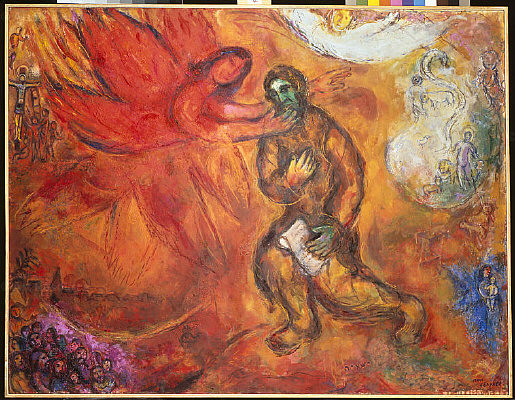
*Above painting of the prophet Isaiah by Marc Chagall, 1968