Who Is Jesus? (John 7:40-52)

The Light of the World, by William Holman Hunt, c.1853

On hearing his words, some of the people said, “Surely this man is the Prophet.”

Others said, “He is the Messiah.”

Still others asked, “How can the Messiah come from Galilee? Does not Scripture say that the Messiah will come from David’s descendants and from Bethlehem, the town where David lived?” Thus the people were divided because of Jesus. Some wanted to seize him, but no one laid a hand on him.

Finally the temple guards went back to the chief priests and the Pharisees, who asked them, “Why didn’t you bring him in?”

“No one ever spoke the way this man does,” the guards replied.

“You mean he has deceived you also?” the Pharisees retorted. “Have any of the rulers or of the Pharisees believed in him? No! But this mob that knows nothing of the law—there is a curse on them.”

Nicodemus, who had gone to Jesus earlier and who was one of their own number, asked, “Does our law condemn a man without first hearing him to find out what he has been doing?”

They replied, “Are you from Galilee, too? Look into it, and you will find that a prophet does not come out of Galilee.” (New International Version)
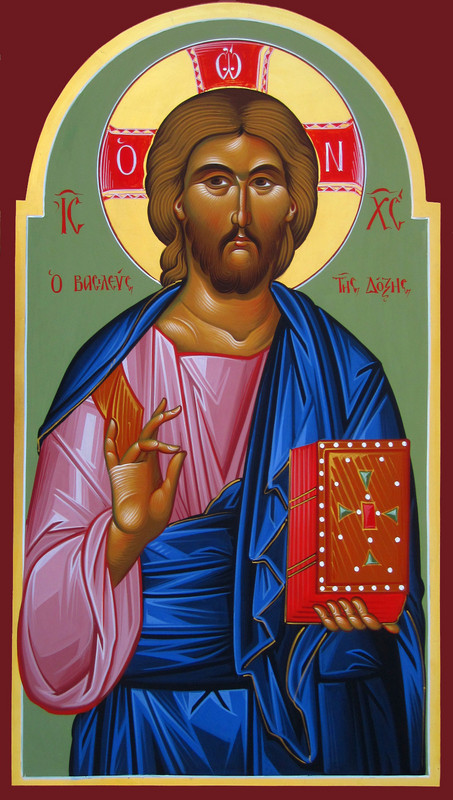
Orthodox Christian icon of Jesus Christ

There was a lot of buzz in Christ’s day of who Jesus really was. Prophet? Messiah? And, if Jesus really is a big deal, would he really come from Hicksville Nazareth? What about his credentials? His class? His pedigree?

Opinions on Jesus haven’t really changed all that much from the ancient world. They are still just as diverse now as when he was on this earth.

Unlike today, ancient people could not simply “Google” Jesus and find out where he was born and grew up. And they had no access to doing background checks in a matter of minutes to find out all kinds of things about him. Had the religious authorities bothered to do their homework and investigated Jesus, they would have found that, indeed, he was born of the Davidic line and in Bethlehem.

The short of it is that a chunk of the people simply assumed they knew Jesus wasn’t of proper Messiah credentials. They assumed and did not investigate because they did not want to know. No one can be faulted for ignorance. However, purposeful ignorance is perhaps the greatest of all sins, betraying a deep egoism of pride and prejudice.

In their hubris, the religious leaders sent the temple guards to bring Jesus in. Yet, in a clear demonstration of heavenly authority, the guards actually listened to Jesus and saw for themselves who he really is. Their simple confession testifies to Christ’s credibility. If one would but just see and listen for themselves, and engage in a genuine investigation, they could walk away finding truth.

6th-Century Byzantine mosaic of Jesus

Opponents of Jesus for the past two thousand years assume that Christians have been duped into taking the opiate of the people. Many think that followers of Christ were manipulated by religious hacks trying to gain power over others. But that’s a curious opinion, considering Jesus continually did just the opposite of that and was a champion for the poor, the powerless, and the marginalized persons of society.

When professional people with recognized degrees and competence do not believe you, nor take your own experience and learning seriously, what do you do?

Well, you could listen to them, or you could listen to your own gut telling you that you’re being gaslighted by a bunch of highly intelligent simpletons who are unfamiliar – are ignorant – of the faith you are familiar with.

What’s more, there are always smart and experienced people in the room who know better. Nicodemus was such a person. He was a serious scholar, and chose to speak up about these things. Authorities and credentials matter, yet of first importance is to know how to go about any sort of inquiry – rather than just passing over an objective investigation and assuming you know better.

Ethiopian artist depiction of Jesus teaching

For decades, I have (graciously) challenged others who do not believe in Jesus to actually read the Gospel accounts and at least engage in some minimal investigation – rather than giving opinions based on limited knowledge and secondary sources.

After all, as Nicodemus pointed out so long ago, shouldn’t we first give Jesus a fair hearing before we start dismissing him as nothing more than a religious figure that a bunch of people follow?

And I must also point out that this applies to us Christians, as well. Rather than waving aside Buddha or Muhammad or any other religious figure as false, don’t you owe their followers the basic respect of hearing them out before you dismiss them as fake, or in some cases, worse than that?

If you accuse another point of view, which is different than your own, as wrong or not real, without first hearing the accused and gathering objective evidence, then we really have no business getting uppity when another person accuses or dismisses our own faith.

Sadly, the colleagues of Nicodemus chose not to answer him but to instead engage in the age old practice of ad hominem argumentation by attacking the person, thereby deflecting having to give an answer.

People attack other people out of fear. And, in this case, it seems to me the religious leaders were downright afraid of investigating Jesus and giving him an honest hearing. Because if they did, they just might have their world turned upside-down; and they wanted the status quo to be maintained, at all costs, even if it meant ignoring the truth.

Jesus Washing the Feet of His Disciple, by Japanese artist Sadao Watanabe (1913-1996)

You don’t have to take my word on any of these things about Christ or Christianity. Read the Gospel of John for yourself – in one sitting if possible. Ingest the words. Drink in the experiences. Then, come and have a conversation with me.

Jesus, Lamb of God, have mercy on us.

Jesus, Bearer of our sins, have mercy on us.

Jesus, Redeemer of the world, give us your peace.

Jesus, Light of the world, shine in our hearts.

Jesus, Hope of all, be our companion on our way.

Jesus, Great Physician, heal our broken lives.

Jesus, Beloved Son of God, kindle within us the fire of your love. Amen.

The Question of Authority (Mark 11:27-33)

The Pharisees Question Jesus, by James Tissot (1836-1902)

Again they entered Jerusalem. As Jesus was walking through the Temple area, the leading priests, the teachers of religious law, and the elders came up to him. They demanded, “By what authority are you doing all these things? Who gave you the right to do them?”

“I’ll tell you by what authority I do these things if you answer one question,” Jesus replied. “Did John’s authority to baptize come from heaven, or was it merely human? Answer me!”

They talked it over among themselves. “If we say it was from heaven, he will ask why we didn’t believe John. But do we dare say it was merely human?” For they were afraid of what the people would do because everyone believed that John was a prophet. So they finally replied, “We don’t know.”

And Jesus responded, “Then I won’t tell you by what authority I do these things.” (New Living Translation)

Jesus was an outsider. During his earthly ministry, he was viewed, at best, as an avant-garde leader; and, at worst, a flat out heretic. It may be easy to overlook that reality, because we typically think of Christ as Lord and always on the inside of things.

Although Jesus was a teacher and a rabbi – and was neither a priest nor a member of any Jewish religious sect – he nevertheless walked around as if he owned the place (which he did). That gave the established religious leadership of the day no end of consternation and frustration.

Jesus made significant inroads into people’s lives, especially with outsiders like himself. And this situation created anger and jealousy with many of the religious ruling class. Since Jesus was not a card-carrying member, the leaders wanted to hear from him why he kept acting confidently and deliberately on their religious turf.

“What gives you the right? Who authorized you to act this way?” was their cry.

The established authorities are depicted in today’s Gospel lesson as a craven bunch who did not want to alienate the crowds, and yet were eager to get the upstart Jesus out the way. This appears to be an age-old situation of leaders putting their fingers to the wind to go with whatever will keep them popular and in power.

Since Jesus consistently refused to play such games, the authorities believed he needed to go. They, however, had no intention of risking an outright confrontation and showing their shadow motives.

Jesus clearly connected himself with John the Baptist, as both coming from the same authority. John was yet another figure for whom the established leaders could not control.

We ought never to underestimate both perceived and actual threats to status quo leadership. Such leaders have no inkling of being public servants when true moral authority comes along. The lack of conformity from John and Jesus would cost them both their very lives.

Speaking truth to power while not becoming defensive doing so is a tricky art. Yet, Jesus did it. Continual challenges to his authority left him unfazed as to his mission and purpose on this earth. Christ was assertive without becoming despotic; forward without taking the bait of useless arguments; confident with no hint of arrogance.

For me, the contrast between Jesus and the religious authorities is trenchant. The confident, wise, and calm authority of Christ is in direct opposition to the fear, anxiety, and worry of the ruling leaders. Whereas they kept anxiously ruminating about what to do about this threat to their established authority, Jesus exhibited a non-anxious presence which maintained a steadfast focus on God’s righteous, holy, and benevolent rule and reign.

Sometimes, continual fear is a big red flag that the leader is so worried about losing their place or position, that the will of God gets pushed aside as merely a secondary concern.

Questioning Christ’s credentials was the giveaway that the existing religious authorities were concerned about their power and privilege, and not the people. The wise person will see such queries for what they are.

Wherever we observe those who refuse to share power, have a xenophobic bent toward outsiders, and seem to do just about anything to maintain the status quo, there we will find the abuse of authority.

Conversely, where we observe a deep concern for equity, justice, and the common good of all persons, there we see compassionate leadership who will champion ethical leadership and espouse moral authority.

In any democratic society, we must choose our leaders wisely.

Great God of hope, in these times of change and uncertainty, unite your people and guide our leaders with your wisdom. Give us courage to overcome our fears and help us to build a future in which all may prosper and share together through Jesus Christ our Lord in the strength of your Holy Spirit. Amen.

Why Not Women? (Romans 16:1-16)

I commend to you our sister Phoebe, a deacon of the church in Cenchreae. I ask you to receive her in the Lord in a way worthy of his people and to give her any help she may need from you, for she has been the benefactor of many people, including me.

Greet Priscilla and Aquila, my co-workers in Christ Jesus. They risked their lives for me. Not only I but all the churches of the Gentiles are grateful to them.

Greet, also, the church that meets at their house.

Greet my dear friend Epenetus, who was the first convert to Christ in the province of Asia.

Greet Mary, who worked very hard for you.

Greet Andronicus and Junia, my fellow Jews who have been in prison with me. They are outstanding among the apostles, and they were in Christ before I was.

Greet Ampliatus, my dear friend in the Lord.

Greet Urbanus, our co-worker in Christ, and my dear friend Stachys.

Greet Apelles, whose fidelity to Christ has stood the test.

Greet those who belong to the household of Aristobulus.

Greet Herodion, my fellow Jew.

Greet those in the household of Narcissus who are in the Lord.

Greet Tryphena and Tryphosa, those women who work hard in the Lord.

Greet my dear friend Persis, another woman who has worked very hard in the Lord.

Greet Rufus, chosen in the Lord, and his mother, who has been a mother to me, too.

Greet Asyncritus, Phlegon, Hermes, Patrobas, Hermas and the other brothers and sisters with them.

Greet Philologus, Julia, Nereus and his sister, and Olympas and all the Lord’s people who are with them.

Greet one another with a holy kiss.

All the churches of Christ send greetings. (Romans 16:1-16, NIV)

The reason we have the “Captain Obvious” people in our lives, is that they simply point out something that is right under our noses we might miss. I’m playing the role of Captain Obvious. In today’s New Testament lesson are a group of women. Paul names, greets, thanks, and encourages several church leaders, and they are not all men:

  1. Phoebe is a deacon. She’s actually the representative who was sent to take Paul’s letter to the church at Rome and read it to the congregation.
  2. Priscilla is co-equal with her husband Aquila. Together they co-pastored a house church. She helped teach and mentor Apollos in Corinth.
  3. Mary
  4. Junia is an apostle. Paul states that she’s outstanding amongst them, of which also he is one.
  5. Tryphena and Tryphosa
  6. Persis is a dear friend of Paul.
  7. Julia

In the earliest church, within the New Testament Scriptures, women are mentioned as serving in every sort of capacity. And yet, women are the greatest and largest untapped resource in the church today.  

You might wonder why I would say such a thing, being that more women attend church than men. However, still in this day and age – removed 2,000 years from the biblical text – the reality for many churches around the world is that only men can hold positions of authority.  

The reasoning goes something like this: “The Bible says women can’t serve over men, so women can’t hold those positions.” Really?

So, a woman can serve as a CEO of a Fortune 500 company, can be elected as governor of a state, and can manage men on a factory floor, but that same woman cannot serve as an elder in many churches? I once asked a pastor that very question, and he answered with “Yes, because the Bible says so.”

I guess he never read Romans 16.

If you are of the belief that a church office is based on gender instead of the calling and gifting of the Spirit, then, methinks, it behooves us to ask these questions of the biblical text:

  • If women are not to exercise authority over men in the church, how do we account for actual women leaders in the Bible, such as Deborah, Huldah, Philip’s daughters, Priscilla’s role in Apollos’ life, not to mention the list of women leaders in Romans 16?  If our impulse is to say that these are exceptions because there were no men to “step up,” then what does that say about our theology? Is God not big enough to find a man to put into a position of leadership?
  • If we insist that women ought not to teach and be silent based on Paul’s letter to Timothy (1 Timothy 3:11-15) then why do we ignore Paul’s instruction that women are to publicly prophecy and pray? (1 Corinthians 11:5; Acts 21:9)
  • Doesn’t the prominence of women in the ministry of Jesus and Paul suggest something different than just having women tag along to teach children?
  • Just when does a boy become too old for a woman to legitimately teach him?  If women can’t teach men, why in the world would we ever think that they are the best teachers for boys?
  • How can we apply Galatians 3:26-28 (there is no male or female in Christ)? Are women the exception?
  • Does the Reformation doctrine of the priesthood of all believers only apply to men?  Doesn’t the absence of women in church leadership go against this?
  • Isn’t it weird and confusing that women have an equal vote in congregational decisions, even when a male leader is being elected and/or disciplined, when they aren’t supposed to exercise authority?

I could go on, but I think you get the picture; the absence of women in leadership is problematic, at best. It’s a problem because there are actually women leaders in the Bible. So, here is my unabashed, dogmatic, and biblical belief:  

All individuals are equally created in God’s image, and, therefore, have equal worth, privilege, and opportunity in Christ’s Church without any limitation, including gender.

In some churches and Christian denominations today, there are far too many wonderful Christian women who are exhausted and depressed because they are trying to live up to a certain expectation of being someone they are not. They suppress their gifts and calling because they believe they must prop-up the fragile male egos around them.  

They aren’t free to serve in leadership positions; and it’s eating them from the inside-out. These women think there is something wrong with them, but the reality is that there is something wrong with the whole system of male-only authority. And, what’s more, we are missing out on the blessing of God. It is high time we value all women, even those with gifts of leadership, by allowing them to serve without limitation.

I have a wife and three daughters. All of them are more intelligent, more gifted, and better leaders than me, the lone family male. To have them using their superior talents in the church by leading and serving is the least threatening thing to me on this earth. I love it that they can outdo me; it is my joy!  

Even more than that, I believe it is Christ’s joy, as well. We must be proactive in cultivating and nurturing the gifts and calling we see in women. They don’t need to be put in their place; instead, the good-old-boy system of the church needs to be put in its place so that men are practicing a leadership that sacrifices on behalf of making women’s leadership a priority.

Lord God, bless all women who daily strive to bring peace to their communities, their homes and their hearts. Give them strength to continue to turn swords into ploughshares. We pray for all women who face prejudice, inequality and gender disparities. Help us to see and to face the discrimination against women in all the many forms it may take.

Forgive all women and men who let differences breed hate and discrimination. Let your example of valuing all of creation help us to see that we are equal partners in the stewardship of your world. Help us to see the strength and goodness in all women and men. Amen.

Imitate the Right Use of Power (1 Corinthians 4:14-20)

I am writing this not to shame you but to warn you as my dear children. Even if you had ten thousand guardians in Christ, you do not have many fathers, for in Christ Jesus I became your father through the gospel. Therefore I urge you to imitate me. For this reason I have sent to you Timothy, my son whom I love, who is faithful in the Lord. He will remind you of my way of life in Christ Jesus, which agrees with what I teach everywhere in every church.

Some of you have become arrogant, as if I were not coming to you. But I will come to you very soon, if the Lord is willing, and then I will find out not only how these arrogant people are talking, but what power they have. For the kingdom of God is not a matter of talk but of power. (New International Version)

We need to talk about power.

And we need solid sacred examples of how to wield power rightly and justly.

Power is a lot like sex. Everyone wants it, but not everyone respects it and uses it well.

Humanity was created by God to exercise power. True human power has always been intended by our Creator as a means of giving love to others. Wherever you find love being extended by people in power to the powerless, there you will see that it works.

Yet, here’s the rub for many of us: This godly use of power may not (and likely will not) achieve instant results. That’s probably why we so often associate humanity’s possession of power with threats, bullying, and violence – because they usually work to get the immediate results of obtaining power and keeping others in subservience to that power.

The right use of power rarely gets rolled out smoothy without any wrinkles to it. Instead, wielding power through love makes its way by means of suffering. It comes from the humble servants like Mother Teresa, and from those who could throw their weight around, but instead choose to use their influence for self-giving love.

This sort of just and right authority is realized when we are aware of our own weaknesses and failures. Believing that “might=right” is merely a prescription for working out our own complexes on other people; it will only result in extending hate, not love, when others resist our authority.

The ones who hold true power are those who know they are unworthy of it, and incapable of using it without humility and divine help. Real power is like a shepherd looking after a flock of sheep – and not like pulling out a sword to kill the bad guys when they come to challenge authority.

Believers everywhere need awareness that the Christian message offers a profound reversal of what we think we know about power. All signs of real power lead us to the foot of the cross. National governments seems to think that power must be both achieved and sustained by the threat of violence. But the power of God’s kingdom is exercised through giving, serving, and loving.

And it is that sort of power which transforms the world in ways that probably won’t make headlines on the nightly news. The power of Christ is passed on throughout the generations of believers – learned by imitating people, like the Apostle Paul, who demonstrated humble service, instead of arrogant authority.

Faith is passed from person to person; and not just handed down from individuals reading their bibles in seclusion. Power and authority are given to those who are capable of handling it with justice and righteousness.

“You have heard me teach things that have been confirmed by many reliable witnesses. Now teach these truths to other trustworthy people who will be able to pass them on to others.”

The Apostle Paul to his protégé Timothy (2 Timothy 2:2, NLT)

Christians learn from leaders how the faith is lived out, and how power is used, by imitating what they see and hear. Therefore, an important question is this: Who do I imitate?

“Dear brothers and sisters, pattern your lives after mine, and learn from those who follow our example.”

The Apostle Paul to the Philippian Church (Philippians 3:17, NLT)

Our great desire is that you will keep on loving others as long as life lasts, in order to make certain that what you hope for will come true. Then you will not become spiritually dull and indifferent. Instead, you will follow the example of those who are going to inherit God’s promises because of their faith and endurance. (Hebrews 6:11-12, NLT)

Remember your leaders who taught you the word of God. Think of all the good that has come from their lives, and follow the example of their faith. (Hebrews 13:7, NLT)

Those who hold authority and power in the Christian Church must exemplify a proven character of persevering love in the face of pain and suffering. Such persons, having shown humility through it all, are worthy to imitate.

This does not necessarily mean that we emulate those who eruditely speak the Word of God, have superior gifts and abilities, and enjoy success in ministry. It does mean that we ought to imitate, and have as mentors, those persons who imitate Christ and are not self-promoting peacocks who go after being admired and praised.

A cocky Christian leader who has not focused on suffering love, and who has not experienced the purgative fiery trials of this life, may easily become seduced by their own importance. However, leaders who have seen their share of hard circumstances, pain, and suffering, and have come through it loving God and serving others out of grace and humility, are leaders worth imitating. 

Character shapes power, and never the other way around.

God of unchangeable and unending power: Look with mercy on your Church everywhere, and carry out your good and loving purposes through us your people. We trust that your power and love will have it’s way in this old fallen world – and that your plan of salvation shall be carried out, through Jesus Christ our Lord, in the strength of the Holy Spirit. Amen.