Dealing with Another’s Evil Intentions (1 Samuel 19:18-24)

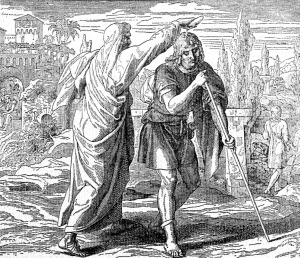
David and Saul, by He Qi

When David had fled and made his escape, he went to Samuel at Ramah and told him all that Saul had done to him. Then he and Samuel went to Naioth and stayed there. 

Word came to Saul: “David is in Naioth at Ramah;” so he sent men to capture him. But when they saw a group of prophets prophesying, with Samuel standing there as their leader, the Spirit of God came on Saul’s men, and they also prophesied. 

Saul was told about it, and he sent more men, and they prophesied too. Saul sent men a third time, and they also prophesied. Finally, he himself left for Ramah and went to the great cistern at Seku. And he asked, “Where are Samuel and David?”

“Over in Naioth at Ramah,” they said.

So Saul went to Naioth at Ramah. But the Spirit of God came even on him, and he walked along prophesying until he came to Naioth. He stripped off his garments, and he too prophesied in Samuel’s presence. He lay naked all that day and all that night. This is why people say, “Is Saul also among the prophets?” (New International Version)

King Saul was in the middle of a personal downward spiral of evil. And David was his target. Even though David served Israel and the king with distinction and bravery, his success aroused the jealousy of Saul.

It came to the point that David needed to flee for his life because Saul saw him as a threat and was out to kill him. Instead of trying to go it alone, feeling angry and defeated, David went to the one person he knew was wise, discerning, and could help: Samuel, the priest and prophet of Israel.

David was not looking to kill Saul, as Saul was trying to kill him. He just needed someone to talk to, some empathy and solid help in this very unwanted and awful situation.

As we move through the biblical narratives which tell of Saul and David, we will observe that God is with David and helps him through his travails; but God is not with Saul, who is continually haunted with a bad spirit whenever he descends into the dark path of jealousy, anger, even murder.

It is only human to wonder why people of faith, with good and genuine hearts, must contend with such self-absorbed narcissistic people like Saul. We can only answer it in part: the presence of evil in the world; the place of trials and tribulations in the believer’s life, etc. For the most part, it is a mystery for which we shall not have answers, this side of heaven.

But what we do know is that God is concerned for the godly, for those who seek to do right, have pure hearts, and think of the common good of all the people. And the Lord can deal with evil, while protecting the good, in quite unexpected ways.

We expect prophets to prophesy. We don’t expect anyone else to necessarily do so. Yet, in this story, we see God sending the spirit of prophetic speech not just upon the prophets and the good folk, but upon those who have ill intentions toward the godly ones.

Yes, the Lord sent a spirit upon people who were trying to kill David, and then even upon Saul himself; not to illumine, but to prevent. The power of prophecy in this instance was not a sign of being chosen by God, but a clear sign from God of rejection.

In stripping off his clothes and laying naked in prophetic utterance, Saul was being humbled, abased, and mortified. Decades later, King David would do so willingly as a repentant person. But here, King Saul does so unwillingly, as an unrepentant person who needs to let himself be among the penitent persons. But, alas, Saul did not do so, and was continually moved by other forces other than the Lord.

For the believer who is in the throes of a gaslighting boss, or a narcissistic leader, or a self-centered relative, today’s story is an encouragement: God’s will on this earth shall prevail; and the Lord will take care of those who desire to live a just, right, and good life.

Conflict and trouble must not necessarily result in one’s devastation and discouragement.

Whenever we find ourselves in the crosshairs of an evil person, we do not need to add to the madness with harsh and divisive words.

Instead, we can be sober-minded and good-hearted by handling the adverse situation with gentle words and a wise spirit. We can face the trouble, without wishing it away, by going to a wise person for counsel and help, if need be.

The mark of a truly good person is not whether they have conflict in their life, or not, but by how they handle the trouble when it comes. And as for the troublemakers and chaotic people themselves, the Lord knows how to deal with them.

You may be in an unwanted situation, dealing with a difficult person. Please don’t let that person steal your personal integrity and happiness from you. The one thing you can always control – that nobody can ever take away from you – is your own attitude and ability to respond.

“Everything can be taken from a man but one thing: the last of the human freedoms—to choose one’s attitude in any given set of circumstances, to choose one’s own way.”

Viktor Frankl, Man’s Search for Meaning

You and I really can deal with this. If the hurt was unintentional, then forgive and let it go. If the hurt was intentional, we need not be judge, jury, and/or executioner. That’s God’s job, not ours. Rather, we can choose to forgive and not hold onto bitterness; talk with a wise person to receive wise counsel, and not spread anger and slander; and determine to be joyful and godly, not sullen and irritable.

O Lord God almighty, listen to the prayer of the righteous! Direct the way of your servants in safety under your gracious divine protection, so that through all of the changes of our earthly pilgrimage, we may be guarded by your mighty help and power. Amen.

A King Is Anointed (1 Samuel 10:1-8)

Samuel anoints Saul as king, by Unknown artist

Then Samuel took a flask of olive oil and poured it on Saul’s head and kissed him, saying, “Has not the Lord anointed you ruler over his inheritance? When you leave me today, you will meet two men near Rachel’s tomb, at Zelzah on the border of Benjamin. They will say to you, ‘The donkeys you set out to look for have been found. And now your father has stopped thinking about them and is worried about you. He is asking, “What shall I do about my son?”’

“Then you will go on from there until you reach the great tree of Tabor. Three men going up to worship God at Bethel will meet you there. One will be carrying three young goats, another three loaves of bread, and another a skin of wine. They will greet you and offer you two loaves of bread, which you will accept from them.

“After that you will go to Gibeah of God, where there is a Philistine outpost. As you approach the town, you will meet a procession of prophets coming down from the high place with lyres, timbrels, pipes and harps being played before them, and they will be prophesying. The Spirit of the Lord will come powerfully upon you, and you will prophesy with them; and you will be changed into a different person. Once these signs are fulfilled, do whatever your hand finds to do, for God is with you.

“Go down ahead of me to Gilgal. I will surely come down to you to sacrifice burnt offerings and fellowship offerings, but you must wait seven days until I come to you and tell you what you are to do.” (New International Version)

Events were in motion. The priest and prophet Samuel was quite aware of the happenings. But the would-be king Saul was not at all savvy to what was transpiring.

While out and about engaging in his regular circuit ministry as judge in Israel, Samuel presided over the sanctuary feast. Saul was the unbeknown guest of honor. He had been picked out and placed at the head of the table. Only Samuel knew what was going on.

Without calling any attention to it, God was at work behind the scenes. The Israelites had petitioned for a king. They were of an attitude that we might imagine them being a bunch of malcontent children who complained to God saying, “All the other nations have a king. Why don’t we? We need a king, too! Give us a king! We want a king!” Who knows but that there maybe was a bit of stomping the foot along with the demand.

Sometimes what we think we want is not what we need.

Despite the people’s frame of mind and heart, and refusal of Samuel’s warning to them, the Lord decided to grant them a king. And Saul was the one chosen by God.

The actual anointing of the king, and setting him apart for that service, happened in private between Samuel and Saul. The priest poured oil on the head of Saul – which was a symbolic way of installation, as well as a sign of God’s blessing on him for a special position of leadership. This is why kings were often referred to as “the Lord’s anointed.”

Samuel anointed Saul as king. Art by Sefira Lightstone

As contemporary readers of the Bible, and separated by thousands of years of ancient Israelite culture, we may fail to grasp how radical this event is in Jewish history. Israel went centuries without any king at all; and now, at this point with Samuel and Saul, they have their first one.

This was a moment that changed everything for Israel. Even though Saul becoming king in Israel, this would likely not be identified by anybody as a seminal event in the Bible. Yet, just because it originally came without any glitz or ornate ceremony, the establishment of a kingship was a watershed moment, nonetheless.

But that’s typically how many things in life shake-out. People pray in the privacy of a secret prayer closet, or decide to step out with obedient faith for a seemingly insignificant place in time. There are no paparazzi or reporters, no large crowds or anyone really paying attention.

We choose to do something in the obscurity of our mundane daily lives. But the Lord is directing us, moving us toward something we could never imagine was going to happen. Big consequences can come about through the smallest acts of humility and quiet obedience.

Hopefully, we are more like this, than like the people who whined and clamored for a king.

Saul was anointed king. The people needed to know it. And Saul needed to be prepared for being a new sort of leader. Israel had to realize that God was setting up the kingship; it wasn’t just a thing Samuel came up with.

Therefore, three signs were given for Saul to expect. Each sign became progressively bigger so that the public could see and know that Saul is the person for whom God anointed.

Up to this point, Saul was really nothing more than another person in Israel. He never went to King’s College and learned how to be royal, simply because there was no such thing. But that was no problem for God. The Lord has the power and authority to turn anyone into a different person – including a king who can lead the people.

The only thing Saul had to do is listen to Samuel and obey the Lord. That’s it. Nothing more. Samuel would keep doing what he’s always been doing; and God will do what God has always done. Saul only needed to hear and do.

However, we can anticipate what happens whenever we humans are left to do nothing but listen and obey; we far too often hear and get anxious. And in our anxiety, we think we heard something different than what we really heard.

Things get complicated pretty fast when anxiety gets in the mix. Yet, to listen and obey is really quite simple, at its core.

Whenever things get crazy and complicated for you, I wonder if its really more complicated in your head or your heart than it really is. Perhaps it might be a lot simpler and calmer if you and I just did what we need to do, when we need to do it, without overthinking things.

Part of the reason the new kingship changed everything so much, is that after Saul became king, things got complicated pretty fast. And I think you know why…

O God, the source of all health, well-being, and peace: So fill my heart with faith in your love and trust in your divine will, that with calm expectancy I may make room for your power to possess me, and gracefully accept your leading in my life. Amen.

The Parable of the Two Sons (Matthew 21:28-32)

Wheatfield with Crows, by Vincent van Gogh, 1890

“What do you think about this? A man had two sons. He went to the first and said, ‘Son, go to work in the vineyard today.’

“His son replied, ‘I don’t want to!’ But later he changed his mind and went.

“The father went to the other son and told him the same thing. He replied, ‘I will, sir,’ but he didn’t go.

“Which of the two sons did what the father wanted?”

“The first,” they answered.

Jesus said to them, “I can guarantee this truth: Tax collectors and prostitutes are going into God’s kingdom ahead of you. John came to you and showed you the way that God wants you to live, but you didn’t believe him. The tax collectors and prostitutes believed him. But even after you had seen that, you didn’t change your minds and believe him. (God’s Word Translation)

I once cheated on a college exam. It was a required class for which I was not much interested, so my grade was rather tenuous going into the final exam of the semester. When the professor stepped out of the classroom for a few minutes during the final, my fellow students began sharing answers. I gave in and went with the others.

I got an “A” on the exam and passed the class easily. However, I royally flunked God’s test. After a few days of misery, I went to the professor’s office and confessed what I had done. I was prepared to take a failing grade for both the exam and the class, yet I think the professor was so shocked that I would come and admit such a thing that he worked up my grade right there in front of me… I passed, but just barely.

I originally said “no” to what was right, but then said “yes” and made it right.  For those who practice repentance, there is a God of grace waiting for them. God has no tolerance for those who profess truth with a big “yes” on the outside but are passive-aggressive on the inside and say “no,” undermining the truth by how they live. 

The Sower, by Vincent Van Gogh, 1888

Today’s Gospel lesson highlights entrance into the kingdom of God – and the people entering might surprise us. Turns out, there are spiritual insiders on the outside of the kingdom, and spiritual outsiders as the ones who really inherit the kingdom.

Christ’s parable is a warning to all the spiritually serious: Beware, lest our insider energies be spent in correctness, conformity of belief, and cockiness rather than following Jesus. At the same time, the parable encourages outsiders with the wonderful possibilities of a changed life. 

Jesus was warning those who arrogantly assume they have the inside track by what they believe, and not by doing God’s will. It may be challenging for us to imagine how truly offensive Christ’s story was to the original hearers of the parable, so I restate it in a more contemporary form:

There was a man who was well respected in the community and had two sons. One son grew up and became a respectable member of the community, too. He was a successful businessman and gave lots of money to causes in his community, including new lights for the school football field – which was no small cost.  He only asked that appropriate and prominent recognition be given him with a plaque bearing his name on each of the light poles. 

The other son was not so successful.  He was the one in school who the teachers said, “Why can’t you be more like your brother?”  There was nothing spectacular about this son.  In fact, he lived an ‘alternate lifestyle’ and people murmured behind his back. 

One day the father said to this son: “Son, go and work at my place of business today; I am going away and need you to do some of the tedious paperwork I have gotten behind on.” “No way!” he answered, but later felt heartsick about the way he spoke to his father and decided to go and do all the grunt work his father needed done.

The father went to the well-respected son and said the same thing about needing him to do all the thankless paperwork that was piled up. That son answered, “Yes, sir, I will; anything you need I will do.” But that son did not go. Instead, he chose to go golfing with some people whom he was trying to coy favor with.

After telling the story, Jesus asked all the upstanding faith leaders and the people listening: “Which of the two did what his father wanted?” “The first,” they answered.

Jesus said, “I tell you the truth, folks with different sexual orientations, unemployed persons on the low rung of society, and the religiously different with esoteric beliefs are entering the kingdom of God ahead of you. For you have had heard thousands of sermons about grace and the way of righteousness, yet you did not believe by putting God’s Word into practice; but the others did. And even after you saw how God can change a person’s life from the inside-out, you yourselves did not repent and believe.

For Jesus to tell such a story was so scandalous that, frankly, it got him killed. Specifically, the scandal is this: Merely believing rightly and living as an upstanding citizen is not the way of salvation. Tax collectors and prostitutes were some of the most despised people in Christ’s time. It was assumed they were outside of God.

However, the proof of genuine belief is not lip service but actively obeying God when no one is looking:

My friends, what good is it to say you have faith, when you don’t do anything to show that you really do have faith? Can that kind of faith save you? If you know someone who doesn’t have any clothes or food, you shouldn’t just say, “I hope all goes well for you. I hope you will be warm and have plenty to eat.” What good is it to say this, unless you do something to help? 

Faith that doesn’t lead us to do good deeds is all alone and dead! Suppose someone disagrees and says, “It is possible to have faith without doing kind deeds.” I would answer, “Prove that you have faith without doing kind deeds, and I will prove that I have faith by doing them.” You surely believe there is only one God. That’s fine. Even demons believe this, and it makes them shake with fear. (James 2:14-19, CEV)

The Christian life comes down to obedience, not cheap talk. Jesus wants to bless a lost world in need of God’s love and grace.

If we have ears to listen, we can hear numerous lost souls crying in the dark. If we have eyes to see, there are people caught in addictions standing in front of us. If we have hands willing to labor, needy folks surround us who can neither help themselves nor ask for it.

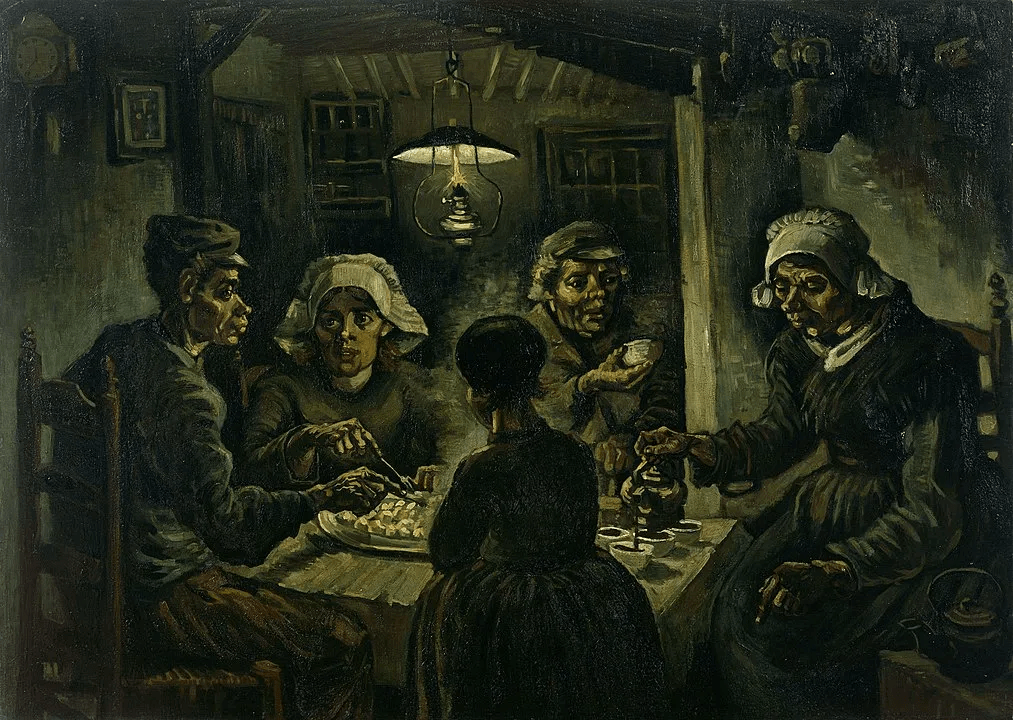
The Potato Eaters, by Vincent Van Gogh, 1885

Honestly, I am heartsick over the grinding loneliness of so many people; the boatloads of shame which thousands secretly carry; and the silent pain experienced by individuals everywhere. I feel this way because I genuinely believe my Lord feels the same. Jesus is looking to activate grace through his people to a world sinking in the depths of incredible human need.

Christ’s parable, however, is more than a warning; it is a story that opens the door of mercy for unlikely people seemingly far from God – people who ruined their lives by saying “no” to God. The parable is an invitation for all the screw-ups and those with little faith to come to Jesus.

There is a rather obscure Scripture reference, tucked away in the Old Testament. David was on the outside looking in. King Saul was on the inside trying to capture and kill him, even though David had done nothing wrong. Here is what happened:

David got away and escaped to the Cave of Adullam. When his brothers and others associated with his family heard where he was, they came down and joined him. Not only that, but all who were down on their luck came around—losers and vagrants and misfits of all sorts. David became their leader. There were about four hundred in all. (1 Samuel 22:1-2, MSG)

This rag-tag group of outsiders in Israel became Israel’s insiders as David eventually became king and these were the “mighty men,” the ones who helped bring Israel into prominence. 

Jesus Christ came into this world and identified himself as the Savior to the outsider when he quoted the prophet Isaiah:

Jesus went to the synagogue on the sabbath day, as was his custom. He stood up to read, and the scroll of the prophet Isaiah was given to him. He unrolled the scroll and found the place where it was written:

“The Spirit of the Lord is upon me,
    because he has anointed me
        to bring good news to the poor.
He has sent me to proclaim release to the captives
    and recovery of sight to the blind,
        to let the oppressed go free,
to proclaim the year of the Lord’s favor.”

And he rolled up the scroll, gave it back to the attendant, and sat down. The eyes of all in the synagogue were fixed on him. Then he began to say to them, “Today this scripture has been fulfilled in your hearing.” (Luke 4:16-21, NRSV)

In Christ, there are no lost causes and no persons too far on the outside to be redeemed. Therefore, now is the time to act on what we believe – to not only affirm right doctrine, but to live out that doctrine in obedience to God’s call.

May it be so, to the glory of God.

Submission Is an Attitude (1 Peter 2:13-17)

For the sake of the Lord submit yourselves to every human authority: to the Emperor, who is the supreme authority, and to the governors, who have been appointed by him to punish the evildoers and to praise those who do good. For God wants you to silence the ignorant talk of foolish people by the good things you do. Live as free people; do not, however, use your freedom to cover up any evil, but live as God’s slaves. Respect everyone, love other believers, honor God, and respect the Emperor. (Good News Translation)

Submission is a word a lot of people would like to do without. And that’s understandable. We’ve all likely had the experience of being under the authority of someone who either didn’t know what they were doing, or who gaslighted us, took advantage of us, and maybe was even downright mean and nasty toward us. What’s more, it’s hard to obey someone or some institution who we aren’t quite sure has our best interests at mind.

And then there’s an association with the word “submission” as being forced to do something you don’t want to do. That sort of understanding of submission is actually slavery and oppression, not submission.

Simply put, to submit is the informed and willing choice to place oneself under the authority of another. If it isn’t a willing and informed choice, then it’s either manipulation or coercion by another.

The Apostle Peter was referring to submitting to human authority by a volitional choice of our will. And what he was encouraging believers to do was no small thing.

The Roman Empire was an ancient behemoth. At the time of Peter’s writing, the Romans were firmly in charge of Palestine – Gentile rule in a Jewish land – and they did not take kindly to any ideas of rebellion. The Jews wanted their own autonomy and rule. To be subject to the Romans was, for many, humiliating and unacceptable.

So, why in the world should anyone willingly choose to submit to an empire that doesn’t align with their values, aspirations, and goals in life?

Peter made it clear why: Submission helps clear away the obstacles to freedom (both personal and corporate) and doesn’t give the persons in authority a reason to speak or act foolishly.

It’s hard to submit; it’s not an easy thing to do. Yet, if we will continually connect submission with why we are doing it, this helps us persevere, especially under leadership which is less than stellar.

The real issue is how we deal with unwanted circumstances in our lives. Although we didn’t ask for many of the unfortunate situations in life, our response to them is critical, and makes all the difference.

“Evil is changed into good when it is received in patience through the love of God; while good is changed into evil when we become attached to it through the love of self. True good lies only in detachment, and abandonment to God. You are now in the trial; put yourself confidently and without reserve into his hand.”

François Fénelon, Let Go: To Get Peace and Real Joy

Admittedly, it is maddening when an injustice is done to us, or we observe someone else experiencing something they don’t deserve. Unjust actions and words perpetrated against us are out of our control. What is, however, within our control is our response. We can choose how to react in each and every situation we face.

“Forces beyond your control can take away everything you possess except one thing, your freedom to choose how you will respond to the situation.”

Viktor Frankl, Man’s Search for Meaning

We, indeed, have a range of responses we may choose from: We can react in passive-aggressive anger, become sullen and morose, stuff all our emotions down and ignore them, lash out and verbally attack; or we can choose to accept the situation for what it is (and not what we want it to be) and submit ourselves to God.

All of you must put on the apron of humility, to serve one another; for the scripture says, “God resists the proud, but shows favor to the humble.” Humble yourselves, then, under God’s mighty hand, so that he will lift you up in his own good time. Leave all your worries with him, because he cares for you. (1 Peter 5:5-7, GNT)

Submission to God often comes in the form of submitting to the human authorities in our lives – even when those persons and institutions over us are imperfect. Systemic evil isn’t changed by our response of perpetrating even more evil back upon them. Rather, unjust structures are transformed through godly persons choosing to work within the system to do good, not harm, and to love, not hate.

Christian freedom is never a matter of simply doing whatever the heck you want to do, regardless of how it impacts anyone else. Our freedom is in the ability to make choices about what sort of attitude we are going to have in all the circumstances of life we encounter.

Don’t do anything from selfish ambition or from a cheap desire to boast, but be humble toward one another, always considering others better than yourselves. And look out for one another’s interests, not just for your own. The attitude you should have is the one that Christ Jesus had:

He always had the nature of God,
    but he did not think that by force he should try to remain equal with God.
Instead of this, of his own free will he gave up all he had,
    and took the nature of a servant.
He became like a human being
    and appeared in human likeness.
He was humble and walked the path of obedience all the way to death—
    his death on the cross. (Philippians 2:3-8, GNT)

Therefore, what we’re left with is the willing choice to alter our own life, instead of continually trying to make everyone else change. It comes down to showing respect for all humanity, honoring God with our attitudes, and loving our sisters and brothers in the faith who face the same sorts of challenges we do.

“When we are no longer able to change a situation, we are challenged to change ourselves.”

Viktor Frankl

Be safe. Be strong. Be spiritual. We are all in this life together.