A Plan That Backfired (1 Samuel 4:1-22)

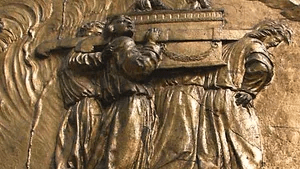
Transporting the Ark of the Covenant, Cathedral of Sainte-Marie, Auch, France

Now the Israelites went out to fight against the Philistines. The Israelites camped at Ebenezer, and the Philistines at Aphek. The Philistines deployed their forces to meet Israel, and as the battle spread, Israel was defeated by the Philistines, who killed about four thousand of them on the battlefield. When the soldiers returned to camp, the elders of Israel asked, “Why did the Lord bring defeat on us today before the Philistines? Let us bring the ark of the Lord’s covenant from Shiloh, so that he may go with us and save us from the hand of our enemies.”

So the people sent men to Shiloh, and they brought back the ark of the covenant of the Lord Almighty, who is enthroned between the cherubim. And Eli’s two sons, Hophni and Phinehas, were there with the ark of the covenant of God.

When the ark of the Lord’s covenant came into the camp, all Israel raised such a great shout that the ground shook. Hearing the uproar, the Philistines asked, “What’s all this shouting in the Hebrew camp?”

When they learned that the ark of the Lord had come into the camp, the Philistines were afraid. “A god has come into the camp,” they said. “Oh no! Nothing like this has happened before. We’re doomed! Who will deliver us from the hand of these mighty gods? They are the gods who struck the Egyptians with all kinds of plagues in the wilderness. Be strong, Philistines! Be men, or you will be subject to the Hebrews, as they have been to you. Be men, and fight!”

So the Philistines fought, and the Israelites were defeated and every man fled to his tent. The slaughter was very great; Israel lost thirty thousand foot soldiers. The ark of God was captured, and Eli’s two sons, Hophni and Phinehas, died.

That same day a Benjamite ran from the battle line and went to Shiloh with his clothes torn and dust on his head. When he arrived, there was Eli sitting on his chair by the side of the road, watching, because his heart feared for the ark of God. When the man entered the town and told what had happened, the whole town sent up a cry.

Eli heard the outcry and asked, “What is the meaning of this uproar?”

The man hurried over to Eli,who was ninety-eight years old and whose eyes had failed so that he could not see. He told Eli, “I have just come from the battle line; I fled from it this very day.”

Eli asked, “What happened, my son?”

The man who brought the news replied, “Israel fled before the Philistines, and the army has suffered heavy losses. Also your two sons, Hophni and Phinehas, are dead, and the ark of God has been captured.”

When he mentioned the ark of God, Eli fell backward off his chair by the side of the gate. His neck was broken and he died, for he was an old man, and he was heavy. He had led Israel forty years.

His daughter-in-law, the wife of Phinehas, was pregnant and near the time of delivery. When she heard the news that the ark of God had been captured and that her father-in-law and her husband were dead, she went into labor and gave birth, but was overcome by her labor pains. As she was dying, the women attending her said, “Don’t despair; you have given birth to a son.” But she did not respond or pay any attention.

She named the boy Ichabod, saying, “The Glory has departed from Israel”—because of the capture of the ark of God and the deaths of her father-in-law and her husband. She said, “The Glory has departed from Israel, for the ark of God has been captured.” (New International Version)
It was a really bad day. Yet, it wasn’t a day disconnected from other days. This particular day had been coming for quite some time.

The Philistines and the Israelites were continually going at each other. They had been enemies for a long time. But the Philistines were only the surface problem. The real issue had been building ever since Eli and his sons Hophni and Phineas were the priests in Israel.

They were tasked with the sacred responsibility of caring for the Tabernacle – the tent which housed the Ark of the Covenant – and attending to the people’s worship and sacrifices. But they had been terribly irresponsible in their work. As biblical readers, we are meant to feel the building tension of inevitable divine intervention of judgment against the injustice that was happening.

In one of the many military battles which took place against the Philistines, the Israelites suffered loss. So, someone had the bright idea of perhaps getting God involved. No one perceived, however, the involvement the Lord was planning. God was ready to deal with the wickedness in Israel.

The Ark of the Covenant was brought from Shiloh to the front lines. This, of course, meant that the persons who handled sacred objects, Hophni and Phineas, would have to be the ones who bring it. We sense as readers that in spite of the Ark’s symbolism of God’s presence with the Israelites, this move isn’t going to end well for Israel.

The story is leading us to an important point: Faithfulness to the invisible God is much more important and powerful than a visible sacred object. The Ark of the Covenant is a symbol of what is right and just; it is not a supernatural talisman to ward off a bad and stressful situation.

Many in Israel were faithful to the Lord. Israel’s leaders, however, were not. In an age old story that has kept repeating itself up to the present time, the people keep supporting a bad government which does not serve the common good of all persons; it only serves itself.

What is interesting here is that God neither fights against the Philistines, nor the Israelites. The Lord simply didn’t show up. God was absent and did not help Israel. The divine intervention turned out to be no intervention at all.

The entire Ark of the Covenant plan completely backfired. The Philistines, understanding the brevity of the situation, were emboldened to fight like never before – thus bringing devastation on the battlefield to Israel. The narrator takes note to let us know the impact this has on the old priest Eli, his two sons, and the rest of that family.

Superstition will get us nowhere – especially when we are looking for solutions to problems we created for ourselves by ignoring righteousness and justice. The hard work of doing what is right cannot be substituted with magic.

There is big difference between believing in God and becoming superstitious and wanting easy solutions to complex problems. God is not, cannot, and will not be contained in a box – even if it’s the Ark of the Covenant.

Eternal God, in whose perfect kingdom no sword is drawn but the sword of righteousness, no strength known but the strength of love: So mightily spread abroad your Spirit, that all people may be gathered under the banner of the Prince of Peace, as children of one Father; to whom be dominion and glory, now and forever. Amen.

How It’s Built Matters (1 Kings 6:1-4, 21-22)

Artist depiction of Solomon’s Temple

Four hundred and eighty years after the people of Israel left Egypt, during the fourth year of Solomon’s reign over Israel, in the second month, the month of Ziv, Solomon began work on the Temple. Inside it was 90 feet long, 30 feet wide, and 45 feet high. The entrance room was 15 feet deep and 30 feet wide, as wide as the sanctuary itself. The walls of the Temple had openings in them, narrower on the outside than on the inside….

The inside of the Temple was covered with gold, and gold chains were placed across the entrance of the inner room, which was also covered with gold. The whole interior of the Temple was covered with gold, as well as the altar in the Most Holy Place. (Good News Translation)

The first major accomplishment – and the crowning achievement – of King Solomon’s reign was building the Temple in Jerusalem. His father, King David, had it in his heart to erect a great Temple for God as both a place of worship, and a permanent place for the Ark of the Covenant to rest. However, the Lord clearly instructed David not to build the Temple, but stated that his son would do so. (1 Chronicles 28:1-21)

Solomon spared no expense for building the Temple. He ordered vast quantities of cedar wood from King Hiram of Tyre, and had huge blocks of stone quarried for the building’s foundation. In order to complete the massive project, Solomon imposed forced labor on all his subjects, drafting people for work shifts that sometimes lasted a month at a time. (1 Kings 5:1-18)

And there was the gold – lots of it! The inside of the Temple was completely covered with gold. Gold is physically and metaphorically one of the most malleable metals on the planet: one gram of gold can be beaten into a 1-square meter sheet, and gold has been used as a symbol for everything from religious devotion to great wealth and immense power.

As glorious and elaborate as the Temple was, the most important room was perhaps the greatest theological statement of all; it contained almost no furniture. Known as the Holy of Holies, it housed the two tablets of the Ten Commandments inside of the Ark of the Covenant. The unseen and almighty God of the universe doesn’t really need a house, and most certainly cannot be contained within one.

Only once a year, on the Day of Atonement (Yom Kippur) the High Priest entered the most sacred Holy of Holies and pray to God on behalf of the Israelite nation. God’s world and God’s word are holy. It was understood that the Ten Commandments are very holy words, with the name of God being the holiest word of all. The Temple – by its sheer architecture – communicated what was most important about God.

Model of the Tabernacle in Timna Valley Park, Israel

Yet, the way in which the Temple was constructed was very different from how the earlier Tabernacle was built. The Tabernacle was a sort of mobile temple for the wilderness journey. The entire community worked together in giving their possessions and services in order to make the Tabernacle a reality.

Without the contributions of the people, the project probably would not have happened at all. But the chance to help out in all the myriad ways of making things for the sanctuary, pulled everyone together in a high degree of compliance. (Exodus 36:1-6)

Indeed, the building of the Tabernacle was a consensual enterprise; the people’s faith was the wellspring of their philanthropy. Yet, in contrast, the mode by which Solomon carried out the construction of the permanent Temple was by sheer wealth, forced labor, and strong administrative business deals.

There was no community participation in the form of voluntarism in Solomon’s financing of the Temple build. To pay for the cedar and cypress wood provided by the King of Tyre and to quarry and transport the building materials, Solomon issued a massive levy. In other words, there wasn’t any free labor and no robust public spirit animating the construction.

The Tabernacle for which the people volunteered wholeheartedly never fell victim to evil. The Temple, however, eventually and certainly did – in large part due to the evil of the kings who presided over the theocracy.  

The fate of any institution is determined by how it is created in the first place. No matter what the polity and organizational structure is, it cannot long survive without popular support. Solomon’s Temple, despite all of its grandeur and gold, rested on a shaky foundation and sandy soil.

After the Temple was constructed, the sacrificial system was authorized only in Jerusalem and at the Temple. Everything was centralized under the behemoth of Solomon’s system. What’s more, practices like volunteerism and community participation were largely replaced with systems of heavy taxation and a large debt. That’s one reason the kingdom immediately split apart after Solomon’s death.

Perhaps if the selfless ethos that went into building the Tabernacle was utilized by Solomon in the building of the Temple, maybe the fate of king after king in Israel would have been quite different. For it is in the spirit of volunteerism and a concern for the public welfare that governments attentive to the common good of all persons are built. How something is built matters.

Almighty and gracious God of all, we humbly offer our gratitude for the blessing of selfless volunteers and those who participate freely in ministries of justice and service. Thank you for their tireless dedication and benevolence.

May your Spirit bless them with continual guidance as they faithfully serve others. Give them resilience, daring, and fortitude. Let joy, peace, and satisfaction be upon the good work that they do. Inspire and motivate them to persist through trying circumstances, steadfast in their dedication to aiding those around them.

Help us all to reflect the profound beauty and compassion of your divine love. Amen.

2 Samuel 6:1-15 – Be Careful How You Celebrate

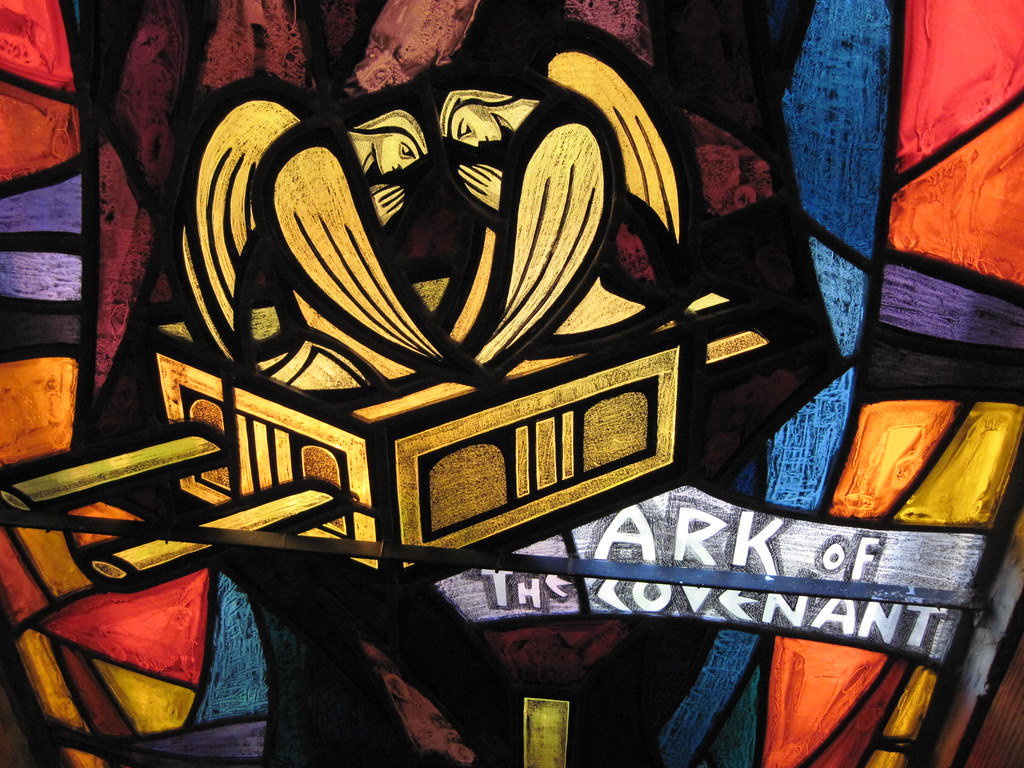
Ark of the Covenant by Isabel Piczek 1982, St. Norbert Catholic Church, Orange, California

David again assembled all the best men in Israel, 30,000 in number. David and all the men who were with him traveled to Baalah in Judah to bring up from there the ark of God which is called by the name of the Lord of Heaven’s Armies, who sits enthroned between the cherubim that are on it. They loaded the ark of God on a new cart and carried it from the house of Abinadab, which was on the hill. Uzzah and Ahio, the sons of Abinadab, were guiding the new cart. They brought it with the ark of God from the house of Abinadab on the hill. Ahio was walking in front of the ark, while David and all Israel were energetically celebrating before the Lord, singing and playing various stringed instruments, tambourines, rattles, and cymbals.

When they arrived at the threshing floor of Nacon, Uzzah reached out and grabbed hold of the ark of God, because the oxen stumbled. The Lord was so furious with Uzzah, he killed him on the spot for his negligence. He died right there beside the ark of God.

David was angry because the Lord attacked Uzzah; so, he called that place Perez Uzzah, which remains its name to this very day. David was afraid of the Lord that day and said, “How will the ark of the Lord ever come to me?” So, David was no longer willing to bring the ark of the Lord to be with him in the City of David. David left it in the house of Obed-Edom the Gittite. The ark of the Lord remained in the house of Obed-Edom the Gittite for three months.

The Lord blessed Obed-Edom and all his family.King David was told, “The Lord has blessed the family of Obed-Edom and everything he owns because of the ark of God.” So, David went and joyfully brought the ark of God from the house of Obed-Edom to the City of David. Those who carried the ark of the Lord took six steps and then David sacrificed an ox and a fatling calf. Now David, wearing a linen ephod, was dancing with all his strength before the Lord. David and all Israel were bringing up the ark of the Lord, shouting and blowing trumpets. (New English Translation)

The Christian season of Eastertide is a grand celebration of Christ’s resurrection and the new life we enjoy in Jesus Christ. Since God is the center of all things, celebrations need to be mindful. Nothing in life is a matter of doing whatever the heck we want to do.

Even celebration has its boundaries and limits.

The narrator who originally compiled, told, and wrote the today’s Old Testament lesson wanted to communicate something significant about God and how to relate to the Lord.

God put the big kibosh on David’s hoedown. At that time in the history of Israel, the ark was the foremost symbol of God’s presence with the people. Within the ark contained the tablets of the Ten Commandments (the symbol of God’s Word); the staff of the first priest, Aaron, (the symbol of God’s choice); and a pot of manna (the symbol of God’s provision). Thus, the ark was a holy object, pointing to a holy God.

The ark of the Lord was built during the time of Moses, when the ritual laws were established concerning offerings and how to approach God in worship. There were detailed prescriptions for how to construct all the sacred articles for worship. (Exodus 35:30-40:33) 

The ark was at the center of worship, representing the presence of God among the people. For nearly five-hundred years before David, the ark had become a familiar object in the life of Israel, always there, continually the symbol of God to the people.

I’ve been a Christian for many decades. One reason I refer to the seasons of the Christian Year in the present tense, is so that it doesn’t become old hat to me. Although I just presided over yet another Easter Sunday in my long tenure as a pastor, I am still in awe of Christ’s resurrection and am eternally grateful and full of joy over new life in Jesus Christ. I always want it to be fresh, as if I’m stepping up to the empty tomb for the first time.

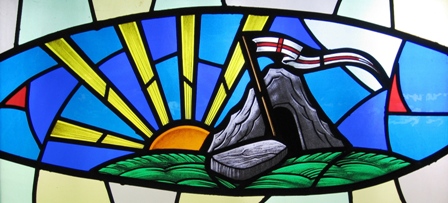
Stained glass in the First Lutheran Church of
Washburn, North Dakota

Yet, we have all likely had the experience of something becoming so familiar, that we begin to lose sight of how important and valuable it really is. Not until we lose it, or something traumatic happens, do we wake up and take stock of its true significance. 

The Israelites had become lethargic and apathetic toward the worship of God, and it led to some disheartening and tragic circumstances. The people of God throughout the ages have always needed to be vigilant against the opiate of familiarity, dulling the senses to the importance of worship.

Moving the ark of the Lord to Jerusalem was one of the first acts David did as the king of Israel and Judah.  God was with David and brought him success against his enemies. David enjoyed a close relationship with God.  Even though David’s heart was in the right place, he made a huge miscalculation, which ended up offending God. 

David had the best of intentions in bringing the ark to Jerusalem and giving it a prominent place in the center of Jewish life. This was an exceptionally good plan. The problem, however, came in the manner the ark was carried from one place to another. 

God’s law laid out in careful detail how the ark was to be transported. Uzzah and Ahio were Levites charged with the ark’s care. Only the Levites could handle the ark and the holy objects of worship that went along with it.

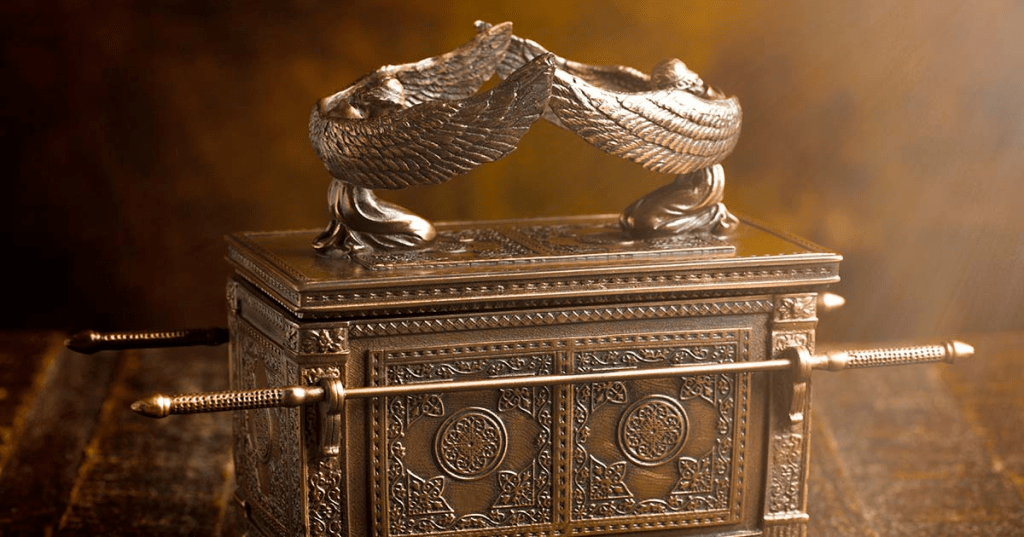
Since it was the job of the Levites for hundreds of years, they knew better than to carry the ark of the Lord on a cart. God clearly told Moses that the ark was to have two long poles of acacia wood overlaid with gold inserted into four gold rings of the ark. The ark was to always be carried on the shoulders of the Levites with the two poles.

We are not told why Uzzah and Ahio were pulling the ark on a cart with oxen instead of carrying it in the prescribed way. Perhaps it was because the ark was incredibly heavy and no easy task to carry.  Maybe they decided it would be easier and more expedient to have the much stronger oxen pull the ark on a nice new cart; it would save a lot of energy transporting it over a long distance.

Or it could be that they were tired of moving the ark in the same old way they had always done it. Maybe it was old hat to them, and they were ready for something different.

For pragmatic people, Uzzah and Ahio’s approach makes a lot of sense. However, God was not okay with this arrangement. When the oxen stumbled and the ark was in danger of falling off the cart, Uzzah reflexively reached out to steady it.  That was the last act Uzzah ever did on this earth. God immediately put him down for his “irreverent act.”

So, here is the not so good idea: Evaluating the worship of God by common sense pragmatism, what we think will work best, and how we feel it ought to be done. Everything about worship is to pay attention to the holiness of God through our obedience. 

Whenever we avoid the prescriptions of Holy Scripture, however best the intentions might be, is not a good thing and people will get hurt. One can never justify an action that goes against God’s Word because people are praising God. Just because the heart is in the right place does not mean what is being done is okay.

David’s first response was anger, then fear. He gave his best effort, and it resulted in God’s disfavor. Perhaps David took for granted that the ark could be moved any old way he wanted to move it. 

Trouble with God happens whenever we value efficiency and expediency over obedience and submission.

The great error of Uzzah, resulting in his death, was trying to manage God. We do not take care of God; God takes care of us. God does not bow to us. The Lord doesn’t allow the creature to manage the Creator.

God wants a pure, unadulterated, and obedient worship celebration from people in the way God wants it to be done, period. It is not up for negotiation.

Holy God, we confess that we have too often forgotten we are yours. Sometimes we carry on our lives as if there was no God and we fall short of being a credible witness to you. For these things we ask your forgiveness and for your strength. Give us clear minds and open hearts so we may bear witness to you in our world. Remind us to be who you would have us to be regardless of what we are doing or who we are with. Hold us close and build our relationship with you and with those you have given us on earth, through Jesus Christ our Lord. Amen.

2 Samuel 6:16-23 – Shameless Worship

As the Ark of the Lord came into the city, Saul’s daughter Michal looked out the window. When she saw David jumping and dancing in the presence of the Lord, she hated him.

David put up a tent for the Ark of the Lord, and then the Israelites put it in its place inside the tent. David offered whole burnt offerings and fellowship offerings before the Lord. When David finished offering the whole burnt offerings and the fellowship offerings, he blessed the people in the name of the Lord All-Powerful. David gave a loaf of bread, a cake of dates, and a cake of raisins to every Israelite, both men and women. Then all the people went home.

David went back to bless the people in his home, but Saul’s daughter Michal came out to meet him. She said, “With what honor the king of Israel acted today! You took off your clothes in front of the servant girls of your officers like one who takes off his clothes without shame!”

Then David said to Michal, “I did it in the presence of the Lord. The Lord chose me, not your father or anyone from Saul’s family. The Lord appointed me to be over Israel. So, I will celebrate in the presence of the Lord. Maybe I will lose even more honor, and maybe I will be brought down in my own opinion, but the girls you talk about will honor me!”

And Saul’s daughter Michal had no children to the day she died. (New Century Version)

“God wants worshipers before workers; indeed the only acceptable workers are those who have learned the lost art of worship.”

A.W. Tozer

A true celebration of God was underway, enjoying the blessing of God. The sacrifices before God were sweet smelling because they were done in a spirit of obedience and humility, and according to the specifications of worship with the Ark of God’s Covenant.

However, David’s wife, Michal, the daughter of the former king, Saul, did not worship. She critically observed David and the others and evaluated the worship service by how it appeared to her. Michal was not with everyone else giving herself to the true worship of God. She did not like how her husband went about worship. 

The acceptable worship of God was not acceptable to her, and she gave David an earful about it. Yet, David was undaunted. He had his focus where it ought to be.

We get a cryptic last note on Michal, describing that she was barren to the day of her death – it is a note on her meant to convey both a physical reality of her body, and a spiritual reality of her soul.

So, how are we to worship God? In the New Testament Gospels, Jesus said about worship: 

“Indeed, the time is coming, and it is now here, when the true worshipers will worship the Father in spirit and truth. The Father is looking for people like that to worship him. God is a spirit. Those who worship him must worship in spirit and truth.” (John 4:4:23-24, GW) 

Neither good intentions alone (in spirit) nor appropriate actions alone (in truth) constitute acceptable worship.  We must possess both. The worship Jesus talked about was literally “to prostrate oneself before God.”  In other words, it is to embrace both the disposition and the attitude of submission and humility toward God, seeking to obey the Lord as rightful Ruler, rather than superimpose our desires on him. 

Furthermore, God is both near to us and far away from us, all at the same time. God is close to us through the person and work of Jesus Christ, and now in the person of the Holy Spirit. God exists supreme and far above us, calling the shots of how we ought to be living our lives.

We must appreciate both divine transcendence and divine immanence.

The presence of God is both comforting and dangerous. God’s holiness is like a fire, giving us light and warmth – get too close to the flame and you will get burned, even destroyed. We do not get to tell God what we are to be doing and how to go about it. We have collective promises and blessings given to us as God’s people. Yet, at the same time, we have a responsibility to know God’s will and to do it in God’s way.

God cares about worship. If we worship any old way we want without consideration of how God wants it done, or if we just critically watch worship without engaging in it, then we ought not to expect blessing. However, if pay attention to God and are careful to do what God wants in God’s way, then we will enjoy God’s approval.

The Church is first and foremost a worshiping community of redeemed persons through the blood of Christ, which are given to the world in order to glorify God:

Everyone on this earth,
    sing praises to the Lord.
Day after day announce,
    “The Lord has saved us!”
Tell every nation on earth,
“The Lord is wonderful
    and does marvelous things!
The Lord is great and deserves
    our greatest praise!
He is the only God
    worthy of our worship.
Other nations worship idols,
but the Lord created
    the heavens.
Give honor and praise
    to the Lord,
whose power and beauty
    fill his holy temple.”

Tell everyone of every nation,
“Praise the glorious power
    of the Lord.
He is wonderful! Praise him
and bring an offering
    into his temple.
Worship the Lord,
    majestic and holy. (1 Chronicles 16:23-29, CEV)

The text in 1 Chronicles, a restatement of our Old Testament lesson for today, goes on to say:

David left Asaph and his coworkers with the Chest of the Covenant of God and in charge of the work of worship; they were responsible for the needs of worship around the clock.

He also assigned Obed-Edom and his sixty-eight relatives to help them. Obed-Edom son of Jeduthun and Hosah were in charge of the security guards. The priest Zadok and his family of priests were assigned to the Tent of God at the sacred mound at Gibeon to make sure that the services of morning and evening worship were conducted daily, complete with Whole-Burnt-Offerings offered on the Altar of Burnt Offering, as ordered in the Law of God, which was the norm for Israel.

With them were Heman, Jeduthun, and others specifically named, with the job description: “Give thanks to God, for his love never quits!” Heman and Jeduthun were also well equipped with trumpets, cymbals, and other instruments for accompanying sacred songs. The sons of Jeduthun formed the security guard. (1 Chronicles 16:37-42, MSG)

David exerted his kingly authority by instituting that in Israel the worship of God was to take place every day – not just one day a week. He hired hundreds of musicians, singers, and worship leaders to minister before the Lord every single day, twice a day. 

“I must take time to worship the One whose name I bear.”

Oswald Chambers

Many believers bemoan the morality and lack of spirituality in our world. Yet, if God’s people are not first and foremost a worshiping community, then we have nowhere else to look to institute the change which is needed.

In addition, every conceivable instrument and voice was used to praise God in worship. New songs were written continually by David, and arranged by Asaph, the worship leader. 

While we make plans and conceive of ideas for our lives, God is waiting for us to worship. It would be good to spend some time each morning when we arise, and each evening at bedtime, in worship following the example of David: remembering God, and who we are; singing to the Lord; confessing sin; claiming forgiveness; reading Scripture; and, praying. 

If we all devoted ourselves to worship without shame, then we might begin to imagine God opening to us blessing upon blessing.

*Above sketches of King David dancing before the Lord, by Rebecca Brogan