Keep On Praying For What’s Important (Romans 15:22-33)

Together We Pray, by Jerome White

This is why I have often been hindered from coming to you.

But now that there is no more place for me to work in these regions, and since I have been longing for many years to visit you, I plan to do so when I go to Spain. I hope to see you while passing through and to have you assist me on my journey there, after I have enjoyed your company for a while. 

Now, however, I am on my way to Jerusalem in the service of the Lord’s people there. For Macedonia and Achaia were pleased to make a contribution for the poor among the Lord’s people in Jerusalem. They were pleased to do it, and indeed they owe it to them. For if the Gentiles have shared in the Jews’ spiritual blessings, they owe it to the Jews to share with them their material blessings. 

So after I have completed this task and have made sure that they have received this contribution, I will go to Spain and visit you on the way. I know that when I come to you, I will come in the full measure of the blessing of Christ.

I urge you, brothers and sisters, by our Lord Jesus Christ and by the love of the Spirit, to join me in my struggle by praying to God for me. Pray that I may be kept safe from the unbelievers in Judea and that the contribution I take to Jerusalem may be favorably received by the Lord’s people there, so that I may come to you with joy, by God’s will, and in your company be refreshed. The God of peace be with you all. Amen. (New International Version)

Paul’s Intentions

It always had been the Apostle Paul’s intention to preach Christ in places where the name of Jesus was not known. He wanted all people everywhere to hear the good news of grace, forgiveness, and new life in Jesus Christ as the fulfillment of all God’s good promises.

Paul wrote a rather complicated historical and theological letter to the Roman Church. He specifically addressed their situation of both Jew and Gentile Christians worshiping together in one church. They were often divided and critical of one another.

Throughout his letter, the Apostle provided a solid apologetic for staying together on clear biblical and theological grounds. Paul also wanted them to work side-by-side in practical matters of ministry, which would help them learn to appreciate each other.

So, Paul intended on visiting them – hopefully sooner than later – to encourage them in the faith, and as a stop on the way to Spain. He longed to get to the farthest geographic point of the continent and make Christ known.

To that end, Paul made a concluding personal statement and emotional appeal to the entire Roman Church – Jew and Gentile alike – for their abiding prayerful support of his ministry and intentions.

Paul’s Prayer

For Paul, and from a New Testament perspective, prayer is the most necessary activity a believer can do. Prayer connects the divine and the human in meaningful dialogue, as well as connecting people to each other in a common purpose of seeking the Lord and knowing Christ.

The Apostle practiced what he preached. Paul continually prayed for the Roman Church and wrestled in prayer for all the believers. (Romans 1:9-12)

He specifically asked the believers to pray that he be rescued from unbelievers; and that his ministry in Jerusalem might be good and acceptable to the believers in that place. Paul took great pains to gather a collection throughout many of the churches he established, so that he could bless the needy persons in Judea.

Paul’s Longing

The Apostle Paul constantly sought and worked toward solidarity between the Christian Jews and converted Christian Gentiles. They were ancient enemies, and at the time of Paul’s writing the Roman Empire and their occupation created even more animosity between the two groups of people.

Paul longed for the world to see an alternative to such enmity. The Church is to be the one place on earth where there are no walls, no separations, no divisions. The Body of Christ is to be a place of unity, mutual encouragement, and sincere love for one another, without prejudice or favoritism.

Unity and the ability to work together in a shared purpose of gospel proclamation was a high value to the Apostle Paul. That’s because it was important to Jesus.

Christ’s Prayer of Unity

Stained glass of Jesus praying

My hope is that Christians will never lose sight of their Lord’s high priestly prayer, as recorded by the Apostle John:

“Holy Father, protect them by the power of your name, the name you gave me, so that they may be one as we are one…My prayer is not for them alone. I pray also for those who will believe in me through their message, that all of them may be one, Father, just as you are in me and I am in you. May they also be in us so that the world may believe that you have sent me. I have given them the glory that you gave me, that they may be one as we are one—I in them and you in me—so that they may be brought to complete unity. Then the world will know that you sent me and have loved them even as you have loved me.” (John 17:11, 20-23, NIV)

If this is the heartbeat of Jesus, then I submit that Christians everywhere ought to also pray this prayer, and work toward that which is important to Christ himself.

I am also keeping in mind that there is nothing automatic about prayer. Paul did not get all of his prayers answered the way he wanted. In fact, so far, neither has Jesus. Two-thousand years later, we are living in a fragmented and polarized world more than ever, even in Christianity between all sorts of different Christian traditions.

On the one hand, we can and ought to bemoan the situation of disunity and even outright animosity between people who confess the name of Christ. This needs to impel us forward by embracing the values of both Jesus and Paul.

On the other hand, there is reason to hope, knowing that the good news can and is making a difference throughout the world. We can be encouraged to keep on praying and to continue persevering in prayer.

The Apostle Paul envisioned a new society in which old enemies would become friends and co-workers around building a community of persons who are redeemed by Jesus and seek to live into his words and ways.

May it be so, to the glory of God. Amen.

Developing the Skill of Wisdom (Colossians 1:9-14)

Colossians 1:9-10, by Bible Art

For this reason, since the day we heard about you, we have not stopped praying for you. We continually ask God to fill you with the knowledge of his will through all the wisdom and understanding that the Spirit gives, so that you may live a life worthy of the Lord and please him in every way: bearing fruit in every good work, growing in the knowledge of God, being strengthened with all power according to his glorious might so that you may have great endurance and patience, and giving joyful thanks to the Father, who has qualified you to share in the inheritance of his holy people in the kingdom of light. 

For he has rescued us from the dominion of darkness and brought us into the kingdom of the Son he loves, in whom we have redemption, the forgiveness of sins. (New International Version)

When I was younger, I played a lot of ping-pong. And I got good at it. In fact, during a several months stretch, back-in-the-day, I had a record of 156-2. Not bad.

That kind of record was only possible because of the two reasons that make any skill an accomplishment:

  1. Knowledge. I learned the game of ping-pong and eventually knew it inside and out.
  2. Experience. I practiced for hundreds, if not thousands, of hours in developing my technique.

The sort of knowledge that Paul was talking about was more than information and intellectual understanding; he used a specific word (in the Greek language – ἐπιγινώσκω, pronounced “EPee-gi-NOS-ko) which refers to knowledge gained by experience.

In English, we need to put two words together in order to communicate Paul’s concept: experiential knowledge – an understanding which is gained by continual repetition and practice until there is proficiency.

There are just some things that can only be learned and integrated into life through constant use and development over time. And this is precisely how a person becomes mature in life:

Growth + Time = Maturity.

And with maturity comes the wisdom to live life as it meant to be lived. This means that wisdom doesn’t come overnight or quickly; to be wise requires a great deal of learning, effort, experience, and time.

The wisdom and understanding Paul refers to is not some sort of secret information which has to be accessed through careful initiation into a group of people who have the inside knowledge. No, this is wisdom which can be gained by anyone who embraces a life of faith and spiritual discipline.

The highest form of knowledge for the Apostle Paul is knowing God in Christ.

This sort of knowledge is an understanding of salvation, and experiencing deliverance from guilt, shame, and the false self. Such knowledge is evidenced by the fruit of the Spirit in living a life of love, joy, peace, patience, kindness, goodness, faithfulness, gentleness, and self-control. (Galatians 5:22-23)

Colossians 1:11, by Bible Art

From the outside of Christianity looking in, it may appear that this is all a grand achievement of the human will. But it isn’t. On the inside, the Christian life is thoroughly a work of God’s glorious power, bringing new life, and effecting spiritual growth and maturity into a wise and good way of life.

We did not deliver ourselves. God did. The Lord transferred our membership from the realm of darkness to the empire of light. Christians are simply people who have been redeemed by God in Christ. Our liberation is because of God’s gracious forgiveness of sins.

Forgiveness, however, is not the end game. Forgiveness frees us to pursue the spiritual life without guilt and shame hindering us and weighing us down all the time. Forgiveness opens us to the possibilities of positive and life-giving relational connections with God and other people.

In our relationship with God, prayer becomes the conduit of divine/human conversation. That connection, in the past, had blockage because of our unhealthy lifestyles. But it is now unobstructed because of God’s gracious intervention by Jesus, in the Spirit.

So, when it comes to our interactions in prayer, there’s no need to invent a new game; we just need to learn the one we’ve got, and put in the hours of work necessary to become accomplished at it. 

Today’s New Testament lesson is a prayer from the Apostle Paul to the Colossian Church. His prayer for them was singular: To have wise minds and spirits, that is, to have knowledge of God – an understanding of who God is and how God operates.

To learn divine ways is to acquire the skill of wisdom.

Paul prayed for a reason: so that we might live our lives in a way which pleases God and enables us to sustain a lifetime of spiritual growth. 

As people created in God’s image and likeness, we are hard-wired with a spirit which needs strengthening and exercise. That happens as we put in the constant repetitions of connecting with the divine and putting in the time on our knees – praying daily for ourselves and others to mature in faith so that we might all together act wisely and justly in this world, for the life of the world.

A good place to start is to use Paul’s prayer as our own. Never has there been such a need than now for us to know how to apply wisdom in the places and in the circumstances we’ve never been in before. 

For wisdom to happen, we must grow in our knowledge by putting in the hours of prayer.

The skill of wisdom doesn’t magically happen. Wisdom is the culmination of acquired understanding; a lot of practice exercising love in the places where love is not; and engaging in a lifetime project of becoming knowledgeable through constant learning, struggling, and growing.

Direct me, O Lord, in all my doings with your most gracious will and wisdom. Further in me your continual help – that in all my work and in all I do and say, I may glorify your holy name; and, by your mercy, obtain the life that is truly life; through Jesus Christ, my Lord.  Amen.

Effective Communication (Acts 17:16-31)

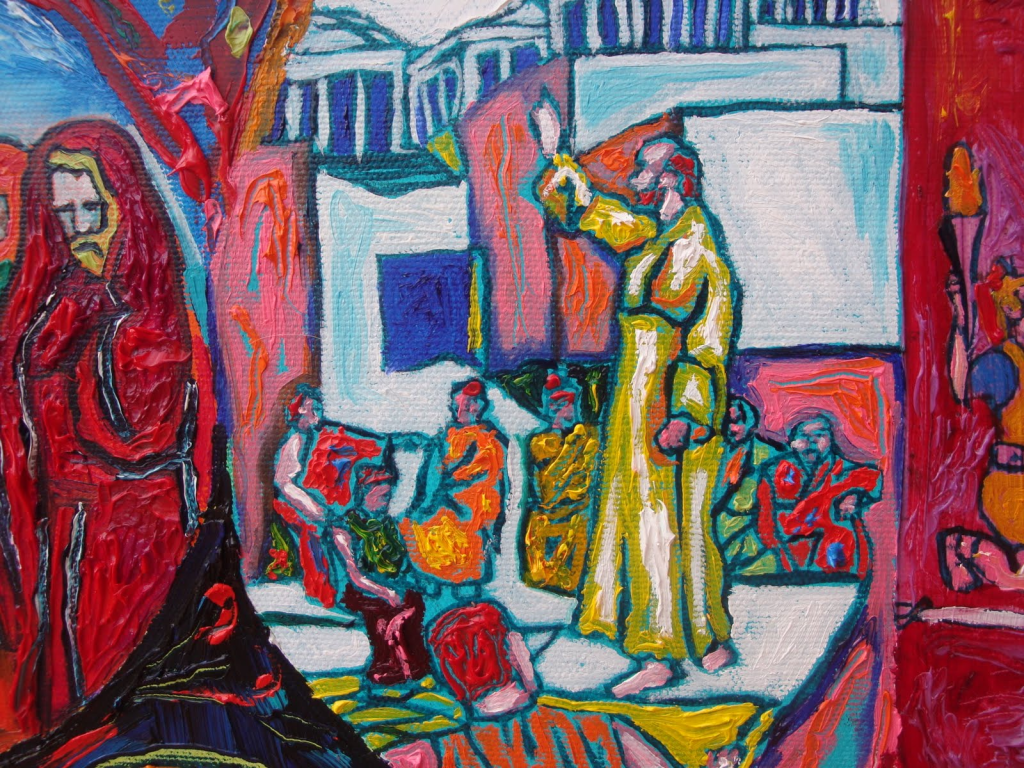
St. Paul preaching at the Areopagus in Athens, by Kennedy A. Paizs

While Paul was waiting for them in Athens, he was deeply troubled by all the idols he saw everywhere in the city. He went to the synagogue to reason with the Jews and the God-fearing Gentiles, and he spoke daily in the public square to all who happened to be there.

He also had a debate with some of the Epicurean and Stoic philosophers. When he told them about Jesus and his resurrection, they said, “What’s this babbler trying to say with these strange ideas he’s picked up?” Others said, “He seems to be preaching about some foreign gods.”

Then they took him to the high council of the city. “Come and tell us about this new teaching,” they said. “You are saying some rather strange things, and we want to know what it’s all about.” (It should be explained that all the Athenians as well as the foreigners in Athens seemed to spend all their time discussing the latest ideas.)

So Paul, standing before the council, addressed them as follows: “Men of Athens, I notice that you are very religious in every way, for as I was walking along I saw your many shrines. And one of your altars had this inscription on it: ‘To an Unknown God.’ This God, whom you worship without knowing, is the one I’m telling you about.

“He is the God who made the world and everything in it. Since he is Lord of heaven and earth, he doesn’t live in man-made temples, and human hands can’t serve his needs—for he has no needs. He himself gives life and breath to everything, and he satisfies every need. From one man he created all the nations throughout the whole earth. He decided beforehand when they should rise and fall, and he determined their boundaries.

“His purpose was for the nations to seek after God and perhaps feel their way toward him and find him—though he is not far from any one of us. For in him we live and move and exist. As some of your own poets have said, ‘We are his offspring.’ And since this is true, we shouldn’t think of God as an idol designed by craftsmen from gold or silver or stone.

“God overlooked people’s ignorance about these things in earlier times, but now he commands everyone everywhere to repent of their sins and turn to him. For he has set a day for judging the world with justice by the man he has appointed, and he proved to everyone who this is by raising him from the dead.” (New Living Translation)

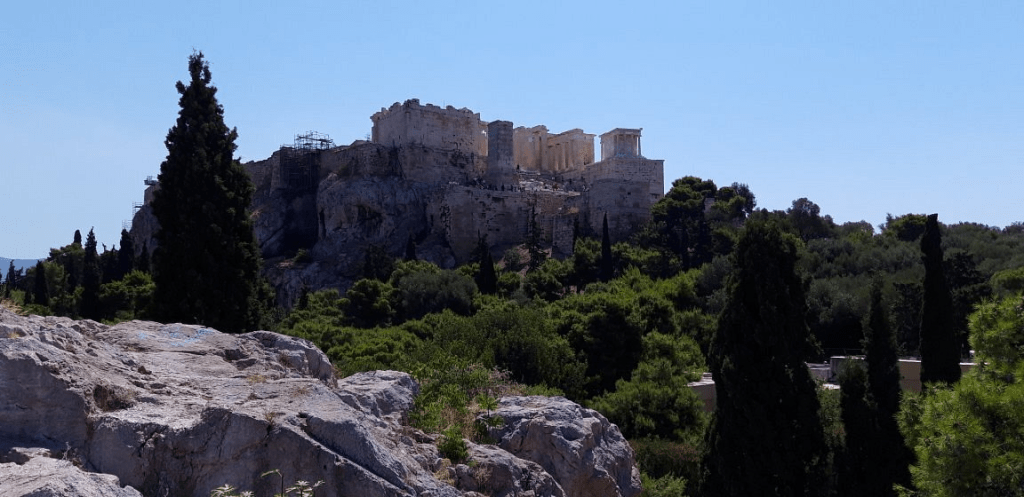
Ancient ruins of Athens, Greece

The city of Athens was a major intellectual center in the ancient world. Ideas, philosophy, reason, rhetoric, and debate were standard fare amongst the citizens. At the time of the Apostle Paul’s arrival in the city, Greece knew next to nothing about Christianity.

Paul’s response to what he saw and felt in the city dictated what he did and said. And those words were wise and impactful for the people of Athens. The Apostle’s interaction with the philosophers was like a seminar in how to communicate with folks who believe and live very differently than ourselves.

Observation

Paul entered the city and made a simple observation: Athens is full of idols. Out of all the observations Paul could have made, this one would not likely be made by most people visiting the city. Athens was a glorious place with its unparalleled architecture. The Acropolis and the Agora were resplendent with the arts and democracy.

For all its physical beauty and brilliance, the one thing Paul homed-in on was the idols. This would have struck many folks as odd – something like focusing on the dog collar instead of the dog. Yet, Paul was using more than his physical eyes – his spiritual sight was making a big observation – that Athens was very much a religious place.

Feeling

The Apostle felt troubled and distressed. Paul was disturbed down deep in his gut with the spiritual state of this renowned city-state. The sheer volume of idols and the practice of idolatry did not sit well with him. He experienced feelings of pity mixed with anger.

Paul handled his emotions well. By freely acknowledging them, he was then able to choose his response. Had he not done so, it’s likely Paul might have gone on some frustrating tirade, thereby never truly connecting relationally with the people. There’s nothing wrong with being irritated or exasperated; it’s what we do with those feelings that’s important.

Need

Emotions, not thoughts, move us to act. Paul knew why he was feeling disturbed, and decided not to stuff those feelings. Instead, he stepped out and addressed the great need he was observing.

Paul decided to meet the Athenians on their turf and on their level by reasoning with them every day in the great buildings and open spaces of the city.

While in Athens, it seems that Paul, understandably, utilized the Socratic method of dialogue – involving questions and answers. It’s impressive that throughout the Acts of the Apostles, Paul demonstrated a deft ability to communicate and connect with a broad range of people.

Appeal

Paul wasn’t interacting and dialoging just for the fun of it; he wanted to make an appeal, a request for people to seriously consider the Christian good news of Jesus Christ’s resurrection as a viable philosophy of life. He made a widespread appeal to Jews, Greeks, and passers-by, as well as philosophers.

Since the massive intellect of Paul could handle any reasoned debate, he was invited to the Areopagus, which was the place where the best-of-the-best carried-on their discussions.

Paul’s address to them was incredibly cogent and well-reasoned – finding common ground from which to debate. While doing so, he maintained outward grace amidst his inward disturbance.

Conclusion

The late British exegete, John R.W. Stott, reflected on today’s New Testament lesson and gave us words which are still relevant for us in these contemporary times:

“Why is it that, in spite of the great needs and opportunities of our day, the church slumbers peacefully on, and that so many Christians are deaf to Christ’s commission, and dumb with tongues-tied in testimony? The major reason is this: We do not speak as Paul spoke because we do not feel as Paul felt. We have never had his indignation. Divine jealousy has not stirred within us. We constantly pray, ‘Hallowed be Thy Name,’ yet we do not seem to mean it… Paul saw people created in the image and likeness of God giving to idols the homage which was due to God alone… and he was deeply pained by it.”

May the good news of Jesus Christ be so pressed into our minds, hearts, and guts that what comes out of us is deep compassion, wise dialogue, and an effective ministry of communication with others. Amen.

Avoid an Ambush (Acts 23:12-35)

The next morning some Jews formed a conspiracy and bound themselves with an oath not to eat or drink until they had killed Paul. More than forty men were involved in this plot. They went to the chief priests and the elders and said, “We have taken a solemn oath not to eat anything until we have killed Paul. Now then, you and the Sanhedrin petition the commander to bring him before you on the pretext of wanting more accurate information about his case. We are ready to kill him before he gets here.”

But when the son of Paul’s sister heard of this plot, he went into the barracks and told Paul.

Then Paul called one of the centurions and said, “Take this young man to the commander; he has something to tell him.” So he took him to the commander.

The centurion said, “Paul, the prisoner, sent for me and asked me to bring this young man to you because he has something to tell you.”

The commander took the young man by the hand, drew him aside and asked, “What is it you want to tell me?”

He said: “Some Jews have agreed to ask you to bring Paul before the Sanhedrin tomorrow on the pretext of wanting more accurate information about him. Don’t give in to them, because more than forty of them are waiting in ambush for him. They have taken an oath not to eat or drink until they have killed him. They are ready now, waiting for your consent to their request.”

The commander dismissed the young man with this warning: “Don’t tell anyone that you have reported this to me.”

Then he called two of his centurions and ordered them, “Get ready a detachment of two hundred soldiers, seventy horsemen and two hundred spearmen[a] to go to Caesarea at nine tonight. Provide horses for Paul so that he may be taken safely to Governor Felix.”

He wrote a letter as follows:

Claudius Lysias,

To His Excellency, Governor Felix:

Greetings.

This man was seized by the Jews and they were about to kill him, but I came with my troops and rescued him, for I had learned that he is a Roman citizen. I wanted to know why they were accusing him, so I brought him to their Sanhedrin. I found that the accusation had to do with questions about their law, but there was no charge against him that deserved death or imprisonment. When I was informed of a plot to be carried out against the man, I sent him to you at once. I also ordered his accusers to present to you their case against him.

So the soldiers, carrying out their orders, took Paul with them during the night and brought him as far as Antipatris. The next day they let the cavalry go on with him, while they returned to the barracks. When the cavalry arrived in Caesarea, they delivered the letter to the governor and handed Paul over to him. The governor read the letter and asked what province he was from. Learning that he was from Cilicia, he said, “I will hear your case when your accusers get here.” Then he ordered that Paul be kept under guard in Herod’s palace. (New International Version)

An “ambush” is a sudden and unexpected attack from a concealed position. In the Apostle Paul’s case, there were those looking to ambush in order to kill him.

Some Jerusalem Jews were determined to be rid of Paul. They demonstrated their commitment by taking a solemn oath to not eat or drink until they killed the Apostle – which has always made me wonder, when I read this story, if the plotters starved to death, or not, when the ambush was foiled.

In retrospect, I hope the would-be assassins saw how stupid it is – in more ways than one – to make an oath of killing someone.

Maybe even more nonsensical is that the oath-takers presented their plan to the Sadducees (the Jewish chief priests and elders) who endorsed the whole thing, signed-off on it, and actually participated in it.

I’ll just make the historical observation that the Sadducees no longer exist today; and they haven’t since the destruction of the Temple in 70 C.E. I grew up with an old rural folk saying that essentially said, “Dumb dogs die young.”

In the end, the nefarious plan of the Jerusalem Jews was foiled by Paul’s nephew. The young lad caught onto the conspiracy, reported it to Uncle Paul, and then to the Roman authorities.

The Roman commander lost no time in providing an impressive display of security in transporting Paul to Ceasarea. There, the Roman official Felix received him, along with a letter from the commander.

Once in Ceasarea, Felix promised Paul a fair hearing when his accusers arrived. In the meantime, Paul was kept under house arrest. The planned ambush was thus averted, and Paul was securely in Roman custody.

Unfortunately, there are people in this world who twist even their own religious ethics in order to justify violence – going so far as to ambush an innocent person to prevent an unwanted agenda (in this case, the Christian faith) from making inroads into society.

It will not do for any of us to believe that we are immune from trouble in the form of an ambush – whether the ambush is a literal physical one, or mental, emotional, or spiritual.

Gaslighting is a sinister form of mental ambush; a group bullying and threatening an individual is a horrible emotional ambush; and I personally have been the victim of, or diverted, many a spiritual ambush from disgruntled parishioners over the years who wanted my ministry finished.

Yet, many of our emotional ambushes are much more subtle. We might not realize, until later, that we’ve been had by one. Many times the ambush is couched in language of flattery, such as:

  • “We’re depending on you.”
  • “You’re the only one who can do this.”
  • “You did such a good job last time.”
  • “I’m counting on you.”

Or the statements can be more blunt:

  • “Don’t mess this up. A lot is riding on you.”
  • “If you don’t do it, everyone will be disappointed; everything will go to hell.”
  • “You’ve done it before. You have to do it again.”
  • “Don’t make me look bad, or else.”

Please remember the following whenever you find yourself in the crosshairs of an ambush:

  1. You are under no obligation to do whatever another person says.
  2. Take a deep breath and respond from the core of your being instead of from your fear and anxiety.
  3. There are 7 billion people on this earth. Everything doesn’t depend on you.
  4. You have the freedom to say, “No,” without having to explain why or justify it.
  5. Call a spade a spade. If you walk into an ambush, call it for what it is, and report it to the proper persons. It’s really okay to do that.

The more we can connect with what is of most value to us, the greater we can make decisions we’re able to live with, even in the moment.

What’s more, it’s possible to prepare ahead of time for a potential ambush, simply through consistent daily growth in wisdom and knowledge.

Be safe. Be strong. Be spiritual. We are all in this life together.