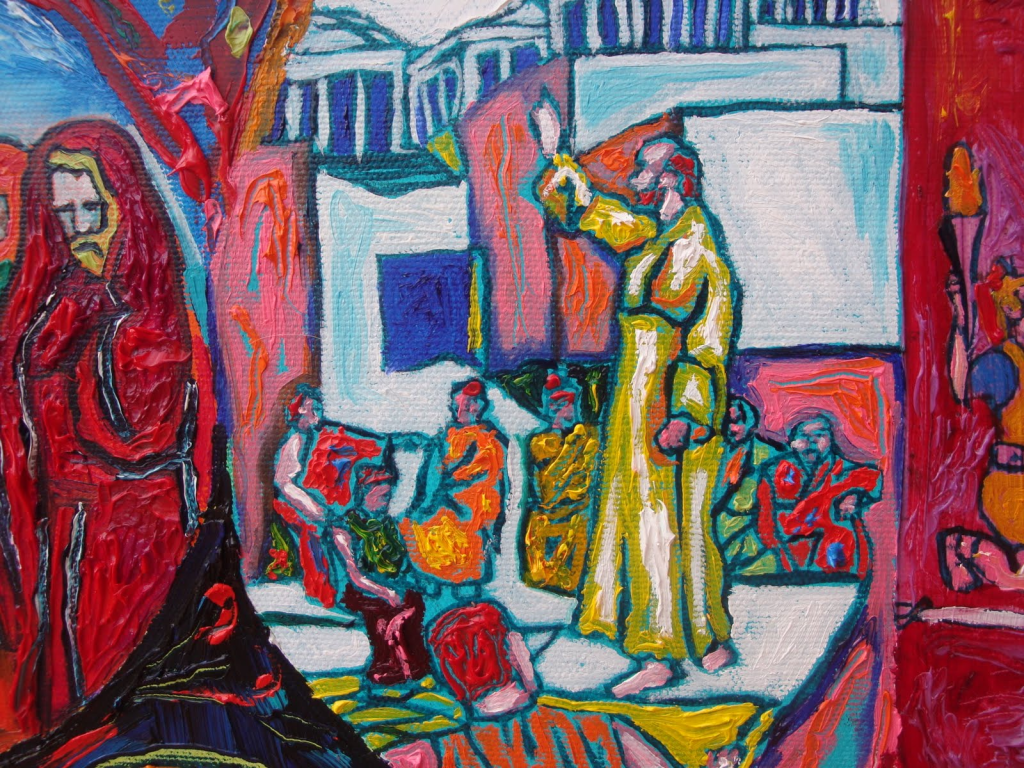
Avoid an Ambush (Acts 23:12-35)

The next morning some Jews formed a conspiracy and bound themselves with an oath not to eat or drink until they had killed Paul. More than forty men were involved in this plot. They went to the chief priests and the elders and said, “We have taken a solemn oath not to eat anything until we have killed Paul. Now then, you and the Sanhedrin petition the commander to bring him before you on the pretext of wanting more accurate information about his case. We are ready to kill him before he gets here.”

But when the son of Paul’s sister heard of this plot, he went into the barracks and told Paul.

Then Paul called one of the centurions and said, “Take this young man to the commander; he has something to tell him.” So he took him to the commander.

The centurion said, “Paul, the prisoner, sent for me and asked me to bring this young man to you because he has something to tell you.”

The commander took the young man by the hand, drew him aside and asked, “What is it you want to tell me?”

He said: “Some Jews have agreed to ask you to bring Paul before the Sanhedrin tomorrow on the pretext of wanting more accurate information about him. Don’t give in to them, because more than forty of them are waiting in ambush for him. They have taken an oath not to eat or drink until they have killed him. They are ready now, waiting for your consent to their request.”

The commander dismissed the young man with this warning: “Don’t tell anyone that you have reported this to me.”

Then he called two of his centurions and ordered them, “Get ready a detachment of two hundred soldiers, seventy horsemen and two hundred spearmen[a] to go to Caesarea at nine tonight. Provide horses for Paul so that he may be taken safely to Governor Felix.”

He wrote a letter as follows:

Claudius Lysias,

To His Excellency, Governor Felix:

Greetings.

This man was seized by the Jews and they were about to kill him, but I came with my troops and rescued him, for I had learned that he is a Roman citizen. I wanted to know why they were accusing him, so I brought him to their Sanhedrin. I found that the accusation had to do with questions about their law, but there was no charge against him that deserved death or imprisonment. When I was informed of a plot to be carried out against the man, I sent him to you at once. I also ordered his accusers to present to you their case against him.

So the soldiers, carrying out their orders, took Paul with them during the night and brought him as far as Antipatris. The next day they let the cavalry go on with him, while they returned to the barracks. When the cavalry arrived in Caesarea, they delivered the letter to the governor and handed Paul over to him. The governor read the letter and asked what province he was from. Learning that he was from Cilicia, he said, “I will hear your case when your accusers get here.” Then he ordered that Paul be kept under guard in Herod’s palace. (New International Version)

An “ambush” is a sudden and unexpected attack from a concealed position. In the Apostle Paul’s case, there were those looking to ambush in order to kill him.

Some Jerusalem Jews were determined to be rid of Paul. They demonstrated their commitment by taking a solemn oath to not eat or drink until they killed the Apostle – which has always made me wonder, when I read this story, if the plotters starved to death, or not, when the ambush was foiled.

In retrospect, I hope the would-be assassins saw how stupid it is – in more ways than one – to make an oath of killing someone.

Maybe even more nonsensical is that the oath-takers presented their plan to the Sadducees (the Jewish chief priests and elders) who endorsed the whole thing, signed-off on it, and actually participated in it.

I’ll just make the historical observation that the Sadducees no longer exist today; and they haven’t since the destruction of the Temple in 70 C.E. I grew up with an old rural folk saying that essentially said, “Dumb dogs die young.”

In the end, the nefarious plan of the Jerusalem Jews was foiled by Paul’s nephew. The young lad caught onto the conspiracy, reported it to Uncle Paul, and then to the Roman authorities.

The Roman commander lost no time in providing an impressive display of security in transporting Paul to Ceasarea. There, the Roman official Felix received him, along with a letter from the commander.

Once in Ceasarea, Felix promised Paul a fair hearing when his accusers arrived. In the meantime, Paul was kept under house arrest. The planned ambush was thus averted, and Paul was securely in Roman custody.

Unfortunately, there are people in this world who twist even their own religious ethics in order to justify violence – going so far as to ambush an innocent person to prevent an unwanted agenda (in this case, the Christian faith) from making inroads into society.

It will not do for any of us to believe that we are immune from trouble in the form of an ambush – whether the ambush is a literal physical one, or mental, emotional, or spiritual.

Gaslighting is a sinister form of mental ambush; a group bullying and threatening an individual is a horrible emotional ambush; and I personally have been the victim of, or diverted, many a spiritual ambush from disgruntled parishioners over the years who wanted my ministry finished.

Yet, many of our emotional ambushes are much more subtle. We might not realize, until later, that we’ve been had by one. Many times the ambush is couched in language of flattery, such as:

  • “We’re depending on you.”
  • “You’re the only one who can do this.”
  • “You did such a good job last time.”
  • “I’m counting on you.”

Or the statements can be more blunt:

  • “Don’t mess this up. A lot is riding on you.”
  • “If you don’t do it, everyone will be disappointed; everything will go to hell.”
  • “You’ve done it before. You have to do it again.”
  • “Don’t make me look bad, or else.”

Please remember the following whenever you find yourself in the crosshairs of an ambush:

  1. You are under no obligation to do whatever another person says.
  2. Take a deep breath and respond from the core of your being instead of from your fear and anxiety.
  3. There are 7 billion people on this earth. Everything doesn’t depend on you.
  4. You have the freedom to say, “No,” without having to explain why or justify it.
  5. Call a spade a spade. If you walk into an ambush, call it for what it is, and report it to the proper persons. It’s really okay to do that.

The more we can connect with what is of most value to us, the greater we can make decisions we’re able to live with, even in the moment.

What’s more, it’s possible to prepare ahead of time for a potential ambush, simply through consistent daily growth in wisdom and knowledge.

Be safe. Be strong. Be spiritual. We are all in this life together.

Yet Another Conflict (Acts 21:27-39)

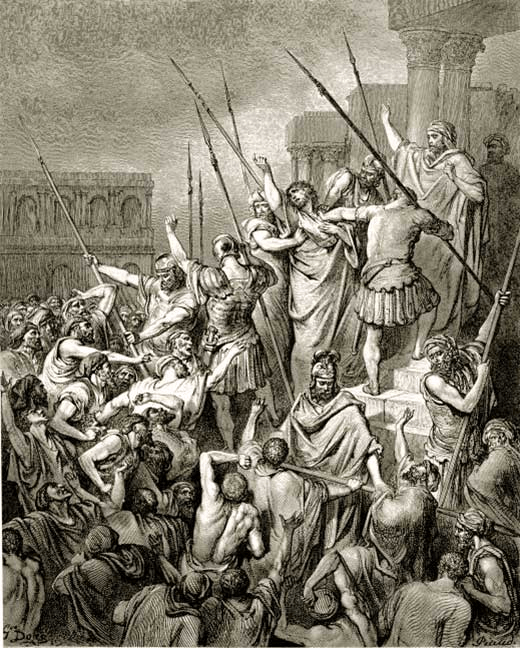
Apostle Paul in Jerusalem, by Gustave Doré, 1878

When the seven days were nearly over, some Jews from the province of Asia saw Paul at the temple. They stirred up the whole crowd and seized him, shouting, “Fellow Israelites, help us! This is the man who teaches everyone everywhere against our people and our law and this place. And besides, he has brought Greeks into the temple and defiled this holy place.” (They had previously seen Trophimus the Ephesian in the city with Paul and assumed that Paul had brought him into the temple.)

The whole city was aroused, and the people came running from all directions. Seizing Paul, they dragged him from the temple, and immediately the gates were shut. While they were trying to kill him, news reached the commander of the Roman troops that the whole city of Jerusalem was in an uproar. He at once took some officers and soldiers and ran down to the crowd. When the rioters saw the commander and his soldiers, they stopped beating Paul.

The commander came up and arrested him and ordered him to be bound with two chains. Then he asked who he was and what he had done. Some in the crowd shouted one thing and some another, and since the commander could not get at the truth because of the uproar, he ordered that Paul be taken into the barracks. When Paul reached the steps, the violence of the mob was so great he had to be carried by the soldiers. The crowd that followed kept shouting, “Get rid of him!”

As the soldiers were about to take Paul into the barracks, he asked the commander, “May I say something to you?”

“Do you speak Greek?” he replied. “Aren’t you the Egyptian who started a revolt and led four thousand terrorists out into the wilderness some time ago?”

Paul answered, “I am a Jew, from Tarsus in Cilicia, a citizen of no ordinary city. Please let me speak to the people.” (New International Version)

The Apostle Paul arrived in Jerusalem, after a sojourn in Greece and the province of Asia. He had been gathering a collection for the believers in need. In his journey, Paul received messages, warnings, and even prophecy that he would be arrested if he went to Jerusalem.

Since the prophecy did not tell Paul to stay away, he kept going, ready not only to be arrested but to also die for his faith, if need be. (Acts 21:10-14)

Iron handcuffs (chains) from the Roman Empire, Archaeological Museum in Durrës, Albania

The first week of being Jerusalem entailed the status quo for Paul: He dealt with yet another church conflict between Jews and Gentiles. Then, the prophecy began to unfold and become reality.

Jews from Asia, who had seen Paul in the Temple and recognized him as a Christian agitator, immediately jumped to the conclusion that Paul was up to no good. It appeared to them that Paul had taken a Gentile into the Temple, thus defiling it, which in fact, he had not.

But when you have a grudge against someone, and an axe to grind, you begin making mental correlations and causations that aren’t really there.

So, the Jews from Asia got the crowd all stirred up by judging Paul as a person who teaches everyone everywhere against the people, the law, and the Temple. In other words, they accused Paul of being anti-Semitic and fomenting violence against the Jews.

Ironically, however, that is just what the Asian Jews did themselves. Without just evidence, they evoked the crowd’s emotions enough to drag Paul from the Temple. And they weren’t inviting him to tea. It seems they had every intention of doing him in, and not by throwing sugar cubes at him.

The only thing that stopped a death that day was the Roman authority getting in between Paul and the crowd. As per the prophecy, Paul was arrested and bound with chains.

The crowd had turned so riotous that the Roman commander could not ascertain Paul’s identity. The mob became violent, so Paul was whisked away by the Roman soldiers. As he left, the shouts of “Away with him!” could be heard throughout the city.

Jesus had a similar experience, but went to his death without any opportunity for a defense speech before an angry crowd.

Paul requested, however, to address the mob. And the Roman commander was aghast to learn that Paul spoke Greek – supposing that he was just another annoying religious nut on the street corner who got up into everyone’s grill a bit too much.

Yet, the commander quickly discovered that he was dealing with a citizen of the Empire who was no kooky preacher. Here we see a turn of events and a flip-flop between two groups of people.

It’s the Roman army who upheld proper justice and protected the interests of the individual; whereas the Jewish crowd became vigilante, ironically violating their own law by trying to put an innocent person to death without justification.

In a twist of history, the Roman arrest of Paul was his deliverance from a Jewish mob. Go figure.

Today’s story opens for me a set of questions that are both genuine, as well as a bit rhetorical:

  • How often do we – as both individuals and churches – accuse others of being unfaithful and/or unbiblical, when it is we ourselves who are going rogue from Holy Scripture?
  • In what ways do we handle false charges, judgmentalism, and unjustified criticism from others who misunderstand and/or misinterpret us?
  • What do we do (and not do) whenever there are differences within the church, family, community, workplace, or nation?
  • Does our manner of approaching conflict include the verbal violence of gossip and slander and/or actual physical violence through passive-aggressive behavior?
  • Am I looking too closely and/or critically under the hood of your soul? What will you do with me, let alone Jesus?

If you can receive this, I recommend taking some time and space today for answering those questions honestly through writing them in a journal and/or talking about them with a trusted friend.

May God have mercy upon our human institutions, societies, and relationships. To God be the glory. Amen.

Our Riches In Christ (Colossians 2:1-5)

I want you to know how hard I am contending for you and for those at Laodicea, and for all who have not met me personally. My goal is that they may be encouraged in heart and united in love, so that they may have the full riches of complete understanding, in order that they may know the mystery of God, namely, Christ, in whom are hidden all the treasures of wisdom and knowledge. 

I tell you this so that no one may deceive you by fine-sounding arguments. For though I am absent from you in body, I am present with you in spirit and delight to see how disciplined you are and how firm your faith in Christ is. (New International Version)

When you already have everything you need, it’s useless – and can even be damaging – to indulge in listening to fine sounding arguments about how you are missing out, lacking something, and/or falling short in some way.

For the Christian, the truth is: You now possess God’s treasure chest of wisdom and knowledge in Christ Jesus. So, why would you ever let someone deceive you through slick persuasion about having something superior to what you already have?

“Heresy” is really nothing more than making a bold claim to an alternative theological understanding than what you presently adhere to.

In some cases, an existing belief system is inferior and bogus. So, it’s a good thing when someone turns from bad religion in order to embrace a religion which is life-giving, helpful, and good.

Yet, if we already have a belief which is robustly full of righteousness and justice, and is good for the common life of everyone in the community, then it is dangerous to consider replacing it, or letting it fall into disuse.

The Apostle Paul’s consistent and overarching theme throughout his letter to the Colossian Christians is that Jesus Christ is sufficient, he is enough – more than enough – for our life and salvation.

That means the task of the Christian is to hold on to and cultivate what already has been taught to them according to apostolic tradition (that is, the Scriptures).

Another way of putting the matter: Learn to appreciate and enjoy what you already have, because it really is worth exploring, living into, and celebrating.

So, let’s put away any notions that standing firm in the faith involves defending your own personal brand of the Christian life (which is usually done obnoxiously) or for others to adhere to every jot and tittle of your own dogmatic theology.

To remain steadfast in the faith means primarily to nurture your faith – to actively pursue the spiritual life and concern oneself with the development of the soul. It is, more specifically, to keep on struggling to live into the words and ways of Jesus Christ; and to keep on learning and applying the apostolic teaching which has been passed down to us.

This is not too much to ask. It is reasonable (and biblical) to expect professing believers in Christ to put solid energy into encouraging one another in love and unity by means of sound Christian theology and doctrine.

Genuine and lasting unity depends upon both truth and love. Christians need to be of one mind and one heart, embracing the same values.

My dear wife and I recently celebrated 39 years of marriage together. Someone asked me today how we’ve made it all these years. I said that the main reason is that, although we are extreme opposites in nearly every way, we have both shared the same basic core values throughout our marriage. And that has gotten us through a lot of things.

Love for one another in the church will be maintained when we understand there is nothing being held back from us by God. The mystery of Christ has been revealed. There are no secrets. Solid and lasting relationships are built upon the foundation of truth. Nothing is held back.

We might as well lay bare everything, because it’s eventually going to happen one way or another.

Nothing in all creation is hidden from God’s sight. Everything is uncovered and laid bare before the eyes of him to whom we must give account.

Hebrews 4:13, NIV

If we begin to think the grass is greener on the other side of the fence, then we start listening to other people – perhaps even inviting other lovers into our lives. But the truth is: If I have some delicious fresh fried catfish on my plate, why in the world would I ever settle for a measly can of tuna?

The unity of the Colossian Church was at stake for the Apostle Paul. Just because someone is skilled in the art of persuasion, and can speak a good line, doesn’t necessarily mean that those words are good, right, or just.

There’s nothing wrong with persuasion. In fact, Paul himself was highly skilled in rhetoric and persuasion. At issue is losing sight of the message and focusing solely on the means of communicating the message.

Oftentimes a false teacher who peddles a different message other than apostolic teaching, has a highly believable way about them – which is why folks can be deceived. When one is being charmed, then critical analysis is rarely on their mind.

We can also be self-deceived, deluding ourselves, and talking ourselves into going down a bad path. It is most necessary to evaluate things according to the content rather than the attractiveness of the packaging.

Gifts of speaking and persuasion are good, so long as they are used for good, and controlled by sound thinking and directed by compassionate hearts.

There is no compelling witness for Christ if the church is fragmented and divided. But if we are convinced that our spiritual riches are found in Jesus Christ, then we shall find ways to remain connected and caring.

Therefore, let’s live as if we really believe this.

I always pray to the great and glorious Father, the God of our Lord Jesus Christ. I pray that he will give you the Spirit, who will let you know truths about God and help you understand them, so that you will know him better.

I pray that God will open your minds to see his truth. Then you will know the hope that he has chosen us to have. You will know that the blessings God has promised his holy people are rich and glorious. And you will know that God’s power is very great for us who believe. Amen. (Ephesians 1:17-19, ERV)

The “Fool’s” Speech (2 Corinthians 11:16-33)

I repeat: Let no one take me for a fool. But if you do, then tolerate me just as you would a fool, so that I may do a little boasting. In this self-confident boasting I am not talking as the Lord would, but as a fool. Since many are boasting in the way the world does, I too will boast. You gladly put up with fools since you are so wise! In fact, you even put up with anyone who enslaves you or exploits you or takes advantage of you or puts on airs or slaps you in the face. To my shame I admit that we were too weak for that!

Whatever anyone else dares to boast about—I am speaking as a fool—I also dare to boast about. Are they Hebrews? So am I. Are they Israelites? So am I. Are they Abraham’s descendants? So am I. Are they servants of Christ? (I am out of my mind to talk like this.) I am more. I have worked much harder, been in prison more frequently, been flogged more severely, and been exposed to death again and again. 

Five times I received from the Jews the forty lashes minus one. Three times I was beaten with rods, once I was pelted with stones, three times I was shipwrecked, I spent a night and a day in the open sea, I have been constantly on the move. I have been in danger from rivers, in danger from bandits, in danger from my fellow Jews, in danger from Gentiles; in danger in the city, in danger in the country, in danger at sea; and in danger from false believers. I have labored and toiled and have often gone without sleep; I have known hunger and thirst and have often gone without food; I have been cold and naked. Besides everything else, I face daily the pressure of my concern for all the churches. Who is weak, and I do not feel weak? Who is led into sin, and I do not inwardly burn?

If I must boast, I will boast of the things that show my weakness. The God and Father of the Lord Jesus, who is to be praised forever, knows that I am not lying. In Damascus the governor under King Aretas had the city of the Damascenes guarded in order to arrest me. But I was lowered in a basket from a window in the wall and slipped through his hands. (New International Version)

Paul escaped the city of Damascus by being lowered in a basket at night (Acts 9: 23-25)

At this point in the Apostle Paul’s second letter to the Corinthian Church, he levels a direct and devastating attack on his proud, arrogant, and boastful opponents in the church. He points out the foolishness of their boasting, by means of playing the fool himself.

The gist of Paul’s argument was to boast of his humiliating experiences. In truth, Paul had plenty of glorious accomplishments he could have droned on about. Instead, he sought to expose the wide gulf that separated his understanding of apostolic ministry, and theirs.

With some rather hefty sarcasm behind his words, Paul offered some foolish boasting according to the human standards of his opponents. The Corinthians believed themselves to have superior strength and wisdom. Surely, they’re able to put up with these pathetic apostolic weaklings!

In reality, it is Paul’s weakness – and not humanly contrived understandings of strength – which establish his credibility and superiority as a minister of Christ’s gospel. The evidence is his hardships and trials – not his many triumphs. Paul intended for this irony to be felt by the Corinthians.

The Apostle’s litany of woes and adversities wasn’t meant to one-up the Corinthians. Rather, it was intended to be a parody of the Corinthians’ claims to superior wisdom and spiritual power.

While the church boasted of all the things that showed their strength, Paul boasted of his weaknesses – because it’s truly in weakness that the transcendent power of God is made known and manifested in this world.

Paul’s experience in Damascus not only illustrated the extreme danger he was in, but it served as an example of his weakness in contrast to the mighty strength of the Roman Empire.

In the Roman army, the soldier with the greatest strength and valor was the one who scaled the enemy wall first. The courageous ascent of the Roman soldier is viewed alongside the inglorious descent of Paul along the wall in escaping.

Christianity grew, flourished, and thrived not because of superior earthly strength, but because of humiliating weakness which allowed the power of heaven to work through it.

In light of Paul’s view of leadership and ministry, I find that many contemporary leadership theories are woefully lacking in an understanding of how people tick.

For example, some philosophies treat humans as if they were machines, and treat workers as cogs or parts in a larger mechanistic worldview, as if they could be replaceable.

Yet, leadership that relies on the factory system will inevitably demean a person’s basic humanity and see nothing of their inherent uniqueness and deserving of respect.

Instead, a more biblical, compassionate, and practical leadership style discerns that relationships are key; and that individual persons bring something special to their work, even if they are doing the same job as others.

In this understanding of leadership, every single person does their work or ministry in a way that isn’t fully reproducible by others. Our individual human uniqueness ensures that our place in the world is needed, and that what we bring to every endeavor we do is a special one-of-a-kind offering that no one else can do.

What’s more, in this view of leadership, there’s no room for boasting, at all. And no place for arrogant pride, because boasting is based upon comparison.

If every person is a unique creation of God, and everyone brings something individually special to their efforts, then comparison is a foolish waste of time, and boasting is nothing more than a fool’s game.

You can always tell the fool by how they keep talking and cannot keep their mouth shut about all of their accomplishments and everything they know. If they believe they’re right, and try and prove it with their comparative superiority to others, then you can bet that what you have in front of you is a card-carrying honest-to-goodness genuine Fool, with a capital “F.”

We can do better. And we can be better leaders and offer better leadership philosophies which are based in humility, the value of each person, sound relationships, and effective peacemaking.

Anything less than that will likely get a sarcastic comment from the Apostle Paul in heaven.

Give us, O God,
leaders whose hearts are large enough
to match the breadth of our own souls;
and give us souls strong enough
to follow leaders of vision and wisdom. Amen.