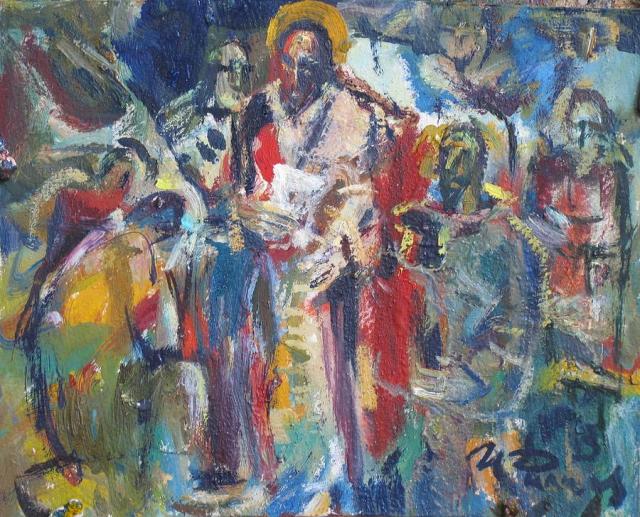
Acts 28:23-31 – Focused on Mission

Apostle Paul by Ivan Filichev

They arranged to meet Paul on a certain day and came in even larger numbers to the place where he was staying. He witnessed to them from morning till evening, explaining about the kingdom of God, and from the Law of Moses and from the Prophets he tried to persuade them about Jesus. Some were convinced by what he said, but others would not believe. They disagreed among themselves and began to leave after Paul had made this final statement: “The Holy Spirit spoke the truth to your ancestors when he said through Isaiah the prophet:

“‘Go to this people and say,
“You will be ever hearing but never understanding;
    you will be ever seeing but never perceiving.”
For this people’s heart has become calloused;
    they hardly hear with their ears,
    and they have closed their eyes.
Otherwise they might see with their eyes,
    hear with their ears,
    understand with their hearts
and turn, and I would heal them.’

“Therefore, I want you to know that God’s salvation has been sent to the Gentiles, and they will listen!”

For two whole years Paul stayed there in his own rented house and welcomed all who came to see him. He proclaimed the kingdom of God and taught about the Lord Jesus Christ—with all boldness and without hindrance! (New International Version)

The Apostle Paul took quite a licking throughout his Christian life. Incredibly, Paul not only physically survived whippings, beatings, stoning, arrests, shipwreck, and imprisonment – he also came through it all with a robust spirit and a dogged determination to live his life with purpose and mission.

Acts 28 is the final chapter in the book. Paul is in Rome under house arrest. Even in this situation, he kept finding ways to engage others. Since he couldn’t go to them, he had others come to him – lots of them.

Paul described to the visitors his own experience of encountering the risen Christ. He reasoned with his fellow Jews and vigorously debated with them from the Scriptures. It was always the deep desire and hope of Paul that his own people come to faith in Christ, just as he had. Although some did, most didn’t.

Many decades ago, my grandfather was approached by one of his friends about investing in a new insurance company startup. For a lot of reasons, grandpa ended up not participating in his friend’s venture. So, the friend asked others. Eventually, the startup happened and steadily grew. Today, Nationwide Insurance has over 250 billion dollars of assets. Good old gramps just didn’t know what he was rejecting.

The good news of Jesus Christ, I believe, is worth infinitely more than an insurance company. Christian mission, I believe, is worth investing my life into. I’m glad the gospel was proclaimed to Gentiles because I am a recipient of such grace. And I’m grateful that Paul tenaciously kept interacting with people for the last two years of his life under arrest.

Despite, and even because of, Paul’s sufferings and his house arrest, the message of faith and forgiveness in Christ was confidently and consistently presented to a steady flow of people, including the highest heads of state. Difficulties are no problem for God. The Lord bends all circumstances to divine and good purposes, creating new avenues of faith, hope, and love that wouldn’t be possible under “normal” times.

“He is no fool who gives what he cannot keep to gain that which he cannot lose.”

Jim Eliot

In fact, Paul endured five years of imprisonment: two in a Caesarea jail; two under house arrest in Rome; and nearly a year in transport between the two cities. For a personality like Paul, we might imagine this would drive him nuts. Yet, several letters to the churches, now contained in the New Testament, were written during that time.

Whether we like it, or not, nothing proves, affirms, and grows our faith quite like our willingness to endure suffering for the gospel. Witness, suffering, and martyrdom are inextricably bundled together in God’s economy. When suffering is viewed as a necessary means to an altruistic and noble end, then, although the pain is no less real, there is the opportunity for both willing endurance and genuine joy.

Paul was willing to labor on behalf of people who were very different from himself. His concern was for all people everywhere – both his own people, the Jews, as well as Gentiles. Paul never gave in and never gave up. He had a magnanimous spirit and even greater spiritual gifts. He willingly and gladly used that spirit and gifts for the benefit of humanity.

In 64 C.E. Paul was condemned and executed. Before his death, he wrote that he had fought the good fight, finished the race, and kept the faith. Now, the next generations of new believers must follow in his footsteps and continue the work

This is precisely why the book of Acts ends so abruptly, with no resolution, no tidy conclusion – because the work is still being done and will carry on until Christ returns.

Gracious and loving God, you work everywhere reconciling, loving, and healing your people and your creation. In your Son Jesus, and through the power of your Holy Spirit, you invite each of us to join you in your work. We ask you to form us more and more in your image and likeness, through our prayer and worship of you and through the study of Holy Scripture so that our eyes will be fully opened to your mission in the world. Then, God, into our communities, our nation, and the world, send us to serve with Christ, taking risks to give life and hope to all people and all of your creation, through Jesus Christ our Lord.. Amen.

Philippians 1:18-26 – Do What’s Most Important

A mosaic of the Apostle Paul, Ravenna, Italy, 5th century C.E.

But what does it matter? The important thing is that in every way, whether from false motives or true, Christ is preached. And because of this I rejoice.

Yes, and I will continue to rejoice, for I know that through your prayers and God’s provision of the Spirit of Jesus Christ what has happened to me will turn out for my deliverance. I eagerly expect and hope that I will in no way be ashamed but will have sufficient courage so that now as always Christ will be exalted in my body, whether by life or by death. For to me, to live is Christ and to die is gain. If I am to go on living in the body, this will mean fruitful labor for me. Yet what shall I choose? I do not know! I am torn between the two: I desire to depart and be with Christ, which is better by far; but it is more necessary for you that I remain in the body. Convinced of this, I know that I will remain, and I will continue with all of you for your progress and joy in the faith, so that through my being with you again your boasting in Christ Jesus will abound on account of me. (New International Version)

So, what do you think leads to disunity in any group, whether in a church or elsewhere?….

Yes, unfortunately, there are many things which can divide a group of people. Chances are that discord comes from a lack of listening and love. And behind that lack is a spirit that desires attention and accolades. In other words, there cannot be unity whenever everyone wants to take credit for what’s good and blame others for what’s bad.

The Apostle Paul, writer of the letter to the Philippian Church, had a humble self-effacing approach to ministry. Paul knew exactly what was important to him and the advancement of the Church, namely, that Jesus Christ is proclaimed, that the good news of grace and forgiveness in Christ is given to people.

“The two most important days in your life are the day you are born and the day you find out why.”

Mark Twain

And so, for Paul, his purpose was crystal clear. Although he really didn’t like bad attitudes and impure motives, if the message of Christ was preached, that was of upmost significance. It didn’t matter to him if people took credit for his work, or not. Not a lot of people can say that.

The Apostle focused on himself. Ultimately, we cannot control anyone; we can only practice self-control. And that is exactly what Paul did. Notice that in today’s New Testament lesson, Paul expressed his own desire to live a life of hope, courage, and selfless ministry. He understood that all the troubles he had experienced up to this point, would likely keep happening in this earthly life.

Paul could have started a new apostles’ retirement community, stepped out of the fray, and simply studied Torah all day. It’s probably what he really wanted to do. But Paul knew better. He knew it was better for all the churches he planted that he keep laboring on their behalf.

Even though Paul was ready to die and be with his Savior forever, he wasn’t going to grab control that wasn’t his. Someday he would die, or Christ will return before that time. Until then, he was going to do his darndest to ensure the gospel of Jesus is spread far and wide.

A spiritually healthy believer in Jesus both longs for heaven and Christ, and also puts their head down and faithfully plugs away with listening to others and loving them to Jesus with gracious words of forgiveness and merciful acts of kindness.

I imagine when Paul wrote this letter, he was downright tired. I can relate. Laboring day after day as a hospital chaplain and a church pastor often leaves me with little rest and carrying the emotional burdens of both places. There are so many people who need basic human kindness, common decency, and focused encouragement. And they don’t get it because there are far too many people far too absorbed in maintaining mastery of their very small worlds.

“The unexamined life is not worth living.”

Socrates

There are days I’d like nothing more than retreat to the Northwoods of Wisconsin, read and write in a small cabin, and catch fresh walleye for my supper. Maybe that will happen someday, but not today. Today is all we have. Today is the day of salvation. There will not always be Today. Christ is coming. Then it will be tomorrow. And tomorrow is too late for too many people.

So, I continue, working with all the energy (or lack thereof) which the good Lord gives me. After all, we are not God. Everyone on this planet has only a finite amount of energy and life. The question then becomes, How will you spend your energy and your finite resources?

I suggest we take our cues from good old Apostle Paul and not bad old Jacob Marley, who didn’t get the picture until it was too late. I’d rather live right, die well, and enjoy eternity – instead of living like a peacock, dying kicking and screaming, and having a miserable eternity.

In this Advent season, we have the opportunity to focus on what’s most important, then live with those priorities in the next year.

May it be so, to the glory of God.

Galatians 3:23-29 – A Ministry of Equals

Until the time when we were mature enough to respond freely in faith to the living God, we were carefully surrounded and protected by the Mosaic law. The law was like those Greek tutors, with which you are familiar, who escort children to school and protect them from danger or distraction, making sure the children will really get to the place they set out for.

But now you have arrived at your destination: By faith in Christ, you are in direct relationship with God. Your baptism in Christ was not just washing you up for a fresh start. It also involved dressing you in an adult faith wardrobe—Christ’s life, the fulfillment of God’s original promise.

In Christ’s family there can be no division into Jew and non-Jew, slave and free, male and female. Among us you are all equal. That is, we are all in a common relationship with Jesus Christ. Also, since you are Christ’s family, then you are Abraham’s famous “descendant,” heirs according to the covenant promises. (The Message)

Ever since the fall of humanity, people have had the predilection to organize themselves in groups that keep them distinct from other groups. Whether it is high school peer groups or office politics; whether class warfare or church cliques; there has always existed a tendency to think better about the groups we identify with, and to look down and believe the worst about those we don’t understand or just don’t plain like.

Jesus is the person who changes it all. Faith in Christ Jesus is what makes each of us equal with each other, whether Jew or a Greek, in bondage or in freedom, a man or a woman. The cross of Christ not only brought deliverance from sin, death, and hell; the work of Jesus Christ ushered-in a new egalitarian society.

I’m not sure the English translations of the Apostle Paul’s phrasing to the Galatian Church can truly capture his emphatic pathos about this issue. For Paul, Christ’s cross has done so much more than bring personal salvation; it has completely eradicated prejudice, discrimination, and division. 

Therefore, the Church is to be the one place on earth where divisions no longer exist. It is to be a foretaste of heaven. The Church is to be a new society, a community of the redeemed, based in equity, diversity, and inclusion, from every people group, race, ethnicity, and gender. Together as one, just as God is One, the Church lives the kingdom values of Christ’s words and ways in a fragmented world.

Since the ground is level at the cross, we are to live into Christian unity with a humble attitude and loving actions. To do otherwise is to be immature. We (hopefully) expect kids to be kids and not be like adults. They need teaching, training, and tutoring to learn. When kids grow up and get into adulthood, we then expect them to be like an adult. If they continue in childish behavior, they are immature.

Many adult Christians are still stuck in spiritual childhood. The evidence of this is seen in trying to stratify church society into insiders and outsiders, those who have always been in the church and newcomers who haven’t, the committed servants and the lax pew sitters.

Rather than all of that dividing of people, energy is to be placed with living into the egalitarian society inaugurated by Jesus (and Paul). Not taking women’s leadership seriously, avoiding relationships with the poor, and being xenophobic all come from a place of immaturity. It is childish behavior. Jesus expects better.

Embracing an egalitarian society neither means we are all the same nor should act alike. The diverse backgrounds and experiences of people help make a rich mosaic of support for one another in the Body of Christ.

Being egalitarian means all people are created in the image and likeness of God – no exceptions. All persons, therefore, deserve morally equal treatment, respect, and justice. A just and good Christian ethic ensures all believers are handled with love, given sound instruction, and are free to explore their gifts and abilities within the church.

Church, at its heart, is a community of equals. Thus, the church, as an egalitarian community, must actively reject racism, sexism, and all forms of discrimination while purposefully seeking ways to create and maintain a unified community without divisions.

Jesus reached out to the misfits and marginalized in society who were suffering from political, cultural, gender, and religious oppression and discrimination. The community of persons Christ formed included people of all ages and backgrounds. Children were welcome. Women sat down with men to learn and became active participants alongside one another.

Christ’s conversation with the Samaritan woman at the well, the parable of the good Samaritan, and the healing of the daughter of the Canaanite woman, all illustrate that ministry is to reach beyond our own familiar group. In short, Jesus practiced a radical hospitality.

Christians would do well to emulate their Lord, as well as take their cues on ministry from Paul, who grounded both his theory and practice in a Trinitarian theology of equals.

Gracious God, you have abolished barriers through the redemption of Christ.  Prevent me from erecting walls that would divide and use me to be a bridge so that others may experience equality in Jesus.  Amen.

Romans 15:1-6 – The Responsibility of the Powerful

We who are powerful need to be patient with the weakness of those who don’t have power, and not please ourselves. Each of us should please our neighbors for their good in order to build them up. Christ didn’t please himself, but, as it is written, The insults of those who insulted you fell on me. Whatever was written in the past was written for our instruction so that we could have hope through endurance and through the encouragement of the scriptures. May the God of endurance and encouragement give you the same attitude toward each other, similar to Christ Jesus’ attitude. That way you can glorify the God and Father of our Lord Jesus Christ together with one voice. (Common English Bible)

“With great power comes great responsibility.”

Stan Lee

Within the ancient church in Rome there existed people of Jewish descent as well as non-Jews (Gentiles) who had come to embrace Christ. These two groups had vastly different backgrounds and experiences. Now they found themselves within one church, with only their shared commitment to Jesus.

Getting along was downright hard. It took a great deal of work for them to understand one another. Throughout the Apostle Paul’s letter to the believers in Rome, he consistently went back and forth, addressing both groups.

Frankly, Paul was most difficult on his fellow Jews. He took them to task. In his view, the Jewish believers had a responsibility to set a tone of Christian equality and fairness. Since the Jewish people have such a rich spiritual history as God’s people, it was Paul’s admonition they use their power on behalf of the non-Jewish Gentiles.

There were some Jewish believers who believed it best that the non-Jewish believers become religiously Jewish. They thought that Gentiles, with no background whatsoever in Old Testament belief and practice, would need to be like them in order to become good Christians.

Paul passionately believed otherwise. The Jewish position of privilege was to be used to encourage and help, not criticize and make things more difficult for non-Jewish persons. Jesus, a Jew himself, did this during his life and ministry on earth.

It came down to a belief of whether Jews ought to hold positions of power within the church, or that power should be shared. As it still is today, it was then with the Jewish people: They have carried an inordinate burden of the world’s sin upon their shoulders. Paul wanted them to continue this special calling – not taking advantage of an opportunity to be on top – but embracing their call for the sake of Christ’s gospel.

Whether Jew or Gentile, all together were to make every effort to do what leads to peace and the encouragement of one another. Those with power were to make room at the table (and Table!) for those without power.

The ideal which Paul so adamantly struggled for was unity – to have both Jew and Gentile together as sisters and brothers in the faith. There was never to be two churches – one Jewish and one Gentile. Christ’s death had abolished all barriers to unity. Now, everyone must come together and re-orient their lives around the good news of new life in Christ. (Ephesians 2:11-22)

Since Jesus closely identified with others, now we, his followers, are to demonstrate a genuine spirit of care and welfare for all people. This is a new family relationship which did not exist before Christ. God, however, has adopted all kinds of non-Jewish people into the family. So, we have responsibilities to get along with each other.

It must always begin with those who possess the power and privilege. They have the first responsibility to initiate an egalitarian society. The onus is on the powerful to ensure that a fully inclusive Christian ethic is established and maintained. We are to welcome others just as Christ welcomed us.

The Christian ethic of welcoming, encouraging, and including is helped by being mindful of the following:

  • Listen more. Talk less. A particular temptation for those with power is to make decisions without consulting or collaborating. Basic human respect comes from listening – neither interrupting nor overtalking. The less powerful folks need to be heard. Give them a seat at the table and honor them with your ears.

People who listen when they are corrected will live, but those who will not admit that they are wrong are in danger. (Proverbs 10:17, GNT)

  • Be curious. Respect another’s contribution. Be welcoming and open, whether or not you agree. Seek understanding rather than always trying to be understood. “Tell me more.” “Help me understand.” And “I’d like some clarification…” are all simple phrases of healthy curiosity which invites others to talk.

The people in Berea were more open-minded than those in Thessalonica. They were so glad to hear the message Paul told them. They studied the Scriptures every day to make sure that what they heard was really true. (Acts 17:11, ERV)

  • Don’t assume. Not everyone has had the same experiences. We don’t all know the same things. Take the posture of a learner. Be something of an anthropologist, seeking to discover rather than superimpose what you already believe on a different group of people.

Don’t fool yourselves! If any of you think you are wise in the things of this world, you will have to become foolish before you can be truly wise. (1 Corinthians 3:18, CEV)

  • Be aware of your own biases. We all have them. It takes some work to uncover our prejudices as well as our privileges.

I solemnly command you in the presence of God and Christ Jesus and the highest angels to obey these instructions without taking sides or showing favoritism to anyone. (1 Timothy 5:21, NLT)

  • Embrace empathy. We all know how it feels to be excluded, left out, and even shamed about something. Let’s use our own experiences to realize what others might be going through. Looking down on another, or dismissing them in some way, is not the way of our Lord.

Laugh with your happy friends when they’re happy; share tears when they’re down. Get along with each other; don’t be stuck-up. Make friends with nobodies; don’t be the great somebody. (Romans 12:15-16, MSG)

  • Focus on connection, not fear. In many groups and in many places, the “other,” the one who is different, is looked upon with suspicion as someone who might upset existing societal norms or steal something we have. Seeking to establish connection with others mitigates fear and anxious feelings.

As many of you as were baptized into Christ have clothed yourselves with Christ. There is no longer Jew or Greek, there is no longer slave or free, there is no longer male and female; for all of you are one in Christ Jesus. (Galatians 3:27-28, NRSV)

  • Be patient with others. People need our gentleness and our humble help, not our judgment and exasperation. Treat others the way you’d like to be treated.

Be humble and gentle in every way. Be patient with each other and lovingly accept each other. (Ephesians 4:2, GW)

“So in everything, do to others what you would have them do to you, for this sums up the Law and the Prophets.”

Jesus (Matthew 7:12, NIV)

That about sums up exactly what Paul intended to say. Now go and do likewise.

O God, in accepting one another wholeheartedly, fully, and completely, we accept you. Fill us then with love and let us be bound together with love as we live our lives, united in this one spirit which makes you present in the world, and which makes you witness to the ultimate reality that is love. Love has overcome. Love is victorious. You are Love. Amen.