The Trumpets of Judgment (Revelation 8:6-9:12)

The seven angels with seven trumpets, and the angel with a censer, c. 1020 C. E.

Then the seven angels who had the seven trumpets prepared to sound them.

The first angel sounded his trumpet, and there came hail and fire mixed with blood, and it was hurled down on the earth. A third of the earth was burned up, a third of the trees were burned up, and all the green grass was burned up.

The second angel sounded his trumpet, and something like a huge mountain, all ablaze, was thrown into the sea. A third of the sea turned into blood, a third of the living creatures in the sea died, and a third of the ships were destroyed.

The third angel sounded his trumpet, and a great star, blazing like a torch, fell from the sky on a third of the rivers and on the springs of water—the name of the star is Wormwood. A third of the waters turned bitter, and many people died from the waters that had become bitter.

The fourth angel sounded his trumpet, and a third of the sun was struck, a third of the moon, and a third of the stars, so that a third of them turned dark. A third of the day was without light, and also a third of the night.

As I watched, I heard an eagle that was flying in midair call out in a loud voice: “Woe! Woe! Woe to the inhabitants of the earth, because of the trumpet blasts about to be sounded by the other three angels!”

The fifth angel sounded his trumpet, and I saw a star that had fallen from the sky to the earth. The star was given the key to the shaft of the Abyss. When he opened the Abyss, smoke rose from it like the smoke from a gigantic furnace. The sun and sky were darkened by the smoke from the Abyss. And out of the smoke locusts came down on the earth and were given power like that of scorpions of the earth. 

They were told not to harm the grass of the earth or any plant or tree, but only those people who did not have the seal of God on their foreheads. They were not allowed to kill them but only to torture them for five months. And the agony they suffered was like that of the sting of a scorpion when it strikes. During those days people will seek death but will not find it; they will long to die, but death will elude them.

The locusts looked like horses prepared for battle. On their heads they wore something like crowns of gold, and their faces resembled human faces. Their hair was like women’s hair, and their teeth were like lions’ teeth. They had breastplates like breastplates of iron, and the sound of their wings was like the thundering of many horses and chariots rushing into battle. They had tails with stingers, like scorpions, and in their tails they had power to torment people for five months. They had as king over them the angel of the Abyss, whose name in Hebrew is Abaddon and in Greek is Apollyon (that is, Destroyer).

The first woe is past; two other woes are yet to come. (New International Version)
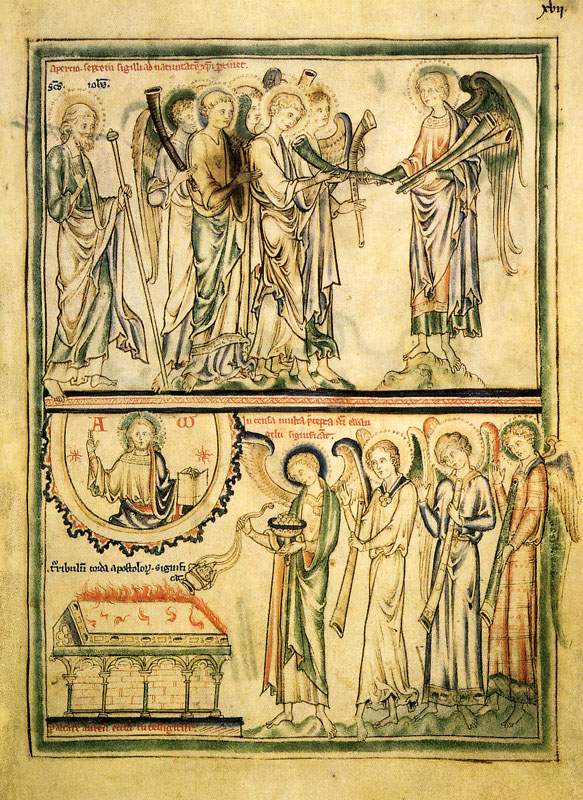
Angels receiving seven trumpets, c. 1255 C.E.

Woah; this isn’t exactly some light bedtime reading. It has to do with the end of all things, with God’s judgment upon the earth. Seven angels with seven trumpets are about to sound them with disastrous results. The last three trumpets are also referred to as the three woes upon the earth.

The first four trumpets are bad, yet not nearly as terrible as the last three. The first four affect the natural world and one-third of the earth; whereas the last three directly impact the earth’s inhabitants and affect the entire world.

As hard as it may be to accept biblical readings like today’s, God is not only the author of abundant flourishing, but also of devastating destruction. And it’s in direct answer to the prayers of the saints. (Revelation 8:3)

Although hail and blood remind the biblical student of the plagues of judgment in ancient Egypt before the great exodus of Israelites, it’s the fire that does damage to the trees and grass of the earth. A third of the earth’s land resources are completely burned up.

The second angel blowing the second trumpet results in a great mountain being hurled into the sea. This is reminiscent, for those familiar with the Gospels, of Jesus stating that one with a small amount of faith can command a mountain to be thrown into the sea, and it will be done. (Mark 11:23)

Going back into the Old Testament, in the giving of the Law on the mountain, and with the disobedience of the people at the foot of the mountain, Mount Sinai was ablaze with fire and the glory of God. The New Testament scene in Revelation appears to be something of a Mount Sinai taken up and thrown into the sea – signifying that the grace of Christ has supplanted the curse of the law.

As a result of the second trumpet, a third of all the great oceans are destroyed.

Although C.S. Lewis gave the name “Wormwood” to a fictional agent of Satan, the Wormwood here is a messenger of God, a star that falls from the sky as a result of the third trumpet blown. A third of all the earth’s drinkable water becomes bitter because of the star – which seems to be a link to previous times of judgment from God:

“I will make them eat bitter food
    and drink poisoned water,
because from the prophets of Jerusalem
    ungodliness has spread throughout the land.” (Jeremiah 23:15, NIV)

“They have followed the stubbornness of their hearts; they have followed the Baals, as their ancestors taught them.” Therefore this is what the Lord Almighty, the God of Israel, says: “See, I will make this people eat bitter food and drink poisoned water. (Jeremiah 9:14-15, NIV)

There’s nothing that falls from the sky with the blast of the fourth trumpet. Yet a third of the sun, moon, and stars are dimmed. This is a portent that something worse is about to happen – which is what the “eagle” [vulture] announces against the earth’s inhabitants.

Another star falls to the earth, but with even more disaster than the previous star – opening a pit in the heart of the earth. Smoke comes billowing out, darkening the sun. Then, locusts with the stinging power of scorpions, come upon the land.

Rather than humans having authority to trample on snakes and scorpions, these demonic insects carry the ability and the authority to harm humanity – much like the great locust horde of judgment during the time of the prophet Joel (Joel 2:1-11). The difference with John’s Apocalypse is that these are a demonic host with Apollyon the Destroyer leading them.

The previous judgments were from above; this first woe is from below – connecting the powers of death, destruction, and the grave together with the force of evil. It’s a time of sheer torture; a traumatic five months of horrendous agony.

Conclusion

None of these terrible scenes of judgment are meant to scare the hell out of anybody and put the fear of heaven into them. Instead, the New Testament book of Revelation (also known as the Apocalypse of John) is meant for devoted believers in Jesus to be encouraged that an end is coming. They can persevere in following Jesus because it will be worth it.

The hardships, difficulties, and persecutions experienced – for following the words and ways of Jesus – will not last; a time is coming soon when God will judge the living and the dead. Evil will be dealt its final blow. And we will enter a realm of unending peace with the God for whom we have given our all.

Therefore, since we are receiving a kingdom that cannot be shaken, let us be thankful, and so worship God acceptably with reverence and awe, for our “God is a consuming fire.” (Hebrews 12:28-29; Deuteronomy 4:24)

May the Lord answer you in the day of trouble!
    The name of the God of Jacob protect you!
May he send you help from the sanctuary
    and give you support from Zion.
May he remember all your offerings
    and regard with favor your burnt sacrifices. Selah

May he grant you your heart’s desire
    and fulfill all your plans. Amen. (Psalm 20:1-4)

Consider Your Reputation (Revelation 18:1-10, 19-20)

After this I saw another angel coming down from heaven. He had great authority, and the earth was illuminated by his splendor. With a mighty voice he shouted:

“‘Fallen! Fallen is Babylon the Great!’
    She has become a dwelling for demons
and a haunt for every impure spirit,
    a haunt for every unclean bird,
    a haunt for every unclean and detestable animal.
For all the nations have drunk
    the maddening wine of her adulteries.
The kings of the earth committed adultery with her,
    and the merchants of the earth grew rich from her excessive luxuries.”

Then I heard another voice from heaven say:

“‘Come out of her, my people,’
    so that you will not share in her sins,
    so that you will not receive any of her plagues;
for her sins are piled up to heaven,
    and God has remembered her crimes.
Give back to her as she has given;
    pay her back double for what she has done.
    Pour her a double portion from her own cup.
Give her as much torment and grief
    as the glory and luxury she gave herself.
In her heart she boasts,
    ‘I sit enthroned as queen.
I am not a widow;
    I will never mourn.’
Therefore in one day her plagues will overtake her:
    death, mourning and famine.
She will be consumed by fire,
    for mighty is the Lord God who judges her.

“When the kings of the earth who committed adultery with her and shared her luxury see the smoke of her burning, they will weep and mourn over her. Terrified at her torment, they will stand far off and cry:

“‘Woe! Woe to you, great city,
    you mighty city of Babylon!
In one hour your doom has come!…’

They will throw dust on their heads, and with weeping and mourning cry out:

“‘Woe! Woe to you, great city,
    where all who had ships on the sea
    became rich through her wealth!
In one hour she has been brought to ruin!’

“Rejoice over her, you heavens!
    Rejoice, you people of God!
    Rejoice, apostles and prophets!
For God has judged her
    with the judgment she imposed on you.” (New International Version)

Much of the book of Revelation, also known as The Apocalypse of John, is related in symbolic language. The Apostle John had a vision – much like a dream – and saw things that were to come. Like the prophet Ezekiel, experiencing a vision from the Lord is hard to put into words once you’ve experienced it.

John sees and hears the fall of Babylon, that is, the city of Rome. He heard the angel proclaim the empire’s utter desolation and saw what the city would lose. It’s bad news for Rome but good news for the rest of the earth. Drunkenness and sexual immorality are metaphors for the Roman Empire’s crime of acquiring wealth and luxury on the backs of others through imperialism.

What’s more, Rome deceived the nations by causing them to think and believe this economic and religious imperialism was right, good, and needed. So, other city states and nations went to bed with them in this impure and unholy cause. Therefore, divine judgment was coming.

The Fall of Babylon, 15th century artwork

The Apostle John wanted his readers to make a clean break with the Roman Empire and everything it represents. Rome had a “good” reputation with many of the conquered and colonized peoples in the Empire. But, in reality, they had spread evil and encouraged others in their immorality. There was an awfully dark underbelly to Rome’s power and authority that the people of God were invited to see and repudiate.

The issue of reputation is an important one, because how we come across to others might be different than who we actually are.

One day at a parent-teacher conference, many years ago when my middle daughter was in second grade, the teacher told my wife and I about the class reading some Winnie the Pooh books. The kids were to talk about which Pooh character they liked the most and why. Since my sweet daughter is an outgoing and bouncy person, I was certain that she had said that Tigger was her favorite. But instead, she told the teacher her favorite was Eeyore, “because Eeyore reminds me of my Daddy.”

Ouch. I wasn’t ready for that one. Yet, as I thought about my daughter’s answer, I began to see that since I was working as a factory supervisor, going to graduate school at night, and being a part-time church pastor, I was continually drained and tired. So, my daughter experienced me as if I was Eeyore loping about the house with a pinned-on tail.  

Before that parent-teacher conference encounter, I never would have described myself as my daughter did. Obviously, my reputation did not match my self-perception – which leads me to ask a question for you to struggle with: What is your reputation with others? 

The question is not: What do you think your reputation is? That’s because the only way to know your reputation is to interact with other people. And their answers may be very different than what you think they might be.

If there is a clear disconnect between what someone or some group says about you, and what you think is true about you, then please do not dismiss their thoughts or opinions. You may not like what they say, but we need to weigh the words and glean as much wisdom as we can from them.  

Also, if it is a negative perception, or truly off the mark, use the information to help inspire you toward change. And if there are things that you know need changing, think about what kind of reputation you want to have and begin setting some goals for achieving what you want. Begin with the results you want, and then focus on the small steps you can do to gain what you are after.

There is yet one more critical question to ask, and the way you answer it requires the utmost honesty and vulnerability: What is your reputation with God?

As with others, your approach is to be the same, that is, ask God what God thinks about you. Read Holy Scripture and spend time with the Lord. No individual believer or faith community can ever hope to glorify God and have effective ministry unless they are genuine and urgent about where they stand before God and what their reputation is with people outside of church.

Let’s not assume that others do or should think highly of us, of Christians, or of the Church. Ask the questions of reputation. Use them to spawn the kind of interaction that is needed to help address what God wants for your life. 

I did not want to be Eeyore, so I reassessed my use of time so that I could be more fully present to my family. What will it mean for you?

Blessed Holy Spirit, in the name of Jesus, help me to cultivate godly character, thereby building a good reputation. Deliver me from whatever will destroy my reputation. Save the leaders of your church everywhere from the enemy that seeks to damage their reputation. Protect and preserve them, O Lord. Amen.

On the Importance of Hospitality (3 John 9-12)

A mosaic of the Apostle John, at the Monastery of St. John the Theologian, in Patmos, Greece

I have written something to the church, but Diotrephes, who likes to put himself first, does not welcome us. So if I come, I will call attention to what he is doing in spreading false charges against us. And not content with those charges, he refuses to welcome the brothers and sisters and even prevents those who want to do so and expels them from the church.

Beloved, do not imitate what is evil, but imitate what is good. Whoever does good is from God; whoever does evil has not seen God. Everyone has testified favorably about Demetrius, and so has the truth itself. We also testify for him, and you know that our testimony is true. (New Revised Standard Version)

I believe in an egalitarian world. Ideally, humanity is meant to live in equity with one another. Humility, meekness, and gentleness are to be the inner dispositions of a person’s life.

These virtues work themselves out in being concerned for the common good of all, laboring toward just and righteous ways of living for everyone and sharing our lives, as well as our resources, with each other. Viewing one another as equals inevitably leads to gracious hospitality.

However, in a world of power disparities, and privileged inequities, are attitudes of seeking attention, a perceived need to always win and be first, and tight-fisted control of authority and money. The common good of all persons is scaled back to be the concern for the common good of some. There is a failure to regard the weak, poor, and vulnerable as legitimate members of the community.

The Apostle John wrote his short succinct letter in a concern that the church may be following a leader who was taking them down a bad path – a road leading to injustice where power and privilege remain with a few, and perhaps even one. John’s plainspoken exhortation was to judge rightly between what is good and bad, and then imitate the good while forsaking the bad.

Hospitality is the true litmus test between the good and the bad.

An openness to the stranger, the immigrant, the migrant, the alien, the foreigner, the newcomer, and the outsider characterizes authentic fellowship.

Being closed to such persons and having a xenophobic bent to others who are different is the mark of unwelcoming and inhospitable people.

Hospitality serves others, whereas being inhospitable cajoles others to serve our needs.

Jesus, the Lord of all, did not come to this earth for people to serve him. Christ came to serve others, and to give his life to save many people (Matthew 20:28; Mark 10:45; John 13:1-17). We are to imitate the loving service and radical hospitality of the Lord Jesus. He is our example. We are to imitate Christ.

We must have both orthodoxy (right belief) and orthopraxy (right practice). Both go together like a hand in a glove. Good actions are the result of good and proper beliefs. The following are some thoughts about this nexus between belief and practice:

  • Hospitality (literally “love of the stranger”) is a way of life fundamental to orthodox Christianity, based in the person and work of Jesus
  • God is hospitable and loves the outsider, welcoming them into the dance of the Trinity, and provides for them; our human hospitality is to reflect this divine welcome
  • Hospitality means extending to another a kindness typically reserved for family or friends
  • The teaching of the New Testament emphasizes the practice of hospitality (Luke 14:12-14; Matthew 25:31-46)
  • The consistent witness of church history is to lift up and hold Christian hospitality.

“Whatever person you meet who needs your aid, you have no reason to refuse to help them.”

John Calvin

This was no mere theoretical advice for Calvin, whose ministry center of Geneva, Switzerland swelled with French Huguenot refugees fleeing persecution. Calvin, always the theologian, grounded his understanding of hospitality in the divine:

“We should not regard what a person is and what they deserve but we should go higher – that it is God who has placed us in the world for such a purpose that we be united and joined together. God has impressed the divine image in us and has given us a common nature, which should incite us to provide one for the other.”

John Calvin
  • Hospitality is a practice which integrates both respect and care. St. John Chrysostom warned his congregation to show “excessive joy” when offering hospitality to avoid shaming the recipient of care.
  • Biblical hospitality does not need to know all the details of someone’s life before extending care. If Christ forgave and healed those who injured him, how could we neglect even a starving murderer? 
  • True hospitality involves a face-to-face relationship of encouragement and respect – not just a distant giving of alms. Hospitable persons pay attention to others and share life with them.
  • The great twin concerns of hospitality are universalizing the neighbor and personalizing the stranger. One reason why many of the rich have little sympathy for the poor is because they seldom visit them. Hospitality depends on us recognizing our commonalities with strangers rather than our differences.
  • This is how we evaluate our hospitality: Did we see Christ in them? Did they see Christ in me?

Hospitable God:

Give us eyes to see the deepest needs of people.

Give us hearts full of love for our neighbors as well as for the strangers we meet.

Help us understand what it means to love others as we love ourselves.

Teach us to care in a way that strengthens those who are sick.

Fill us with generosity so we feed the hungry, clothe the naked, and give drink to the thirsty.

Let us be a healing balm to those who are weak and lonely and weary by offering our kindness to them.

May we remember to listen, smile, and offer a helping hand each time the opportunity presents itself. And may we conspire to create opportunities to do so.

Give us hearts of courage to risk loving our enemy.

Inspire us to go out of our way to include outsiders.

Help us to be welcoming and include all whom you send our way.

Let us be God’s hospitality in the world. Amen.

Believe, Love, and Obey (1 John 5:1-12)

Everyone who believes that Jesus is the Christ is born of God, and everyone who loves the father loves his child as well. This is how we know that we love the children of God: by loving God and carrying out his commands. In fact, this is love for God: to keep his commands. And his commands are not burdensome, for everyone born of God overcomes the world. This is the victory that has overcome the world, even our faith. Who is it that overcomes the world? Only the one who believes that Jesus is the Son of God.

This is the one who came by water and blood—Jesus Christ. He did not come by water only, but by water and blood. And it is the Spirit who testifies because the Spirit is the truth. For there are three that testify: the Spirit, the water and the blood; and the three agree. We accept human testimony, but God’s testimony is greater because it is the testimony of God, which he has given about his Son. 

Whoever believes in the Son of God accepts this testimony. Whoever does not believe God has made him out to be a liar, because they have not believed the testimony God has given about his Son. And this is the testimony: God has given us eternal life, and this life is in his Son. Whoever has the Son has life; whoever does not have the Son of God does not have life. (New International Version)

Faith, love, and obedience are words so tightly woven together, that to pull one of them out, is to unravel the whole bunch. 

To believe, love, and obey are the true marks of a Christian; and they are vital to living the Christian life and overcoming the dark forces of the world.

Let’s talk some grammar – because it will help us better understand the Apostle John’s message….

The main verb is the main thing

One of the dominant main verbs throughout these verses: “is.” And the verb tense is key, grammatically describing a past action of God which people need to receive. In other words, the grammar dictates that God has given us new birth. 

We do not give ourselves spiritual birth any more than we can tell our mothers that it was us who gave birth to ourselves.

The participles describe the main thing

God saves us from sin and grants us forgiveness. The action is from God to us; we are recipients of God’s good grace toward us.

There are three participles connected to the main verb, “is:”

  1. Believe
  2. Love
  3. Obey

A participle is a word which is connected to the verb’s action. 

Our actions are a result of God’s action toward us.

Simply put, a person born from God will believe, love, and obey.

Just as a newborn baby first breathes, then learns to eat, sleeps, grows-up, learns to walk, and over time develops into an adult just like their mother and father, so the Christian who is born again from God exhibits faith, learns to love, and grows up developing the skills of obeying Jesus and following him, learning to walk in his ways, becoming just like him.

Overcoming the world

In the same way a child must grow and mature to have the necessary skills for facing the world in all its trials and temptations, so the Christian must develop the requisite abilities of faith, love, and obedience, to overcome the world.

To “overcome” is to experience the victory the Lord Jesus has achieved on the cross. 

Through being spiritually born again by God, it sets us on a course requiring faith, love, and obedience in overcoming the world. As we learn to apply these three spiritual characteristics to our lives, we experience practical victory over the world.

The term “world” is used by the Apostle John as the patterns, systems, and operations of the world, which are in direct contrast to how God operates. For example:

  • The world engages in revenge and payback when wronged, whereas the Christian learns to believe God will be the Judge, loves the person who has offended them through prayer for their enemy, and obeys God through good works that seeks the welfare of the other. 
  • The world uses other people as either objects of their pleasure or to get ahead in life, whereas the Christian believes God will take care of their needs, will seek to love the other person instead of use them, and would rather obey God by cutting off their right hand off than being selfish. 
  • The world thinks nothing of lying, cheating, and stealing, if they can get away with it, whereas the Christian believes Jesus is the way, the truth, and the life, loves being a person of integrity, and obeys God even when it hurts.

This in no way suggests we avoid or belittle the world. In overcoming the world, we must have principled civility. Using faith, love, and obedience, we respect another’s viewpoint through allowing our spirits to grow in faith, expanding our hearts in love, and learning obedience through interaction with others for whom we disagree.

Faith, love, and obedience

We need faith in God:

Trust in the Lord with all your heart,
    and do not rely on your own insight.
In all your ways acknowledge him,
    and he will make straight your paths. (Proverbs 3:5-6, NRSV)

We need love for God and others:

Don’t love the world’s ways. Don’t love the world’s goods. Love of the world squeezes out love for the Father. Practically everything that goes on in the world—wanting your own way, wanting everything for yourself, wanting to appear important—has nothing to do with the Father. It just isolates you from him. The world and all its wanting, wanting, wanting is on the way out—but whoever does what God wants is set for eternity. (1 John 2:15-17, MSG)

We need obedience to the call of God:

The commandment that God has given us is: “Love God and love each other!” (1 John 4:21, CEV)

When faith, love, and obedience are working together, as intended, we overcome the world and all its crud; and keep ourselves from being polluted and stained by it.

Overcoming the world is a high calling from God. 

Faith means putting aside fear and taking the kind of risk God wants you to take.

Love means putting aside hate and serving others, even when it hurts.

Obedience means putting aside selfishness and choosing to do what is best for another person’s welfare.

Being characterized by these three Christian virtues will have the effect of overcoming the world. It is not a burdensome or heavy way to live. It’s the way of Jesus.

Blessed God – Father, Son, and Spirit – the Lord whom we serve: Sometimes our hearts and minds are flooded with fears. Sometimes we are paralyzed and overwhelmed and feel unable to go on. Yet, we hold onto the victory you have accomplished through the cross of Jesus Christ. You have told us not to fear, for you have overcome the world. In moments of crippling fear, we choose to hold your hand and believe; to love as we have been loved; and, to obey even in the most fearful places because we know that you have risen again.

Holy Spirit, we invite you and all your ministry within us. Holy God of all, we offer you our heart, mind, body, soul, spirit, hopes, plans and dreams. We surrender to you our past, present and future problems, habits, character defects, attitudes, livelihood, resources, finances, medical coverage, occupation and all relationships. We give you our health, physical appearance, disabilities, disorders, family, marriage, children, grandchildren, and friendships.

Loving Lord Jesus, we surrender to you all our hurt, pain, worry, doubt, fear and anxiety, and ask you to wash us clean. We release everything into your compassionate care. Open our ears to hear your voice. Open our hearts to commune with you more deeply. Open the doors that need to be opened and close the doors that need to be closed. Set our feet upon the straight and narrow road that leads to everlasting life. Amen.