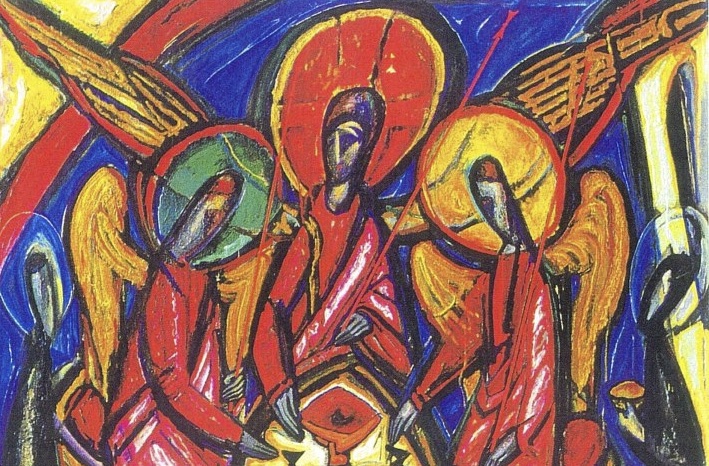
John 5:19-40 – The Centrality of Christ

The Risen Lord by Chinese artist He Qi

Jesus gave them this answer: “Very truly I tell you, the Son can do nothing by himself; he can do only what he sees his Father doing, because whatever the Father does the Son also does. For the Father loves the Son and shows him all he does. Yes, and he will show him even greater works than these, so that you will be amazed. For just as the Father raises the dead and gives them life, even so the Son gives life to whom he is pleased to give it. Moreover, the Father judges no one, but has entrusted all judgment to the Son, that all may honor the Son just as they honor the Father. Whoever does not honor the Son does not honor the Father, who sent him.

“Very truly I tell you, whoever hears my word and believes him who sent me has eternal life and will not be judged but has crossed over from death to life. Very truly I tell you, a time is coming and has now come when the dead will hear the voice of the Son of God and those who hear will live. For as the Father has life in himself, so he has granted the Son also to have life in himself. And he has given him authority to judge because he is the Son of Man.

“Do not be amazed at this, for a time is coming when all who are in their graves will hear his voice and come out—those who have done what is good will rise to live, and those who have done what is evil will rise to be condemned. By myself I can do nothing; I judge only as I hear, and my judgment is just, for I seek not to please myself but him who sent me.

“If I testify about myself, my testimony is not true. There is another who testifies in my favor, and I know that his testimony about me is true.

“You have sent to John and he has testified to the truth. Not that I accept human testimony; but I mention it that you may be saved. John was a lamp that burned and gave light, and you chose for a time to enjoy his light.

“I have testimony weightier than that of John. For the works that the Father has given me to finish—the very works that I am doing—testify that the Father has sent me. And the Father who sent me has himself testified concerning me. You have never heard his voice nor seen his form, nor does his word dwell in you, for you do not believe the one he sent. You study the Scriptures diligently because you think that in them you have eternal life. These are the very Scriptures that testify about me, yet you refuse to come to me to have life. (NIV)

There are many things in this world of great importance: how we govern ourselves as a free people; addressing issues of poverty, disease, education, taxes, healthcare, racism, and international relations; building local community relationships; supporting small business; working to make a decent contributive living; being a responsible citizen; and, loving our families and faith communities. It is my unshakable conviction that all these issues need more than mental and physical attention; they need our spiritual resources. People need the Lord.

Seasons, years, centuries, and even millennia come and go. People are born, live, and die. Generations exist and then are no more. Civilizations rise and fall. Yet, through it all and above it all is Jesus.

Christ is alive, and he continually brings life from dust, beauty from ashes, and everlasting meaning from apparent meaninglessness.

Today, Christ is still on the throne of all creation. 

Human elections and institutions only have authority as given by Jesus, the Ruler of all. Presently, Jesus remains attentive to people, even interceding for us at the right hand of his Father in heaven.  At this very moment, God’s Holy Spirit roams the earth and continues to apply all the redemptive consequences of Christ’s cross mysteriously and graciously to the lives of millions. 

Sometimes we need to do the occasional spiritual fact check, to remember what is really of ultimate significance in this old broken world.  If people need the Lord, then it only makes sense to live in ways that foster connection with Jesus. 

So, this morning I did what I do every morning: I began the day with Scripture reading, prayer, reflection, and gratitude – all done with the realization that Christ’s authority is real and pervasive, and his reign is supreme.

No matter the Christian tradition, Jesus Christ is the exalted and glorified Son of God, the Sovereign authority over every dominion. Jesus is God. God the Father works through God the Son. The works of Jesus bear testimony to the cosmic reality that he is Lord of all. And, if that were not enough, Jesus shares his divine power with us, his people.

In the face of the greatness and majesty of the Lord Jesus, the only valid and appropriate response is sheer submission to Christ’s authority.  Just as Jesus listened to the Father and obeyed the Father’s will, so we need to listen to Jesus and carry out his will.  Just as Jesus enjoyed his relationship with the Father, so we are to bask in our wonderful relationship with Jesus. 

Since Jesus submitted to death on a cross and rose from the dead through God’s power, we now have access to that power by God’s grace through faith in Christ.

We need not bend to any other master other than King Jesus, the rightful ruler of the universe.  Let us put away all other “gods” in which we depend for solace and help.  Jesus is the pioneer of our salvation who guides us with grace into God’s will for us. Thanks be to God!

Almighty God, to you all hearts are open, all desires known, and from you no secrets are hid: Cleanse the thoughts of our hearts by the inspiration of your Holy Spirit, that we may perfectly love you, and worthily magnify your holy Name; through Christ our Lord. Amen.

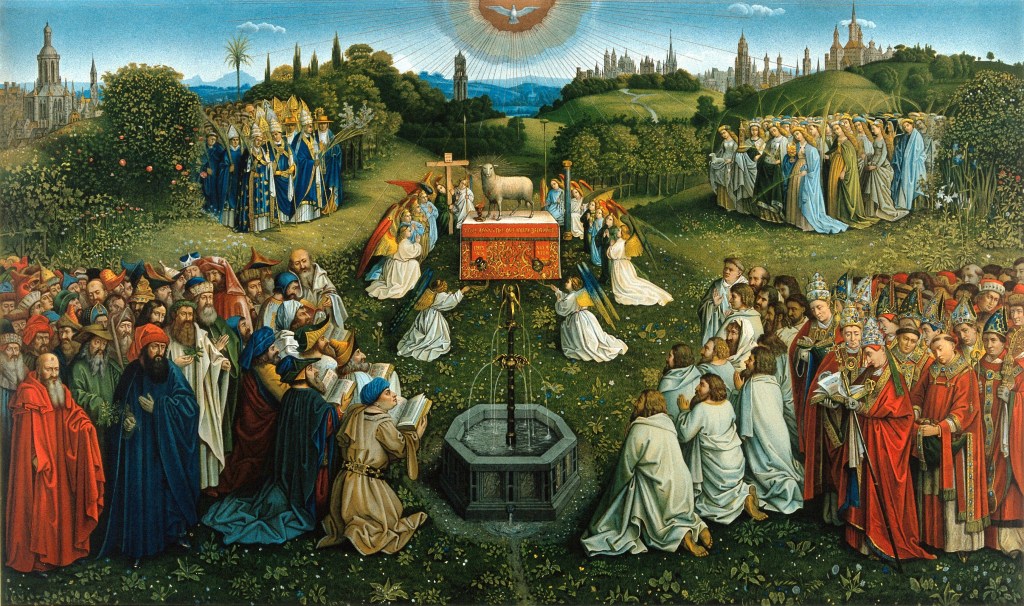
Revelation 19:1-9 – “Hallelujah!”

Adoration of the Lamb by Renaissance artist Jan van Eyck, 1432

After this I heard what sounded like the roar of a great multitude in heaven shouting:

“Hallelujah!
Salvation and glory and power belong to our God,
    for true and just are his judgments.
He has condemned the great prostitute
    who corrupted the earth by her adulteries.
He has avenged on her the blood of his servants.”

And again, they shouted:

“Hallelujah!
The smoke from her goes up for ever and ever.”

The twenty-four elders and the four living creatures fell and worshiped God, who was seated on the throne. And they cried:

“Amen, Hallelujah!”

Then a voice came from the throne, saying:

“Praise our God,
    all you his servants,
you who fear him,
    both great and small!”

Then I heard what sounded like a great multitude, like the roar of rushing waters and like loud peals of thunder, shouting:

“Hallelujah!
    For our Lord God Almighty reigns.
Let us rejoice and be glad
    and give him glory!
For the wedding of the Lamb has come,
    and his bride has made herself ready.
Fine linen, bright and clean,
    was given her to wear.”

(Fine linen stands for the righteous acts of God’s holy people.)

Then the angel said to me, “Write this: Blessed are those who are invited to the wedding supper of the Lamb!” And he added, “These are the true words of God.” (NIV)

Things will not always be this way. There is coming a time when pandemics and poverty will end. In the age to come there will be no more grief, tears, oppression, hardship, and suffering. The day will arrive when, together with all saints past and present, and along with the angelic host, we will collectively shout, “Hallelujah!”

Time is simply the relationship between events. When all events are ended, there will be no more time – only unending eternity in the presence of God. For the Christian, this is our hope and ultimate salvation. Our deliverance from sin, death, and hell will be complete.

So, we wait and watch, preparing ourselves for the consummation of God’s kingdom. Meanwhile, we are truly in an awkward time between the two advents of Christ. It is the already/not yet time. We are already saved, yet not fully; we are holy, yet not completely; we have our adoption papers as children of God, yet still wait for our celebration feast with Christ.

Second Coming by English painter Kevin Derek Moore

There are few times more awkward, agonizing, joyful, and hopeful than a marriage engagement. Its as if two people are inextricably connected but not yet completely together. I still remember the downright weird feeling of the six months between my engagement to my heart’s love and standing at the altar marrying my bride.

Those months included every emotion imaginable, from exuberant happiness to terrible impatience, along with hopeful anticipation and sheer nervousness. It was a time, for me, of unique joy and unwanted suffering. Since I was separated by two-thousand miles from my beloved for most of our engagement, it was an unparalleled longing for the marriage to occur.

That is likely how believers have felt throughout the ages as they anticipate the second coming of Christ. In a period of hardship and even persecution, Christians long for their Savior – to be with Jesus forever and be shed of the world, the flesh, and the devil.

In this present age, we have received the Holy Spirit as a sort of engagement ring, a continual sign and presence to help us until the marriage happens with Christ as groom and the Church as bride. Since we have not yet experienced this, it is difficult for us to anticipate just how incredible and inconceivable the coming age will be.

Yet, the Christian intuitively knows, by means of the Spirit, that the upcoming marriage supper will be a heavenly paradise – and so we long for it, especially in these days of uncertainty and difficulty.

Presently, the great harlot attempts to seduce the believers, if that were possible, away from Christ. However, along with all God’s holy angels, we will join in the heavenly chorus which continually sings, “Hallelujah!” to Father, Son, and Spirit.

The book of Revelation describes the end of history for the purpose of encouraging the saints of God in the present. God will once and for all destroy evil and faithful believers will be united with Christ forever in glory.

So, as we draw near to a close of this Christian Year with its anticipation of the new, beginning with Advent, we are mindful of both advents, both comings of Jesus. As we remember the first, we anticipate and gaze longingly for the second. Holding them both together, the past and the future, guides us in the present because Jesus Christ bookends our lives with the mercy of the cross and the grace of his coming again.

Even so, come, Lord Jesus. Amen.

3 John 9-12 – On Hospitality and Against Being Inhospitable

Trinity by Russian artist Alek Rapoport (1933-1997)

I wrote to the church, but Diotrephes, who loves to be first, will not welcome us. So, when I come, I will call attention to what he is doing, spreading malicious nonsense about us. Not satisfied with that, he even refuses to welcome other believers. He also stops those who want to do so and puts them out of the church.

Dear friends, do not imitate what is evil but what is good. Anyone who does what is good is from God. Anyone who does what is evil has not seen God. Demetrius is well spoken of by everyone—and even by the truth itself. We also speak well of him, and you know that our testimony is true. (NIV)

I believe in an egalitarian world. That is, humanity is meant to live, ideally, in equity with one another. Humility, meekness, and gentleness are to be the inner dispositions of a person’s life. These virtues work themselves out in being concerned for the common good of all, laboring toward just and righteous ways of living for everyone and sharing our lives as well as our resources with each other. In short, viewing one another as equals inevitably leads to gracious hospitality.

However, in a world of power disparities and privileged inequities are attitudes of seeking attention, a perceived need to always win and be first, and tight-fisted control of authority and money. The common good of all persons is scaled back to be the concern for the common good of some. There is a failure to regard the weak, poor, and vulnerable as legitimate members of the community.

The Apostle John wrote his short succinct letter in a concern that the church may be following a leader who was taking them down a bad path – a road leading to injustice where power and privilege remain with a few, and perhaps even one. John’s plainspoken exhortation was to judge rightly between what is good and bad, and then imitate the good while forsaking the bad.

Hospitality is the true litmus test between the good and the bad. An openness to the stranger, the immigrant, the migrant, the alien, the foreigner, the newcomer, and the outsider characterizes authentic fellowship. Being closed to such persons and having a xenophobic bent to others who are different is the mark of unwelcoming and inhospitable people. Hospitality serves others, whereas being inhospitable cajoles others to serve our needs.

Even Jesus, the Lord of all, did not come to this earth for people to serve him. He came to serve others and to give his life to save many people (Matthew 20:28; Mark 10:45; John 13:1-17). We are to imitate the loving service and radical hospitality of the Lord Jesus. He is our example. We are to imitate Christ.

We are to have both orthodoxy (right belief) and orthopraxy (right practice). Both go together like a hand in a glove. Good actions are to be the result of good and proper beliefs. The following are some thoughts about this nexus between belief and practice:

  • Hospitality (which literally means “love of the stranger”) is a way of life fundamental to orthodox Christianity, based in the person and work of Jesus.
  • God is hospitable and loves the outsider, welcoming them into the dance of the Trinity, and provides for them. Our human hospitality is to reflect this divine welcome.
  • Hospitality means extending to another a kindness typically reserved for family or friends.
  • The teaching of the New Testament emphasizes the practice of hospitality, i.e. Luke 14:12-14; Matthew 25:31-46.
  • The consistent witness of the Church in history is to lift and uphold Christian hospitality. For example, the Reformer John Calvin said, “Whatever person you meet who needs your aid, you have no reason to refuse to help them.” This was no mere theoretical advice for Calvin, whose ministry center of Geneva, Switzerland swelled with French Huguenot refugees fleeing persecution. Calvin, always the theologian, grounded his understanding of hospitality in the divine: “We should not regard what a person is and what they deserve but we should go higher – that it is God who has placed us in the world for such a purpose that we be united and joined together. God has impressed the divine image in us and has given us a common nature, which should incite us to provide one for the other.”
  • Hospitality is a practice which integrates both respect and care. St. John Chrysostom warned his congregation to show “excessive joy” when offering hospitality to avoid shaming the recipient of care.
  • Biblical hospitality does not need to know all the details of someone’s life before extending care. If Christ forgave and healed those who injured him, how could we neglect even a starving murderer? 
  • True hospitality involves a face-to-face relationship of encouragement and respect – not just a distant giving of alms. Hospitable persons pay attention to others and share life with them.
  • The great twin concerns of hospitality are universalizing the neighbor and personalizing the stranger. One reason why many of the rich have little sympathy for the poor is because they seldom visit them. Hospitality depends on us recognizing our commonalities with strangers rather than our differences.
  • This is how we evaluate our hospitality: Did we see Christ in them? Did they see Christ in me?

Hospitable God:

Give us eyes to see the deepest needs of people.

Give us hearts full of love for our neighbors as well as for the strangers we meet.

Help us understand what it means to love others as we love ourselves.

Teach us to care in a way that strengthens those who are sick.

Fill us with generosity so we feed the hungry, clothe the naked, and give drink to the thirsty.

Let us be a healing balm to those who are weak and lonely and weary by offering our kindness to them.

May we remember to listen, smile, and offer a helping hand each time the opportunity presents itself. And may we conspire to create opportunities to do so.

Give us hearts of courage to risk loving our enemy.

Inspire us to go out of our way to include outsiders.

Help us to be welcoming and include all whom you send our way.

Let us be God’s hospitality in the world.

Amen.

1 John 3:11-16 – Live in the Realm of Love

Love One Another

For this is the message you heard from the beginning: We should love one another. Do not be like Cain, who belonged to the evil one and murdered his brother. And why did he murder him? Because his own actions were evil and his brother’s were righteous. Do not be surprised, my brothers and sisters, if the world hates you. We know that we have passed from death to life because we love each other. Anyone who does not love remains in death. Anyone who hates a brother or sister is a murderer, and you know that no murderer has eternal life residing in him.

This is how we know what love is: Jesus Christ laid down his life for us. And we ought to lay down our lives for our brothers and sisters. (NIV)

It would be good for us to get a few words defined and explained before we look at the message of the Apostle John. “Death” and “life” are full of meaning in Holy Scripture. Whereas we tend to use death and life as referring chiefly to the body, they are primarily relational terms in the Bible. So, then, death is a separation from God and others; and, life is connection with God and others. In addition, death and life are biblically understood as forces or realms of being within or without. When someone moves from death to life, they are leaving the realm of separation with its loneliness, lostness, lethargy, and lack of meaningful and helpful interaction with God and others to a place of connection in which there is love.

There is no love in the realm of death. Love is not a solitary affair – it requires another. Death is awful in the sense that it places one outside of love. Like death and life, love is also a relational term and a force or power which exists. In fact, love is such a huge realm of being and such a large domain that it almost defies definition. We are mostly left to describe love because all attempts to nail down love with a precise definition will never do it justice. Therefore, the Apostle Paul, in his great ode to love, did not even try to define it, but merely attempted to characterize love:

Love is patient. Love is kind. Love isn’t jealous. It doesn’t sing its own praises. It isn’t arrogant. It isn’t rude. It doesn’t think about itself. It isn’t irritable. It doesn’t keep track of wrongs. It isn’t happy when injustice is done, but it is happy with the truth. Love never stops being patient, never stops believing, never stops hoping, never gives up. (1 Corinthians 13:4-7, GW)

Consistent with the force and relational nature of death, life, and love, hate is not primarily a feeling toward another but exists as a stance toward another within the domain of darkness and death. To hate is to deliberately and volitionally separate from another person and/or from God. It is to consider someone as the “other” who is not like me, and so, I will neither associate nor interact with “those” people.

Love, however, thrives in the vast multi-dimensional realm of life. Love seeks connection with another and desires to act through discovering needs and meeting them. Although emotions of love are very real, those feelings are the result of calculated actions and words which benefit humanity and the common good of all persons.

With all the understanding of hate and death, love and life, now plug that into the Apostle John’s message. We need to make clear decisions to pursue life and love others. And Jesus is our model for this. Christ is the ultimate Connector, bringing vibrant life, even eternal life, through loving actions. Jesus intentionally entered the dark realm of death and absorbed all the hate of the world for you and me. In a great and loving reversal, Jesus Christ’s death – his separation from God and others – brought connection with God and others.

MLK quote 3

Likewise, followers of Jesus will learn to take on the world’s hatred, not fearing death’s ability to disconnect, and love others as they themselves have been loved by Christ. Christians are known by the way they act toward those in the realm of death who use the tool of hatred to stay there.

On the flip side of love, the biblical character Cain is Exhibit A of modeling the way of hatred and death. He separated himself from his brother, Abel, in every way possible – relationally, emotionally, mentally, and finally, physically through outright killing of the body.

The message from John is this: Do not be like Cain. Be like Jesus. Love others, and not hate them. Live for others, die to self.

Murder is also a relational term in Scripture. It is, of course, a tool forged from the flames of hell to be used by the hand of hatred to bring death’s realm of separation. Jesus clearly understood murder in this manner:

You know that our ancestors were told, “Do not murder” and “A murderer must be brought to trial.” But I promise you that if you are angry with someone, you will have to stand trial. If you call someone a fool, you will be taken to court. And if you say that someone is worthless, you will be in danger of the fires of hell. (Matthew 5:21-22, CEB)

Christians are people who put love where love is not – which means they brave death’s door to pull others from the flames. As the little New Testament book of Jude says:

But you, dear friends, must build each other up in your most holy faith, pray in the power of the Holy Spirit, and await the mercy of our Lord Jesus Christ, who will bring you eternal life. In this way, you will keep yourselves safe in God’s love. And you must show mercy to those whose faith is wavering. Rescue others by snatching them from the flames of judgment. Show mercy to still others, but do so with great caution, hating the sins that contaminate their lives. (Jude 20-23, NLT)

May your soul be blessed with love’s kiss.

May the grace and kindness of love bring you life and continue to be life-giving for you.

May the hardness of hatred be far from you.

May death’s destructive power dwindle to nothing in the face of Christ’s love working in and through you to the glory of God.