“Follow Me” (John 21:19b-24)

By Unknown Artist

Then he [Jesus] said to him [Peter], “Follow me!”

Peter turned and saw that the disciple whom Jesus loved [John] was following them. (This was the one who had leaned back against Jesus at the supper and had said, “Lord, who is going to betray you?”) When Peter saw him, he asked, “Lord, what about him?”

Jesus answered, “If I want him to remain alive until I return, what is that to you? You must follow me.” Because of this, the rumor spread among the believers that this disciple would not die. But Jesus did not say that he would not die; he only said, “If I want him to remain alive until I return, what is that to you?”

This is the disciple who testifies to these things and who wrote them down. We know that his testimony is true. (New International Version)

To actually follow Jesus around during his earthly ministry on this planet was amazing; yet singular, for just a few years of time. But to be called to follow Jesus in a post-resurrection world is, obviously, going to look different. It’s not the same.

It seems to me that the command from Jesus to “follow me” in such a world would take anyone a bit of time to wrap their head around. After all, Jesus had risen from death, and was about to ascend to heaven. How do you follow someone who is here, but not here?

Maybe Peter needed some space to try and make sense of it all by deflecting the command onto what’s going to happen with his fellow disciple John, who was hanging around following the two of them.

Jesus, undeterred by Peter trying to get Jesus on another subject, kept his focus on Peter. Again, Christ reiterated the command to Peter: “You follow me.”

It’s far too easy to look at others and wonder about their following, and to be overly concerned about somebody else’s Christian discipleship. If we are honest, oftentimes by doing that approach, we don’t have to deal with our own relationship with Jesus, and what he is saying specifically to me.

The beginning of Christ’s earthly ministry involved the command to “follow me.” And here, at the end of that phase of his ministry, he came back to the disciples, and to Peter, saying the very same thing: “Follow me.”

Even though so much had changed from the first time the disciples were called to follow Jesus, the basic nature of Christian discipleship had not really changed at all. In fact, even today, it still hasn’t much changed. The call still remains from the Lord Jesus to “follow me.”

“Whoever wants to be my disciple must deny themselves and take up their cross and follow me. For whoever wants to save their life will lose it, but whoever loses their life for me will find it.” (Matthew 16:24-25, NIV)

“I am the light of the world. Whoever follows me will never walk in darkness, but will have the light of life.” (John 8:12, NIV)

Anyone who loves their life will lose it, while anyone who hates their life in this world will keep it for eternal life. Whoever serves me must follow me; and where I am, my servant also will be. My Father will honor the one who serves me.” (John 12:25-27, NIV)

Unlike Christ’s earthly ministry, in this post-resurrection world, the call of discipleship and apprenticeship to Jesus, goes out into all the world. It’s for everyone, and not just a select few persons to follow Jesus physically as their rabbi and teacher.

Yet, what is similar, concerning the call to follow Christ, is that we can still today get sidetracked by rumors about other followers. Believers can become enamored with what is happening, or going to happen, with particular Christians and about whether Jesus is going to return today or tomorrow.

But our singular focus, as Christians, as people who embrace the name of Christ, is to follow Jesus. “Follow me” is just as relevant now as it was two millennia ago.

What is important for each of us is to actually focus on our own part in following Jesus. The Good Shepherd is perfectly capable of properly sorting the sheep and the goats. That’s not our job.

We have quite enough on our spiritual plate in dealing with our own Christian discipleship, without sticking our nose in another’s Christian walk with Jesus. There is a fine line between holding another accountable, and just plain old being a no-good spiritual busybody.

So, when it comes to Christian discipleship and following Jesus, we are to mind our own business. Butt out of other people’s walk of faith, and concentrate on your own special calling from God.

We are not to compare our discipleship with others, namely because we each have our place and particular set of spiritual gifts to edify the community. And if we will put our focus on our own specific call to follow, then the Body of Christ is healthy and works together in unity, harmony, and love. (1 Corinthians 12:4-11)

If we concentrate on Jesus, we will be fine. If we choose, however, to be a spiritual busybody, or the self-appointed spiritual police, then we are going to have Judge Jesus to contend with in a way you probably won’t like.

So, what is you calling? How will you relate to Jesus? Will you take up the command from Jesus to “follow me?”

Merciful Lord, give me the courage to take up my cross and follow you, even if it means sacrificing my own comfort and desires. Help me to be obedient to your commandments, to live a life of love, and to serve others with humility.

Thank you, Lord, for your faithfulness and your endless grace. Help me to follow you with all my heart and to live out your teachings in my daily life. Amen.

The Coming Judgment (Revelation 11:1-14)

Then I was given a measuring stick, and I was told, “Go and measure the Temple of God and the altar, and count the number of worshipers. But do not measure the outer courtyard, for it has been turned over to the nations. They will trample the holy city for 42 months. And I will give power to my two witnesses, and they will be clothed in burlap and will prophesy during those 1,260 days.”

These two prophets are the two olive trees and the two lampstands that stand before the Lord of all the earth. If anyone tries to harm them, fire flashes from their mouths and consumes their enemies. This is how anyone who tries to harm them must die. They have power to shut the sky so that no rain will fall for as long as they prophesy. And they have the power to turn the rivers and oceans into blood, and to strike the earth with every kind of plague as often as they wish.

When they complete their testimony, the beast that comes up out of the bottomless pit will declare war against them, and he will conquer them and kill them. And their bodies will lie in the main street of Jerusalem, the city that is figuratively called “Sodom” and “Egypt,” the city where their Lord was crucified. And for three and a half days, all peoples, tribes, languages, and nations will stare at their bodies. No one will be allowed to bury them. All the people who belong to this world will gloat over them and give presents to each other to celebrate the death of the two prophets who had tormented them.

But after three and a half days, God breathed life into them, and they stood up! Terror struck all who were staring at them. Then a loud voice from heaven called to the two prophets, “Come up here!” And they rose to heaven in a cloud as their enemies watched.

At the same time there was a terrible earthquake that destroyed a tenth of the city. Seven thousand people died in that earthquake, and everyone else was terrified and gave glory to the God of heaven.

The second terror is past, but look, the third terror is coming quickly. (New Living Translation)

There are many people who look upon Christians as oppressors and persecutors in history. And they aren’t wrong. From calls to war for the Crusades, to the Spanish Inquisition, and much more, a great deal of blood has been spilled in the name of Christianity.

The Book of Revelation, however, knows nothing of that history, simply because it pre-dates all of it. Many people forget, in it’s first few hundred years, that Christianity was a persecuted religion by all sorts of people.

Christians were often the scapegoats to many a leader’s problems. From throwing Christians to the lions in the Roman Coliseum, to burning them at the stake because of their faith, many a martyr has faced a bloody death.

The Apostle John’s Apocalypse, which is known to us as the Book of Revelation, was a vision given to John in order to encourage the persecuted Christian Church that God knows their suffering; and that Jesus will return to judge the living and the dead.

John’s vision had a message of judgment on those who were persecuting Christians for their faithful witness of Jesus. The believers in Jesus who were suffering at the hands of oppressors, cried out for vindication and retribution against their persecutors.

Today’s portion of Revelation is situated between the sixth and seventh trumpets of God’s judgment (which are the second and third woes upon the earth). This interlude has to do with two godly witnesses. And the whole world is able to see them.

The space which the two witnesses occupy is in the outer courtyard of the Temple. The two of them symbolize all the faithful people of God in the world. They are attacked and killed, having carried out their witness for 1,260 days (42 months).

This is a time, related to the Old Testament prophecy of Daniel, appointed for the godless to overcome the city. But this time of suffering and woe will not last.

The two witnesses are not named or identified. The point is that whomever they are, these two maintain their prophetic witness to the Lord consistently to their martyrdom.

Like their Lord before them, the two witnesses lay dead for three days. Their bodies visible for all to see. The godless inhabitants of earth gloat over them, and celebrate their demise.

But again, like Jesus, the two are raised from death and ascend to heaven. This evokes a mass of fear throughout the world. The fact that the event causes fear and terror, instead of repentance  and penitence, speaks to how warped the people of earth have become.

Indeed, the Book of Revelation is highly symbolized reading, and John’s vision is not easy to understand. Yet, there are a few things we can reflect upon in light of this passage; and some questions we can ask of ourselves:

  1. It is important to be faithful and persevere to the very end of our lives. How will we respond to this present darkness in the world?
  2. The way in which we live our lives is the legacy we leave for others when we are gone. What will we be remembered for?
  3. Our lives speak to others about who the God of heaven is. Therefore, it is profoundly important how we go about living our current mundane daily existence. How, then, shall you and I live?
  4. Our short lives have eternal ramifications, not only for ourselves, but for future generations. In what ways will you build into the next generation and help them persevere in faith?
  5. Everything you and I see today will change. There is a Judgment Day coming, just as sure as summer will transition to autumn and then into winter. What will you do today that prepares for the final season of the earth as we know it?

Although much of John’s apocalyptic vision deals with wickedness reaching a ripeness which releases the wrath of God’s judgment; it is also simultaneously the church’s entrance into her eternal inheritance. Systemic sin, structural evil, and devilish deeds shall be no more.

Even so, come Lord Jesus. May peace soon come to this world, and within our hearts. Amen.

Mercy and Judgment (Revelation 8:1-5)

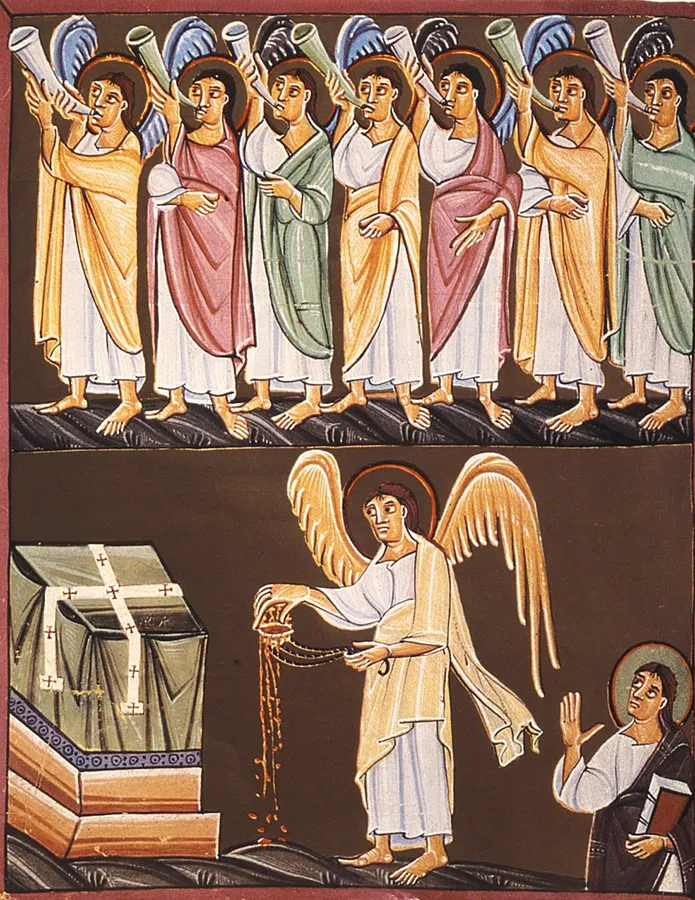
Seven angels with seven trumpets, and the angel with a censer, from the Bamberg Apocalypse, c.1020 C.E.

Then, when the Lamb opened the seventh seal, there was silence in heaven for about half an hour.

Then I saw the seven angels who stand before God, and seven trumpets were given to them. Another angel came and stood at the altar, and he held a gold bowl for burning incense. He was given a large amount of incense, in order to offer it on behalf of the prayers of all the saints on the gold altar in front of the throne. 

The smoke of the incense offered for the prayers of the saints rose up before God from the angel’s hand. Then the angel took the incense container and filled it with fire from the altar. He threw it down to the earth, and there were thunder, voices, lightning, and an earthquake. (Common English Bible)

When I was kid, growing up on a Midwest American farm, I remember times when severe weather was coming. I knew it was going to be bad whenever everything became still and there was complete silence: No wind, no birds singing, no insects chirping, nothing moving whatsoever. It was the eerie silence which precedes something big coming.

That is the way it will be in heaven when the seventh seal is opened. The silence is so quiet that you know a lot of noise and movement are about to happen. It’s not serene silence; it’s scary silent.

With the opening of the seventh seal, a climactic moment is reached. The silence is not only an anticipation of the coming drama, but is also a sign of reverence and awe.

The seventh seal initiates a series of woes: The seven trumpets. But before the trumpets begin, an angel appears. Standing before a heavenly altar, the angel mixes incense along with prayers from the people, then offers them on the altar.

These prayers of the people are for justice, and a longing for the kingdom to come, and God’s will to be done, on earth, as it is always done in heaven.

The imagery relates to us that God hears the prayers, and will act, according to the divine character and will.

The angel takes fire from the altar and hurls it down to earth, causing thunder and lightning, and an earthquake. In other words, the prayers are being answered; they are having an effect. Judgment on the earth begins with the blowing of the seven trumpets.

As we may expect, the incredible silence gives way to an equally incredible noise of weather and the earth moving. And the angel, serving as a quiet and contemplative high priest, now moves to becoming a judge upon the earth.

It turns out that mercy and judgment are not two contrasting concepts and actions; they are two sides of the very same coin. The altar of mercy becomes the source of judgment.

Whenever there is an injustice, we want (and expect) to have that act acknowledged and taken care of by a proper authority. To have a judge simply say that he/she is merciful and will acquit the guilty, does not work in every situation. Mercy only exists because of the presence of guilt and judgment.

God takes care of sin because God loves. An unloving deity would be unconcerned, random, and capricious in handling injustice. But not the God of the Bible. God shows mercy to the righteous, and will judge the wicked.

God’s mercy extends to the point of acquitting the guilty, if God so desires to do so. And everyone needs mercy, because we all have committed injustices in our lives.

Yet, by means of humble contrition and faith, we can mercifully discover gracious amnesty. This is why Jesus came, to take care of the sin issue once for all through the Cross.

We have been made holy by God’s will through the offering of Jesus Christ’s body once for all. (Hebrews 10:10, CEB)

In the time of the Apostle John’s vision, which is the Book of Revelation, Christians were facing persecution and martyrdom. The prayers of the suffering believers rose to heaven:

They cried out with a loud voice, “Holy and true Master, how long will you wait before you pass judgment? How long before you require justice for our blood, which was shed by those who live on earth?” (Revelation 6:10, CEB)

God’s response to the prayers of the saints is to send judgmental fire against the earth by the hand of the angel. In John’s apocalyptic vision, not only are the believers in Christ facing trials and tribulations for their faith, but the unbelieving persecutors who victimize the saints will be punished, as well.

If the persecutors use fiery elements against the believers, God can (and will) turn that fire back on the them. This is similar to the Book of Exodus, in which the plagues that struck and judged the Egyptians were, at the same time, a means of protecting and preserving the Israelites.

The Book of Revelation included in the Christian canon of scripture, not for the purpose of predicting the time or the season in which Jesus Christ will come back to judge the living and the dead. Rather, John’s Apocalypse is meant to encourage the followers of Christ that their suffering will not last forever; and neither will the arrogance of the wicked.

We don’t know when all of this end-of-the-age stuff is going to shake out. Which is why it is so important we learn to persevere through suffering. Because we might have to wait awhile.

Prayer for us then becomes not simply something we do if we have a bit of discretionary time; it becomes vital for us. We discern that we must speak with God. We are compelled to offer our prayers. We feel the great need to cry out and petition God for justice and righteousness.

It seems, if I don’t pray, I won’t make it. Therefore, I must pray. I will pray with all of my heart and soul, till I cannot pray anymore. And then I will pray some more, because I need God.

There is nothing easy about moving through suffering. It’s hard to persevere. It hurts to be the brunt of another’s violent tongue and/or hand. Yet, we do not experience this alone. The divine presence is with us. And that makes all the difference.

Oh God:
Give me strength to live another day;
Let me not turn coward before its difficulties, or fail in its duties;
Let me not lose faith in other people;
Keep me sweet and sound of heart, in spite of ingratitude, treachery, or meanness;
Preserve me from minding little stings, or giving them;
Help me to keep my heart clean, and to live so honestly and fearlessly that no outward failure can dishearten me, or take away the joy of conscious integrity;
Open wide the eyes of my soul that I may see good in all things;
Grant me this day some new vision of your truth;
Inspire me with the spirit of joy and gladness and make me the cup of strength to suffering souls; in the name of the strong Deliverer, our only Lord and Savior, Jesus Christ. Amen.

For the Life of the World (John 6:1-21)

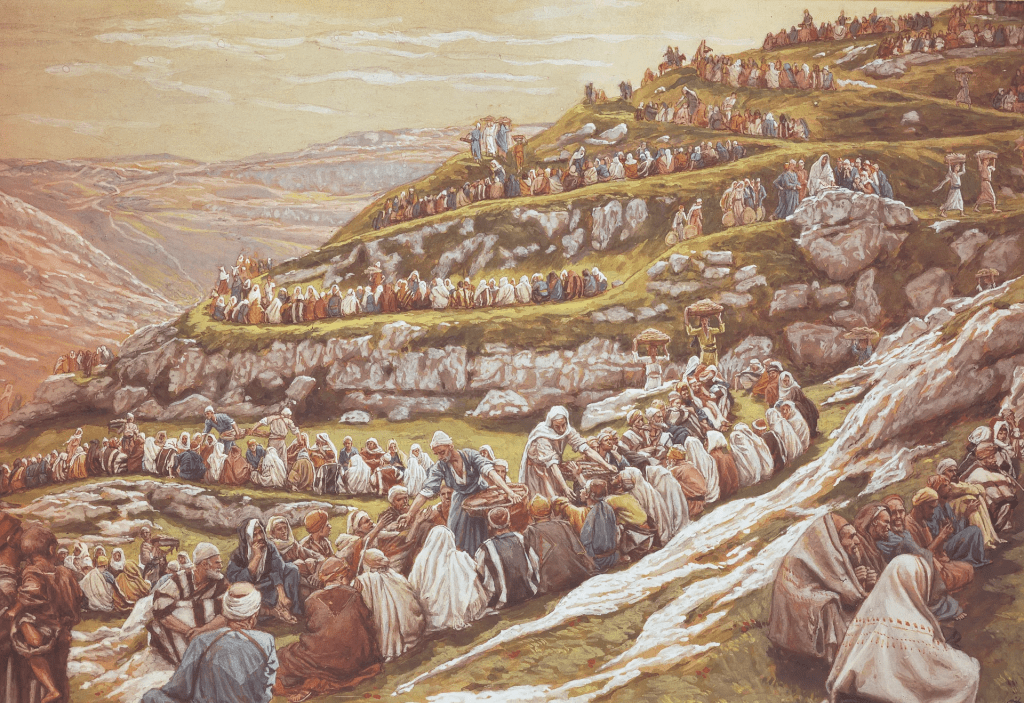
The Miracle of the Loaves and Fishes, by James Tissot, 1886

After this Jesus went to the other side of the Sea of Galilee, also called the Sea of Tiberias. A large crowd kept following him because they saw the signs that he was doing for the sick. Jesus went up the mountain and sat down there with his disciples. 

Now the Passover, the festival of the Jews, was near. When he looked up and saw a large crowd coming toward him, Jesus said to Philip, “Where are we to buy bread for these people to eat?” He said this to test him, for he himself knew what he was going to do. 

Philip answered him, “Two hundred denarii would not buy enough bread for each of them to get a little.” One of his disciples, Andrew, Simon Peter’s brother, said to him, “There is a boy here who has five barley loaves and two fish. But what are they among so many people?” 

Jesus said, “Make the people sit down.” Now there was a great deal of grass in the place, so they sat down, about five thousand in all. Then Jesus took the loaves, and when he had given thanks he distributed them to those who were seated; so also the fish, as much as they wanted. 

When they were satisfied, he told his disciples, “Gather up the fragments left over, so that nothing may be lost.” So they gathered them up, and from the fragments of the five barley loaves, left by those who had eaten, they filled twelve baskets. When the people saw the sign that he had done, they began to say, “This is indeed the prophet who is to come into the world.”

When Jesus realized that they were about to come and take him by force to make him king, he withdrew again to the mountain by himself.

When evening came, his disciples went down to the sea, got into a boat, and started across the sea to Capernaum. It was now dark, and Jesus had not yet come to them. The sea became rough because a strong wind was blowing. When they had rowed about three or four miles, they saw Jesus walking on the sea and coming near the boat, and they were terrified. But he said to them, “It is I; do not be afraid.” Then they wanted to take him into the boat, and immediately the boat reached the land toward which they were going. (New Revised Standard Version)

Christ Walking on the Waters, by Julius Sergius Von Klever, c.1880

The Deliverers Moses and Jesus

The Apostle John intended us to see the link between Moses and Jesus. God used Moses to bring deliverance of the people from slavery through a miracle at the Red Sea. The Lord also used him for a divine provision of manna in the wilderness.

And the Lord Jesus brought about a deliverance of the disciples from anxiety through a miracle on the Sea of Galilee. Christ also brought a divine provision of food in the middle of nowhere for thousands of people.

The miraculous displays by Jesus happened at the time of Passover, the very time that Jews celebrate the deliverance from Egypt. Just as divine power was exerted at the time of Moses in the original Passover, so also divine power likewise showed itself with Jesus in the supply of food and control of the sea.

What’s more, today Christians everywhere around the world remember God’s saving events with the elements of bread and cup, recalling divine deliverance and provision, and finding relief from their fears and anxieties.

A Miraculous Provision and Distribution of Food

It’s no coincidence that Jesus is pictured as sitting on a mountain – reminiscent of Moses on a mountain receiving the divine law and wisdom. The gathering of people around Christ was so great (thousands of them) and the need for food equally as great, that Jesus questioned his disciples concerning resources for such a large crowd.

Christ, of course, could have circumvented his disciples and simply provided the needed foodstuffs without them. Yet, he didn’t, on purpose. Always the rabbi and teacher, Jesus intended to give the disciples a lesson they wouldn’t forget.

After ascertaining that the only food available was a boy’s five barley loaves and two dried fish, Jesus knew that this was plenty, in order to feed up to 5,000 people. It was enough, because Jesus is enough. Only a small amount is needed to fill the bellies of thousands.

Sacramental Living, by Charissa Jaeger-Sanders

And, what is more, for those with the faith to see it, a little communion wafer and a small swallow from a cup is more than enough to satisfy and satiate the hungriest of faithful and penitent people.

Not only did the people eat as much as they needed and wanted, but there was also so much remaining food that the twelve disciples collected twelve baskets of bread. They could keep on ministering, providing, and distributing for people because little is much when God is in it. Long after Christ’s death and resurrection, his followers continued to give with the divine largess from Jesus.

Walking on Water

It had been a full day of teaching and miraculous ministry, in the full light for all to see. Christ’s power, however, is also operative at night. The darkness is not able to subdue continued miracles from Jesus.

For the Apostle John’s writings, darkness is almost always a theological statement, denoting that there are dark forces operative on this earth. And those powers definitely did not like Christ’s effective day of ministry.

The actual physical storm symbolized the chaotic and angry response of the sinister elements in the world. But despite the terrible conditions, Jesus calmly walked on the sea as the new Moses who takes charge of the water.

The disciples abject fear turned on a dime into exuberant joy, as they realized it was indeed Jesus who entered the boat. In addition, they experienced an immediate place of safe harbor.

Christ was standing in the divine tradition of bringing people from stormy circumstances and evil situations to the safe haven of God’s presence.

Jesus saves people from their fears and anxieties, their travails and ills, and their guilt and shame. Christ also provides everything we need, both material and immaterial. And he does it for the life of the world, for everyone who comes by faith.

Gracious Lord, you are the Sustainer of the hungry. Like a mother, you long to feed your children until each is satisfied. Turn our eyes to you alone, so that, aware of our own deepest longings, we will reach out with Christ to feed others with the miracle of your love. Amen.