God Is Good, Idols Are Bad (2 Kings 17:7-20)

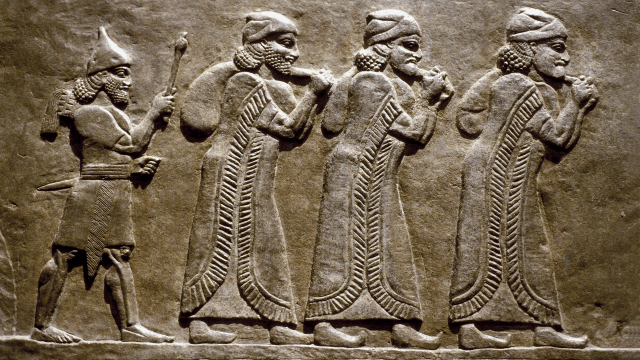
 An Assyrian solider deporting people from their land (From the Southwest Palace of Tiglath-Pileser III at Nimrud, ca. 730-727 B.C.E.; British Museum.)

The Israelites sinned against the Lord their God, who brought them out of Egypt and rescued them from the power of Pharaoh (the king of Egypt). They worshiped other gods and lived by the customs of the nations that the Lord had forced out of the Israelites’ way. They also did what their kings wanted them to do.The Israelites secretly did things against the Lord their God that weren’t right:

They built for themselves illegal places of worship in all of their cities, from the smallest watchtower to the largest fortified city.

They set up sacred stones and poles dedicated to the goddess Asherah on every high hill and under every large tree.

At all the illegal places of worship, they sacrificed in the same way as the nations that the Lord had removed from the land ahead of them.

They did evil things and made the Lord furious.

They served idols, although the Lord had said, “Never do this.”

The Lord had warned Israel and Judah through every kind of prophet and seer, “Turn from your evil ways, and obey my commands and decrees as I commanded your ancestors in all my teachings, the commands I sent to you through my servants the prophets.” But they refused to listen. They became as impossible to deal with as their ancestors who refused to trust the Lord their God. They rejected his decrees, the promise he made to their ancestors, and the warnings he had given them. They went after worthless idols and became as worthless as the idols. They behaved like the nations around them, although the Lord had commanded them not to do that. They abandoned all the commands of the Lord their God:

They made two calves out of cast metal.

They made a pole dedicated to the goddess Asherah.

They prayed to the entire army of heaven.

They worshiped Baal.

They sacrificed their sons and daughters by burning them alive.

They practiced black magic and cast evil spells.

They sold themselves by doing what the Lord considered evil, and they made him furious.

The Lord became so angry with Israel that he removed them from his sight. Only the tribe of Judah was left. Even Judah didn’t obey the commands of the Lord their God but lived according to Israel’s customs. So the Lord rejected all of Israel’s descendants, made them suffer, handed them over to those who looted their property, and finally turned away from Israel. (God’s Word Translation)

The Flight of the Prisoners, by James Tissot, 1898, depicting the Babylonian exile from Jerusalem

The prophets had warned the northern kingdom of Israel; but they did not listen, nor did they heed the prophetic utterance. Israel then stood as an example and a warning to the southern kingdom of Judah; yet they, too, refused to learn from their brother’s downfall.

And even before the kingdom was split between Israel in the north and Judah in the south, the ancient Israelites had a troubling tendency to buck the Lord’s instructions and find other more and creative ways of expressing themselves spiritually.

Every generation of people are responsible for their own spirituality and their own actions in life. We, in our contemporary time and place, need to learn the lessons of the past – for we also are not an exception in history, as if we can do whatever we want without attending to the common good of all persons and worshiping in any sort of way we want.

The trouble with the ancient worshipers of Yahweh is that they decided to pick and choose whatever commands they wanted to follow, or not. They went through continual times of idolatry and forgot about God and God’s Word to them.

To respect and revere the Lord is to obey God’s instructions. To worship Yahweh is to have an undivided allegiance to God and God’s commands. The failure to obey is really a failure of faith.

The prophets Amos, Hosea, Micah, and Isaiah specifically called out the sinful practices of the people and their negligence in upholding basic social and economic justice for everyone. They condemned violence and oppression of the poor; and expressed the divine displeasure with taking advantage of the disadvantaged.

How to treat people and live well were explicitly spelled out in the entirety of God’s Law. Yet, the leaders and the people, as a whole, decided to go another way. They kept introducing idolatrous and unhealthy forms of worship and living. And it led to their ruin.

The ancient people were continually offered grace if they would only accept it. They could return to the Lord and come back to the true worship and obedience of the God who had rescued them from trouble again and again. Turning from their unholy practices, and turning back to Yahweh, would reverse God’s impending judgment. Yet, tragically, the people did not listen.

Idolatry is a failure to trust God, and to rely instead on something else which is not able to sustain a life. Unfortunately, those who create a god according to their own liking end up becoming like the thing they worship, that is, worthless.

The tragedy of the Israelites is that they were to be God’s people, the Lord’s treasured possession, a kingdom of priests, and a holy nation which brings blessing to the earth. Instead, they traded their meaning and purpose in life to imitate everyone else around them.

Sadly, people have felt throughout history, and even we ourselves today, that there is something else, other than God, that we need in order to be happy – something more important to your heart than the Lord – whether it is human acceptance and approval, social reputation, political power and control, or financial advantage and privilege.

Idolatry creates an ignoring of the divine in our life. We might even have the chutzpah to think we can challenge God, like some small yippee pup who growls and takes on the big dog, who knows that with an effortless paw across the body, could toss the prideful pup away.

Like a mother bird who scours the land for food to sustain the babies, and brings it back to their gaping mouths, God longs to provide us with a good and beautiful life – if we will but only receive it.

Listen, my people, I’m warning you!
    If only you would listen to me, Israel.
There must be no foreign god among you.
    You must not bow down to any strange deity.
I am the Lord your God,
    who brought you up from Egypt’s land.
    Open your mouth wide—I will fill it up! (Psalm 81:8-10, CEB)

O Lord, as you gave us the greatest commandment, to love you with all our heart, soul, strength and mind, help us to love you above all else, putting you above the potential idols in our lives, including success, fame and wealth. May your benevolent kingdom come, and your moral and ethical will be done, here on this earth for this time, as it is always done in your heaven. Amen.

The Golden Calf (Exodus 32:1-14)

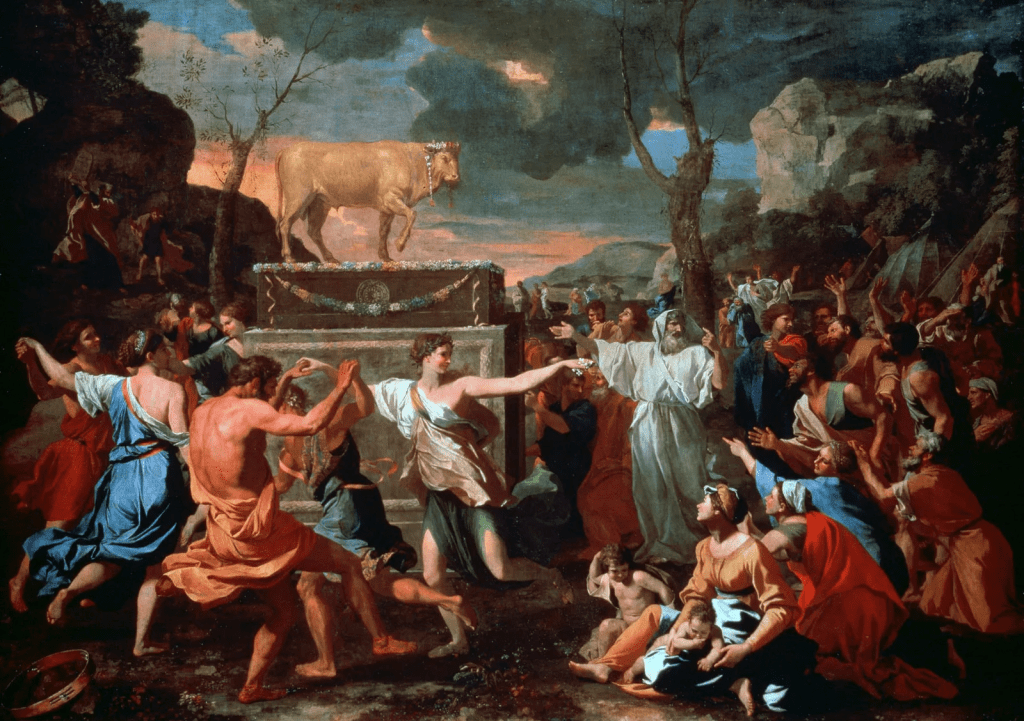
Adoration of the Golden Calf, by Nicolas Poussin (1594-1665)

When the people saw that Moses was so long in coming down from the mountain, they gathered around Aaron and said, “Come, make us gods who will go before us. As for this fellow Moses who brought us up out of Egypt, we don’t know what has happened to him.”

Aaron answered them, “Take off the gold earrings that your wives, your sons and your daughters are wearing, and bring them to me.” So all the people took off their earrings and brought them to Aaron. He took what they handed him and made it into an idol cast in the shape of a calf, fashioning it with a tool. Then they said, “These are your gods, Israel, who brought you up out of Egypt.”

When Aaron saw this, he built an altar in front of the calf and announced, “Tomorrow there will be a festival to the Lord.” So the next day the people rose early and sacrificed burnt offerings and presented fellowship offerings. Afterward they sat down to eat and drink and got up to indulge in revelry.

Then the Lord said to Moses, “Go down, because your people, whom you brought up out of Egypt, have become corrupt. They have been quick to turn away from what I commanded them and have made themselves an idol cast in the shape of a calf. They have bowed down to it and sacrificed to it and have said, ‘These are your gods, Israel, who brought you up out of Egypt.’

“I have seen these people,” the Lord said to Moses, “and they are a stiff-necked people. Now leave me alone so that my anger may burn against them and that I may destroy them. Then I will make you into a great nation.”

But Moses sought the favor of the Lord his God. “Lord,” he said, “why should your anger burn against your people, whom you brought out of Egypt with great power and a mighty hand? Why should the Egyptians say, ‘It was with evil intent that he brought them out, to kill them in the mountains and to wipe them off the face of the earth’? Turn from your fierce anger; relent and do not bring disaster on your people. Remember your servants Abraham, Isaac and Israel, to whom you swore by your own self: ‘I will make your descendants as numerous as the stars in the sky and I will give your descendants all this land I promised them, and it will be their inheritance forever.’” Then the Lord relented and did not bring on his people the disaster he had threatened. (New International Version)

The Golden Calf, by Sefira Lightstone

The ancient Israelites were dramatically delivered from slavery through a series of plagues on Egypt. Then, their lives were saved when God parted the Red Sea and the people fled from the advancing Egyptian army; collapsing the water on the soldiers when they tried to pursue the people.

The Israelites were led to Mount Sinai where God graciously entered into covenant with them; and gave them the law and the commandments. Yet, between receiving the covenant, and waiting for Moses to return from the mountain, the Israelites fell into chaos and a failure of faith. So, how did the relationship between God and Israel go so awfully sideways?

Moses spent a great amount of time with God on Mount Sinai. Apparently, the people believed that the forty days and forty nights on the mountain was too long and assumed that Moses would not return. So, what followed was idolatry, near annihilation, and intercession.

A failure of leadership

Aaron was left to lead the people during Moses’ absence. It didn’t take long for the people to get unruly and start working on Aaron. They asked him to make gods who will go before them, just as Yahweh and Moses had done in the pillar of cloud by day and fire by night.

For whatever reason, Aaron complied with their request. Maybe the people pestered him to death with constant bickering and asking, and he eventually gave-in to their coercion. Perhaps Aaron thought they had a point, and went with it as a willing participant. We aren’t told why. We are told that Aaron ordered the people to remove all the gold earrings they were wearing and bring them to him.

Aaron took all the gold he received and fashioned it into the form of a calf. Again, we aren’t told why Aaron chose to make a golden calf, in particular. Maybe he was forging a false god altogether in the shape of one of the Egyptian gods. After all, there had been a significant “back to Egypt” movement earlier, when circumstances got tough without food or water in the desert. Or perhaps Aaron was making a false image of the one true God. Either way you look at it, it’s not good.

The golden calf was handed to the people and proclaimed as the gods who brought them out of Egypt. If that weren’t bad enough, Aaron made the situation even worse by building an altar for the calf and declaring a feast for the next day. So, it’s no surprise to us as readers when we see poor leadership decision-making that leads to the people getting way out-of-hand in their festivities through drunkenness and sexual immorality.

The consequences of poor leadership

All of the revelry got God’s attention. The Lord saw the people’s depravity and commanded Moses to get back down the mountain, at once. God’s tone of voice and choice of pronouns took a turn. The Lord said to Moses, “Your people have acted perversely,” effectively distancing the divine from the mass of humanity at the foot of the mountain.

God was so upset that he started planning to destroy the whole lot of them and completely start over through the descendants of Moses. Yet, even though the Lord was very angry, and rightly so, Moses stepped in and interceded on the people’s behalf. Moses appealed to God’s reputation rather than God’s compassion. In an interesting twist, Moses turned the responsibility for the Israelites back onto God by saying they are your people, the ones whom you brought out of the land of Egypt.

What’s more, Moses pointed out to God that the Egyptians would question God’s motives for bringing the Israelites into the desert. And then Moses appealed to God’s covenant with Abraham, Isaac, and Jacob (Israel) to make a great nation of their descendants to dwell forever in the land God promised them. Moses actually persuaded the God of the universe to set aside divine anger and let the people live.

The people forgot who rescued them from slavery in Egypt. Regardless whether or not they had good intentions, the people failed in keeping their covenant obligations to God and sought to substitute God’s physical absence with a false image of God.

The implications of leadership for us

Today’s Old Testament story raises many questions for us. Here are just a few to ponder:

  • Which golden calves in our culture today draw our loyalty and love away from God when we get impatient with waiting for God’s timetable? Maybe our grumbling and complaining is a telltale sign that we are not content with God and what God is doing among us – and that we are fashioning (or have already fashioned) a god of our own making in the form of financial budgets, church buildings, or dogmatic theologies.
  • How have we made the God whom we worship into an idol that we try to control and manipulate for our own purposes? Perhaps we have substituted the one true God who is free, untamed, mysterious, and surprising, for a puny humanly constructed image, ideology, institution, or idol.
  • How do we maintain the balance between divine judgment with its consequences for disobedience, alongside God’s mercy, forgiveness, and faithfulness to the people? It could be, we are being led to grace, no matter how we go about answering the question.

Faithful God, you preside over an unfaithful people. Just as the people of Israel doubted your power and turned to other gods to fulfill their needs, we too, turn to other gods, seeking acceptance, power, and independence. Show us how to live humbly and walk in your ways, through the One who offered true power to all humanity, Jesus Christ our Savior and Lord. Amen.

The Pathology of Complaining (Numbers 20:1-13)

In the first month the whole Israelite community arrived at the Desert of Zin, and they stayed at Kadesh. There Miriam died and was buried.

Now there was no water for the community, and the people gathered in opposition to Moses and Aaron. They quarreled with Moses and said, “If only we had died when our brothers fell dead before the Lord! Why did you bring the Lord’s community into this wilderness, that we and our livestock should die here? Why did you bring us up out of Egypt to this terrible place? It has no grain or figs, grapevines or pomegranates. And there is no water to drink!”

Moses and Aaron went from the assembly to the entrance to the tent of meeting and fell facedown, and the glory of the Lord appeared to them. The Lord said to Moses, “Take the staff, and you and your brother Aaron gather the assembly together. Speak to that rock before their eyes and it will pour out its water. You will bring water out of the rock for the community so they and their livestock can drink.”

So Moses took the staff from the Lord’s presence, just as he commanded him. He and Aaron gathered the assembly together in front of the rock and Moses said to them, “Listen, you rebels, must we bring you water out of this rock?” Then Moses raised his arm and struck the rock twice with his staff. Water gushed out, and the community and their livestock drank.

But the Lord said to Moses and Aaron, “Because you did not trust in me enough to honor me as holy in the sight of the Israelites, you will not bring this community into the land I give them.”

These were the waters of Meribah, where the Israelites quarreled with the Lord and where he was proved holy among them. (New International Version)

Moses Strikes the Rock, by Rivka Korf

Every heinous sin you can think of – the worst of the worst – initially began as complaining and quarreling. Wherever you find murmuring and disrespect, you are looking at a spiritual illness which, if untreated, will poison the soul and result in apostasy, that is, a complete failure and repudiation of faith.

Today’s Old Testament lesson is a reminder and a warning that people’s faith can weaken to the point of becoming almost non-existent. There is a pathological process which brings people to a point of turning away from their faith:

  1. Complaining. It all starts with muttering some discontentment under the breath; murmuring dissatisfaction; and grumbling some ingratitude for what one already has. The Israelites complained about the lack of water. They quarreled with Moses about it and directed their anger at him.
  2. Psychotic depression. Most depression is normal, understandable, and even needed. However, psychotic depression is expressing a wish to be dead because of spiritual instability and an inability to see God at work. In other words, it’s manipulative. It’s a passive-aggressive type of anger directed at those who represent God. This is not a depression you can diagnose or put on someone; it’s a grief reaction gone sideways in wishing harm at self or others.
  3. Daydreaming. This is a preoccupation with “the good old days.” Back there in Egypt, the Israelites had figs, and grapevines, and water. But out here, they’ve got nothing. The people were experiencing extreme tunnel vision, only remembering the food they used to eat, instead of the bland manna they had to gather every day. They had completely blocked out the reason they were in the desert – because God brought a miraculous deliverance from slavery. Egypt was, in fact, anything but the good old days.
  4. Blaming. The people blamed Moses for bringing them into the wilderness. They criticized him for their lack of food and water. In reality, Moses was just doing what God wanted – and actually what the people wanted. The Israelites wanted out of Egypt; and then, when they left and things got hard, the people shifted the blame of hard circumstances onto Moses (and God).
  5. Disobeying. Why obey Moses or even Yahweh if you believe they’re out to get you, or don’t care? Maybe we just look out for ourselves and do what we think is best. (Exodus 16:1-28)
  6. Idolatry. Eventually, the people formed a “Back to Egypt” campaign. They turned their backs on Moses and on God. They lost faith, made a golden calf, and called it their god. (Exodus 32:1-8)

Despite all the whining and twisted thinking, God was gracious. The Lord told Moses to take up his staff, gather the people, and speak to a rock. God would provide by causing water to gush out of it.

At this point, Moses was upset. It seems to me he had enough of the people’s insolence and complaining. So, he ends up speaking to the people instead of the rock; and striking the rock with his staff instead of letting God do the striking.

It looks like rebellion rubs off and infects everyone, because Moses is chided by God for his own rebelliousness. Specifically, he was rebuked for not trusting God. As a result, Moses would not join the rest of the community in entering the Promised Land.

This is really a sad ending to the story. Moses was just trying to obey the Lord and lead the people. I can totally understand how exasperated he must have been from the constant griping of the people. Yet, Moses was held to account for his own lack of faith. And the people would eventually experience a harsh judgment for their faithlessness.

Don’t be misled. Bad company corrupts good character. (1 Corinthians 15:33)

Being around a bunch of ingrates will cause the good person to quit giving thanks.

Surrounding oneself with faithless people will result in that person eventually losing faith.

And hearing other people continually complain about their circumstances will cause you to grumble, setting the whole group on the road to spiritual death.

I don’t want that. And I don’t want it for you, either. If you are in such a group, get out, go, and be around people with the sort of values you care about. Life is too short to mess around with a bunch of complainers.

Lord Jesus Christ, you prayed for your friends that they would be one as you and your Father are one. We confess our resistance to your prayer. We have failed to maintain the unity of the Spirit. We have broken the bond of peace.

For the times we have not listened to each other, when we have spoken in anger, haste or fear, we are sorry. For the times we have not loved each other, when we have competed, or insulted or judged each other, we are sorry. For the harm that our disunity has done to our witness to the Gospel, we are sorry.

Have mercy on us, we pray. Restore us to friendship with you and with one another, through the power of your Spirit. Amen.

Hebrews 10:26-31 – On Rejecting Divine Love

 If we deliberately keep on sinning after we have received the knowledge of the truth, no sacrifice for sins is left, but only a fearful expectation of judgment and of raging fire that will consume the enemies of God.Anyone who rejected the law of Moses died without mercy on the testimony of two or three witnesses. How much more severely do you think someone deserves to be punished who has trampled the Son of God underfoot, who has treated as an unholy thing the blood of the covenant that sanctified them, and who has insulted the Spirit of grace? For we know him who said, “It is mine to avenge; I will repay,” and again, “The Lord will judge his people.”It is a dreadful thing to fall into the hands of the living God. (New International Version)

Love isn’t all rainbows and unicorns. Sometimes it’s downright tough, unabashedly truthful, and concerned for appropriate justice.

Love is compassionate, kind, and full of good deeds. Love is also subversive. Love takes a breach in relations seriously. Love announces that the hurt which has happened is not to be accepted as normal. Love is a refusal to settle for what is.

So, whenever God’s people drift away and slide into unhealthy or damaging ways of living, God’s love is not okay with it.

There’s a reason why we feel emotional pain. That’s because God feels pain. We don’t have to go very far into that thick book, the Bible, to find the hurt:

The Lord saw that the human beings on the earth were very wicked and that everything they thought about was evil. He was sorry he had made human beings on the earth, and his heart was filled with pain. (Genesis 6:5-6, NCV)

There is perhaps no more awful pain than being brokenhearted. A thousand kidney stones are not as painful as becoming heartsick over a relationship gone awry. Love can be an affliction – a deep ache which longs for wholeness, integrity, connection, and unity.

Perhaps we have neglected how much God hurts and longs for prodigal people to return in love to a divine relationship of grace. Just because God is always content, happy, and celebrating within perfect Trinitarian Love does not mean that God isn’t also profoundly sad, full of grief, and gazing from heaven, watching and waiting for sinful humanity to come to their senses.

God’s wrath exists because of God’s love.

God doesn’t paper over humanity’s guilt and shame and pretend it isn’t there. Instead, God has gone to the ultimate length to realize a restored relationship with fallen people. God got down in the trenches with us, in the person of Jesus, and dwelt among us – willing to suffer and die for us. Grace is most certainly free; however, it is anything but cheap.

Therefore, to know this great Love, then spurn it, is much more than agonizingly painful – it isn’t right. The preacher in the New Testament book of Hebrews captures the pathos of God against all that separates people from such perfect Love.

To renege on a commitment to Jesus is tantamount to crucifying him all over again.

This is an emotional and spiritual pain which transcends any human disappointment or failed friendship. Because God’s heart is so large, so God’s agony over defiant persons who turn from Love is immense beyond what we can even imagine.

Yes, it is a dreadful thing to fall into the hands of the Living God. Those who hate ought to beware. The ones trampling God’s moral law and ethical will into the ground, like some animal dung, ought not to think they are outside the reach of Divine Love, complete with Divine Wrath purging the resentment and rancor from Earth.

The warning of the preacher is of rejecting the spirit of Love and replacing it with the ancient evil spirt of hubris, animosity, and fear. Perfect Love drives out fear, restores comity, and embraces humility.

We are responsible for our own transgressions against others; our own failures to love as we ought; and our own neglect of God. Therefore, we must forsake willful and deliberate treatment of God and others by denigrating the work of the Spirit and attributing evil intentions to them.

If we focus on loving God and neighbor, then there is no room for apostasy, for lashing out and being an evangelist of wickedness. By clarifying and focusing on what matters most; being non-retaliatory; and reminding oneself of divine Love, we can cultivate a spirit of grace and forsake the hateful spirit.

Whenever we are wounded by another, or even by God, holding onto the hurt only causes gangrene of the soul. Yet, through forsaking all forms of violent and destructive language and behavior, and embracing the wounds of Christ, we can experience healing – even if our present adverse circumstance does not change.

So, be kind to yourself and others. Allow God’s kindness to penetrate the deep portions of your heart. Live a life of grace. Why be punished for acting like a foolish person? If you must suffer, suffer for doing good, not evil.

O Lord God, I confess and acknowledge your infinite mercy and goodness to me, and my ingratitude for such grace shown. You have saved me and made me your own child, and an heir of heaven. And I end up ignoring your gracious blessings, giving into temptation, and treating faith like a paper plate to be trashed when I’m done with it. I am truly sorry for my offenses toward you and admit my failure to observe your goodness. Accept my imperfect repentance, forgive my wickedness, purify my uncleanness, strengthen my weakness, heal my unstable spirit, and let your divine Love rule in my heart, through the love of Jesus Christ. Amen.