First Sunday of Advent – The Paradoxical Christ (Luke 21:25-36)

Christ Among the Doctors, by Paolo Veronese, c.1560

“There will be signs in the sun, the moon, and the stars and on the earth distress among nations confused by the roaring of the sea and the waves. People will faint from fear and foreboding of what is coming upon the world, for the powers of the heavens will be shaken. Then they will see ‘the Son of Man coming in a cloud’ with power and great glory. Now when these things begin to take place, stand up and raise your heads, because your redemption is drawing near.”

Then he told them a parable: “Look at the fig tree and all the trees; as soon as they sprout leaves you can see for yourselves and know that summer is already near. So also, when you see these things taking place, you know that the kingdom of God is near. Truly I tell you, this generation will not pass away until all things have taken place. Heaven and earth will pass away, but my words will not pass away.

“Be on guard so that your hearts are not weighed down with dissipation and drunkenness and the worries of this life and that day does not catch you unexpectedly, like a trap. For it will come upon all who live on the face of the whole earth. Be alert at all times, praying that you may have the strength to escape all these things that will take place and to stand before the Son of Man.” (New Revised Standard Version)

Do we understand the dire situation of humanity? Is there comprehension of the sinister road that many choose to walk? Or are we cut off from ourselves, fragmented and unable (or unwilling) to participate in becoming people who are wise and seek what is just?

Perhaps we are adrift, lost in our own hubris, believing that our beliefs and opinions are so right as to either force them on others; or either live and let live, as if nothing bad will ever happen.

But the Son of Man is coming. He has a lesson for us from a tree; and an exhortation to beware.

I just hope it’s not too late for many of us.

Today’s Gospel lesson is part of a longer discourse by Jesus, warning about coming persecution and impending destruction of the Temple. It’s apocalyptic stuff about famine, war, judgment, with exhortations in the midst of suffering.

This is how we are beginning the new Christian Year, and season of Advent. Dealing with judgment and cosmic cataclysm may seem out of sync with the month of December.

Advent helps us prepare our hearts in anticipation of Christ’s birth. It’s actually one of the best times to remember that just as Jesus came as a child in his first advent, a second advent is yet to come, in which Jesus returns as the judge.

The Coming of the Son of Man

The season of Advent, and Jesus himself, are paradoxical. In my estimation, all of Christianity is inherently paradoxical. A paradox brings two contrasting truths or images together. Jesus is God. Jesus is human. Both are true. Jesus is a paradox. Jesus came. Jesus is coming. His advent is a paradox.

Jesus and his teaching may seem self-contradictory. But it nonetheless shows us truth. That’s what a paradox does. It expresses things like Jesus being both a baby and a savior, an infant and a king, a servant and a sovereign.

Christ brings peace. And Christ brings division. To keep your life, you must lose it. In order to be first, you must be last.

The Lesson of the Tree

Trees are some of our greatest teachers, that is, if we will but listen to them and observe them. The tree teaches us the paradox that with the changing of the leaves, death can be beautiful. In using the tree’s wood, we learn there is new life through destruction.

The dormancy of the tree in winter appears as if it will last forever. Yet, when Spring arrives, we discover that the bare branches and lifelessness is temporary, not permanent. The tree blossoms, almost exploding with life and color.

Our earthly trials and tribulations will not last. God will vindicate the righteous. Redemption is near. There is the paradox of suffering that leads to glory, and tears which will give way to great comfort.

The Exhortation to Watch

But we must watch. Jesus tells us to beware. With paradox, and in the apocalyptic view of things, events that happen on this earth that we see are mere reflections of much greater workings on an unseen plane of existence.

Paradoxically, the struggle between good and evil is both earthly and celestial; it is playing out on multi-dimensional levels. There is always more going on than what meets the eye. Therefore, watch out, because you do not really know what’s happening unless you’re looking with both physical and spiritual eyes.

So, stay awake. Pay attention. Be prepared. Keep awareness of yourself and your situations.

As we move into the busyness and bustle of this month, let us not overprepare for something transitory and impermanent. Let’s remember to use our vision to see a large and expansive world in need of the paradoxical Christ.

If you are reading this, or listening to this, then there is hope. This present existence is not permanent; it won’t last forever.

For what is at stake is the coming of the kingdom of heaven, a realm of existence that is both already here, and not yet here. In allowing such a rule to come and take over our lives, we find freedom and peace and permanence.

Tying our hopes to earthly rulers and all of their construction of petty kingdoms and fiefdoms will only end in darkness and disappointment.

The Servant King, who rules through loving service, is coming. And the Universal Judge, who controls all things with a powerful gracious force, is also coming.

The paradoxical Jesus was here, is here, and is to come.

Almighty God, give us grace that we may cast away the works of darkness, and put on the armor of light, now in the time of this mortal life, in which your Son Jesus Christ came to visit us in great humility; that in the last day, when he shall come again in his glorious Majesty, to judge both the living and the dead, we may rise to life immortal; through him who lives and reigns with you and the Holy Spirit, now and forever. Amen.

The Coming Judgment (Revelation 11:1-14)

Then I was given a measuring stick, and I was told, “Go and measure the Temple of God and the altar, and count the number of worshipers. But do not measure the outer courtyard, for it has been turned over to the nations. They will trample the holy city for 42 months. And I will give power to my two witnesses, and they will be clothed in burlap and will prophesy during those 1,260 days.”

These two prophets are the two olive trees and the two lampstands that stand before the Lord of all the earth. If anyone tries to harm them, fire flashes from their mouths and consumes their enemies. This is how anyone who tries to harm them must die. They have power to shut the sky so that no rain will fall for as long as they prophesy. And they have the power to turn the rivers and oceans into blood, and to strike the earth with every kind of plague as often as they wish.

When they complete their testimony, the beast that comes up out of the bottomless pit will declare war against them, and he will conquer them and kill them. And their bodies will lie in the main street of Jerusalem, the city that is figuratively called “Sodom” and “Egypt,” the city where their Lord was crucified. And for three and a half days, all peoples, tribes, languages, and nations will stare at their bodies. No one will be allowed to bury them. All the people who belong to this world will gloat over them and give presents to each other to celebrate the death of the two prophets who had tormented them.

But after three and a half days, God breathed life into them, and they stood up! Terror struck all who were staring at them. Then a loud voice from heaven called to the two prophets, “Come up here!” And they rose to heaven in a cloud as their enemies watched.

At the same time there was a terrible earthquake that destroyed a tenth of the city. Seven thousand people died in that earthquake, and everyone else was terrified and gave glory to the God of heaven.

The second terror is past, but look, the third terror is coming quickly. (New Living Translation)

There are many people who look upon Christians as oppressors and persecutors in history. And they aren’t wrong. From calls to war for the Crusades, to the Spanish Inquisition, and much more, a great deal of blood has been spilled in the name of Christianity.

The Book of Revelation, however, knows nothing of that history, simply because it pre-dates all of it. Many people forget, in it’s first few hundred years, that Christianity was a persecuted religion by all sorts of people.

Christians were often the scapegoats to many a leader’s problems. From throwing Christians to the lions in the Roman Coliseum, to burning them at the stake because of their faith, many a martyr has faced a bloody death.

The Apostle John’s Apocalypse, which is known to us as the Book of Revelation, was a vision given to John in order to encourage the persecuted Christian Church that God knows their suffering; and that Jesus will return to judge the living and the dead.

John’s vision had a message of judgment on those who were persecuting Christians for their faithful witness of Jesus. The believers in Jesus who were suffering at the hands of oppressors, cried out for vindication and retribution against their persecutors.

Today’s portion of Revelation is situated between the sixth and seventh trumpets of God’s judgment (which are the second and third woes upon the earth). This interlude has to do with two godly witnesses. And the whole world is able to see them.

The space which the two witnesses occupy is in the outer courtyard of the Temple. The two of them symbolize all the faithful people of God in the world. They are attacked and killed, having carried out their witness for 1,260 days (42 months).

This is a time, related to the Old Testament prophecy of Daniel, appointed for the godless to overcome the city. But this time of suffering and woe will not last.

The two witnesses are not named or identified. The point is that whomever they are, these two maintain their prophetic witness to the Lord consistently to their martyrdom.

Like their Lord before them, the two witnesses lay dead for three days. Their bodies visible for all to see. The godless inhabitants of earth gloat over them, and celebrate their demise.

But again, like Jesus, the two are raised from death and ascend to heaven. This evokes a mass of fear throughout the world. The fact that the event causes fear and terror, instead of repentance  and penitence, speaks to how warped the people of earth have become.

Indeed, the Book of Revelation is highly symbolized reading, and John’s vision is not easy to understand. Yet, there are a few things we can reflect upon in light of this passage; and some questions we can ask of ourselves:

  1. It is important to be faithful and persevere to the very end of our lives. How will we respond to this present darkness in the world?
  2. The way in which we live our lives is the legacy we leave for others when we are gone. What will we be remembered for?
  3. Our lives speak to others about who the God of heaven is. Therefore, it is profoundly important how we go about living our current mundane daily existence. How, then, shall you and I live?
  4. Our short lives have eternal ramifications, not only for ourselves, but for future generations. In what ways will you build into the next generation and help them persevere in faith?
  5. Everything you and I see today will change. There is a Judgment Day coming, just as sure as summer will transition to autumn and then into winter. What will you do today that prepares for the final season of the earth as we know it?

Although much of John’s apocalyptic vision deals with wickedness reaching a ripeness which releases the wrath of God’s judgment; it is also simultaneously the church’s entrance into her eternal inheritance. Systemic sin, structural evil, and devilish deeds shall be no more.

Even so, come Lord Jesus. May peace soon come to this world, and within our hearts. Amen.

Beware of Your Fear (Mark 13:1-8)

As he came out of the temple, one of his disciples said to him, “Look, Teacher, what large stones and what large buildings!” Then Jesus asked him, “Do you see these great buildings? Not one stone will be left here upon another; all will be thrown down.”

When he was sitting on the Mount of Olives opposite the temple, Peter, James, John, and Andrew asked him privately, “Tell us, when will this be, and what will be the sign that all these things are about to be accomplished?” 

Then Jesus began to say to them, “Beware that no one leads you astray. Many will come in my name and say, ‘I am he!’ and they will lead many astray. When you hear of wars and rumors of wars, do not be alarmed; this must take place, but the end is still to come. For nation will rise against nation and kingdom against kingdom; there will be earthquakes in various places; there will be famines. This is but the beginning of the birth pangs. (New Revised Standard Version)

In my undergraduate college days, decades ago, springtime brought a regular staple of sidewalk preachers calling for people to repent, because the end of the world is imminent.

That was in the days of the Cold War; the specter of a nuclear holocaust was a real fear among many. The outdoor preachers got a serious hearing with some.

Although religious end times preaching gets little attention anymore, the idea of a cataclysmic apocalypse is still very much a part of the culture. Dystopian novels are widely read; and stockpiling for a zombie apocalypse is a real thing.

End of the world stuff is, at the least, interesting and/or fascinating to many; and, at the most, there are folks fully prepared for an apocalypse of the world to happen in their lifetime.

Christ’s disciples asked him a question. And Jesus went directly to talking apocalypse.

In the Gospel of Mark, Jesus takes on demons and all sorts of other-worldly opposition. Christ is certainly presented by Mark as one who discerns there is much more going on – and will go on – in this world than what it may seem on the surface of things.

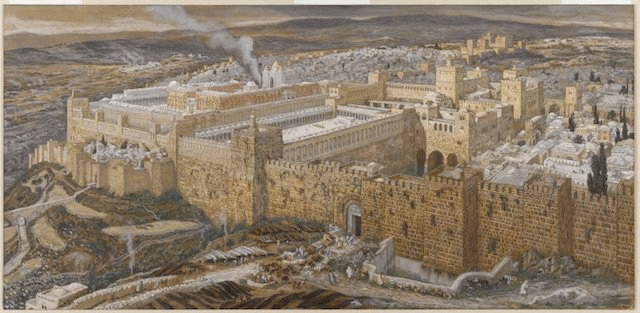
Jerusalem and Herod’s Temple, by James Tissot, c.1890

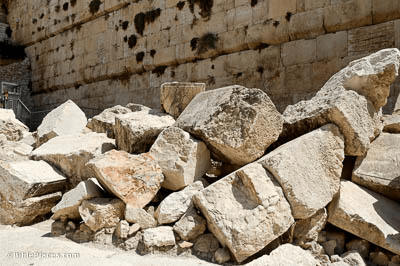
The disciples saw large and wonderful stones which were part of the temple. They marveled at what their physical eyes perceived. But Jesus saw further, into the future, and was not at all impressed; he saw a time of apocalypse. All of those stones in a heap. No one marveling over the temple.

Christ’s disciples wanted to know when such a time would happen. As was often the case with Jesus, he didn’t answer their question, at least not directly. He used it as an opportunity to teach about things to come.

The gist of Christ’s words to his disciples was to communicate that things are going to get worse than what they already are. The Roman occupation they were experiencing is nothing compared to what’s coming.

The apocalyptic language had been around in ancient Judea for a long time. There had been centuries of people talking about the world’s end.

Apocalyptic stuff is nothing new to contemporary folk, as well. Just mention the Book of Revelation and heads pop up, eyebrows raise, and imagination goes to seed.

We as biblical readers, however, need to observe that Jesus didn’t answer the question of his disciples. Which is perhaps something we must become more alert to.

Nobody knows when the end of the world will come. Not even Jesus. But that doesn’t seem to stop folks from asking anyway. Perhaps we need to ask a different question. Instead of asking “When will these things happen?” maybe we ought to ask, “What must I watch out for?”

The change of question orients us in a different way. Rather than end times speculation, we begin watching for things which are dangerous to humanity, things that bring upheaval to our world.

We start valuing awareness and observance, listening and contemplating. We learn to place our energies wisely into the things we believe truly matter in this life for the common good of all.

God is up to all sorts of kingdom business that is beyond our purview, and frankly, even beyond our ability to perceive or understand.

When we accept the exhortation of Jesus to “beware,” then we watch and look for things that are already here among us, and not get lost in a future we cannot predict. That type of future orientation only produces the kind of worry and anxiety that leads to fear.

And when fear takes root, it spawns the evils of hate and injustice. We become vulnerable to selfish incompetent leaders who make promises to take our fears away. We end up doing terrible acts against others, like imprisoning political opponents, denaturalizing and deporting citizens we don’t like, and creating fascist states that oppress others.

Fallen stones from the destruction of the Temple

But if we will wake up, hear the call of Jesus to beware, and awaken to our true commitment to the kingdom of God, we will then forsake fear-based tactics, and courageously help others in both body and soul.

It also means that, at times, we are off somewhere in centering and contemplative prayer, just like our Lord in the Garden of Gethsemane, knowing that the real source of power and authority is outside of us.

A true biblical view of the end times is about God working out divine purpose on behalf of all humanity. It isn’t about us and all of our fears and anxieties getting worked out in harmful ways.

The realization of a coming apocalypse must lead us toward faith and trust in the God who holds justice, righteousness, and mercy in good divine hands.

God has no limitations because of our questions. God will be God. God is who God is. Our task is to watch, remain faithful, and persevere until Christ returns to judge the living and the dead.

May it be so, to the glory of God.

The Coming Divine Judgment (Revelation 20:7-15)

Lake of Fire, by David Howard Hitchcock, 1888

When the thousand years are over, Satan will be released from his prison and will go out to deceive the nations in the four corners of the earth—Gog and Magog—and to gather them for battle. In number they are like the sand on the seashore. They marched across the breadth of the earth and surrounded the camp of God’s people, the city he loves. But fire came down from heaven and devoured them. And the devil, who deceived them, was thrown into the lake of burning sulfur, where the beast and the false prophet had been thrown. They will be tormented day and night for ever and ever.

Then I saw a great white throne, and he who was seated on it. The earth and the heavens fled from his presence, and there was no place for them. And I saw the dead, great and small, standing before the throne, and books were opened. Another book was opened, which is the book of life. The dead were judged according to what they had done as recorded in the books. The sea gave up the dead that were in it, and death and Hades gave up the dead that were in them, and each person was judged according to what they had done. Then death and Hades were thrown into the lake of fire. The lake of fire is the second death. Anyone whose name was not found written in the book of life was thrown into the lake of fire. (New International Version)

Almost everything is temporary. All things temporal must come to an end. Therefore, it is foolish to live as if everything we have will last forever.

Conversely, there are a few things which are permanent, namely, God and relationships. So, it only makes sense that we exist for values that will last, while holding very loosely the temporal things. Jesus put the matter like this:

“Do not store up for yourselves treasures on earth, where moths and vermin destroy, and where thieves break in and steal. But store up for yourselves treasures in heaven, where moths and vermin do not destroy, and where thieves do not break in and steal. For where your treasure is, there your heart will be also. (Matthew 6:19-21, NIV)

Yet, despite knowing this, people struggle with their espoused values. Many times, we succumb to the temporal as if it were permanent; and with permanence the things which are temporary. This situation speaks to the power of evil; and evil is not something to trifle with.

Just when we might evil is contained, it isn’t. In today’s lesson, Satan is loosed from his imprisonment, still a threat. That is the nature of evil amongst us; it has the sinister capacity to rebound and wreak havoc in people’s lives.

In the Apostle John’s apocalyptic vision, Satan is joined by Gog and Magog, who represent the nations of the earth. This hearkens back to the prophecy of Ezekiel in the Old Testament (Ezekiel 38-39) in which Gog – the leader of the land of Magog – leads an attack on Jerusalem. In other words, evil comes together and focuses its energies on the people of God in order to destroy them.

However, God intervenes; the destruction the nations intended on God’s people comes upon them. Evil is finally done for, once and for all; it is thoroughly purged from the presence of the righteous.

With evil put in its place, there is nowhere for the old rebellious systems and order of things to exist anymore. A new heaven and a new earth is needed – not just a reconstituted heaven and earth – because that’s how nasty evil really is, that it must be completely purged. New systems are put in place which can accommodate righteousness. Jesus predicted this new reality:

And no one pours new wine into old wineskins. Otherwise, the new wine will burst the skins; the wine will run out and the wineskins will be ruined. No, new wine must be poured into new wineskins.  (Luke 5:37-38, NIV)

When the time comes, all persons will stand as they truly are before the Lord. There can be no making oneself look better than they are, or presenting a particular optic that spins a good look in order to impress. All the actions and deeds of people are laid bare.

God’s grace, along with and human actions, are held together in tension. God grants salvation; and what we humans do with that gift matters a great deal.

Humanity’s works in this life demonstrate what sort of person they actually are. So, if those works are inconsistent and incongruent with how one’s life has been lived, it demonstrates where their hearts truly are; and where their final destination will be.

There is a coming judgment in which death and hell are done away with forever. Anyone whose name is not found in the Book of Life goes the way of death and hell, because when they had the chance to use their temporal life to give permanent life for others, they did not.

The point is not to try and determine who Gog and Magog are; or when in the future this all will happen. The sage person remains far away from such useless folly.

The aim of the Apostle John, for which we must pay attention, is twofold: encourage the faithful; and warn the unfaithful.

The Book of Revelation was given to believers in Jesus, to help them see that suffering, persecution, and hardship is temporary; remain faithful, persevere in faith, and you will see your name written in the Book of Life.

Revelation was also given as great warning sign to those who have put so much stock into power politics, jostling for authority, and oppressing others to get what they want. The positions they hold now are temporary. The oppression they give in this life will be what they receive in the next.

In the end, all things shall be judged rightly. In this, I take great comfort and hope.

Lord Jesus Christ, by your patience in suffering you hallowed earthly pain and gave us the example of obedience to your Father’s will: Be near me in my time of weakness and pain; sustain me by your grace, that my strength and courage may not fail; heal me according to you will; and help me always to believe that what happens to me here is of little account if you hold me in eternal life, my Lord and my God. Amen.