Luke 12:29-32 – Be Content

And do not set your heart on what you will eat or drink; do not worry about it. For the pagan world runs after all such things, and your Father knows that you need them. But seek his kingdom, and these things will be given to you as well.

“Do not be afraid, little flock, for your Father has been pleased to give you the kingdom. (New International Version)

If we’re honest with God, we acknowledge that we often worry a lot about tomorrow and how our needs will be met. 

Every day we send God moribund signals that our heads are not in the moment, and that our hearts are not into today. We fret about the future, leaving us profoundly discontent. So, we do busywork, distract ourselves with social media, and numb ourselves with spirits rather than turn to the Holy Spirit – all in the futile attempt to reduce the racing thoughts in our heads.

Far too many of us fail to enjoy the present moment. Our minds are someplace else. 

Contented people do not find their happiness in far-off places, in someday being able to acquire the things they desire, or in having a laser-like orientation to achieving a future goal. Instead, they find contentment in their present circumstances. 

Those living without fear and eschewing worry have discovered that happiness is not found in a new job, a new car, a new spouse, or a new anything.

“If I ever go looking for my heart’s desire again, I won’t look any further than my own backyard because if it isn’t there, I never really lost it to begin with.”

Dorothy, The Wizard of Oz

Focusing on the present does not mean ignoring the past or neglecting the future; it just means we are to put our primary attention on living in the here and now rather than on a romanticized future free of doubt, insecurity, and uncertainty. 

If we are not present to the here and now, we either get stuck in the past or continually worry about the future.  Everything then becomes either about recapturing some bygone era or of dreaming about some idyllic future state – buying into the wrongheaded notion that whenever I get out of school, or get married, or have kids, or get the job I want, or the kids leave home, or I retire, then all will be good, and I shall finally have contentment. 

Planning for the future is wise, good, and necessary; worrying about it and neglecting the present is bad.

Whenever we rush through the present to get to the future, we lose what God wants to do for us now.  It takes flow, mindfulness, and savor to fully engage the present.

“Flow” is a psychological term that means “being in the zone,” that is, to be actively involved in the present situation with focused attention. 

“Mindfulness” means to be aware of your present surroundings, and to especially be aware of your present state of mind and emotions; it is to pay attention to all that is within you and around you. 

To “savor” something is to enjoy it so much that you want it to last forever. It is to be slow, deliberate, and enjoyable. It’s about the journey, not just the destination.

Flow, mindfulness, and savor are what Jesus asked us to do. Christ wants us to stop and smell the roses. He wants us to give focused attention to what is currently in front of us; to be mindful of all the wonder of creation that presently surrounds us; and, to take the time to simply savor and enjoy it all. 

Once I was in a bible study with a group of people and the family’s dog kept licking a particular person to the point of distraction. Finally, I said to the group: “What do you think God is trying to tell us through the dog?”  We ended up having a very enlightening conversation on our own relationships with God and one another.

We are to be present to today. 

This is the day that the Lord has made;
    let us rejoice and be glad in it.

Psalm 118:24, NRSV

When we realize life is short, we will not waste it on worrying about the future. Although we don’t know about tomorrow, we do know about today. And today we are to enjoy God’s good gifts to us in the here and now.

So, teach us to consider our mortality,
so that we might live wisely. (Psalm 90:12, NET)

The wise way to live is one day at a time. That was God’s message through the prophet Jeremiah to the exiled Israelites. The ancient Jews kept spending their time reminiscing about the past and wishing for a better future.  So, God told them what to do in their exile:

“Build homes, and plan to stay. Plant gardens and eat the food they produce. Marry and have children. Then find spouses for them so that you may have many grandchildren. Multiply! Do not dwindle away! And work for the peace and prosperity of the city where I sent you into exile. Pray to the Lord for it, for its welfare will determine your welfare.” (Jeremiah 29:5-7, NLT)

Being content means to enjoy today, to savor the present moment God has you in, even if you don’t like where you are right now.

So go eat your food and enjoy it;
    drink your wine and be happy,
because that is what God wants you to do.
Put on nice clothes
    and make yourself look good.

Enjoy life with the wife you love. Enjoy all the useless days of this useless life God has given you here on earth, because it is all you have. So, enjoy the work you do here on earth. Whatever work you do, do your best, because you are going to the grave, where there is no working, no planning, no knowledge, and no wisdom. (Ecclesiastes 9:7-10, NCV)

Appreciate God’s simple gifts

Sometimes we look so hard for a future miracle, and want out from the circumstance we are in, that we fail to experience contentment in the present time. We are to enjoy the simple pleasures of life which God gives to us, even within our adversity.

I know what it is to be in need, and I know what it is to have plenty. I have learned the secret of being content in any and every situation, whether well fed or hungry, whether living in plenty or in want. (Philippians 4:12, NIV)

No matter what is going on in our lives, whether good or not, we can still appreciate a beautiful sunset, a good book, a walk on the beach, time with friends, good food, and a host of other simple gifts which God provides for us on a daily basis. Yet, we must stop long enough to experience and enjoy them.

Remember to celebrate

We are meant to celebrate life. The genuineness of Christianity is seen whenever Christians throw the best parties and have the most fun.

Someday we are all going to die. Rather than this being a downer, it is an opportunity to ponder an important question: Will you celebrate the time you have here on this earth and enjoy it? 

It’s not hedonistic (living for pleasure) to enjoy life and have a party. It’s actually a biblical thing to do. A spirit of celebration is a Christian spirit.

Work with enthusiasm

Dive in and enjoy your work. We end up worrying whenever our focus is on the destination. However, the real point of life is to enjoy the journey and the process. Be present to your work now and enjoy a job well done for the day, instead of looking forward to a fatter paycheck and a better job in the future.

My God will meet all your needs according to the riches of his glory in Christ Jesus.

Philippians 4:19, NIV

Engage in work with joyful abandon, and not with compulsive perfectionism (which is joyless and life-draining). Find ways of enjoyment within the kind of work that may be draining and not very exciting. Every job has mundane repetitive work to it. Yet, how we go about that work is significant.

If the here-and-now is not the best time of your life, then you and I need to be mindful to the words of Jesus because our focus is somehow misplaced. Contented people focus on the present, what is happening now, today, and they do not worry about tomorrow because that future state is the responsibility of God. 

Ever-present God, enlarge my heart to receive more of your grace and contentment. Rescue me from my small thoughts of your love and goodness. Free me from any unbelief and uncover my many fears. May I rest secure in the knowledge that you are good and everything you do is right, just, and fair. Amen. 

Psalm 23 – I Have Everything I Need

Psalm 23 by John August Swanson, 2010

The Lord is my shepherd;
    I have everything I need.
He lets me rest in fields of green grass
    and leads me to quiet pools of fresh water.
He gives me new strength.
He guides me in the right paths,
    as he has promised.
Even if I go through the deepest darkness,
    I will not be afraid, Lord,
    for you are with me.
Your shepherd’s rod and staff protect me.

You prepare a banquet for me,
    where all my enemies can see me;
you welcome me as an honored guest
    and fill my cup to the brim.
I know that your goodness and love will be with me all my life;
    and your house will be my home as long as I live. (Good News Translation)

I once had a neighbor named Art. Art was a shepherd. He spent a good chunk of his day, every day, leading his sheep around his five acres of property across the road from me. On occasion, Art would politely ask if some of his sheep could come to my backyard and feed on some of the wild plants that were in abundance. I was amazed how “artfully” he cared for his sheep.

Sheep get a bad rap, in my opinion. I have often heard others refer to them as stupid. Having grown up on a farm, I realize there are animals that are not so bright. Sheep aren’t one of them. Cows, however, are. I think when God created cows the raccoons came along and stole some of their brains. 

There’s a reason sheep possess the reputation of lacking smarts – they are prone to being afraid. Sheep get spooked and upset easily. And, when they are skittish and scared, sheep tend to panic.

More than once I’ve seen a flock of sheep run full-steam head-first into a stone wall. If you don’t know much about sheep and come along and see this, they most certainly appear to be downright stupid. Yet, sheep are really, quite intelligent.  It’s just when fear overcomes them, they can do some nonsensical things.

Jesus the Good Shepherd by Solomon Raj

The presence of a faithful shepherd makes all the difference.

Sheep become familiar with their shepherd and learn to depend on them. There were times that Art had to leave the sheep alone and I would do a sort of babysit with them. Around me the sheep were cautious and had their guard up. The presence of anxiety was clear. But when Art showed up, he didn’t have to say a word. I could feel and observe the flock collectively relaxing.

God Pastors

God is the ultimate shepherd of the sheep. Jesus is the Good Shepherd. When we sense the presence of God’s Spirit, there is faith, trust, and confidence. This, then, brings a settled conviction of calm and comfort. Whenever that sense is absent, we do things like buy two pallets of toilet paper and try to bring it home in a compact car. It’s non-sense.

Psalm 23 is a beloved portion of Holy Scripture for a reason; it helps us as sheep to settle down and trust, even in the middle of uncertainty and anxiety. 

God’s presence + God’s provision + God’s protection = God’s providential care. God’s presence is constant, not sporadic; his provision is enough, not stingy; and his protection is total, not partial.

To know and feel God’s presence watching over us and giving generously to us is the very balm we need. It melts our fear in the face of adversity and opposition; it helps us relax in tough economic times; and it inoculates us from believing the sky is falling. 

Our courage and confidence cannot be ginned-up through sheer willpower; it comes as we get to know the great shepherd of the sheep standing there watching over us with compassionate and competent care.

God Provides

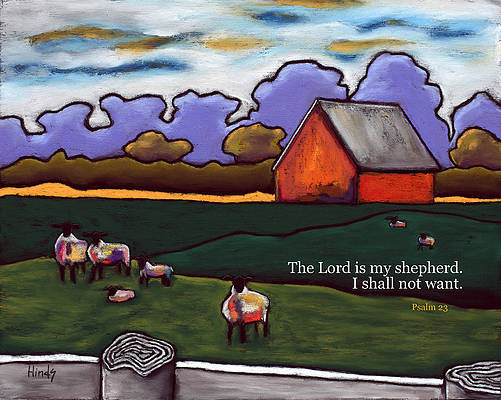
God is personal, not generic. God is the great “I AM,” the God who is. The Lord is my shepherd – not was or will be – is. God is not just somebody else’s God and shepherd, but my shepherd. 

The Lord is My Shepherd by David Hinds

Shepherd is an apt term because a shepherd cares for the sheep – watches over them, is present with them, protects them, and provides whatever they need to both survive and thrive.

God benevolently leads us; and does not act outside of his character and attributes. If we believe this about the great “I AM,” then worry and anxiety begins to diminish. Too many of us suffer from the heebie-jeebies because we don’t see the shepherd standing in the field watching over us.

The answer to our worry is not to keep telling ourselves to stop being anxious. With God on the job as shepherd, I shall not be in want; I have everything I need. 

Troubled times will always be with us, this side of heaven. Fear can grab hold and prevent us from living with settled intentions and reasonable plans toward the future. Every day we see folks running headlong into a stone wall. 

It’s okay to be afraid; it is not okay to let fear rule our lives. The solution is to speak, despite your fear; to act, despite your worry; to live, knowing God has your back.

God Is Present

Within much of Hebrew poetry, the focus of the writing is found smack in the middle. Everything before it builds toward it; everything after it points back. Smack in the middle of Psalm 23 is that God is with us. 

Even though I walk through the valley of the shadow of death, even though it may seem that everything is bleak and that all things are against me – God is with me, which is why I do not succumb to fear. 

We walk through the valley, not around it. God does not cause us to avoid difficult circumstances. Instead, God promises to be with us through them. The way to deliverance is to confront our fears and walk with God, rather than expecting God to take away everything unpleasant that we don’t like.

My neighbor Art had a shepherd’s crook. He mostly used it as a walking stick. Yet, I did see times when he fended-off predators seeking to get to the sheep. More often, Art used his shepherd’s crook as a way of guiding the sheep where they could feed and be protected. 

The discovery of God’s guidance comes from movement and creativity. We aren’t going to experience the leading we want apart from embracing the uncomfortable in the confidence that God provides and protects through the trouble, and not apart from it.

Coptic Church icon of Jesus the Good Shepherd

God Protects

Even with enemies of disease, death, and disorder surrounding us, God’s presence is such that his protection and provision are providentially working to create blessing in the middle of trouble. Whereas fear and panic believe in a culture of scarcity, a culture of abundance discerns that there is plenty for all – and will thus work toward equitable distribution and fostering an egalitarian spirit.

God refreshes, encourages, and restores. There are abundant blessings – even within troubled times. God’s provision is right here, amidst the worst of circumstances. We don’t have to pick a fight with someone in the Costco parking lot, who has what I want, to get the things we need.

It’s easy to believe that God’s goodness and love will follow me when my health is good, my income is solid, and I have plenty of friends around me. It is another thing to have an awareness of that goodness in dark days.  Yet, God’s love and goodness hasn’t sequestered itself.  God providentially uses each life situation and bends it to redemptive purposes.

Experientially knowing God brings contentment and confidence. The radical nature of Psalm 23 is that peace is realized while chaos and uncertainty is all around. Establishing spiritual practices that reinforce our sense of security can aid us through difficulty and hardship.

With a settled conviction that God indeed has our backs and stands as the divine sentinel watching over the beloved sheep, we find the ability to relax and trust that all is well with my soul.

Lord, help me to relax.

Take from me the tension
that makes peace impossible.
Take from me the fears
that do not allow me to venture.
Take from me the worries
that blind my sight.
Take from me the distress
that hides your joy.

Help me to know
that I am with you,
that I am in your care,
that I am in your love,
that you and I are one,

Through the mighty name of Jesus,

In the power of the Holy Spirit. 

Amen.

John 11:45-57 – Gripped by Worry and Fear

Many of the Jews who had come to visit Mary [the sister of Lazarus] and had seen what Jesus did [raised Lazarus from death] believed in him. But some of them went to the Pharisees and told them what Jesus had done. Then the chief priests and the Pharisees called a meeting of the Sanhedrin.

“What are we accomplishing?” they asked. “Here is this man performing many signs. If we let him go on like this, everyone will believe in him, and then the Romans will come and take away both our temple and our nation.”

Then one of them, named Caiaphas, who was high priest that year, spoke up, “You know nothing at all! You do not realize that it is better for you that one man die for the people than that the whole nation perish.”

He did not say this on his own, but as high priest that year he prophesied that Jesus would die for the Jewish nation, and not only for that nation but also for the scattered children of God, to bring them together and make them one. So, from that day on they plotted to take his life.

Therefore, Jesus no longer moved about publicly among the people of Judea. Instead, he withdrew to a region near the wilderness, to a village called Ephraim, where he stayed with his disciples.

When it was almost time for the Jewish Passover, many went up from the country to Jerusalem for their ceremonial cleansing before the Passover. They kept looking for Jesus, and as they stood in the temple courts they asked one another, “What do you think? Isn’t he coming to the festival at all?” But the chief priests and the Pharisees had given orders that anyone who found out where Jesus was should report it so that they might arrest him. (New International Version)

Helping others, Christian ministry, and compassionate service can be risky business. Just ask Jesus.

The Jewish ruling council (Sanhedrin) was deeply disturbed by all the hubbub Jesus was stirring. Rather than celebrating the healing of many people in both body and soul, the rulers were anxious, worried, and afraid. They feared the worst: All the attention might rile the Roman occupation of the land. Then, they will obliterate both temple and nation.

“Fear is the path to the Dark Side. Fear leads to anger, anger leads to hate, hate leads to suffering.”

Yoda

Wherever you find a group of folks living in continual fear that something awful is going to happen, there you will find a strict code of conformity and no allowances for difference. After all, rocking the boat only draws attention. Fear dictates that if anything, or anyone, deviates from established protocol, the entire religious system and even its people will be destroyed.

Jesus was anything but a conformist to the status quo. He frequently operated outside of established religious norms. Thus, Christ was viewed by many religious leaders as a loose cannon that was making too much noise and needed to be silenced before something terrible happened.

One of the problems with living in the fearful worry of what horrible thing may occur is that we play an ignorant game of prognostication. We simply do not know the future. We can predict. We can become full-time pundits, opining about what’s going to happen. Yet, when all is said and done, the future is not ours to see. Only God is privy to standing above time and space.

Any institution whose chief focus is keeping everyone in line out of a fear of losing influence, power, privilege, money, devotion, buildings, or people will likely experience a self-fulfilled prophecy of doom. Therefore, it is necessary we define our ministries, services, and actions by who we are and not by what we don’t do.

“The enemy is fear. We think it is hate; but it is fear.”

Gandhi

Today’s Gospel lesson chronicles the forward progress of Jesus to his ultimate suffering and death. Within the Gospel of John, there are two streams running parallel to one another. There is a group who observes Jesus, listens to his teaching, sees his miraculous works, and believes in him.  Alongside them is another group who experiences all the same events and hears all the same words of Jesus – yet responds in a different manner by plotting how Jesus might be arrested and killed.

Fear can take such a tight hold within an organization that premeditated murder is executed without any moral misgivings.

Worry can worm its way so deeply into a group that verbal assassinations seem both justified and necessary.

Anxiety can overwhelm an institution to such a degree that rationalizations for unethical behavior are rife. People cease to be looked at as people. They are referred to as threats, demonized as monsters who are trying to take away a way of life.

Caiaphas, the high priest, spoke to his fellow religious leaders, perhaps without even knowing the truth and deep import of his prophetic words: “You know nothing at all.  Nor do you understand that it is better for you that one man should die for the people, not that the whole nation should perish.” Indeed, not only did Jesus die for the nation of Israel, but on behalf of all nations, and all people. 

The implications of Christ’s death are magnanimous. The extent of his atonement for the people includes redemption from the bondage of sin; reconciliation between us and God; satisfaction of God’s wrath against the sin of the world; and victory over demons, death, and hell.

With all this incredible work of restoration and renewal, fear and worry take a back seat. Courage and confidence take the wheel.

Merciful Jesus, you are my guide, the joy of my heart, the author of my hope, and the object of my love. I come seeking refreshment and peace. Show me your mercy, relieve my fears and anxieties, and grant me a quiet mind and an expectant heart, that by the assurance of your presence, I may learn to abide in you, my Lord and my God. Amen.

Psalm 17 – Prayer in Anxious Times

Listen to what’s right, Lord;
    pay attention to my cry!
Listen closely to my prayer;
    it’s spoken by lips that don’t lie!
My justice comes from you;
    let your eyes see what is right!
You have examined my heart,
    testing me at night.
You’ve looked me over closely,
    but haven’t found anything wrong.
    My mouth doesn’t sin.
But these other people’s deeds?
    I have avoided such violent ways
    by the command from your lips.
My steps are set firmly on your paths;
    my feet haven’t slipped.

I cry out to you because you answer me.
    So tilt your ears toward me now—
    listen to what I’m saying!
Manifest your faithful love in amazing ways
    because you are the one
    who saves those who take refuge in you,
    saving them from their attackers
    by your strong hand.
Watch me with the very pupil of your eye!
    Hide me in the protection of your wings,
        away from the wicked
            who are out to get me,
        away from my deadly enemies
            who are all around me!
They have no pity;
    their mouths speak arrogantly.
They track me down—
    suddenly, they surround me!
    They make their plans to put me in the dirt.
They are like a lion eager to rip its prey;
    they are like a strong young lion lying in wait.

Get up, Lord!
    Confront them!
    Bring them down!
Rescue my life from the wicked—
    use your sword!
Rescue me from these people—
    use your own hands, Lord!
Rescue me from these people
    whose only possession is their fleeting life.
But fill the stomachs of your cherished ones;
    let their children be filled full
    so that they have leftovers enough for their babies.

But me? I will see your face in righteousness;
    when I awake, I will be filled full by seeing your image. (Common English Bible)

This is one of David’s personal psalms of lament. It’s a prayer forged smack in the middle of adversity with unjust adversaries seeking to take his life. 

The psalm is a visceral plea for God to vindicate David and subdue those who wanted to harm him. Today’s psalm is also a heartfelt lament that wickedness exists and often gets its way; it is an expression of grief about the constant threats swirling around David.

There was so much mean and arrogant violence that David prayed God would keep him as the apple of his eye and hide him in the shadow of his wings. 

Indeed, perhaps no better prayer could be said in times when there are people who make untrue accusations and only wish harm to be done to you, that the Lord will keep a continual watchful, focused, and vigilant gaze upon us.

In times when angry simpletons spew their worst and misguided miscreants seek us harm, we need to confidently know: God watches over us with affection and cares for us as a mother hen protects her chicks.

Even before we make the request, neither our predicament nor our hearts are strangers to the Lord. Our human ingenuity and stamina is not enough to overcome intense hardship and adversity. The Lord must be there to help us and to guide our hearts toward the good. Even when the way is painful, later it will bear the fruit of righteousness.

You and I are precious to God. We can run to the Lord when there is trouble. There truly is a benevolent God showing firm commitment to those who seek truth, loving actions, and merciful words. 

When going through a difficult season, in which another or others accuse you of wrongdoing and you know you are innocent, the proper prescription is to pray this very psalm repeatedly at night before bed. For we all know that sleep can be elusive and hard to come by in such difficult circumstances. The palpable stress can make it impossible to tone down the racing thoughts.

Trying to fall asleep through sheer willpower is totally ineffective. Instead, try to stay awake by praying. While it may sound counterintuitive, trying to stay awake through prayer lessens the anxiety around trying to fall asleep. Since falling asleep is an involuntary process, taking our minds off of the task at hand gives the brain the break it needs, and the heart the comfort it needs. 

Perhaps, along with David, you will be able to say that your prayers are answered – that you beheld the face of righteousness and had good sleep. And in the morning, when you awake, you will feel satisfied with having seen the likeness of a God who hears and cares.

Gracious and merciful Lord, you are the holy One who has pity for all our weakness. Put away from us worry and every anxious fear so that at the end of a hard day – in which you saw all of our labor and all our adversities – your compassionate eye will watch over us and your loving hand will hold us as we lay down for rest. And when the night has come, may we receive from you your priceless gift of sleep, through Jesus Christ our Lord. Amen.