Jesus Is Greater (Hebrews 1:5-14)

Christ the Redeemer, in Rio de Janeiro, Brazil

For to which of the angels did God ever say,

“You are my Son;
    today I have become your Father”?

Or again,

“I will be his Father,
    and he will be my Son”?

And again when God brings his firstborn into the world, he says,

“Let all God’s angels worship him.”

In speaking of the angels he says,

“He makes his angels spirits,
    and his servants flames of fire.”

But about the Son he says,

“Your throne, O God, will last for ever and ever;
    a scepter of justice will be the scepter of your kingdom.
You have loved righteousness and hated wickedness;
    therefore God, your God, has set you above your companions
    by anointing you with the oil of joy.”

He also says,

“In the beginning, Lord, you laid the foundations of the earth,
    and the heavens are the work of your hands.
They will perish, but you remain;
    they will all wear out like a garment.
You will roll them up like a robe;
    like a garment they will be changed.
But you remain the same,
    and your years will never end.”

To which of the angels did God ever say,

“Sit at my right hand
    until I make your enemies
    a footstool for your feet”?

Are not all angels ministering spirits sent to serve those who will inherit salvation? (New International Version)

The people were weary. They were good and faithful Jews in Jerusalem, just trying to worship God and live their lives in faith, patience, and righteousness. And then, through incredible events, they came to believe that Jesus is the promised Messiah. They placed all their hopes and their very lives upon him.

And then, persecution broke out against the believers in Jesus. They were scattered. They fled Jerusalem. The people found themselves as Christian refugees in strange Gentile countries. In those places, they faced hardship and disrespect, not only for being Jews, but for being Christians. In many cases, their families disowned them; and the laws of the land were not good to them.

The believers started off well. But over time, the difficulty began to get to them. The people started wondering if all this commitment to Jesus Christ was worth it, or not. Their spiritual resolve was slowly ebbing away.

The author of Hebrews insists, biblically, that Jesus is superior over everything and everyone. The author stepped into the flagging believers’ situation, and went about answering that question of whether Jesus is truly all he’s cracked up to be. And he began the comparisons of superiority with Jesus over the angels.

Jesus Christ is greater than the angels

Jesus is the Son – the Son of God – which is a way of saying that Jesus is God. And he proved it through his life and ministry, his death and resurrection, his ascension and glorification.

When Jesus began his earthly ministry, he was sent into the desert for 40 days and nights. That experience demonstrated his true muster. Christ fully identified with the people, accomplished what no other human did, and became the pioneer of our salvation.

In bringing many sons and daughters to glory, it was fitting that God, for whom and through whom everything exists, should make the pioneer of their salvation perfect through what he suffered. Both the one who makes people holy and those who are made holy are of the same family. So Jesus is not ashamed to call them brothers and sisters. (Hebrews 2:10-11, NIV)

Jesus Christ has greater dignity than the angels

Unlike angels, Jesus, the Son, is worthy of worship. Angels may be exalted and immortal beings, but they are creatures, just like us humans. Jesus, however, as God, was there at creation. What’s more, Jesus presently holds all things together.

The Son is the image of the invisible God, the firstborn over all creation. For in him all things were created: things in heaven and on earth, visible and invisible, whether thrones or powers or rulers or authorities; all things have been created through him and for him. He is before all things, and in him all things hold together. (Colossians 1:15-17, NIV)

Jesus Christ has a greater status than the angels

Times change. Circumstances change. People are fickle. What is celebrated today is condemned tomorrow, and vice versa. But God never changes in the basic divine character. And God is eternal. Therefore, the Lord Jesus is a solid rock from which to construct a firm spiritual life.

Jesus Christ is the same yesterday and today and forever.

Hebrews 13:8, NIV

Jesus Christ has a greater function than the angels

As the Son of God, Jesus is the sovereign ruler over all things. We do not simply make him the Lord of our lives; he already is that. We just need to acknowledge this reality, submit to Christ’s authority, and persevere in faith. We must continually remember this, or we will become spiritually weary.

So do not throw away your confidence; it will be richly rewarded.

You need to persevere so that when you have done the will of God, you will receive what he has promised. For,

“In just a little while,
    he who is coming will come
    and will not delay.” And,

“But my righteous one will live by faith.
    And I take no pleasure
    in the one who shrinks back.”

But we do not belong to those who shrink back and are destroyed, but to those who have faith and are saved. (Hebrews 10:35-39, NIV)

Christians are never defenseless in this world. God has not only provided salvation through the Son, but has also given the angels to help us sustain our commitment to Christ. God cares so much about us that he has enlisted millions of angels for our benefit, so that we can continue to live out the words and ways of Jesus till the very end of our earthly lives.

God of wonder and of joy: grace comes from you, and you alone are the source of life and love. Without you, we cannot please you; without your love, our deeds are worth nothing. Send your Holy Spirit, and pour into our hearts that most excellent gift of love, that we may worship you now with thankful hearts and serve you always with willing minds; through Jesus Christ our Lord. Amen.

A Vision of the End (Revelation 14:1-11)

The Great Day of His Wrath, by John Martin, 1852

Then I looked, and there before me was the Lamb, standing on Mount Zion, and with him 144,000 who had his name and his Father’s name written on their foreheads. And I heard a sound from heaven like the roar of rushing waters and like a loud peal of thunder. The sound I heard was like that of harpists playing their harps. And they sang a new song before the throne and before the four living creatures and the elders. No one could learn the song except the 144,000 who had been redeemed from the earth. These are those who did not defile themselves with women, for they remained virgins. They follow the Lamb wherever he goes. They were purchased from among mankind and offered as first-fruits to God and the Lamb. No lie was found in their mouths; they are blameless.

Then I saw another angel flying in midair, and he had the eternal gospel to proclaim to those who live on the earth—to every nation, tribe, language and people. He said in a loud voice, “Fear God and give him glory, because the hour of his judgment has come. Worship him who made the heavens, the earth, the sea and the springs of water.”

A second angel followed and said, “‘Fallen! Fallen is Babylon the Great,’ which made all the nations drink the maddening wine of her adulteries.”

A third angel followed them and said in a loud voice: “If anyone worships the beast and its image and receives its mark on their forehead or on their hand, they, too, will drink the wine of God’s fury, which has been poured full strength into the cup of his wrath. They will be tormented with burning sulfur in the presence of the holy angels and of the Lamb. And the smoke of their torment will rise for ever and ever. There will be no rest day or night for those who worship the beast and its image, or for anyone who receives the mark of its name.” (New International Version)

Throughout the book of Revelation (The Apocalypse of John) the Apostle John communicates visions of the end, of God’s wrath and human suffering. Yet John also pauses throughout his vision to offer encouragement for the faithful followers of Jesus in the present time who are undergoing suffering, even persecution.

The assurance believers have is that God sees their struggle, their devotion; the Lord will protect them – not from suffering and death – but from the effects of divine judgment and punishment on the earth. The Lord will not abandon the believers. Instead, they will share in God’s new realm.

The Lamb and the Redeemed

The ultimate destiny of Christ’s faithful followers is not in judgment but in triumph – even though many of them had to face extreme circumstances and died the martyr’s death. Christ, the Lamb of God, stands in the center of God’s kingdom with the 144,000, who sing a new song to God.

It could be that these 144,000 persons are representative and symbolic of all redeemed humanity. Or, they may likely be Christian martyrs, the ones who were the victims of evil (Revelation 13). Whoever they actually are, their description is figurative in order to convey that these faithful persons are morally and spiritually pure; they did not defile themselves with the wickedness of the world’s systemic and structural evil.

These redeemed persons are the first fruits, believers who have sacrificed their lives for God and maintained their witness to King Jesus, and not to Ceasar as Lord. In the Old Testament, every firstborn (both human and animal) belonged to the Lord. The first fruits (the initial yield of crops) were set aside specifically as a sacrificial offering to God.

In the New Testament, the concept and practice of first fruits is used as a metaphor for something given to God in advance. So, in the book of Revelation, this refers to the harvest at the end of the age; the first fruits are the 144,000, the ones who are the anticipation of Christian resurrection. In other words, there are many more converts to come – people redeemed by the Lamb and set aside for resurrection and new creation. A great harvest of souls comes; because of Christ’s resurrection, his followers shall also experience resurrection.

The Message of the Three Angels

The Apostle John spoke of three angels, each of whom proclaim a coming judgment of God. The first angel has a call to repentance and a warning of imminent judgment. The second angel announces the fall of Babylon (Rome). And the third angel pronounces judgment upon those who gave themselves to the powers of this fallen world, who participated in organizational wickedness through oppression, abuse, neglect, disrespect, and dishonor of others.

It is with the third angel that the “mark of the beast” upon a person’s forehead is the mark of judgment on them. Although the language and picture of this, and what happens to them, was (and still is for some) used to scare the hell out of people so that they would embrace heaven, we must very much distance ourselves from such disgraceful rhetoric.

Again, the vision is full of symbolism and is not to be taken literally; it is John’s attempt to convey an otherworldly experience he had, in terms which his readers could grasp. The big idea is that those who have become devoted members to the machinations of evil in its various forms on this earth will experience the judgment of God.

As they sought glory in this world by any means possible – including using people to keep and hold power – so, they will face an inglorious end when God holds them accountable for their wrongdoing and for letting their own hearts become shriveled and dry.

This is neither the time to participate in evil, nor to procrastinate in making things right – while you still have time to do so.

For those holding on to bitterness, it is time to forgive.

For the ones giving in to their anger through hating others, it is now time to humble yourself, repent, and turn to right and healthy ways of dealing with that anger.

For the persons allowing themselves to be used by others for perpetuating evil in their workplace, neighborhood, or church, it is high time to find your voice, renounce the damaging practices, and speak truth to power.

We all must suffer. What it is we suffer for, is up to us.

Almighty and everlasting God, the rightful Judge of all things and all people, help us, your people, to be rightly prepared for Christ’s coming, through a right confession and right practices in this life. Enable us to walk in a manner worthy of our calling so that we might cast the bright beams which radiate from the approaching day of glory into those dark days and nights of suffering.

Sovereign God, draw us, we pray, near to Christ and in union with him. May we taste and see the goodness of the Lord; be strengthened in faith for the trials and tribulations which lie before us; bask in the love of Jesus; and hold fast to divine promises, and our confession, especially since the end of all things is at hand. Amen.

The Trumpets of Judgment (Revelation 8:6-9:12)

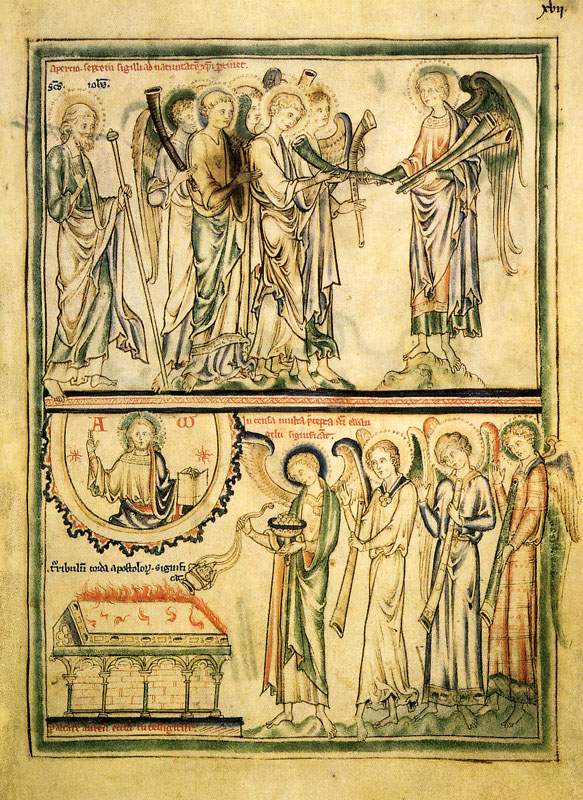
The seven angels with seven trumpets, and the angel with a censer, c. 1020 C. E.

Then the seven angels who had the seven trumpets prepared to sound them.

The first angel sounded his trumpet, and there came hail and fire mixed with blood, and it was hurled down on the earth. A third of the earth was burned up, a third of the trees were burned up, and all the green grass was burned up.

The second angel sounded his trumpet, and something like a huge mountain, all ablaze, was thrown into the sea. A third of the sea turned into blood, a third of the living creatures in the sea died, and a third of the ships were destroyed.

The third angel sounded his trumpet, and a great star, blazing like a torch, fell from the sky on a third of the rivers and on the springs of water—the name of the star is Wormwood. A third of the waters turned bitter, and many people died from the waters that had become bitter.

The fourth angel sounded his trumpet, and a third of the sun was struck, a third of the moon, and a third of the stars, so that a third of them turned dark. A third of the day was without light, and also a third of the night.

As I watched, I heard an eagle that was flying in midair call out in a loud voice: “Woe! Woe! Woe to the inhabitants of the earth, because of the trumpet blasts about to be sounded by the other three angels!”

The fifth angel sounded his trumpet, and I saw a star that had fallen from the sky to the earth. The star was given the key to the shaft of the Abyss. When he opened the Abyss, smoke rose from it like the smoke from a gigantic furnace. The sun and sky were darkened by the smoke from the Abyss. And out of the smoke locusts came down on the earth and were given power like that of scorpions of the earth. 

They were told not to harm the grass of the earth or any plant or tree, but only those people who did not have the seal of God on their foreheads. They were not allowed to kill them but only to torture them for five months. And the agony they suffered was like that of the sting of a scorpion when it strikes. During those days people will seek death but will not find it; they will long to die, but death will elude them.

The locusts looked like horses prepared for battle. On their heads they wore something like crowns of gold, and their faces resembled human faces. Their hair was like women’s hair, and their teeth were like lions’ teeth. They had breastplates like breastplates of iron, and the sound of their wings was like the thundering of many horses and chariots rushing into battle. They had tails with stingers, like scorpions, and in their tails they had power to torment people for five months. They had as king over them the angel of the Abyss, whose name in Hebrew is Abaddon and in Greek is Apollyon (that is, Destroyer).

The first woe is past; two other woes are yet to come. (New International Version)

Angels receiving seven trumpets, c. 1255 C.E.

Woah; this isn’t exactly some light bedtime reading. It has to do with the end of all things, with God’s judgment upon the earth. Seven angels with seven trumpets are about to sound them with disastrous results. The last three trumpets are also referred to as the three woes upon the earth.

The first four trumpets are bad, yet not nearly as terrible as the last three. The first four affect the natural world and one-third of the earth; whereas the last three directly impact the earth’s inhabitants and affect the entire world.

As hard as it may be to accept biblical readings like today’s, God is not only the author of abundant flourishing, but also of devastating destruction. And it’s in direct answer to the prayers of the saints. (Revelation 8:3)

Although hail and blood remind the biblical student of the plagues of judgment in ancient Egypt before the great exodus of Israelites, it’s the fire that does damage to the trees and grass of the earth. A third of the earth’s land resources are completely burned up.

The second angel blowing the second trumpet results in a great mountain being hurled into the sea. This is reminiscent, for those familiar with the Gospels, of Jesus stating that one with a small amount of faith can command a mountain to be thrown into the sea, and it will be done. (Mark 11:23)

Going back into the Old Testament, in the giving of the Law on the mountain, and with the disobedience of the people at the foot of the mountain, Mount Sinai was ablaze with fire and the glory of God. The New Testament scene in Revelation appears to be something of a Mount Sinai taken up and thrown into the sea – signifying that the grace of Christ has supplanted the curse of the law.

As a result of the second trumpet, a third of all the great oceans are destroyed.

Although C.S. Lewis gave the name “Wormwood” to a fictional agent of Satan, the Wormwood here is a messenger of God, a star that falls from the sky as a result of the third trumpet blown. A third of all the earth’s drinkable water becomes bitter because of the star – which seems to be a link to previous times of judgment from God:

“I will make them eat bitter food
    and drink poisoned water,
because from the prophets of Jerusalem
    ungodliness has spread throughout the land.” (Jeremiah 23:15, NIV)

“They have followed the stubbornness of their hearts; they have followed the Baals, as their ancestors taught them.” Therefore this is what the Lord Almighty, the God of Israel, says: “See, I will make this people eat bitter food and drink poisoned water. (Jeremiah 9:14-15, NIV)

There’s nothing that falls from the sky with the blast of the fourth trumpet. Yet a third of the sun, moon, and stars are dimmed. This is a portent that something worse is about to happen – which is what the “eagle” [vulture] announces against the earth’s inhabitants.

Another star falls to the earth, but with even more disaster than the previous star – opening a pit in the heart of the earth. Smoke comes billowing out, darkening the sun. Then, locusts with the stinging power of scorpions, come upon the land.

Rather than humans having authority to trample on snakes and scorpions, these demonic insects carry the ability and the authority to harm humanity – much like the great locust horde of judgment during the time of the prophet Joel (Joel 2:1-11). The difference with John’s Apocalypse is that these are a demonic host with Apollyon the Destroyer leading them.

The previous judgments were from above; this first woe is from below – connecting the powers of death, destruction, and the grave together with the force of evil. It’s a time of sheer torture; a traumatic five months of horrendous agony.

Conclusion

None of these terrible scenes of judgment are meant to scare the hell out of anybody and put the fear of heaven into them. Instead, the New Testament book of Revelation (also known as the Apocalypse of John) is meant for devoted believers in Jesus to be encouraged that an end is coming. They can persevere in following Jesus because it will be worth it.

The hardships, difficulties, and persecutions experienced – for following the words and ways of Jesus – will not last; a time is coming soon when God will judge the living and the dead. Evil will be dealt its final blow. And we will enter a realm of unending peace with the God for whom we have given our all.

Therefore, since we are receiving a kingdom that cannot be shaken, let us be thankful, and so worship God acceptably with reverence and awe, for our “God is a consuming fire.” (Hebrews 12:28-29; Deuteronomy 4:24)

May the Lord answer you in the day of trouble!
    The name of the God of Jacob protect you!
May he send you help from the sanctuary
    and give you support from Zion.
May he remember all your offerings
    and regard with favor your burnt sacrifices. Selah

May he grant you your heart’s desire
    and fulfill all your plans. Amen. (Psalm 20:1-4)

The Angels’ Candle of Peace (Luke 1:68-79)

“Praise be to the Lord, the God of Israel,
    because he has come to his people and redeemed them.
He has raised up a horn of salvation for us
    in the house of his servant David
(as he said through his holy prophets of long ago),
salvation from our enemies
    and from the hand of all who hate us—
to show mercy to our ancestors
    and to remember his holy covenant,
the oath he swore to our father Abraham:
to rescue us from the hand of our enemies,
    and to enable us to serve him without fear
in holiness and righteousness before him all our days.

And you, my child, will be called a prophet of the Most High;
    for you will go on before the Lord to prepare the way for him,
to give his people the knowledge of salvation
    through the forgiveness of their sins,
because of the tender mercy of our God,
    by which the rising sun will come to us from heaven
to shine on those living in darkness
    and in the shadow of death,
to guide our feet into the path of peace.” (New International Version)

Old Zechariah the Priest

Zechariah and his wife Elizabeth were old and well past childbearing years. In fact, Zechariah is portrayed earlier in Luke’s Gospel as something of a stereotypical grump. After being taken up to the temple in a golf cart because he couldn’t walk so well anymore, Zechariah was confronted by an angel and nearly lost his dentures out of fear. 

The angel Gabriel told him that his wife would bear a son who will prepare the way of Messiah. Zechariah then gave a sort of “Hmpff!  That’s not likely, Sonny. Look at me and my wife. Are you sure you have the right couple, and the orders in heaven didn’t get screwed up?”

The Angel Appears to Zechariah by William Blake, 1800

The angel Gabriel was not very keen on being doubted, and it earned Zechariah losing his voice until John the Baptist was born. It was after Zechariah had nine months to think about that encounter, and experience watching a child grow in his wife’s womb, that after John’s birth, Zechariah was a changed man. 

Zechariah then experienced peace. He went from just one of the old priests in Israel, to being inspired by the Spirit and singing the praises of God. We can almost imagine him acting like Fred Astaire, picking up his cane and dancing with joy.

The lack of peace

Our lives are not so different than Zechariah in this respect: We are a complex concoction of both fear and joy that could combust at any time in either direction. We sway back and forth from fear and anxiety to joy and gratitude. Certain words can swing us to one extreme or the other: finances, healthcare, politics, religion, the future. They can create in us either immediate tension or smiling happiness; tomorrow they might do just the opposite.  Zechariah went from anxious to elated, fearful to joyful, unsettled to peaceful.

We live in a toxic world filled with polarizing opposites and entrenched stereotypes of others.  We vacillate between love and hate, pursed lips of anger and dispositions of peace.  How are we going to deal with all the disharmony and vitriol that exists in our world?

By possessing the peace given to us in the prophecy and promise of Jesus.

Jesus gives peace

“Peace I leave with you; my peace I give you. I do not give to you as the world gives. Do not let your hearts be troubled and do not be afraid.”

Jesus (John 14:27, NIV)

Jesus came to give peace. All the words of Zechariah’s inspiration point toward the harmonious peace of salvation, rescue, and forgiveness. The time was finally coming when there would be peace in its fullest sense – wholeness and thriving in life which was unprecedented and unthinkable before Jesus. 

The presence of peace

“True peace is not merely the absence of some negative force, tension or war – it is the presence of some positive force, justice, good will, brotherhood.”

Martin Luther King, Jr.

We are to live the Christian life and have a ministry in the church and the world without fear and with peace. We must focus on what we are called to be and to do. Jesus rescues and delivers so that we will have forgiveness of sins. This enables us to serve the Lord with peace and without fear.

Few good things in life simply materialize out of thin air. Whether it’s losing weight, getting in shape, building trust and relationships, or reaching out to make a difference, a lot of blood, sweat, and tears go into just about everything of importance – including the Christian life.

The pursuit of peace

Peace rarely just happens. Peace was bought at a price – the blood of Jesus. And it must be pursued and engrafted into our lives if we are going to experience it on the daily practical level. Yes, obtaining peace is difficult; yet we instinctively know it’s worth it.

We can pursue peace by:

  • Avoiding chronic negativity and embracing the positive.
  • Reconciling and making things right with others.
  • Pursuing Jesus with heart, soul, mind, and strength.
  • Reframing our situations from only problem solving to a fresh vision of peace, wholeness, integrity, spiritual growth, and relational health.

Zechariah, by means of the Holy Spirit, gave us a vision of a future full of peace. The name “Zechariah” means in Hebrew “God remembered.” God has not forgotten divine promises. We must take hold of the vision God had from the very beginning to walk with humanity in continual fellowship and happiness in the garden, a place of abundant growth, beauty, and health.                      

Peace and happiness

Even with our vast resources, the United States of America, collectively speaking, is full of unhappy people. The World Happiness Report evaluates each nation on six criteria related to quality of life: gross domestic product (GDP); social support, healthy life expectancy, freedom, generosity, and an absence of corruption.

The Report consistently concludes that citizens of the happiest nations on earth continually find a steady stream of peace and joy in three sources: their families, their rituals/traditions, and their religion. The United States currently ranks 16th in the world as the happiest country to live in. Israel is 9th and Finland is 1st.

Each of the Reports six subjects can be found with abundance in Holy Scripture. And if we are attentive to them all, the result will be a peaceful people. It will be hard to find joy and happiness in our lives through our Christianity if we are not experiencing the peace of Jesus Christ. Christian liturgical rituals and observances of seasons like Advent help remind us we have peace with God through our Lord Jesus Christ. (Romans 5:1)

Practicing the peace of Christ

The birth of Jesus turned Zechariah’s world upside-down. Forgiveness of sins, spiritual peace, and human well-being can be found in Christ. Here are seven practical ways we can implement the peace we have in Jesus Christ today:

1. Slow down, pause, breathe, and pray.

Do not worry about anything; instead, pray about everything. Tell God what you need and thank him for all he has done. Then you will experience God’s peace, which exceeds anything we can understand. His peace will guard your hearts and minds as you live in Christ Jesus. (Philippians 4:6-7, NLT)

2. Exchange fear for the presence of God.

For I, the Lord your God, hold your right hand; it is I who say to you, “Do not fear, I will help you.” (Isaiah 41:13, NRSV)

3. Listen to music, sing, or make music yourself.

Encourage each other with psalms, hymns, and spiritual songs. Sing and make music in your hearts to the Lord. (Ephesians 5:19, ERV)

4. Have a “go to” word, phrase, or Scripture verse.

Such as:

The Lord is my shepherd. I lack nothing. (Psalm 23:1, CEB)

5. Close your eyes.

It reduces distractions and allows for better focus. Several studies have shown that closing the eyes is the simplest way to change your state of mind. 

We live by what we believe, not by what we can see. (2 Corinthians 5:7, NCV)

6. Smell the peace.

Use some aromatherapy. When you slow down to smell something, you breathe more deeply; this slows the heart rate and lowers blood pressure. It also allows us to give off a peaceful scent.

Through us, God brings knowledge of Christ. Everywhere we go, people breathe in the exquisite fragrance. Because of Christ, we give off a sweet scent rising to God, which is recognized by those on the way of salvation—an aroma redolent with life. (2 Corinthians 2:14-15, MSG)

7. Say “no.”

Set healthy boundaries.

Jesus went into a village. A woman named Martha welcomed him into her home. She had a sister named Mary. Mary sat at the Lord’s feet and listened to him talk. But Martha was upset about all the work she had to do. So, she asked, “Lord, don’t you care that my sister has left me to do the work all by myself? Tell her to help me.” The Lord answered her, “Martha, Martha! You worry and fuss about a lot of things. There is only one thing you need. Mary has made the right choice, and that one thing will not be taken away from her.” (Luke 10:38-42, GW)

May the peace of Christ guide you into the path of peace and be with you, now and forever. Amen.