Don’t Be Afraid (Matthew 17:1-9)

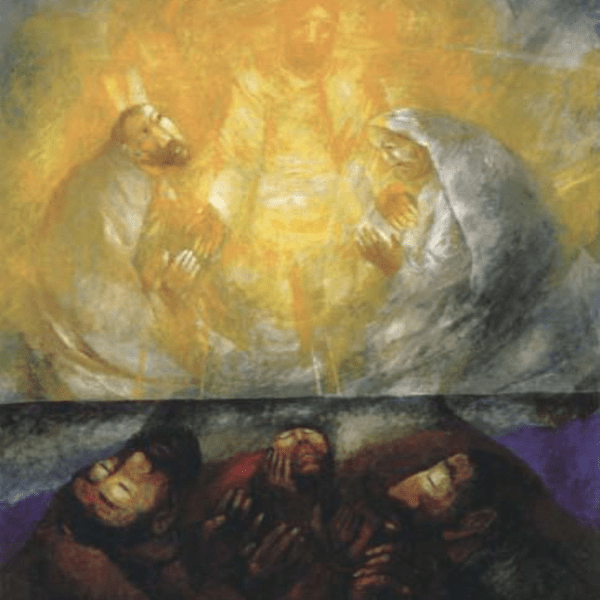
Transfiguration by Sieger Köder (1925-2015)

After six days Jesus took with him Peter, James and John the brother of James, and led them up a high mountain by themselves. There he was transfigured before them. His face shone like the sun, and his clothes became as white as the light. Just then there appeared before them Moses and Elijah, talking with Jesus.

Peter said to Jesus, “Lord, it is good for us to be here. If you wish, I will put up three shelters—one for you, one for Moses and one for Elijah.”

While he was still speaking, a bright cloud covered them, and a voice from the cloud said, “This is my Son, whom I love; with him I am well pleased. Listen to him!”

When the disciples heard this, they fell facedown to the ground, terrified. But Jesus came and touched them. “Get up,” he said. “Don’t be afraid.” When they looked up, they saw no one except Jesus.

As they were coming down the mountain, Jesus instructed them, “Don’t tell anyone what you have seen, until the Son of Man has been raised from the dead.” (New International Version)

Fear is a universal feeling and experience. None of us has to work at being afraid – but we all have to work at being brave and having the courage to face our fears.

Sometimes, we adults teach children not to fear because we assume they are afraid of the dark, high places, and monsters in the closet. But I tend to think a lot of our own adult fear is projected on kids. Why? Because some of the bravest folks I have ever known are children. 

Kids don’t understand near as much as we adults do, yet they conquer their fears every day by facing the world with courage. If you were to go to any children’s hospital today, I believe you would be amazed at the kind of courage you would find amongst kids. We adults have a whole lot to learn about being brave because we have become far too sophisticated in hiding our fears and avoiding courage.

This is why the most repeated exhortation is all of Holy Scripture is to not be afraid. We need courage to live the way God wants. Every day is a fresh opportunity to practice courage.

We need the courage to stand alone

Korah son of Izhar, the son of Kohath, the son of Levi, and certain Reubenites—Dathan and Abiram, sons of Eliab, and On son of Peleth—became insolent,and rose up against Moses. With them were 250 Israelite men, well-known community leaders who had been appointed members of the council. They came as a group to oppose Moses and Aaron and said to them, “You have gone too far! The whole community is holy, every one of them, and the Lord is with them. Why then do you set yourselves above the Lord’s assembly?” (Numbers 16:1-3, NIV)

When Moses heard this, he responded with prayer to God – because he clearly understood that this was all a big power play by Korah, who got others stirred up to take action against him. 

Moses stood alone. Out of the millions of Israelites, not one single person stood with Moses. To be sure, the majority of Israelites did not side with Korah; but neither did they come and stand with Moses. Why? They were too afraid to be involved and took the posture of bystanders. 

God did a miraculous thing, never done before or since, by opening up the ground and having the earth swallow Korah and his followers. The Lord wasn’t only upset with Korah; God was also angry with the people for fearfully standing in the safety of numbers and doing nothing. In fact, God was so mad that he was ready to wipe them all off the face of the earth. But, yet again, Moses, in humility, prayed and pleaded with God to spare them – and God did.

There will always be someone opposing you when you are just trying to obey God and do the right thing. And there will always be a crowd of people who do not want to be involved because they are afraid.

The church everywhere needs to be what Jesus wants it to be, and not what a particular person or group of people want it to be. Courageous people need to stand up to people who want positions of power in order to lead in self-serving ways.

We need the courage to love people

Now while he was in Jerusalem at the Passover Festival, many people saw the signs he was performing and believed in his name. But Jesus would not entrust himself to them, for he knew all people. He did not need any testimony about mankind, for he knew what was in each person. (John 2:23-25, NIV)

Jesus did not get carried away with his own press. Whether people responded to him by the hundreds, or whether they refused him altogether and tried to throw him off a cliff, Jesus was consistently the same. He did not need people’s responsive affirmation in order to do his mission on earth. Christ loved people just because he wanted to, and not because he was trying to get them to love him in return, like insecure and fearful people do.

We need the courage to love the unlovely. And we must understand that perfect love casts out fear.

“We should not only love our brothers and sisters, but also not consider ourselves better than them. Instead, we should show compassion and acceptance to others. We want to have others strictly reprimanded for their offenses, but we will not be reprimanded ourselves. We are inclined to think the other person has too much freedom, but we ourselves will not put up with any restraint to our freedom. There must be rules for everyone else, but we must be given free rein. It is seldom that we consider our neighbor equally with ourselves. If everyone was perfect, what would we have to endure for the love of God?… for we cannot live in this world without adversity. Those who can suffer well will enjoy the most peace, for such persons are brave, courageous, not afraid of pain, have Christ as their friend, and heaven as their reward.”

Thomas à Kempis, The Imitation of Christ, c.1425, C.E.

It is no test of virtue to be on good terms with easy-going people. And, of course, all of us want to live in peace and prefer those who agree with us. Yet, in this mortal life, our peace consists in the humble bearing of suffering and contradictions, not in being free of them.

We need the courage to please God

The devil took him to a very high mountain and showed him all the kingdoms of the world and their splendor. “All this I will give you,” he said, “if you will bow down and worship me.” Jesus said to him, “Away from me, Satan! For it is written: ‘Worship the Lord your God, and serve him only.’” (Matthew 4:8-10, NIV)

Jesus is our model of courage. He sought to please the Father, and not anyone else. Jesus bravely resisted becoming someone other than he was called to be. 

On the Mount of Transfiguration, Jesus courageously refused to remain on the mountain, instead choosing to go into the valley and undertake a new and risky ministry. 

Christ fearlessly came to this earth in the incarnation and resisted the comfort of security. He valiantly confronted sin, overturned the money-changers’ tables, and did his Father’s will, instead of shrinking in fear about what people would think. 

Jesus heroically faced crucifixion, even though he was terribly stressed about it, in order to offer forgiveness in the face of persecution. Jesus gallantly said “No!” to the power of sin by rising from death. And he boldly ascended to heaven and confidently passed the work of ministry to a motley group of people who did not show any promise to carry the mantle of his teaching.

The Son found his identity in relation to the Father. For us to please God, we need the courage to play to an audience of One. 

If we need other people’s acceptance and approval in order to do anything, then we will never have the courage to act for God. 

We must live by conviction, and not by sticking our finger to the wind to see which way popular opinion is blowing.

Conclusion

History is filled with men and women who said “no” to destructive fear and changed the world. But imagine if they had succumbed to the paralyzing effects of fear in their lives. Imagine if…

The Apostle Paul, fearing resistance or rejection, chose to stay home rather than embarking on the missionary journeys that took the message of Christ throughout the known world.

Martin Luther King Jr. gave speeches filled with gentle hints about the evils of segregation, because he feared pushing too hard.

Jackie Robinson refused to enter major league baseball so as to not rock the boat; or Branch Rickey, the owner of the Brooklyn Dodgers, just going with the way baseball had always operated. But neither of them went that way. In the film, “42,” Robinson asks Rickey:

“You want a player that doesn’t have the guts to fight back?” “No. No.” replies Rickey. “I want a player who has the guts not to fight back. People aren’t going to like this. They’re going to do anything to get you to react. Follow a curse with a curse and they’ll hear only yours. Follow a blow with a blow and they’ll say the Negro lost his temper; that the Negro does not belong. Your enemy will be out in force and you cannot meet him on his own low ground. We win with hitting, running, fielding—only that. We win only if the world is convinced of two things: That you are a fine gentleman, and a great ball player. Like our Savior, you’ve got to have the guts to turn the other cheek. Can you do it?”  Robinson replies, “You give me a uniform; you give me a number on my back; and I’ll give you the guts.”

42 (2013 film)

Now imagine yourself, fully aware of the mission and vision God has placed in your heart to advance his gracious and benevolent rule in this world – and yet there is also present all the phobias, irrational worries, and destructive fears of failure, harm, or rejection. So I ask:

If you don’t fulfill the mission God assigned to you, who will?

I Am Sending You (Judges 6:11-24)

The Messenger of the Lord came and sat under the oak tree in Ophrah that belonged to Joash from Abiezer’s family. Joash’s son Gideon was beating out wheat in a winepress to hide it from the Midianites. The Messenger of the Lord appeared to Gideon and said, “The Lord is with you, brave man.”

Gideon responded, “Excuse me, sir! But if the Lord is with us, why has all this happened to us? Where are all the miracles our ancestors have told us about? Didn’t they say, ‘The Lord brought us out of Egypt?’ But now the Lord has abandoned us and has handed us over to Midian.”

The Lord turned to him and said, “You will rescue Israel from Midian with the strength you have. I am sending you.”

Gideon said to him, “Excuse me, sir! How can I rescue Israel? Look at my whole family. It’s the weakest one in Manasseh. And me? I’m the least important member of my family.”

The Lord replied, “I will be with you. You will defeat Midian as if it were only one man.”

Gideon said to him, “If you find me acceptable, give me a sign that it is really you speaking to me. Don’t leave until I come back. I want to bring my gift and set it in front of you.”

“I will stay until you come back,” he said.

Then Gideon went into his house and prepared a young goat and unleavened bread made with 18 quarts of flour. He put the meat in a basket and the broth in a pot. Then he went out and presented them to the Messenger of the Lord under the oak tree.

The Messenger of the Lord told him, “Take the meat and the unleavened bread, put them on this rock, and pour the broth over them.” Gideon did so. Then the Messenger of the Lord touched the meat and the bread with the tip of the staff that was in his hand. Fire flared up from the rock and burned the meat and the bread. Then the Messenger of the Lord disappeared. That’s when Gideon realized that this had been the Messenger of the Lord. So he said, “Lord God! I have seen the Messenger of the Lord face to face.”

The Lord said to him, “Calm down! Don’t be afraid. You will not die.” So Gideon built an altar there to the Lord. He called it The Lord Calms. To this day it is still in Ophrah, which belongs to Abiezer’s family. (God’s Word Translation)

Today’s story is familiar in more ways than one. It’s a typical interaction between the Lord and the individual. And it’s also the typical way people respond to God, even now in our contemporary world.

Notice how the interaction between the Lord and Gideon unfolds:

The message: The Lord is with you. You are brave.

The pushback: It doesn’t look like the Lord is with our people (and a purposeful ignoring of the bravery thing).

The message: The Lord is sending you (and a purposeful ignoring of the pushback).

The pushback: I’m too weak for that.

The message: The Lord is with you. You got this.

The pushback: It can’t be me. Give me sign.

The message: I will stay. I am with you.

The pushback: I am not acceptable. Here’s an offering.

The message: Chill, dude. You’re wound way too tight. I am with you. You got this.

The acceptance of the message: Here’s an altar to remind me that God is here, and God calms my fear.

Sound familiar? How many times have you had a similar sort of interaction with the Lord?

The message: “Don’t be afraid. The Lord is with you. You have everything you need.” (assurance and reassurance)

The pushback: “Huh!? If I had everything I need, why are my circumstances so hard? Every time I turn around, there’s another adversity staring me in the face!” (ignoring the presence of God)

The message: “Go and make disciples. Love God. Love your neighbor.” (ignoring the bunny trail)

The pushback: “I’m the least gifted person in the world to be doing that sort of ministry.” (goes off point)

The message: “I am with you always until the end of time.” (stays on point)

The pushback: “It can’t be me. Give me a sign.” (i.e. I can’t accept myself, so there’s no way that you do!)

The message: “You will receive power when the Holy Spirit comes upon you.” (a demonstration of the presence)

The pushback: “I’m not the acceptable person for this… Here, I’ll put something in the offering plate.” (having a hard time wrapping head and heart around God’s grace)

The message: “You are anxious and upset about a great many things. I am with you. You got this.” (still remains on point)

The acceptance of the message: “Here I am, Lord, a living sacrifice.” (now on the same page with the Lord)

Christian ministry is not the absence of doubt or fear; it is doing what the Lord calls us to do, despite the surrounding circumstances.

We are never promised anywhere in Holy Scripture that life will be a bowl of cherries, that somehow circumstances will always be smooth. Instead, we are continually reminded of the promise that God is with us.

It’s the presence of the Lord that makes all the difference. Our abilities, or lack thereof, have nothing to do with the equation. We are already in the image and likeness of God, created with the inner resources to do the will of God.

The Lord is my shepherd;
    I have everything I need. (Psalm 23:1, GNT)

We have everything we need to live a life that pleases God. It was all given to us by God’s own power. (2 Peter 1:3, CEV)

You already have God’s acceptance; you don’t need to earn it.

“I now realize that it is true that God treats everyone on the same basis. Those who fear him and do what is right are acceptable to him, no matter what race they belong to.” (Acts 10:34-35, GNT)

When God promised Abraham and his descendants that the world would belong to him, he did so, not because Abraham obeyed the Law, but because he believed and was accepted as righteous by God. (Romans 4:13, GNT)

Honor God by accepting each other, as Christ has accepted you. (Romans 15:7, CEV)

There’s a lot we don’t know. Yet, what we do know is that God is with us and God has accepted us. And that’s all we need to hang our hat on.

Shining the Light on Fear (Psalm 27:1-6)

The Lord is my light and my salvation.
        Should I fear anyone?
    The Lord is a fortress protecting my life.
        Should I be frightened of anything?
When evildoers come at me trying to eat me up—
    it’s they, my foes and my enemies,
    who stumble and fall!
If an army camps against me,
        my heart won’t be afraid.
    If war comes up against me,
        I will continue to trust in this:
    I have asked one thing from the Lord—
    it’s all I seek:
        to live in the Lord’s house all the days of my life,
        seeing the Lord’s beauty
        and constantly adoring his temple.
Because he will shelter me in his own dwelling
    during troubling times;
    he will hide me in a secret place in his own tent;
        he will set me up high, safe on a rock.

Now my head is higher than the enemies surrounding me,
    and I will offer sacrifices in God’s tent—
        sacrifices with shouts of joy!
    I will sing and praise the Lord. (Common English Bible)

Being afraid of the dark is a common fear. After all, whenever we cannot see anything around us, then we don’t know what’s really there – and that’s understandably frightening for most people. Typically, it’s not what we see that’s so scary; the scary stuff is what our imagination conjures up that’s out there in the dark, which we cannot see.

Kids, with their curiously active imaginations, tend to be fearful of the dark – which is why we parents, and grandparents, ensure there’s a nightlight for them so they can sleep. The light illumines their surroundings, reminding them of where they are; the light also helps them remember that we are with them.

As children of God, we need the same reminders. We must continually check-in with our internal selves, reorienting our lives around the reality that the Lord is present, that Jesus is our Immanuel, God with us.

Having the Light of the World surrounding us provides confidence that God is watching and will save us from whatever threatens our life. Indeed, being immersed in the Lord helps us snuggle down and realize our ultimate security blanket holds us tight.

Not only do we have confidence with God’s presence, but we are also fearless in the face of the most adverse and scary of circumstances. Knowing that God has our back enables us to accept, cope, and transcend overwhelming situations.

God protects because God is present.

Admittedly, we don’t have all the answers as to why the Lord sometimes seems absent in the midst of our trouble. That’s maybe because God is a Being, a Person, and not an insurance policy. Ultimately, personal presence and protection is a whole lot better than the impersonal and legal sort.

Which is why it’s important to delight in the Lord, to enjoy being in God’s house, to bask in the beauty of divine holiness, righteousness, and justice. With this as our way of life, we tend to better understand that not everything is necessarily going to go right but that the Lord is alongside us, giving strength and hope.

It’s important to note that divergent emotions can be held together. Many folks tend to believe that if there is fear within the heart, then faith, courage, and praise cannot exist. But nothing could be further from the truth.

The more likely scenario is that trying to suppress feelings of fear only results in becoming more afraid; thus, leading to forced or manufactured praise with little to no bravery behind it.

Instead, the sage thing to do is acknowledge whatever emotions bubble up for us. That is our inner spirit’s way of alerting us that we must pay attention to something. Ignoring the fear makes the monster under the bed more fearsome.

Being aware of the emotion and acknowledging it brings options and choices. Getting it out there to actually feel it means that now we can choose what we’re going to do with the emotion. Hiding the fear only gives it power; naming the fear gives us control over it.

This is one reason why I believe it is significant to read the psalms out loud; it provides more fortitude in dealing with what’s in front of us.

Holding both our fears and our faith together enables us to face our troubles with wisdom and courage. If attacked – whether it be spiritual, emotional, mental, or physical – the worst thing to do is grin and bear it or plaster a fake smile on your face.

It’s okay to be conflicted, to wonder what the heck is going on, to not know what’s up or down, to live with the seeming incongruence of emotions.

Healing comes through feeling, speaking, and acting – and not by suppressing emotions, keeping words bottled up inside, and acting as though everything is peachy keen when it isn’t. Expressing words of trust in the Lord, without having first expressed words describing our emotions, is a fool’s errand. If we trust God to answer a prayer, then we also need to trust God in hearing our real emotions.

God encourages honesty, sincerity, and feeling; the Lord disparages ingenuine offerings of praise and inauthentic gestures merely meant to fake-it-till-you-make-it. The psalmist encourages us to express all our emotions – whether “positive” or “negative” – and find the empathy, solidarity, and healing we need.

God is our light. So, let’s not keep him in the dark about our real selves.

Let It Out (Isaiah 51:1-16)

If you want to do right
and obey the Lord,
    follow Abraham’s example.
He was the rock from which
    you were chipped.
God chose Abraham and Sarah
    to be your ancestors.
The Lord blessed Abraham,
and from that one man
    came many descendants.

Though Zion is in ruins,
    the Lord will bring comfort,
and the city will be as lovely
as the garden of Eden
    that he provided.
Then Zion will celebrate;
it will be thankful
    and sing joyful songs.

The Lord says:
You are my people and nation!
    So pay attention to me.
My teaching will cause justice
to shine like a light
    for every nation.
Those who live across the sea
are eagerly waiting
    for me to rescue them.
I am strong and ready;
soon I will come to save
    and to rule all nations.

Look closely at the sky!
    Stare at the earth.
The sky will vanish like smoke;
the earth will wear out
    like clothes.
Everyone on this earth
    will die like flies.
But my victory will last;
my saving power never ends.

If you want to do right
    and obey my teaching
with all your heart,
    then pay close attention.
Don’t be discouraged
when others insult you
    and say hurtful things.
They will be eaten away
    like a moth-eaten coat.
But my victory will last;
my saving power
    will never end.

Wake up! Do something, Lord.
    Be strong and ready.
Wake up! Do what you did
    for our people long ago.
Didn’t you chop up
    Rahab the monster?
Didn’t you dry up the deep sea
and make a road for your people
    to follow safely across?
Now those you have rescued
will return to Jerusalem,
    singing on their way.
They will be crowned
    with great happiness,
never again to be burdened
    with sadness and sorrow.

I am the Lord, the one
    who encourages you.
Why are you afraid
    of mere humans?
They dry up and die like grass.

I spread out the heavens
and laid foundations
    for the earth.
But you have forgotten me,
    your Lord and Creator.
All day long you were afraid
of those who were angry
    and hoped to oppress you.
Where are they now?

Everyone crying out in pain
    will be quickly set free;
they will be rescued
from the power of death
    and never go hungry.
I will help them
    because I am your God,
the Lord All-Powerful,
    who makes the ocean roar.

I have told you what to say,
and I will keep you safe
    in the palm of my hand.
I spread out the heavens
and laid foundations
    for the earth.
Now I say, “Jerusalem,
    your people are mine.” (Contemporary English Version)

“There will always be fear; do it anyway. Let your courage inspire the world around you.”

Steve Maraboli

Courageous, brave, bold, and strong – it seems most people do not characterize themselves this way. I suppose it makes some kind of sense in our minds as to why this is: Every one of us can readily recall a time or several events in which we wilted with fear; did not speak up; or were not assertive. 

The many conversations we will never have that take place in our heads are testament to our supposed withdrawal in the face of adversity. In other words, we have far too many discussions with ourselves of how something should have gone and way too many brave retorts for someone whom we really have no intention of saying those words toward.

If this all sounds like the convoluted musings of a wimpy kid, that’s not far off the mark. Getting bullied, even as adults, may easily cause us to wilt, or to take it, or to simply find a way to avoid the bully. With some folks, we even create elaborate internal reasons why it’s our fault someone is upset with us. In such times, bravery and courage seem a long way from our true selves.

Faced with a daunting task at work, at home, or at school, we may wonder if we really have the internal stuff to pull it off.  We feel that maybe someone else would be better suited to do it. When given an unwanted medical diagnosis, it might feel as if it is way above our emotional pay grade. It’s not only the added hard situations of life that make us look fearful; it is the crippling losses that can leave us feeling anything but strong and brave.

Yet, what if I told you that you are, indeed, brave, strong, and confident? 

What if I insisted that courage resides within you, even if you yourself cannot see it right now? 

And, what if I told you that bravery isn’t something you must go on a quest to find, but that it’s been in you all along? 

You only need to let it out. You must release the words and resilience already given to you by the One who holds you in the hollow of his hand.

You intuitively know I’m on to something here. After all, the most common exhortation and assurance in the entirety of Holy Scripture is to not be afraid because God is with us.

“Be strong and courageous. Do not be afraid or terrified because of them, for the Lord your God goes with you; he will never leave you nor forsake you.”

Deuteronomy 31:6, NIV

“God has said, ‘Never will I leave you;
    never will I forsake you.” So we say with confidence, ‘The Lord is my helper; I will not be afraid.
    What can mere mortals do to me?’” (Hebrews 13:5-6, NIV)

Believe it, or not, the Bible tells us 365 times to not be afraid. Maybe that’s not a coincidence that we can quote a verse every day of the year about our own fearfulness in the face of so much of life’s cruel junk.

Yet, the tack I want you to take in the great litany of fear we daily face is that bravery is not something that is so much commanded as it is a calling forth of something which is already within you.

Now, before you go thinking I’m some strange spiritual huckster, hear me out. From the beginning of the world, God created by calling forth from within himself. What I mean is this: God did not simply command everything into being; instead, God said, “Let there be…”  Thus, letting out what was already there within God’s very Being.

I also find it interesting that when it comes to fear and bravery God does not so much command us to be courageous, as calls us to draw from the great reservoir within. The Lord has already created us strong, as creatures in the divine image. We just need to get in touch with what is already there. 

“Do not let your hearts be troubled,” said Jesus to his disciples because he knew his followers had it in them to walk in his way without fear. (John 14:6, NRSV)

“Let not your heart faint, and be not fearful,” said God to the prophet Jeremiah in the face of a terrible destruction that was about to unfold against Jerusalem because the Lord knew that Jeremiah could face what was going to happen. (Jeremiah 51:46, ESV)

Christians can act with boldness because Jesus is the pioneer of our salvation. He is the One who enables us to draw from the deep well of courage:

“So then, since we have a great High Priest who has entered heaven, Jesus the Son of God, let us hold firmly to what we believe. This High Priest of ours understands our weaknesses, for he faced all of the same testing we do, yet he did not sin. So let us come boldly to the throne of our gracious God. There we will receive his mercy, and we will find grace to help us when we need it most.” (Hebrews 4:14-16, NLT)

When I say that you are brave, you are strong, you are good – those are not words meant to make you believe something which may or may not be true, as if I were trying to convince you to take some panacea to feel better. No, I say it because it is true. 

You really can face the immense mountain in front of you and climb it. You can actually surmount the adversity you are in the middle of – not because of some words I say, but because you were created for courage.

So, how do you let out the bravery and let the boldness shine? 

That seems to be the million dollar question. I’m going to go out on a limb here and say that you already know the answer to this. Yes, you possess the answers to your own questions. You have all the knowledge you need to face your problems.  The real question is:

Will you let your bravery come out to play, or will you keep it hidden beneath layers of insecurity?

It’s a whole lot easier to let me tell you what to do than to draw from what you already know deep down how to handle that troublesome something. 

So, I’m not going to give you a simple three-step process out of fear and into courage because you already have been endowed with the process. 

This certainly isn’t a sexy way to end a blog post, but it just might be the most effective and lasting.