Nativity of the Lord (Luke 2:1-20)

Nativity, by He Qi, 1998

In those days a decree went out from Caesar Augustus that all the world should be registered. This was the first registration and was taken while Quirinius was governor of Syria. 

All went to their own towns to be registered. Joseph also went from the town of Nazareth in Galilee to Judea, to the city of David called Bethlehem, because he was descended from the house and family of David. He went to be registered with Mary, to whom he was engaged and who was expecting a child. 

While they were there, the time came for her to deliver her child. And she gave birth to her firstborn son and wrapped him in bands of cloth and laid him in a manger, because there was no place in the guest room.

Now in that same region there were shepherds living in the fields, keeping watch over their flock by night. Then an angel of the Lord stood before them, and the glory of the Lord shone around them, and they were terrified. 

But the angel said to them, “Do not be afraid, for see, I am bringing you good news of great joy for all the people: to you is born this day in the city of David a Savior, who is the Messiah, the Lord. This will be a sign for you: you will find a child wrapped in bands of cloth and lying in a manger.” 

And suddenly there was with the angel a multitude of the heavenly host, praising God and saying,

“Glory to God in the highest heaven,
    and on earth peace among those whom he favors!”

When the angels had left them and gone into heaven, the shepherds said to one another, “Let us go now to Bethlehem and see this thing that has taken place, which the Lord has made known to us.” 

So they went with haste and found Mary and Joseph and the child lying in the manger. When they saw this, they made known what had been told them about this child, and all who heard it were amazed at what the shepherds told them, and Mary treasured all these words and pondered them in her heart. 

The shepherds returned, glorifying and praising God for all they had heard and seen, just as it had been told them. (New Revised Standard Version)
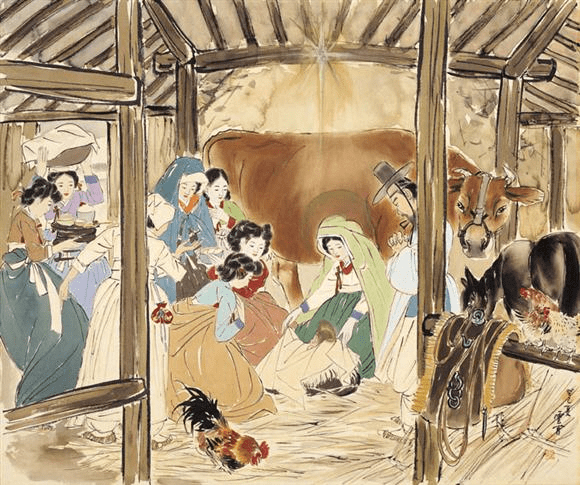
The Birth of Jesus Christ, by Woonbo Kim Ki-chang, 1953

Overwhelmed. That’s the word I imagine the characters in this story had, for various reasons.

To have spiritual or emotional overwhelm is to feel overpowered by several circumstances at once. It’s experiencing a lot of emotions all at the same time.

The sense of overwhelm can come from many different things, including complicated grief, relational distance, and too many responsibilities. Depending upon why we are overwhelmed, it will likely either leave us stuck and chronically tired, or free and forever rejoicing.

A good sense of overwhelm is awe and wonder. A bad sense of overwhelm is despondency and dejection.

Mary probably experienced the full range of overwhelm. An angel showed up and announced to her that she would give birth to a son and name him Jesus, meaning that God will save the people. He will fulfill the promise of being the Son of the ancient King David who has a permanent reign.

In other words, Mary would give birth to the Messiah. That sounds like the very definition of overwhelm, in both its good and bad sense.

Despite the temporal worldly power of the Roman Empire, Mary’s child would have a kingdom without end. And in spite of the Romans, God’s will and purpose would prevail.

And yet, Mary and Joseph were still subject to Roman authority. That meant they needed to be registered, along with everyone else in the Empire, so that the government knew about their tax base, and who was going to pay it.

The decree from Ceasar meant that, even though Mary was quite pregnant, she and Joseph would have to travel to Bethlehem, the family’s ancestral town, in order to be properly registered.

Jesus would not be born in the city of overwhelming power and control in Jerusalem. Rather, Bethlehem, a small non-descript town south of the city, is the place for an overwhelming birth experience to happen.

It’s appropriate that from the beginning, the life and ministry of Jesus would be more about the smaller and less powerful place and people.

And so, the new king, from the line of David, is born in the most humble of circumstances. It is fitting that the humblest of persons were the first to receive the birth news.

Shepherds were literally out on the margins of society. Their typical reputation was not good. They stink. They drink too much. They’re on the lower rung of cultural power.

Yet, a huge angelic delegation was sent from heaven to shepherds to announce the birth. It was an overwhelming experience, no matter how you view it.

Seeing Shepherds, by Daniel Bonnell

Angels showed up, and the shepherds were nearly paralyzed with fear. But their terror turned on a dime to awe, wonder, and joy.

What’s more, the good news shared with the lowliest of persons, is for everyone. All the overwhelm and awe is contained in a savior who has been born, Christ the Lord.

Overwhelming feelings were a regular experience of people in the Gospel of Luke who encountered angels – fear being the initial response. But it’s then followed by an assurance that God is extending grace to them, not judgment. No one need be afraid, because God is with them.

It’s not a new message; but it is a message that is newly focused in this savior of a baby. He is Immanuel, God with us. The presence of God is here, because the attention and love of God are here.

Out of my distress I called on the Lord;
    the Lord answered me and set me in a broad place.
With the Lord on my side I do not fear.
    What can mortals do to me?
The Lord is on my side to help me;
    I shall look in triumph on those who hate me. (Psalm 118:5-7, NRSV)

The real genuine authentic power of the universe is here – not found within political empires or governments, nor with the wealthy and influential – but discovered in the arrival of the actual savior, who holds all power and authority, and wields it according to proper justice and righteousness.

All along, God is the true deliverer who backs up the needy and oppressed. It is demonstrated in the angelic proclamations of good news about this Savior, the Christ, the One anointed and chosen by God, the son of David, the deliverer from ancient enemies.

The angel’s proclamation erupts with the sudden appearance of a multitude of God’s heavenly messengers praising God, declaring God’s glory, favor, and blessing of peace on the earth. The emphasis is upon God’s grace rather than human action.

In response to the announcement they received, the shepherds went to see if what they had heard was true, and indeed, it all was. When they saw the sign for themselves, they could not keep silent about all they had heard and seen.

The shepherds praised God, out of an overwhelming sense of amazement that the Lord had paid attention to them.

Praise is still the reaction in the life of the person touched by all that they have seen and heard.

Creator God, by your greatness you became small; by your power you became powerless; and by your limitlessness you became limited. Through the birth of your son, we can live in the divine light that shines on a world transformed by the limitless power of your love. Amen. Praise the Lord!

Beware of Your Fear (Mark 13:1-8)

As he came out of the temple, one of his disciples said to him, “Look, Teacher, what large stones and what large buildings!” Then Jesus asked him, “Do you see these great buildings? Not one stone will be left here upon another; all will be thrown down.”

When he was sitting on the Mount of Olives opposite the temple, Peter, James, John, and Andrew asked him privately, “Tell us, when will this be, and what will be the sign that all these things are about to be accomplished?” 

Then Jesus began to say to them, “Beware that no one leads you astray. Many will come in my name and say, ‘I am he!’ and they will lead many astray. When you hear of wars and rumors of wars, do not be alarmed; this must take place, but the end is still to come. For nation will rise against nation and kingdom against kingdom; there will be earthquakes in various places; there will be famines. This is but the beginning of the birth pangs. (New Revised Standard Version)

In my undergraduate college days, decades ago, springtime brought a regular staple of sidewalk preachers calling for people to repent, because the end of the world is imminent.

That was in the days of the Cold War; the specter of a nuclear holocaust was a real fear among many. The outdoor preachers got a serious hearing with some.

Although religious end times preaching gets little attention anymore, the idea of a cataclysmic apocalypse is still very much a part of the culture. Dystopian novels are widely read; and stockpiling for a zombie apocalypse is a real thing.

End of the world stuff is, at the least, interesting and/or fascinating to many; and, at the most, there are folks fully prepared for an apocalypse of the world to happen in their lifetime.

Christ’s disciples asked him a question. And Jesus went directly to talking apocalypse.

In the Gospel of Mark, Jesus takes on demons and all sorts of other-worldly opposition. Christ is certainly presented by Mark as one who discerns there is much more going on – and will go on – in this world than what it may seem on the surface of things.

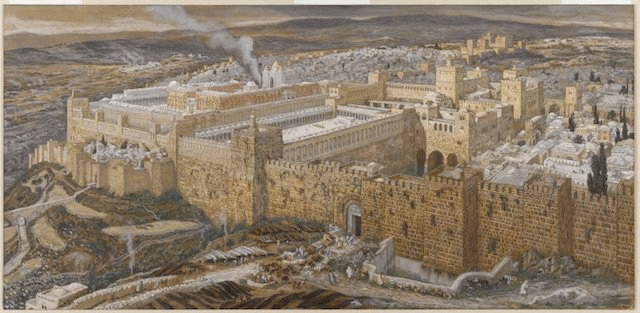
Jerusalem and Herod’s Temple, by James Tissot, c.1890

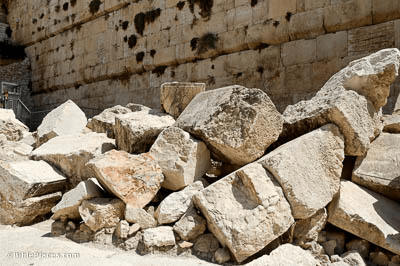
The disciples saw large and wonderful stones which were part of the temple. They marveled at what their physical eyes perceived. But Jesus saw further, into the future, and was not at all impressed; he saw a time of apocalypse. All of those stones in a heap. No one marveling over the temple.

Christ’s disciples wanted to know when such a time would happen. As was often the case with Jesus, he didn’t answer their question, at least not directly. He used it as an opportunity to teach about things to come.

The gist of Christ’s words to his disciples was to communicate that things are going to get worse than what they already are. The Roman occupation they were experiencing is nothing compared to what’s coming.

The apocalyptic language had been around in ancient Judea for a long time. There had been centuries of people talking about the world’s end.

Apocalyptic stuff is nothing new to contemporary folk, as well. Just mention the Book of Revelation and heads pop up, eyebrows raise, and imagination goes to seed.

We as biblical readers, however, need to observe that Jesus didn’t answer the question of his disciples. Which is perhaps something we must become more alert to.

Nobody knows when the end of the world will come. Not even Jesus. But that doesn’t seem to stop folks from asking anyway. Perhaps we need to ask a different question. Instead of asking “When will these things happen?” maybe we ought to ask, “What must I watch out for?”

The change of question orients us in a different way. Rather than end times speculation, we begin watching for things which are dangerous to humanity, things that bring upheaval to our world.

We start valuing awareness and observance, listening and contemplating. We learn to place our energies wisely into the things we believe truly matter in this life for the common good of all.

God is up to all sorts of kingdom business that is beyond our purview, and frankly, even beyond our ability to perceive or understand.

When we accept the exhortation of Jesus to “beware,” then we watch and look for things that are already here among us, and not get lost in a future we cannot predict. That type of future orientation only produces the kind of worry and anxiety that leads to fear.

And when fear takes root, it spawns the evils of hate and injustice. We become vulnerable to selfish incompetent leaders who make promises to take our fears away. We end up doing terrible acts against others, like imprisoning political opponents, denaturalizing and deporting citizens we don’t like, and creating fascist states that oppress others.

Fallen stones from the destruction of the Temple

But if we will wake up, hear the call of Jesus to beware, and awaken to our true commitment to the kingdom of God, we will then forsake fear-based tactics, and courageously help others in both body and soul.

It also means that, at times, we are off somewhere in centering and contemplative prayer, just like our Lord in the Garden of Gethsemane, knowing that the real source of power and authority is outside of us.

A true biblical view of the end times is about God working out divine purpose on behalf of all humanity. It isn’t about us and all of our fears and anxieties getting worked out in harmful ways.

The realization of a coming apocalypse must lead us toward faith and trust in the God who holds justice, righteousness, and mercy in good divine hands.

God has no limitations because of our questions. God will be God. God is who God is. Our task is to watch, remain faithful, and persevere until Christ returns to judge the living and the dead.

May it be so, to the glory of God.

Living Without Answers (Job 41:12-34)

“I will not keep silent concerning its limbs
    or its mighty strength or its splendid frame.
Who can strip off its outer garment?
    Who can penetrate its double coat of mail?
Who can open the doors of its face?
    There is terror all around its teeth.
Its back is made of shields in rows,
    shut up closely as with a seal.
One is so near to another
    that no air can come between them.
They are joined one to another;
    they clasp each other and cannot be separated.
Its sneezes flash forth light,
    and its eyes are like the eyelids of the dawn.
From its mouth go flaming torches;
    sparks of fire leap out.
Out of its nostrils comes smoke,
    as from a boiling pot and burning rushes.
Its breath kindles coals,
    and a flame comes out of its mouth.
In its neck abides strength,
    and terror dances before it.
The folds of its flesh cling together;
    it is firmly cast and immovable.
Its heart is as hard as stone,
    as hard as the lower millstone.
When it raises itself up the gods are afraid;
    at the crashing they are beside themselves.
Though the sword reaches it, it does not avail,
    nor does the spear, the dart, or the javelin.
It counts iron as straw
    and bronze as rotten wood.
The arrow cannot make it flee;
    slingstones, for it, are turned to chaff.
Clubs are counted as chaff;
    it laughs at the rattle of javelins.
Its underparts are like sharp potsherds;
    it spreads itself like a threshing sledge on the mire.
It makes the deep boil like a pot;
    it makes the sea like a pot of ointment.
It leaves a shining wake behind it;
    one would think the deep to be white-haired.
On earth it has no equal,
    a creature without fear.
It surveys everything that is lofty;
    it is king over all that are proud.” (New Revised Standard Version)

In a long anticipated response, God finally spoke to Job with his companions present. And it was nothing like anyone expected.

Today’s Old Testament lesson continues God’s questioning of Job, and talking of the great Leviathan – a large and uncontrollable creature.

Trying to figure out exactly what Leviathan is or was (e.g. a dragon, a dinosaur, or some dang demon) is not the point of having this chapter in Holy Scripture.

We can become obsessed with having our questions answered, everything neatly categorized and understood, every problem and mystery solved to our satisfaction.

If the Book of Job teaches us anything, it is that there are questions for which there are no answers this side of heaven. There are problems which we humans cannot logically and scientifically solve.

Ironically, we discover the presence of God through God’s absence; and hear the voice of God through God’s silence.

Any encounter we may have with God will typically shatter any preconceived notions about divinity. Any experience with God shall prevent us from packaging up an answer with some nice pretty paper and bows, as if we were enjoying a delightful Christmas at home.

Facing God is much more like coming face to face with who you really are, and what motivations and intentions are really in your heart. It’s more like Halloween than Christmas. It’s staring at a scary monstrous Leviathan, and not a bright jolly Santa Claus.

Coming to grips with our fears and anxieties, struggles and weaknesses, mortality and vulnerability, is the real sort of encounter people have with God. It’s not so much that God is scary; it’s we who are scary.

It’s scary what people will sometimes do in order to try and get answers to their questions. And it is equally scary what we will do to avoid the questions asked of us.

We don’t like hearing there are some things which are unanswerable. Yet, the mystery of God is real, which means that we are never going to know about everything we want to understand.

And we also don’t like being questioned. But what can you do, whenever you cannot move, and God begins peppering you with his own questions?

We would like to justify and vindicate ourselves – even rationalize our words and actions, if that’s what it takes. Yet, it is God alone who has the power to absolve and exonerate, to bring justice while in the teeth of injustice.

Furthermore, such justification comes in God’s own timing, not ours. Again, this is one of those realities which is far above us, for which we have only a very limited perspective on.

As we move ever closer to the end of the Book of Job, Job’s quest for answers and vindication hasn’t come, at least yet. We, along with Job, must handover the entire affair thoroughly to God in complete trust – without insisting that God say or do what I want God to say or do.

Living by faith is the only real option we have. All other options leave us in an existential angst, sliding toward nihilism.

Anyone who believes they can govern the world better than God, better brace themselves for some serious questioning.

There is not a person on this earth, including myself, that I would trust to run it for ten minutes. Because within ten seconds the world would be burning.

I don’t want that world.

I want a world with God – because I wholeheartedly believe that grace is the real and true operative force on this earth.

The grace of God allows us to see the divine without having to have our puny questions answered. Grace reassures us that we are not lost, that God sees and knows what is happening, and will do something about it.

So therefore, I can rest assured that everything is held in the sinewy strong arms of God. And no person, no monster, no Leviathan, is outside of God’s ability to effect justice and righteousness in the world.

It may take some time to realize complete and total justice, but God has given me enough faith to rest in mystery, and to live with uncertainty.

May it be so, to the glory of God.

Creator of the world, we pray

That you, with steadfast love, would keep

Your watch around us while we sleep.

From evil dreams defend our sight,

From fears and terrors of the night;

Tread underfoot our deadly foe

That we no sinful thought may know.

O Father, we ask your will to be done

Through Jesus Christ, your only Son;

And Holy Spirit, by whose breath

Our souls are raised to life from death. Amen.

For Such a Time as This (Esther 4:1-17)

When Mordecai learned of all that had been done, he tore his clothes, put on sackcloth and ashes, and went out into the city, wailing loudly and bitterly. But he went only as far as the king’s gate, because no one clothed in sackcloth was allowed to enter it. In every province to which the edict and order of the king came, there was great mourning among the Jews, with fasting, weeping and wailing. Many lay in sackcloth and ashes.

When Esther’s eunuchs and female attendants came and told her about Mordecai, she was in great distress. She sent clothes for him to put on instead of his sackcloth, but he would not accept them. Then Esther summoned Hathak, one of the king’s eunuchs assigned to attend her, and ordered him to find out what was troubling Mordecai and why.

So Hathak went out to Mordecai in the open square of the city in front of the king’s gate. Mordecai told him everything that had happened to him, including the exact amount of money Haman had promised to pay into the royal treasury for the destruction of the Jews. He also gave him a copy of the text of the edict for their annihilation, which had been published in Susa, to show to Esther and explain it to her, and he told him to instruct her to go into the king’s presence to beg for mercy and plead with him for her people.

Hathak went back and reported to Esther what Mordecai had said. Then she instructed him to say to Mordecai,“All the king’s officials and the people of the royal provinces know that for any man or woman who approaches the king in the inner court without being summoned the king has but one law: that they be put to death unless the king extends the gold scepter to them and spares their lives. But thirty days have passed since I was called to go to the king.”

When Esther’s words were reported to Mordecai, he sent back this answer: “Do not think that because you are in the king’s house you alone of all the Jews will escape. For if you remain silent at this time, relief and deliverance for the Jews will arise from another place, but you and your father’s family will perish. And who knows but that you have come to your royal position for such a time as this?”

Then Esther sent this reply to Mordecai: “Go, gather together all the Jews who are in Susa, and fast for me. Do not eat or drink for three days, night or day. I and my attendants will fast as you do. When this is done, I will go to the king, even though it is against the law. And if I perish, I perish.”

So Mordecai went away and carried out all of Esther’s instructions. (New International Version)

Mordecai and Esther (Bible Project)

King Xerxes was the royal sovereign over the greatest empire up to that time in history. Haman was the king’s right hand man who arranged a sinister plot to destroy the Jewish people. Queen Esther was a Jew, for which neither Haman nor Xerxes knew; she rose from obscurity to become the queen. And Mordecai was Esther’s cousin, having taken her in and raised her.

The Jewish people were exiles, due to the Babylonians capturing Jerusalem and taking the people into captivity. Although the Persians, who overthrew the Babylonians, began allowing some of the Jews to return to Judah, there were still many diaspora Jews who made a life for themselves in Persia.

Esther was an unlikely candidate as both a queen and a heroine. She was an orphan and not well-known, even within her own community. Yet, Esther was taken from her foster home with Mordecai, and was thrown into all the perturbations of Persian life in the empire’s court and the nation’s culture.

She was the ultimate outsider, thrust into insider status. Esther was a minority in a majority culture; a resident alien; and a foreigner to Persian society and royalty. It was a lot for her.

Try and put yourself in her shoes. Do you hide your Jewishness, or make it known, and how much? How do you navigate being raised in a culture very different than the one you are being immersed and assimilated in? Who am I? What am I really supposed to be about? Why am I here?

Expressing one’s spiritual identity requires some significant consideration and careful application. And it will be dynamic, with ongoing considerations of how to grow and sustain a healthy sense of self so that it will be impactful and lasting.

We may reflexively think that since Esther was queen, she could freely exercise power and leverage her position to achieve anything she wanted. However, Esther was in a totally new reality. She didn’t enter it with political savvy or understanding about how things work or get done. Esther was very much subject to the whims and plans of King Xerxes.

Queen Esther must have thought she was in an impossible position. Haman had hatched a strategy to rid the empire of her own people, the Jews. And they were beside themselves. Mordecai entreated Esther to do something. But Esther was green and scared and way out of her element.

And yet, the heroine was inside her all along; it just needed the proper experience to bring her out.

We might understand if Esther saw herself as a mere orphan Jew who was just trying to fake-it-till-you-make-it in a world and a situation that was way over her head. We could understand if she saw herself without any real agency to effect anything in a large overwhelming empire.

Yet, here we are, all these millennia later, talking about Queen Esther and her bravery. There is even a Jewish holiday, Purim, celebrated because of her extraordinary courage… But I am getting ahead of myself. Today’s piece of the story begins in tension, and ends with even more.

Mordecai arose and gave a coach’s speech to Esther. He told her that she must step up and step into this particular historical moment in time. Providence had led her to be in her unique position; and the Jewish people were in an awful position.

It was precisely the right time for Esther to dig deep and release the heroine within. Esther could save her own people. Nobody else could. Only her.

Like it or not for Esther, her Jewishness was part of the whole gnarly situation. She could deny it and hide it – which would mean suppressing and stuffing the heroine. Or she could put herself out there, speak truth to power in love, and let the consequences come what may.

What impresses me about Esther is that not only did she listen to Mordecai, but she took the further step of calling upon the support of her own Jewish community. Esther was straightforward in telling them exactly what she needed from them, and what she would do herself.

Esther staked out her identity and faith, and risked her life for an entire nation of people… but we are not to the end of the story yet.

For now, we need to sit with this painful and awkward tension between life and death. Three days of sorrowful and heartfelt prayer. Three days of darkness. Three days of seeming as if one is in a grave with a huge stone boulder in front of it.

Like Esther, it is important for us to struggle with our own identity, and to take risks in soliciting the help of the believing community. We all must grapple with the nature of faith, the challenges of living in this present culture, and the politics of it all.

We need to take a good hard look at ourselves and discern who we truly are – people created in the image and likeness of God, who have majesty stamped on our very souls; and who truly have it within ourselves to make a difference in this big world of ours.

If we are to truly become aware of our majesty as people, we shall be willing to take the risk of helping those who are vulnerable, powerless, and threatened. That’s because our identity shapes our choices and actions. We live into who we believe we are.

By realizing that we belong to God, we avoid becoming complicit in evil. Instead, we leverage our place and position in life to do what is right, just, and good. There is confidence, even if afraid, of doing what is right.

I am wondering if you can think the thought, and embrace the reality, that you were sovereignly placed here on this earth by God “for such a time as this.”

Just and right God, you sent your servant Esther into a life of privilege, so that those without would be taken care of. In our privilege, show us how to advocate for those who have less, so that your world might be peaceful and good. Amen.