A Crippling Grace

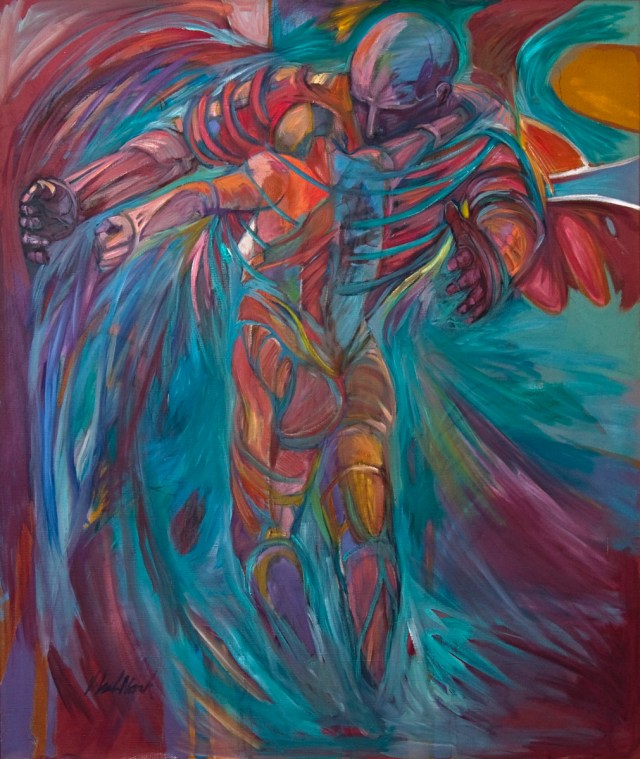
Jacob Wrestling the Angel by Karen Laub-Novak
Jacob Wrestling the Angel by Karen Laub-Novak (1937-2009)

Confrontation and struggle were a way of life for me in my first solo pastorate.  In the first six weeks of being in the church I faced every kind of sin imaginable, to the point that my mentor in the faith recommended I take some time off. I had not even been there for two months!  Although that was a difficult time, the greatest struggle was with God himself and feeling like my prayers were doing nothing but bouncing off the ceiling.  In fact, I spent several years of my life in an extended wrestling match with God.  He touched me and crippled me by his grace, reminding me how much he is in control.  Since that time, I walk with a limp that is not visible – an invisible limp which reminds me I am a different person – one who knows Jesus better and is much more at peace with life.

If we do not wrestle with God in the stressful times of our lives, we will have difficulty discovering what genuine humility is, how much we need the Holy Spirit, and the grace that can be ours to face the rest of our lives.  Five hundred years ago Thomas à Kempis wrote to new priests entering ministry with this advice:

“We should so firmly establish ourselves in God that we have no need to seek much human encouragement.  It is when a man of good will is distressed or tempted, or afflicted with evil thoughts, that he best understands the overwhelming need he has for God, without whom he can do nothing.  While enduring these afflictions he takes himself to prayer with sighs and groans; he grows tired of this life and wishes to die so that he could be undone to live with Christ.  It is in such times of trial that he realizes that perfect security and full peace are not to be found in this world.”

The Old Testament patriarch, Jacob, was worried and stressed.  He knew he had deceived his brother Esau many years earlier to gain their father’s blessing.  Now Jacob is about to meet Esau after all these years, and he is downright afraid for himself and his large family.  So, he divided them up into two groups, thinking that if Esau were to attack, the other group could escape. The night before the big stressful meeting, Jacob sent his wives and family across a tributary of the Jordan River, the Jabbok, and spent the night alone wrestling with God. (Genesis 32:22-31)

God will put us in life-compromising positions to create divine encounters so that we will walk away changed.  Those events usually come in the form of engaging God with all the questions and difficulties of an incredibly stressful situation.  The inner change that occurs comes in the form of a new identity, a new limp, and a renewed understanding of God’s grace. A new confidence arises, convinced that through disability and weakness we are strong and able.

Jacob Wrestling with the Angel by Lippy Lipshitz
Jacob Wrestling with the Angel by Israel Isaac Lipshitz (1903-1980)

There is a good deal of symbolism happening in the story of Jacob wrestling with the angel of God.  First, take note that this Scripture story raises more questions than it answers, such as: Who was the man Jacob wrestled? Was he God, an angel, or someone else? Why have a wrestling match? What in the world is going on here?  The unanswered questions are symbolic of the reality that we do not and probably will not get the clarity we are looking for in our struggles with God.  Sometimes we might not even know it is God whom we are wrestling with.  It is quite possible where we see God estranged from us, he really has us in the grip of grace and will not let go.

Second, Jacob got up during the night, representing his dark night of the soul and struggle with the circumstance he must face.  Jacob was left alone with no one to deceive (his typical modus operandi) which is symbolic of his great need – he had no “tricks up his sleeve” and had nowhere to turn but to God.  Jacob was asked by his wrestling opponent what his name is. Jacob’s answer is a humble one, confessing who he really is (Jacob means “schemer” or “deceiver”).  Jacob asked for a blessing, which in itself is an act of humility because it is an honest profession that he lacks something necessary for life that he cannot provide on his own through any kind of ingenuity on his part.

Third, Jacob asked for God’s name – and got no answer to his question, no clarity, and no satisfaction.  This is deeply symbolic of the fact that God is mysterious, and we will not always get the answers to our questions we want.  God will not kowtow to our puny attempts at controlling him.  Jacob would not let the wrestling match end and held on, just like he grasped the heel of his brother Esau at their birth.  This is a symbolic reference to Jacob’s stubbornness which was redeemed and transformed into tenacity, rather than a manipulation of people to get what he wanted.

Fourth, God renamed Jacob, “Israel.”  Jacob is now distinguished from the old deceiver with a new identity.  Israel literally means “God fights” which is a reference of hope for Jacob’s descendants.  That Jacob struggled with God and was able to walk away from it is not really a statement of physical victory so much as a reference to Jacob’s having overcome his constant fear and need for control which prompted his continual trickery.
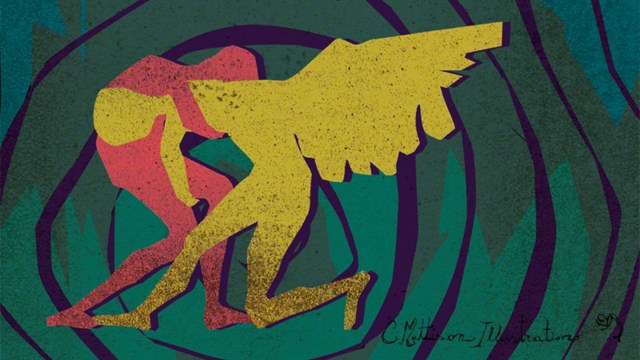
Jacob Wrestles the Angel by Christina Mattison Ebert

Fifth, Jacob’s limp is a permanent sign of God’s grace to Jacob. God is with him and his descendants.  Jacob is a different person having encountered God, and the limp is a continual reminder God changed his life forever – Jacob will never be the same after this.  Ironically, the limp made Jacob stronger, not weaker.  From this point forward in Jacob’s life, he is mindful of his limitations and that God is the One who will arise to fight, protect, and carry on the covenant promises.  There is no longer any need or even desire to scheme to accomplish anything.

It will be difficult to find grace apart from wrestling with God in the painful situations of life.  It is in such times we must be crippled by grace.  We need to be willing to fight with God. It is necessary to get in the match and struggle with God rather than worry within ourselves or just pretend everything is okay so that we will avoid the hard contest in front of us.

Has God left a permanent mark on you?  Do you carry a limp from him?  What is your name?  How does God identify you?  Our great need is not in being clever, smart, or working harder; it is God’s grace that we all need.  As a kid, when my parents left the house, my brother and I would rearrange the furniture so that we could have a good-solid-knock-down-drag-out wrestling match.  Since my brother was older, it usually ended badly for me with a pile-driver that left me incapacitated.  It is seriously a miracle that I am still alive after being dropped on my head so many times.

Whenever Christians approach the Lord’s Table, we are reminded of the Son who wrestled with the Father in prayer in the garden of Gethsemane and came away confident of facing a cruel cross so that we might have life.  The Lord Jesus carries with him even now the reminders of his suffering – the marks on his hands and his feet from a crucifixion that accomplished deliverance from sin on our behalf.  The elements of bread and cup are deeply symbolic reminders of what Jesus did as the cost for our salvation.  And they are further reminders that just as we eat this bread and drink this cup we will drink again with Jesus at the end of the age.  It is faith in Jesus alone that creates and secures for us a transformed life so that we can share in a crippling grace from him forever.


Psalm 13 – How Long, O Lord?

The Scream by Edvard Munch
“The Scream” by Edvard Munch, 1893.

How long, O Lord? Will you forget me forever?
How long will you hide your face from me?
How long must I make decisions alone
with sorrow in my heart day after day?
How long will my enemy triumph over me?

Look at me! Answer me, O Lord my God!
Light up my eyes,
or else I will die
and my enemy will say, “I have overpowered him.”
My opponents will rejoice because I have been shaken.

But I trust your mercy.
My heart finds joy in your salvation.
I will sing to the Lord because he has been good to me. (GW)

Faith is more than the mind’s affirmation of theological beliefs. Faith is also visceral, an expression from deep in the gut about what is going on around us. For faith to be truly faith it needs to hold the whole person, not merely the brain.

Today’s psalm is the reaction of a person of faith to God when the world as they knew it was crumbling and broken. This is a psalm of lament which moves and deepens the faith of the worshiper.

When the world around us changes and all seems horribly awry, we understandably become disoriented – we lose our normal bearings and feel confused and lost.

One of the simplest observations we can make about this psalm, along with all psalms of lament, is that, whether the content is ethically pure or not, the words of the psalmist directed toward God reflect the pain and agony of  people in the middle of world-shattering circumstances. In such dire situations, there are no simplistic answers or easy diagnoses of problems. Complicated layers of grief exist, and mere cerebral responses will always fall short of adequately being in the present moment, sitting with emotions, and getting in touch with the gut.

I am leery of folks who quickly affirm trust in God when a terrible event has just occurred. Bypassing the gut and the heart cannot bring a whole person response to that event and will inevitably result in a cheap faith which cannot support the immensity of the situation. Even worse, it leads to a bootstrap theology where people are expected to pull themselves up in a free-willpower way that is impossible to even do. Sometimes failure of faith comes not because of a person’s weakness but because the faith being espoused is not faith, at all.

Biblical faith expresses weakness, need, help, curiosity, and doubt with a healthy dose of emotional flavor and visceral reaction.

If we had just one psalm of lament as an example, that would be enough. In fact, we have dozens of them, with more sprinkled throughout Holy Scripture. We even have an entire book of the Bible, Lamentations, a deep reflection of the prophet Jeremiah’s grief.

So, let us now be honest with ourselves and each other. All of us, at one time or another, have given a cry of “How long, O Lord!” There are times when our prayers seem unheard and unnoticed, as if they only bounce off the ceiling and fall flat. There are hard circumstances which continue to move along unabated with evil seeming to mock us. We long for divine intervention, we long for deliverance, we long for healing – and when it does not come our disappointment and frustration boils over into an unmitigated cry of wondering where God is in all the damned thick crud.

When a person and/or a group of people are traumatized not once but over-and-over again, how can we not cry aloud, “How long, O Lord!?” When despair settles in the spirit, disappointment seeps in the soul, and depression becomes our daily bread, how can we not muster up the voice that yells, “How long, O Lord!?” When powerful people cause the lives of others to be downtrodden and despised, how can we not scream, “How long, O Lord!?” When the covert actions of others demean and denigrate, leaving us with private pain which no one sees, how can we not bring forth the words, “How long, O Lord!?” If you have never uttered this kind of wondering about God, then perhaps a profound disconnect with your own spirit exists.

A full orb faith names the awful events and sits with the feelings surrounding those events with God.

Psalm 13 is important because it gives us words when the bottom falls out of our lives and everything is upside-down. This psalm helps us admit that life is not as well-ordered as a simple Sunday School faith may pretend. The psalm acknowledges that life is terribly messy, and the psalmist protests to heaven that this quagmire of injustice is plain unfair. What is more, this psalm helps move the sufferer to a new place.

God is big enough to handle everything we throw at him — our pain, our anger, our questions, our doubts. Genuine biblical faith is comfortable challenging God. And God is there, listening, even if we cannot perceive it. Just because we might need to endure adversity does not mean there is something wrong with us, or God.

We likely will not get an answer to our “how long?” We will get something else: mercy. Mercy is compassion shown to another when it is within one’s power to punish. If we widen our horizon a bit, we will observe a God who cares:

“The Lord isn’t slow to keep his promise, as some think of slowness, but he is patient toward you, not wanting anyone to perish but all to change their hearts and lives.” (2 Peter 3:9, CEB)

The only thing better than the joy of personal salvation is the joy of many people’s deliverance and collective emancipation. Patience, perseverance, and endurance through hardship will require expressions of faith with words of affirmation, along with words of agony. The psalms help us with both.

Lord God Almighty, I pray for the forgotten and the unseen – the stranger, the outcast, the poor and homeless – may they be remembered and seen by you.

Merciful God, I pray for those who struggle with mental illness, anxiety, depression, and suicidal ideation – may there be resources to help, enough staff employed, and finances given, toward mental health services. May there be basic human kindness available for the hurting.

Compassionate God, I pray for those who wrestle with sorrow – may they know your comfort within the dark thoughts which currently seem to triumph.

Attentive Lord, I pray for the crestfallen and the ones considered fallen by those around them – may they receive your restoration and reconciling grace. Protect them from judgment and shield them with your mercy.

Lord of all creation, I trust in your steadfast love and rely upon your infinite grace. May our tears turn to songs of joy, to the glory of Jesus Christ. Amen.

Revelation 2:8-11 – Persevering to the End

perseverance

“And to the angel of the church in Smyrna write: These are the words of the first and the last, who was dead and came to life:

“I know your affliction and your poverty, even though you are rich. I know the slander on the part of those who say that they are Jews and are not but are a synagogue of Satan. Do not fear what you are about to suffer. Beware, the devil is about to throw some of you into prison so that you may be tested, and for ten days you will have affliction. Be faithful until death, and I will give you the crown of life. Let anyone who has an ear listen to what the Spirit is saying to the churches. Whoever conquers will not be harmed by the second death. (NRSV)

What is unique about chapters two and three of Revelation is that Jesus himself is the speaker to seven different churches. Today’s New Testament lesson is addressed to the church at Smyrna, which was a large and beautiful port city in the ancient world. Jesus was letting the believers in Smyrna know they were about to experience severe persecution. However, they need not be fearful and can remain faithful because their Lord knows all about suffering. The church’s perseverance under such trouble would result in the crown of life, given to them by Jesus himself.  This was surely an encouragement to the believers as they underwent difficulty.

The congregation at Smyrna was facing imprisonment and, for some, even death for their faith. The heart of the message by Jesus is to remain faithful.  There will always be cowards and those with weak faith who will fold when the going gets tough. Yet, persecution and hardship have a way of purging the soul as well as the church of its dross.

Suffering is inevitable; how we handle adversity when it comes is completely under our own control.

Few of us reading this will ever likely face a hardship that could result in martyrdom. Knowing there are brothers and sisters in the faith throughout the world who do face daily hardship for their devotion and beliefs puts our own troubles in a different light. The daily irritations and trials God puts in our way to refine us and shape our faith certainly seem small compared to imprisonment and martyrdom. Yet, no matter who we are and where we are located on this earth, whether facing uncommon hardship or banal difficulty, the afflictions of both body and soul come to us as opportunities to lean into faith and love Jesus to the end.

Our Lord is not looking for perfect people, just faithful followers willing to endure suffering with the truth that our Lord stands with us. 

Whatever our current circumstances may be, Jesus offers us his perspective on it. He knows precisely what is going on and understands the spiritual resources you and I possess for each adverse situation we encounter. In fact, few of us really discern the largess of internal resources are within us because of Christ’s redemptive work and the Spirit’s abiding presence – not to mention the very personality God graciously gave us in the womb before we were even born. Even though it seems, at times, we lack strength, wisdom, and courage for what is ahead – Jesus has supreme confidence in us to maintain faith and endure through our afflictions.

Life is not a sprint. Life is a marathon.

To finish the race we need to be in good spiritual health. The perseverance of the saints will happen as we run step after step with boldness despite fear of the unknown future around the bend. This requires the equipment of risk, vulnerability, accountability, and steadfast love which is both received and given. Perhaps most of all it requires keeping our heads up and running toward the promise of reward at the finish. The crown of life is an image of both congratulation and celebration of a race well-run and the enjoyment of unending fellowship with our Lord for whom we have endured so much.

When all is said and done, and the end of the age has occurred, we will be able to look back in hindsight and see that it was really Jesus who all along was fortifying us to keep standing and keep going. Christ is so vested in us that he continually ensures our ultimate victory through a constant presence of help and encouragement. The heritage of both Reformation and Holy Scripture testify to this truth:

“All our progress and perseverance are from God.” –John Calvin

“I’m sure about this: the one who started a good work in you will stay with you to complete the job by the day of Christ Jesus.” (Philippians 1:6, CEB)

May the grace of Jesus sustain you; the love of God surround you; and, the encouragement of the Spirit surprise you, today and every day. Amen.

Grant, O God, That we may never lose the way through our self-will, and so end up in the far countries of the soul; that we may never abandon the struggle, but that we may endure to the end, and so be saved; that we may never drop out of the race, but that we may ever press forward to the goal of our high calling; that we may never choose the cheap and passing things, and let go the precious things that last forever; that we may never take the easy way, and so leave the right way; that we may never forget that sweat is the price of all things, and that without the cross, there cannot be the crown.

So keep us and strengthen us by your grace that no disobedience and no weakness and no failure may stop us from entering into the blessedness which awaits those who are faithful in all the changes and chances of life down even to the gates of death; through Jesus Christ our Lord. Amen

William Barclay, Prayers for the Christian Year

Hebrews 13:20-21 – Conflict and Peace

Pretty Place Chapel Blue Ridge Mountains
Pretty Place Chapel in the Blue Ridge Mountains

May the God of peace,
who brought back the great shepherd of the sheep,
our Lord Jesus,
from the dead by the blood of the eternal covenant,

        equip you with every good thing to do his will,
by developing in us what pleases him through Jesus Christ.
To him be the glory forever and always. Amen. (CEB)

These verses are the benediction, that is, the blessing given at the end of a long letter to a group of struggling Jewish Christians. In fact, things were so difficult for these believers that they were giving serious consideration to reneging on their commitment to Christ. So, the author of Hebrews sent them an exhortation and an encouragement to remain true and steadfast to the faith.

What is needed is not a shrinking back from faith but instead an enduring faith which is sustainable for the long haul of a person’s life.

The believers had both inner and outer conflict. They were experiencing hardship and persecution in the form of confiscation of their property and public insults. The Christians had started out well, facing such trouble with confidence through standing side-by-side with others who were suffering as well as holding on to their vibrant faith.

Yet, over time, their resolve began to break down. A slow drift occurred. Eventually, they started to retreat from the helping of others. They emotionally and spiritually inched their way to becoming despondent to the point of questioning whether all this Christianity stuff was worth it. The outer conflict worked its way inside their souls and damaged their spirits. By the time the writer of Hebrews comes along, a group of Christians are stuck in discouragement.

It’s one thing to deal with trouble and hardship on one day, even two. It’s quite another thing when that difficulty does not let up – when days turn into weeks, weeks into months, even months into years.

There are times when peace seems to have about as much chance of being realized as winning the lottery.

Yet, God is the God of peace, real lasting harmonious spiritually restful peace. It was achieved through the life and death of Jesus. The peace Jesus has brought is so much more than the absence of conflict. God’s peace is freedom from fear and anxiety. It is a settled confidence deep down inside that God will ultimately make good on all his promises and that things will not always be this way.

Until that day comes, God is not sitting in some divine Lazy-Boy recliner watching old reruns of the Angels playing baseball. Rather, God is active through carefully, deliberately, and, to our occasional consternation, slowly equipping us and developing us into spiritually fortified people who do the will of God and please Jesus in everything they do and say. Jesus is the Great Shepherd of the sheep who will not lead us astray but will settle us in green pastures.

The word translated “equip” is a rich word (Greek καταρτίσαι, pronounced “cot-ar-tids-ay”) which means to set something straight. Picture a bone which has been broken and needs to be reset and have time to heal. That is what God is doing in his people – repairing broken spirits. This divine healing is equipping believers for a lifetime of handling adversity with faith, confidence, and endurance. The process, frankly, hurts and requires patience before healing and health come.

If God can raise the dead, he can most certainly handle any earthly trouble we are going through.

God is in the transformation business. Extreme makeovers are his specialty. He uses hard circumstances, troubles, and torments of our lives and bends them into divine tools to form and shape his people to both survive and thrive in the world.

Complaining spirits, blaming and shaming others, and impatience borne of unrealistic expectations are the evidence of damaged emotions, wounded souls, and weak faith. This is the antithesis of God. He’s not overlooking humanity with a divine *sigh* in exasperation. That’s because he is the God of peace who is bringing all things to a conclusion in Christ. Jesus will come to judge the living and the dead. The Holy Spirit is now and very presently active to heal damaged emotions, repair wounded souls, and strengthen faith.

In those times when God seems absent and prayers seem to bounce off the ceiling are the times that God is establishing peace and expanding our capacity for faith and patience.

Benediction, blessing, and doxology come through the dark night of the soul and not by avoiding it.

Soli Deo Gloria. To God be the Glory.

Almighty God,
all thoughts of truth and peace
proceed from you.
Kindle in the hearts of all people
the true love of peace.
Guide with your pure and peaceable wisdom
those who take counsel
for the nations of the earth;
that in tranquility your kingdom
may go forward,
till the earth is filled
with the knowledge of your love;
through Jesus Christ our Lord. Amen.

–From the Book of Common Order of the Church of Scotland, St. Andrew Press.

Click It Is Well with My Soul by TenTwoSix Music and arranged by David Wise.