Psalm 27 – Waiting Patiently

The Waiting Room by South African artist Gerard Sekoto (1913-1993)

The Lord is my light and my salvation—
    so why should I be afraid?
The Lord is my fortress, protecting me from danger,
    so why should I tremble?
When evil people come to devour me,
    when my enemies and foes attack me,
    they will stumble and fall.
Though a mighty army surrounds me,
    my heart will not be afraid.
Even if I am attacked,
    I will remain confident.

 The one thing I ask of the Lord—
    the thing I seek most—
is to live in the house of the Lord all the days of my life,
    delighting in the Lord’s perfections
    and meditating in his Temple.
For he will conceal me there when troubles come;
    he will hide me in his sanctuary.
    He will place me out of reach on a high rock.
Then I will hold my head high
    above my enemies who surround me.
At his sanctuary I will offer sacrifices with shouts of joy,
    singing and praising the Lord with music.

 Hear me as I pray, O Lord.
    Be merciful and answer me!
My heart has heard you say, “Come and talk with me.”
    And my heart responds, “Lord, I am coming.”
Do not turn your back on me.
    Do not reject your servant in anger.
    You have always been my helper.
Don’t leave me now; don’t abandon me,
    O God of my salvation!
Even if my father and mother abandon me,
    the Lord will hold me close.

 Teach me how to live, O Lord.
    Lead me along the right path,
    for my enemies are waiting for me.
Do not let me fall into their hands.
    For they accuse me of things I’ve never done;
    with every breath they threaten me with violence.
Yet I am confident I will see the Lord’s goodness
    while I am here in the land of the living.

Wait patiently for the Lord.
    Be brave and courageous.
    Yes, wait patiently for the Lord. (NLT)

The message of the Advent season is perfectly and succinctly encapsulated in this heartfelt psalm to wait patiently for the Lord. Oh, how impatient we can be as people!  Not only do we anticipate the celebration of Christmas with the coming Christ child, but we long for deliverance, courage, help, strength, and, of course, patience.

The way to wait patiently is through hope. And hope is one of those things which needs to be continually be fortified. Whatever it is that we desire to see realized – the return of a wayward son or daughter; revitalization and revival within the church; courage to face the high wall of adversity; protection and deliverance from mean-spirited people; an end to pandemic; freedom from racism and injustice – whatever the situation we long for, patience is to be our breakfast every morning to help us through each day, living one day at a time, putting one foot forward.

Apart from patience and faith in God, we will lose our spiritual zeal and settle for a mediocre existence with tepid relationships and lukewarm engagement of the world. God desires more for us than simply having a marriage in which two people only exist under the same roof; for church to be more than buildings, budgets, and butts in the pews; for our work to be more than a necessary evil to make a living; for our lives to be more than fear, worry, and anxiety; more than broken dreams, messed up relationships, and situations gone sideways.

The confident expectation of hope neither eliminates trouble from our lives nor magically makes everything better. Deep faith, like the psalmist expressed, does not change reality – but it does change us. The way in which we view and handle our troubles is understood differently through the filter of faith and the lens of hope. The mammoth adversity in our lives is no longer feared because of settled trust in God; the danger which lurks about has no teeth to hold us when we are secure in the Lord.

The actions we ourselves take toward God amidst the fallen nature of this world are to wait and hope, be strong and take courage. It is precisely when we are totally discombobulated that these actions are to take effect. “I believe…” and “I have confidence…” become the beginning pronoun and verbs to every sentence we utter. So, let us flesh out those words:

I believe the Lord is the Light which keeps me safe and illumines my path.

I believe the Lord is my Fortress, a castle to protect me.

I believe the Lord is an Army surrounding me, defending my life.

I believe the Lord is the Rock of my salvation, keeping me secure.

I believe the Lord is a Parent who holds me close and does not let go.

I believe the Lord is the righteous, just, and good Judge, always extending grace and mercy to me.

Therefore, I have confidence and courage to engage the world, knowing God has my back.

I have confidence God will handle malevolent persons, systemic evil, and sinister forces on my behalf.

I have confidence I can approach God, since God’s character is always gracious and loving.

I have confidence to pray with authority, understanding God is the Sovereign of the universe.

I have confidence better days are ahead, that the Christ is soon coming.

I have confidence God bends to attentively listen to me praying.

I have confidence God is neither angry at me nor hidden from me.

I have confidence God shall lead me, guide me, and teach me in the way I ought to go.

Rather than losing heart, we can be strengthened with solid theology. Making daily affirmations of faith, persevering in hope, and performing small acts of love are our daily tasks while we wait and watch….

Almighty and everlasting God, the One who sees, knows, and protects, by the power of your Holy Spirit, you are refining us, purifying our discipleship, pulling us into following Jesus in this scary new world of uncertainty. Grant us mercy and grace to trust you more deeply, for the only secure place is with you, our light and our salvation, the stronghold of our life. We pray in the name of Jesus, the first-born of your new creation, and our hope, our life. Amen.

Psalm 27 by British songwriter and producer Jonathan Ogden

James 2:14-26 – Faith Works

What good is it, my brothers, and sisters, if someone claims to have faith but has no deeds? Can such faith save them? Suppose a brother or a sister is without clothes and daily food. If one of you says to them, “Go in peace; keep warm and well fed,” but does nothing about their physical needs, what good is it? In the same way, faith by itself if it is not accompanied by action, is dead.

But someone will say, “You have faith; I have deeds.”

Show me your faith without deeds, and I will show you my faith by my deeds. You believe that there is one God. Good! Even the demons believe that—and shudder.

You foolish person, do you want evidence that faith without deeds is useless? Was not our father Abraham considered righteous for what he did when he offered his son Isaac on the altar? You see that his faith and his actions were working together, and his faith was made complete by what he did. And the scripture was fulfilled that says, “Abraham believed God, and it was credited to him as righteousness,” and he was called God’s friend. You see that a person is considered righteous by what they do and not by faith alone.

In the same way, was not even Rahab the prostitute considered righteous for what she did when she gave lodging to the spies and sent them off in a different direction? As the body without the spirit is dead, so faith without deeds is dead. (NIV)

Genuine authentic faith is more than mere sentiment and head knowledge. Faith without works does not work. Strong robust faith is active and can withstand adversity.

The rhetorical questions the Apostle James asked were meant to awake his readers to the reality that true faith is always active. In other words, inactive faith is not really faith at all. In his letters to the churches, the Apostle Paul typically talked about the relationship between faith and works before a person converts to Christ, whereas the Apostle James emphasized the role of works after a profession of faith in Christ.

St. James was getting at the heart of how a believer in Jesus ought to live. And he did this by giving an illustration of the relationship between faith and works: If someone is in need and a person expresses a sentimental feeling, even if that feeling is sincere, without backing it up with action – the expression is merely an expression, nothing more. 

I once came home after a long day at work on a Valentine’s Day several years ago. I had picked up some flowers at a drive through flower shop. I walked into the door and handed my wife the flowers with an “I love you.”  Then, I sat down in a heap and turned on the television. My dear wife’s response was not so favorable to my sentimental overtures. I did not really put any thought or action behind Valentine’s Day, and she knew it. My words of “I love you” just did not sync with my actions. 

Just so you know, I redeemed myself the next year by winning a contest on a local radio station for a spouse’s best love note, and it got read on the air several times throughout the day for my lovely wife to hear. My commitment and actions were were nicely aligned so that when I said “I love you” at the end of that workday, there was no doubt about it.

Faith requires that actions sync with words. For example, when we say “I will pray for you” it needs to be more than an expression of concern – we need to spend the time and commitment it takes in praying for them.

Faith involves emotions yet ought not be limited by them. Faith can neither exist nor survive without deeds. Christian works are not an added extra to faith any more than breathing is an added extra to the body. Both faith and action is needed for the Christian life.

True faith is shown as the genuine article by how it acts in real life situations. Faith is more than a checklist of right beliefs to sign-off on, as if it were some fire insurance policy against hell. Frankly, as a Pastor, I have heard some pretty lame justifications over the decades for failing to help others, give to the poor, be involved in justice work, and just plain serve in the church, like, “I’m not wired that way,” “That’s not my gift,” “That’s what we pay you to do,” and the ever-prolific, “This church is not meeting my needs.”

Those in the habit of complaining without an intent to boots-on-the-ground helping do not yet have an active faith. Each person is to do their part in serving the common good of all. And we all suffer when that does not happen. Bifurcating faith and action leave us with a false faith. 

If faith without action is okay, then so is the entire demonic realm. The glimpses of Satan we get in the Bible leads me to think that the devil has the entire thing memorized and knows it well from Genesis to Revelation. Yet, knowledge puffs up but love builds up. Information by itself is useless unless it is accompanied by gracious and loving action. (1 Corinthians 8:1)

Salvation is a term Christians are familiar with. In the Christian tradition, it refers to being saved from sin, death, and hell. Sanctification is another term most Christians recognize. It means “to become holy,” or, “to be set apart” for God. Sanctification is not an event but a process. Whereas saving faith is a gift given without works, sanctifying faith requires a great deal of effort. A lot of energy is expended to live the Christian life. The late Dallas Willard used to often say, “Grace is not opposed to effort, it is opposed to earning. Earning is an attitude. Effort is an action.” 

The Apostle James dealt primarily with the sanctifying faith every Christian needs to exhibit. It is as if we have been graciously granted a full-ride scholarship to a university (salvation) but now the real work begins (sanctification) to learn, grow, and obtain the degree. And, just as a student will surely become discouraged at some point throughout their education and wonder if they ought to drop out, so the Christian will face tremendous adversity and challenge. Indeed, a lot of blood-sweat-and-tears goes into our spiritual studies so that our faith will be strengthened for a lifetime of active loving service.

For example, the Old Testament character Abraham was saved from an empty way of life in a pagan country and given a gift of grace to move to the country God would show him. Abraham did nothing to earn this favor.  God just chose him (Joshua 24:2-3). Abraham sojourned as a pilgrim throughout the land God gave him, which mirrored his spiritual sojourning and learning to be a follower of God. Abraham faced a monumental test of faith when asked to sacrifice his son Isaac (Genesis 22:1-19).

Abraham’s faith was made complete by what he did. Testing of faith is necessary so that we become mature and complete, not lacking anything (James 1:3-4). The way for authentic faith to develop and grow is in the fiery trial of adversity and hardship. Spiritual maturation, holiness, and a well-rounded faith come by means of difficult life circumstances.

Rahab and the Two Spies by Unknown artist

To press the significance of faith and works, the example of the Old Testament character Rahab is highlighted. Rahab was a prostitute who lived in the red-light district of Jericho. St. James was doing something profound and important – he took two extreme examples, one a giant of the faith, and the other an almost overlooked example of faith, to demonstrate we all are candidates for real faith.

Rahab’s faith and actions worked harmoniously. She genuinely believed the city of Jericho was going to be overcome by God’s judgment, and, so, she housed the visiting Israelite spies (Joshua 2:1-11). Methinks we must expand our understanding of faith to include persons others might exclude. Some may be quick to judge those with dubious lives and backgrounds, as well as the poor and needy. The bald fact of the matter is that we cannot sanitize Rahab as something other than what she was – and because of her faith she ended up being an ancestor of Jesus himself (Matthew 1:5).

From the standpoint of faith, Abraham and Rahab are on the same level. In Christ’s new egalitarian society, all are welcome, all are equal. Together, we work on our sanctifying faith by submitting to adversity as our teacher; finding solace in God’s Holy Word and Spirit; praying for and with others; worshiping God like there is no tomorrow; leaning into faithful relationships; keeping our eyes open to what God is doing; being patient with the process of sanctification; and embracing unwanted change as our friend.

Faith works, my young Padawan. Embrace it. Enjoy it. Energize it.

Psalm 130 – Waiting in Hope

waiting

Out of the depths I cry to you, Lord;
Lord, hear my voice.
Let your ears be attentive
to my cry for mercy.

If you, Lord, kept a record of sins,
Lord, who could stand?
But with you there is forgiveness,
so that we can, with reverence, serve you.

I wait for the Lord, my whole being waits,
and in his word I put my hope.
I wait for the Lord
more than watchmen wait for the morning,
more than watchmen wait for the morning.

Israel, put your hope in the Lord,
for with the Lord is unfailing love
and with him is full redemption.
He himself will redeem Israel
from all their sins. (NIV)

This psalm is the miserable cry of a nobody from nowhere. Yet, because the Lord is attentive to the righteous, the cry penetrates heaven and is received. The psalmist only wants to serve God with a new beginning and fresh obedience – and he will wait and hope for liberation from his misery.

We typically use the term “hope” in a wishful thinking sort of way. That is because we are not quite sure if things will shake-out like we want.  But biblical hope is not wishful thinking.  Rather, it is a confident expectation of what is to come. Hope is like anticipating the seasons.  In the dead of winter when it is bitter cold with little sunshine, we hope, and not wish, for Spring because we know it is coming.  It might come in early March, maybe in late April. The trees will bud, the grass will turn green, and the temperature will warm – you can bet your britches on it.

This old world might be messed up and broken right now, but it will not always be this way.  Because of the person and work of Jesus Christ, there is hope, the confident expectation that deliverance from sin, death, and hell will be fully realized. We are saved from the bondage of sin through the cross and resurrection of Christ.  We are delivered into an inheritance which can never perish, spoil, or fade – kept in heaven for us until the time is right. Meanwhile, we hope with the confident expectation of Christ’s coming again.

Praise be to the God and Father of our Lord Jesus Christ! In his great mercy he has given us new birth into a living hope through the resurrection of Jesus Christ from the dead, and into an inheritance that can never perish, spoil, or fade. This inheritance is kept in heaven for you, who through faith are shielded by God’s power until the coming of the salvation that is ready to be revealed in the last time. In all this you greatly rejoice, though now for a little while you may have had to suffer grief in all kinds of trials. (1 Peter 1:3-6, NIV)

Until our hope is fully realized, we cry out to God and watch for his deliverance. Regarding our salvation, it is accurate to say that we have been saved (from the realm of sin); we are currently being saved (through being made holy in this life); and, we will be saved (when Jesus returns). Liberation from both our personal struggles and the evil machinations of this world is an ongoing process that will only reach its complete fulfillment at the end of the age.

That is why we experience such a weird existence on this earth, a strange amalgam of good and bad.  We not only get mixed messages from the world, but also internally, within our souls, we experience the struggle between right and wrong.  Outwardly, we suffer in all kinds of earthly grief from others who do not understand us.  Inwardly, we have the silent pain and terrible wrestling of wanting to forgive but desiring revenge; of seeking to be gracious but seething with anger; of looking to express kind words but having hate speech blurt out instead.

It will not always be this way. We have a living hope.  Jesus has risen from death. He is alive. He is coming back to judge the living and the dead.  He will take us to be with him forever.  It is the confident expectation of unhindered relationship, with no obstacles of difficult people, and without any systemic evil from organizational structures giving us a hard time.

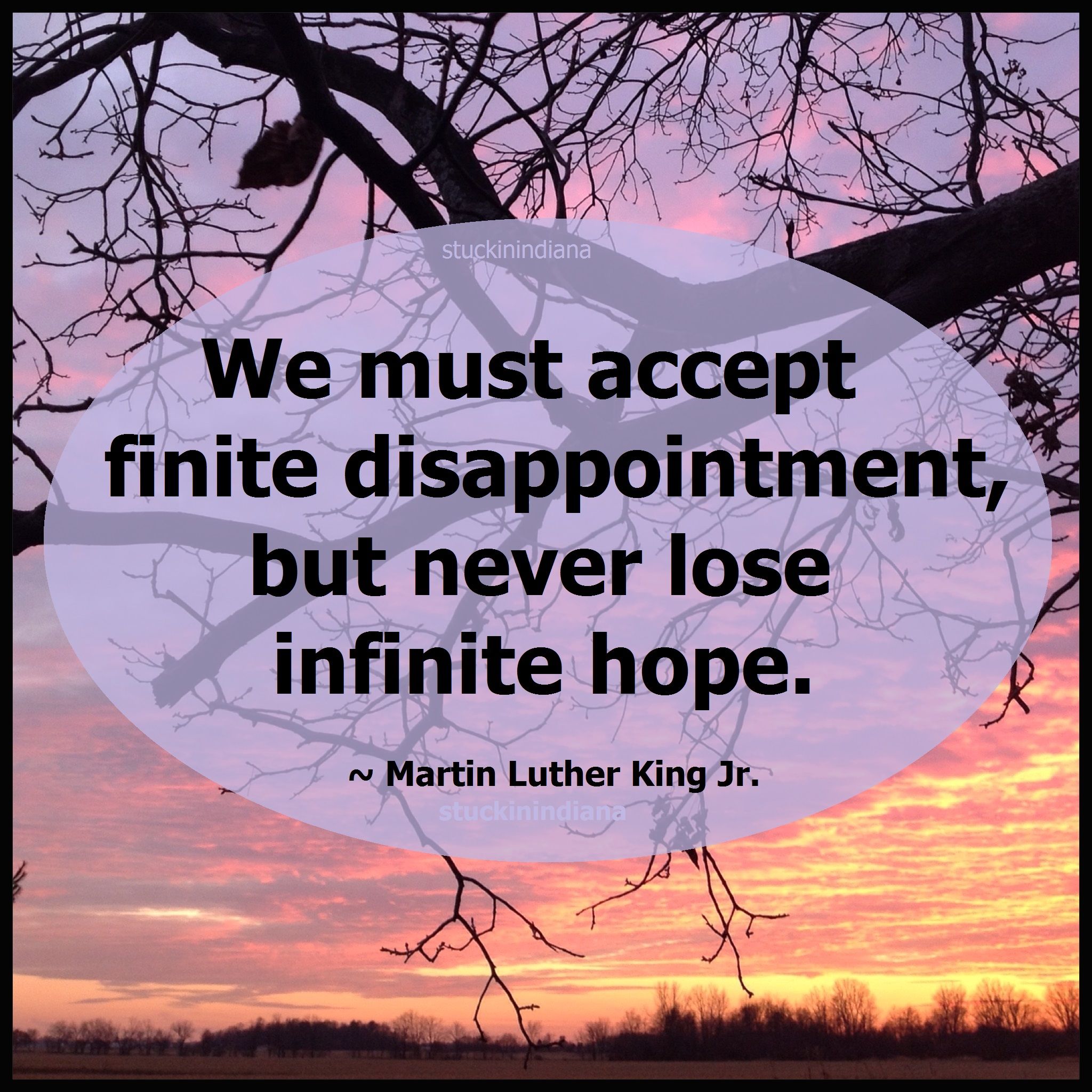
MLK hope quote

Hope is real. It is just as real as anything we will ever know this side of heaven. We might not always find what we are looking for in this life, yet, in the next life, we shall find the life that is truly life in Jesus Christ, who is our hope. Until then, we are to wait neither idly nor passively. Instead, it is sage for us to do the following:

Occupy the time. One of the best ways to avoid becoming anxious while waiting is to do what we are on this earth to do: be a blessing to others.

Bless those who persecute you; bless and do not curse. Rejoice with those who rejoice; mourn with those who mourn. Live in harmony with one another. Do not be proud but be willing to associate with people of low position. Do not be conceited…. Do not be overcome by evil but overcome evil with good. (Romans 12:14-16, 21, NIV)

Don’t try too hard. Trying to use willpower to squelch anxiety will only prompt even greater anxiety. Accept that we will have to wait and that we are not privy to God’s timetable.

Give all your worries and cares to God, for he cares about you. (1 Peter 3:7, NLT)

Wait with other people. Waiting with others through talking about our shared hope helps redeem our time in the here and now.

Be still in the presence of the Lord and wait patiently for him to act. Don’t worry about evil people who prosper or fret about their wicked schemes. (Psalm 37:7, NLT)

Think of patience as compassion. Becoming impatient about something in life is entirely normal and happens to all of us. Our impatience is a stress response to a situation. Learning to be more patient is a way of being more compassionate to ourselves and others.

Therefore, as God’s chosen people, holy and dearly loved, clothe yourselves with compassion, kindness, humility, gentleness, and patience. (Colossians 3:12, NIV)

Lord God Almighty, your hope arises with each dawn, pushing back the rubble of our lives. Each new day reminds us of your grace as you paint hope across the sky. Into the deafening cry of hopelessness, you whisper love that catches and holds us. There is no end, just new beginnings. No finish, just new starts. Into your resurrection we follow you into hope. You are alive in the world and in us. So, we carry your hope within our spirits always. Help us to lift our eyes and experience Christ’s resurrection hope arise in our lives through Jesus our Lord. Amen.

Genesis 45:1-15 – The Big Reveal

Welcome, friends! Click the video below and let us gather together around the Word of God.

You may also view this video at TimEhrhardtYouTube

For the story of Joseph set to song, click Bend by Brandon Heath.

May the Lord bless you
    and keep you.
May the Lord smile down on you
    and show you his kindness.
May the Lord answer your prayers
    and give you peace. Amen.