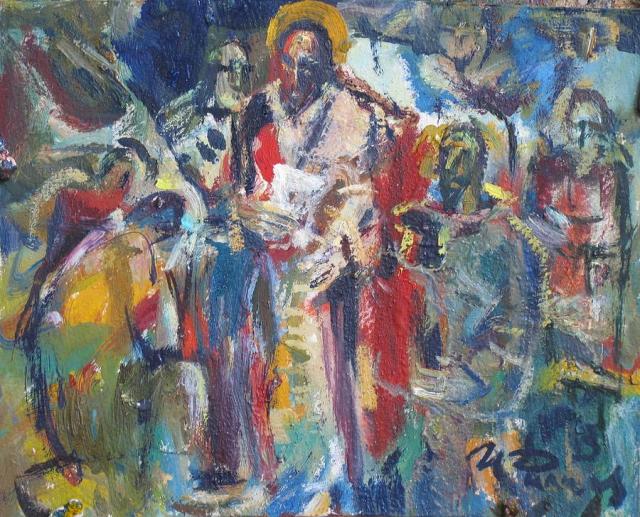
Isaiah 61:1-7 – Better Days Ahead

The Spirit of the Sovereign Lord is on me,
    because the Lord has anointed me
    to proclaim good news to the poor.
He has sent me to bind up the brokenhearted,
    to proclaim freedom for the captives
    and release from darkness for the prisoners,
to proclaim the year of the Lord’s favor
    and the day of vengeance of our God,
to comfort all who mourn,
    and provide for those who grieve in Zion—
to bestow on them a crown of beauty
    instead of ashes,
the oil of joy
    instead of mourning,
and a garment of praise
    instead of a spirit of despair.
They will be called oaks of righteousness,
    a planting of the Lord
    for the display of his splendor.

They will rebuild the ancient ruins
    and restore the places long devastated;
they will renew the ruined cities
    that have been devastated for generations.
Strangers will shepherd your flocks;
    foreigners will work your fields and vineyards.
And you will be called priests of the Lord,
    you will be named ministers of our God.
You will feed on the wealth of nations,
    and in their riches you will boast.

Instead of your shame
    you will receive a double portion,
and instead of disgrace
    you will rejoice in your inheritance.
And so you will inherit a double portion in your land,
    and everlasting joy will be yours. (New International Version)

The message of better days ahead was a breath of fresh air to a beaten down people.

Just today I was speaking with an intensive care nurse who said, “It’s one thing to have a hard day, or know a few weeks will be difficult. It’s altogether another thing when it seems there’s no end to the hard deaths we experience.” Whenever things have gone sideways for so long, we find our lives needing restoration and renewal.

That was the situation for the ancient Israelites. They needed deliverance from their awful predicament. They longed for healing, freedom, and comfort from their grief. After centuries of a downward spiral into disobedience and going their own way, the people found themselves bereft of resources.

After you have suffered for a little while, the God of all grace, the one who called you into his eternal glory in Christ Jesus, will himself restore, empower, strengthen, and establish you.

1 Peter 5:10, CEB

The people needed the year of the Lord’s favor – the year of Jubilee. The Jubilee was supposed to occur every fiftieth year of Israel’s existence in the Promised Land. For forty-nine years there were individuals and families who either incurred debt, indentured themselves into servitude for survival, landed in prison, or ended up laboring in the fields they once owned.

According to the Law, after the forty-nine years, on the fiftieth year, the debts were erased, slaves were freed, fields allowed to rest, and the land restored back to its original owners. God’s deliverance is meant to be not only spiritual, but also very tangible and real.

Salvation is not just otherworldly – it’s also a transformation of the world we inhabit in the here and now.

The need for good news presupposes there’s been some bad news happening. The Lord deliberately gives attention to the oppressed, the brokenhearted, the captives, the prisoners, those who mourn, and the faint of heart. God is concerned for the lowly and the weak. 

It’s significant to note that Israel found themselves in such need not necessarily because they were always victims of adverse situations, but also because they failed to obey the stipulations of their covenant with God. 

We have no actual evidence the Israelites even practiced the Jubilee. After entering the Promised Land, by the time fifty years came down the pike, they had slid so far down the spiritual drain, it was completely off their radar to practice a Jubilee.

It seems no one had any intention of forgiving debts, freeing their indentured servants, giving back the land to original owners, or providing the land itself with a Sabbath rest. 

To not practice the Jubilee was to rob people of their land and practice injustice. But God loves justice and hates robbery. God pays attention to those who are not receiving very real and tangible needs for their lives. So, God speaks words of hope and deliverance for those in circumstances beyond their ability to cope.

The first few verses of today’s Old Testament lesson were the words Jesus read in the synagogue when he began his earthly ministry. Christianity observes that Jesus Christ is the ultimate fulfillment of this promise for deliverance and provision. He came to establish a Jubilee celebration that would never end.

It might be easy for some folks to overlook these verses as pertaining to them. After all, they are blessed, both materially and spiritually. They can always identify people who are in much more need than they are. But we must recognize that the maladies of our hearts are very real. There are specific conditions in our lives that leave us, not just them,in bondage and in need of restoration, renewal, and revitalization, just like the Israelites of old. 

We must name those maladies which are stuffed away in a closet of our heart, such as: the love of things and money; severed relationships; old grudges; hidden addictions; domestic violence; denial of depression; secret affairs; cutting; fear; anger; greed; and hatred. Outward smiles and small talk may hide the truth from others, but they do nothing to hide from a God for whom everything is laid bare.

It’s okay to be a glowstick, sometimes we need to break before we shine.

The good news is not just something for someone else who has “obvious” needs. The gospel must touch our lives and bring us freedom so that we can pass on that very real good news to the legion of social ills that make our world sick. 

There are people all around us who need spiritual, emotional, and material help. Yet, we will not have eyes to see them, or have hearts to help, if we are stuffing our burdens so deep within that we are blind to others.

On the other hand, we may too easily read today’s lesson in a manner it was not meant to be heard, as if we are more in need than we actually are, hearing it something like this: The Spirit of consumer choices is upon me, because the Lord has anointed me to preach good news to the middle-class. He has sent me to bind up the half-hearted, to proclaim more options for the limited, and release from Black Friday for the buyers, to proclaim the year of the Cyber-Monday. 

Perhaps we may not be so crass as to say that out loud, but we might have the tendency to misinterpret Bible passages so as to avoid our own great poverty of heart.

Whichever lens we tend to look at Isaiah’s prophecy, when we become experts at ignoring our needs and emotions, we fail to see the year of Jubilee. The stark reality is that no matter who we are, we need a biblical Jubilee.

Many people are either one paycheck, one prodigal kid, one mental health diagnosis, one serious illness, one drink, one affair, or one bad decision away from being the people we typically identify as in need – the ones that bad things happen to – the ones we do not want as next door neighbors.

We may not yet be vulnerable enough to admit our situation. So, we keep practicing the denial of our spiritual poverty. But everyone knows what a broken heart is. Everybody has a bondage they don’t want to admit. All people need renewal and restoration.

If we believe that tomorrow will be better, we can bear a hardship today.

How, then, shall we live?

Turn from the things which cause us poverty and bondage and turn toward delighting in the Lord your God. Rejoice, because God will make a sprout come up. God will cause us to grow. God will rebuild our ruined souls. God will restore the places of our lives that have been devastated. God will even renew the places that haven’t seen renewal for generations. It begins with you and me allowing the justice of God to work within us.

God can neither bring comfort to those who don’t mourn, nor turn grief into joy unless there is an acknowledgment of a dire situation. If we want to be an oak of righteousness, then there must be a confession of despair and an allowance of God’s justice through Jesus Christ to work its way in us.

Let us envision Jesus coming into our lives and replacing a tattered hat of grief with a crown of beauty. Picture the Lord placing on us a garment of praise to replace those stinky clothes of grumbling. Allow your life to display the grace of God in Christ, since we have been profoundly touched by the justice of God.

Lord Jesus, Carpenter and King, be merciful to the multitudes who today bear the indignities of injustice everywhere. Raise up leaders in every land dedicated to your righteous standards of order, equity, and justice. Grant to us the grace to fulfill our vocation of being loyal to kingdom ethics. Sharpen our intellects to pierce the pettiness of prejudice; to perceive the beauty of human fellowship. Guide our minds to a meaningful understanding of the problems of the poor, the oppressed, the unemployed, and the needy. Incline our hearts toward them, as is your heart, O Lord. May we hunger and thirst after justice always and do it in the power of the Holy Spirit. Amen.

Acts 28:23-31 – Focused on Mission

Apostle Paul by Ivan Filichev

They arranged to meet Paul on a certain day and came in even larger numbers to the place where he was staying. He witnessed to them from morning till evening, explaining about the kingdom of God, and from the Law of Moses and from the Prophets he tried to persuade them about Jesus. Some were convinced by what he said, but others would not believe. They disagreed among themselves and began to leave after Paul had made this final statement: “The Holy Spirit spoke the truth to your ancestors when he said through Isaiah the prophet:

“‘Go to this people and say,
“You will be ever hearing but never understanding;
    you will be ever seeing but never perceiving.”
For this people’s heart has become calloused;
    they hardly hear with their ears,
    and they have closed their eyes.
Otherwise they might see with their eyes,
    hear with their ears,
    understand with their hearts
and turn, and I would heal them.’

“Therefore, I want you to know that God’s salvation has been sent to the Gentiles, and they will listen!”

For two whole years Paul stayed there in his own rented house and welcomed all who came to see him. He proclaimed the kingdom of God and taught about the Lord Jesus Christ—with all boldness and without hindrance! (New International Version)

The Apostle Paul took quite a licking throughout his Christian life. Incredibly, Paul not only physically survived whippings, beatings, stoning, arrests, shipwreck, and imprisonment – he also came through it all with a robust spirit and a dogged determination to live his life with purpose and mission.

Acts 28 is the final chapter in the book. Paul is in Rome under house arrest. Even in this situation, he kept finding ways to engage others. Since he couldn’t go to them, he had others come to him – lots of them.

Paul described to the visitors his own experience of encountering the risen Christ. He reasoned with his fellow Jews and vigorously debated with them from the Scriptures. It was always the deep desire and hope of Paul that his own people come to faith in Christ, just as he had. Although some did, most didn’t.

Many decades ago, my grandfather was approached by one of his friends about investing in a new insurance company startup. For a lot of reasons, grandpa ended up not participating in his friend’s venture. So, the friend asked others. Eventually, the startup happened and steadily grew. Today, Nationwide Insurance has over 250 billion dollars of assets. Good old gramps just didn’t know what he was rejecting.

The good news of Jesus Christ, I believe, is worth infinitely more than an insurance company. Christian mission, I believe, is worth investing my life into. I’m glad the gospel was proclaimed to Gentiles because I am a recipient of such grace. And I’m grateful that Paul tenaciously kept interacting with people for the last two years of his life under arrest.

Despite, and even because of, Paul’s sufferings and his house arrest, the message of faith and forgiveness in Christ was confidently and consistently presented to a steady flow of people, including the highest heads of state. Difficulties are no problem for God. The Lord bends all circumstances to divine and good purposes, creating new avenues of faith, hope, and love that wouldn’t be possible under “normal” times.

“He is no fool who gives what he cannot keep to gain that which he cannot lose.”

Jim Eliot

In fact, Paul endured five years of imprisonment: two in a Caesarea jail; two under house arrest in Rome; and nearly a year in transport between the two cities. For a personality like Paul, we might imagine this would drive him nuts. Yet, several letters to the churches, now contained in the New Testament, were written during that time.

Whether we like it, or not, nothing proves, affirms, and grows our faith quite like our willingness to endure suffering for the gospel. Witness, suffering, and martyrdom are inextricably bundled together in God’s economy. When suffering is viewed as a necessary means to an altruistic and noble end, then, although the pain is no less real, there is the opportunity for both willing endurance and genuine joy.

Paul was willing to labor on behalf of people who were very different from himself. His concern was for all people everywhere – both his own people, the Jews, as well as Gentiles. Paul never gave in and never gave up. He had a magnanimous spirit and even greater spiritual gifts. He willingly and gladly used that spirit and gifts for the benefit of humanity.

In 64 C.E. Paul was condemned and executed. Before his death, he wrote that he had fought the good fight, finished the race, and kept the faith. Now, the next generations of new believers must follow in his footsteps and continue the work

This is precisely why the book of Acts ends so abruptly, with no resolution, no tidy conclusion – because the work is still being done and will carry on until Christ returns.

Gracious and loving God, you work everywhere reconciling, loving, and healing your people and your creation. In your Son Jesus, and through the power of your Holy Spirit, you invite each of us to join you in your work. We ask you to form us more and more in your image and likeness, through our prayer and worship of you and through the study of Holy Scripture so that our eyes will be fully opened to your mission in the world. Then, God, into our communities, our nation, and the world, send us to serve with Christ, taking risks to give life and hope to all people and all of your creation, through Jesus Christ our Lord.. Amen.

Hebrews 10:32-39 – Believe, Be Patient, and Remember

Remember those earlier days after you had received the light, when you endured in a great conflict full of suffering. Sometimes you were publicly exposed to insult and persecution; at other times you stood side by side with those who were so treated. You suffered along with those in prison and joyfully accepted the confiscation of your property, because you knew that you yourselves had better and lasting possessions. So do not throw away your confidence; it will be richly rewarded.

You need to persevere so that when you have done the will of God, you will receive what he has promised. For,

“In just a little while,
    he who is coming will come
    and will not delay.”

And,

“But my righteous one will live by faith.
    And I take no pleasure
    in the one who shrinks back.”

But we do not belong to those who shrink back and are destroyed, but to those who have faith and are saved. (New International Version)

Sometimes we get stuck in our troubles. We might get lost in adversity and cannot see either how we got here or a way out. This is hopelessness. Without a confident expectation of better days ahead, while in the throes of difficulty, a failure of faith can too easily happen.

To realize better days, it’s important to remember the earlier days. I’m not talking about living in the past and wishing it were the 1950s again with Beaver Cleaver across the street. This is not about believing that the past was the good old days, and the present is no good. Rather, I’m referring to remembering the ways we endured and persevered with joy in past experiences.

The original Christian recipients of the message of Hebrews needed to recall the various ways they stood firm and tall in their faith, despite the adversity. They were insulted and persecuted, showing solidarity to others in similar situations. They were attentive to prisoners and sought to meet their needs. And they actually responded to the confiscation of their property with joy because they knew there was more than this present life.

God blesses those who patiently endure testing and temptation. Afterward they will receive the crown of life that God has promised to those who love him.

James 1:12, NLT

The believers needed to reconnect with their purpose, with their why. The reason they had such incredible attitudes while enduring hard things is because they were pursuing heavenly treasure. Their earthly possessions were merely temporary things, not of eternal value. It is people who have eternal value, and the believers willingly focused efforts in helping others.

However, the Christians eventually, over time, lost their focus and could only see the pain and the difficulty. They became disconnected with their purpose. And so, they were in danger of losing their faith and becoming utterly hopeless.

Remember what God has done for you. Affirm what is right, just, and true. Embrace faith and patience. That’s what the prophet Habakkuk did. And his resilience helped to bring proper perspective to present troubles.

“Nothing that is worth doing can be achieved in a lifetime; therefore, we must be saved by hope.”

Reinhold Niebuhr

Habakkuk was distressed over the corruption of his fellow Israelites. So, he complained to God about it. God responded by informing Habakkuk that judgment was coming to Israel through the Babylonians. This was neither what Habakkuk expected nor wanted. The prophet grumbled even more because the Babylonians were more corrupt than the Israelites. “The Babylonians need judgment, too!” believed Habakkuk. 

Habakkuk struggled to come to terms with what God was doing, and not doing. Finally, he concluded the matter by reconnecting with his faith: 

Even though the fig trees have no blossoms,
    and there are no grapes on the vines;
even though the olive crop fails,
    and the fields lie empty and barren;
even though the flocks die in the fields,
    and the cattle barns are empty,
yet I will rejoice in the Lord!
    I will be joyful in the God of my salvation!
The Sovereign Lord is my strength!
    He makes me as surefooted as a deer,
    able to tread upon the heights. (Habakkuk 3:17-19, NLT)

One of the most significant faith experiences we can ever have, is to come to the point of complete trust in God so that our happiness is not dependent upon good circumstances. The truth is that the Christian’s joy and spiritual security is independent of what is going on around us. Even though situations might be difficult and even evil, believers can still rejoice because we do not need everything to go our way in order to experience happiness.

Faith, patience, and joy are neither cheap, nor easy. It requires daily affirmations of faith and patience. It requires remembering. There is a reward ahead if we persevere to the end.

We can remain patient, express faith, kindle hope, and remember necessary things whenever we stop doing unimportant things which do not add value to our ultimate goals; be mindful of those things which are most important to us; and move through life at a pace of hope, not anxiety.

God, give us grace to accept with serenity
the things that cannot be changed,
Courage to change the things
which should be changed,
and the Wisdom to distinguish
the one from the other.

Living one day at a time,
Enjoying one moment at a time,
Accepting hardship as a pathway to peace,
Taking, as Jesus did,
This sinful world as it is,
Not as I would have it,
Trusting that You will make all things right,
If I surrender to Your will,
So that I may be reasonably happy in this life,
And supremely happy with You forever in the next.

Amen.

Hebrews 10:11-25 – Don’t Give Up!

Day after day every priest stands and performs his religious duties; again, and again he offers the same sacrifices, which can never take away sins. But when this priest had offered for all time one sacrifice for sins, he sat down at the right hand of God, and since that time he waits for his enemies to be made his footstool. For by one sacrifice, he has made perfect forever those who are being made holy.

The Holy Spirit also testifies to us about this. First he says:

“This is the covenant I will make with them
    after that time, says the Lord.
I will put my laws in their hearts,
    and I will write them on their minds.”

Then he adds:

“Their sins and lawless acts
    I will remember no more.”

And where these have been forgiven, sacrifice for sin is no longer necessary.

Therefore, brothers and sisters, since we have confidence to enter the Most Holy Place by the blood of Jesus, by a new and living way opened for us through the curtain, that is, his body, and since we have a great priest over the house of God, let us draw near to God with a sincere heart and with the full assurance that faith brings, having our hearts sprinkled to cleanse us from a guilty conscience and having our bodies washed with pure water. Let us hold unswervingly to the hope we profess, for he who promised is faithful. And let us consider how we may spur one another on toward love and good deeds, not giving up meeting together, as some are in the habit of doing, but encouraging one another—and all the more as you see the Day approaching. (New International Version)

The book of Hebrews was originally a sermon preached to a group of struggling Jewish Christians who were discouraged. They were a congregation in decline. The preacher’s approach throughout is to demonstrate that Jesus is better and superior to anything or anyone ever.

With this high view of the person and work of Christ, the preacher comes to the punch line of his sermon. He insists that what the believers need is perseverance to keep going – no matter what adversity they face. For without the ability to endure hardship, the sagging congregation would continue to decline and eventually give up.

Yet, giving up is not an option when it comes to the Christian life. The Christians may not have been going through a Job-like experience, but they needed to get some spiritual spine to them so that they could stand up for Jesus. 

Sometimes, because most of life is lived in the mundane, we can slowly drift from our spiritual moorings and just go through the motions of Christianity without really living for Jesus. Boring and repetitive work; the monotony of caregiving; the tedium of busywork; and the continual grind of it all can be an effective tool in the devil’s workshop. 

When we begin sleepwalking through life, we are in danger of wandering from faith. We then need some stout spiritual stamina. “I didn’t sign up for this!” can be the cry of both the person who is downtrodden with hard circumstances, as well as the person who is simply living a dull life. 

We all have our quitting point – that point where we say, “enough is enough” and we give up and cry uncle. Those times usually come when the pain or inconvenience of what is happening overcomes the resolve to persevere. The devil keeps detailed notes on everyone’s quitting points, and he tries to get us to that point of being ineffective and giving up on the Christian life. 

It easily begins with some minor irritation or complaint against from another. Then moves further along by the loss of someone close. Frustration mounts if financial hardship happens. After a while, if things do not markedly improve, living day in and day out with missed expectations and disappointing situations may lead to bailing out, blowing up, or binging on a sinful desire.

At the quitting point, we throw up our hands, wrongheadedly believing others don’t care and that God is indifferent to our situation.

The preacher of Hebrews knows that the one real measure of a person is the learned ability to push through the quitting points of life. We need endurance and perseverance. But how will we get it?  How can we endure, living for Jesus for the rest of our lives?

There are three indispensable elements of the Christian life, necessary to persevering. Perseverance is a privilege, and not some drudging duty to slog through. Following Jesus for a lifetime comes as we embrace our spiritual privileges.

Faith is the privilege of continually approaching the Lord with confidence

We possess the incredible privilege of approaching the throne of grace with confidence because Jesus has opened the way to God. No longer do we need the elaborate Old Testament sacrificial system in order to approach God. So, let us draw near to God with a sincere heart in full assurance of faith.

We need faith to keep going in the Christian life. Faith is more than doctrinal confession; it is something we experientially live by every day. By faith, we come to God through Jesus – not only soaking in more information but also drawing near to Christ.

Jesus, when on this earth, drew near to the Father. We are to follow Christ in his example. Jesus practiced solitude, silence, and extended times of prayer. Our Lord oriented his teaching and healing ministry around his relationship with the Father by engaging in basic spiritual disciplines that put him in a position to hear and listen so that he could then do the will of God. 

“We can all see God in exceptional things, but it requires the culture of spiritual discipline to see God in every detail.”

Oswald Chambers

A successful student orients her life around certain study disciplines in order to learn and reach graduation day. A winning athlete orients his life around certain daily practices in order to develop the skills needed to face the upcoming competition. Likewise, if we want to follow Christ and draw near to God, we need to reorient our time and commitment in order to take advantage of the privilege of growing and maturing in Jesus. 

The perspective of Hebrews is that we must orient our lives around basic disciplines of faith and put our hands out in order to receive the gift of faith God wants to give us.  Faith is a muscle that must be exercised, or it will atrophy and become useless. And with puny weak faith muscles, it is easy to give up because we have no “umpff” for the Christian life.

Hope is the privilege of living for Jesus with a confident expectation that God keeps divine promises

Perseverance requires hope. Hopelessness happens without the continuing practice of faith expressed in drawing near to God. Hope in Scripture is not wishful thinking; it is a confident expectation that God is good for his promises. 

Hope enables us to bank on the words and ways of Jesus. In those times when we feel hopeless; when there is negativity in the air that brings us to the quitting point; when we sense a season of blessing is not going to come; it is in those very times the preacher of Hebrews says to hold unswervingly to your profession.

We will not always squint our spiritual eyes, looking for the least little hope. Just as young mothers must remember that constant lack of sleep and caring for a needy infant is not always going to be the status quo; just as kids must remember that they will not be in school for the rest of their lives; in the same way, we must remember that God will accomplish everything he sets out to do; that there is an end and a goal to Christianity; and we will be richly rewarded if we keep going and do not give up.

Love is the privilege of encouraging fellow believers

We are to pay thoughtful attention to one another. Believers are to take an interest in each other’s welfare, and put some significant thought into how to spur, incite, cajole, and provoke others into keeping up with Jesus. 

A major opportunity for encouragement is corporate gatherings. Attendance is not an end in itself. Worship services, small group Bible studies, and other ministries of the Church are important because they are moments for us to encourage other people.

Let’s play good response/bad response to this. Bad response: “I feel guilty about what you just said, so I will try harder to love and encourage others.” That’s a prescription for frustration and failure. It ends in reaching the quitting point because we are focusing too much on the strength of our own will, or lack thereof.

Good response: “Wow!  God wants to use me to love other people! I’ll seek to know Jesus better so that I can learn to live and love, just like him. I can’t wait to encourage someone and build them up in the faith.”

Church is not optional equipment for the Christian life. We need each other. We need the Church.

“Love cannot exist in isolation: away from others, love bloats into pride. Grace cannot be received privately: cut off from others, it is perverted into greed. Hope cannot develop in solitude: separated from the community, it goes to seed in the form of fantasies. No gift, no virtue can develop and remain healthy apart from the community of faith. ‘Outside the church there is no salvation’ is not ecclesiastical arrogance but spiritual common sense, confirmed in everyday experience.”

Eugene Peterson

“No one can have God as his Father who does not have the Church as his Mother.”

Cyprian (210-258 C.E.) Bishop of Carthage

“May Christians be guided by the Church’s maternal care until they grow up to maturity and attain the perfection of faith…. To those whom God is a Father, the Church must also be a Mother.”

John Calvin

The Church:

  • Creates a unique presence with God. (Matthew 18:20)
  • Provides the nurture, guidance, and encouragement necessary for spiritual development. (Romans 12:4-5)
  • Helps form our identity as Christians. (Ephesians 2:19-20)
  • Enables endurance through suffering and brings comfort and encouragement in difficult times. (James 5:14-15)
  • Nourishes with the Word in preaching and sacrament. (Acts 2:46-47)
  • Lifts up godly examples to imitate. (1 Corinthians 4:16)
  • Intervenes when sheep go astray. (Colossians 3:16)
  • Fosters spiritual transformation. (Philippians 2:12)
  • Brings maternal care and help. (1 Thessalonians 2:7)

Conclusion

Let’s be encouragers – loving others with the grace of Jesus. The following are six types of encouragers displayed in the book of Hebrews for us to emulate:

  1. The Promoter. Cheering others on to endurance. We are surrounded by a great cloud of witnesses cheering us on and promoting us to push through the quitting points. They did it, and so can we (12:1).
  2. The Professor. Affirming others’ work as valuable and important. God will not forget your work and the love you have shown God’s people and how you continue to help them (6:9-10).
  3. The Preacher. Rebuking and admonishing in love (Proverbs 27:5). We must pay more careful attention to what we have heard, so that we do not drift away.  How shall we escape punishment if we ignore such a great salvation? (2:1-3).
  4. The Prayer Warrior.  Approaching the throne of grace with confidence, so that we may receive mercy and find grace to help us in our time of need (4:16).
  5. The Partner. Coming alongside one another daily so that no one may be hardened by sin’s deceitfulness” (3:13).
  6. The Pastor. Shepherding others through the confusing situations of life. Jesus suffered outside the city gate to make the people holy through his own blood. Together, let’s go to him outside the camp, bearing the disgrace he bore, as we look forward to the heavenly city to come (13:12-14).

It’s our privilege to persevere through the spiritual gifts of faith, hope, and love. Use them for building up one another so that together we can endure for a lifetime.