Psalm 30 – Mourning Has Turned to Joy

I will exalt you, Lord, for you rescued me.
    You refused to let my enemies triumph over me.
O Lord my God, I cried to you for help,
    and you restored my health.
You brought me up from the grave, O Lord.
    You kept me from falling into the pit of death.

Sing to the Lord, all you godly ones!
    Praise his holy name.
For his anger lasts only a moment,
    but his favor lasts a lifetime!
Weeping may last through the night,
    but joy comes with the morning.

When I was prosperous, I said,
    “Nothing can stop me now!”
Your favor, O Lord, made me as secure as a mountain.
    Then you turned away from me, and I was shattered.

I cried out to you, O Lord.
    I begged the Lord for mercy, saying,
“What will you gain if I die,
    if I sink into the grave?
Can my dust praise you?
    Can it tell of your faithfulness?
Hear me, Lord, and have mercy on me.
    Help me, O Lord.”

You have turned my mourning into joyful dancing.
    You have taken away my clothes of mourning and clothed me with joy,
that I might sing praises to you and not be silent.
    O Lord my God, I will give you thanks forever! (New Living Translation)

Life is not only full of the tears which give way to joy; a great deal of life is learning to move through our grief and transform the pain into something beautiful.

Hard circumstances make us either better or bitter.

The psalmist, King David, had his share of adversity, difficulty, and distress. The youngest of seven sons, David was something like the runt of the litter. He was given the grunt work that nobody else wanted to do, since he was the lowest person in the household.

So, off to the fields he went, shepherding the sheep, dealing with hot days and cold nights, fighting off predators, and keeping the sheep healthy and safe. Yet out there where no one was looking, God was watching. And the Lord was developing within David the very qualities needed to one day rule over all Israel and Judah.

Even in-between becoming a member of the king’s court and becoming king himself, David’s life was mostly characterized by misunderstanding and being victimized. In other words, David had intimate first-hand experience of terrible sorrow, buckets of tears, and stress-filled anxiety. Through it all, he did not become bitter. Instead, David learned to transform his mourning to joy.

Many persons, having experienced the sort of things David of old did, come through their difficulties and adversity with a hard heart. They end up hurting people, just like they were hurt. Their verbal and physical acts of violence betray their inability to turn pain into something useful.

So, what makes the difference between those who experience the same sorts of painful events, yet go in the different directions of caring or harming?

I believe the twentieth-century Trappist monk, Thomas Merton, understood the true source of violence and non-violence…

“There is a pervasive form of contemporary violence to which the idealist most easily succumbs: activism and overwork. The rush and pressure of modern life are a form, perhaps the most common form, of its innate violence. To allow oneself to be carried away by a multitude of conflicting concerns, to surrender to too many demands, to commit oneself to too many projects, to want to help everyone in everything, is to succumb to violence. The frenzy of our activism neutralizes our work for peace. It destroys our own inner capacity for peace. It destroys the fruitfulness of our own work, because it kills the root of inner wisdom which makes work fruitful.”

Thomas Merton, Conjectures of a Guilty Bystander

Merton rightly discerned that the false self (the self we project to others and try to maintain as real) is in fact the source of violence – specifically, the false self’s need to gratify impulses for power and control, affection and esteem, security and safety, at all costs.

However, we do not find ourselves in those ways. The cultivation of solitude, silence, and contemplation are non-violent practices which organically produce non-violent ways of being in the world. Those were the very practices which characterized David’s early life as a shepherd.

It’s what we do when no one is watching, and nobody is around, that makes the difference. Our way of being in the world is determined by the way we are with ourselves when we are alone.

How you are, matters.

“If we do not transform our pain, we will most assuredly transmit it.”

Richard Rohr

We need to be present to our pain, to pay attention to it. Our hurts don’t simply vanish if we ignore them, try to go around them, or seek quick fixes to them. The pain is still there, and over time, becomes gangrene of the soul.

Instead, we must dare to go to the unexplored territory of the inner person, to confront and contend with our inner turmoil and be open to hearing from it.

“The endurance of darkness is the preparation for great light.”

St. John of the Cross

Today, like every day, we have the opportunity and even responsibility to bring our whole selves, pain included, to the relationships we have, the work we do, and everywhere we go. The world not only needs our skills and abilities; it needs us.

The path to joy isn’t through perfect circumstances and having all our wants satisfied; joy comes after a season of darkness with all it’s sobbing, tears, and wondering. As we become more comfortable with the shadowy places of our lives, the more open we become to transforming our pain to a beauty which blesses the world.

O God, you are my God, and I will praise you, whether at night’s inky blackness, or in the day’s bright sunshine of happiness. As I endure each difficult situation, help me to see it’s transformative power and it’s potential to make me a better and more godly person, through Jesus Christ my Lord, in the enablement of the Holy Spirit. Amen.


Revelation 11:16-19 – Be Encouraged

The Episcopal Church of the Heavenly Rest in Abilene, Texas

Then the twenty-four elders who sit on their thrones before God fell on their faces and worshiped God, singing,

“We give you thanks, Lord God Almighty,
    who are and who were,
for you have taken your great power
    and begun to reign.
The nations raged,
    but your wrath has come,
    and the time for judging the dead,
for rewarding your servants, the prophets
    and saints and all who fear your name,
    both small and great,
and for destroying those who destroy the earth.”

Then God’s temple in heaven was opened, and the ark of his covenant was seen within his temple; and there were flashes of lightning, rumblings, peals of thunder, an earthquake, and heavy hail. (New Revised Standard Version)

Late in his life, as the old Apostle John lived in exile, he experienced a grand vision. It is what we today refer to as The Book of Revelation, or The Apocalypse of John. 

At the turn of the first century, Christ’s Church was facing a great deal of difficulty and hardship. Christians were the minority. Believers in Jesus were looked at with suspicion. Followers of Christ were often misunderstood and persecuted because of false information. 

In short, all of the myriad sufferings and persecutions that Jewish people currently face and have faced for millennia were true of the early believers in Jesus.

Therefore, the purpose of John’s vision was not to give slick preachers a reason to craft elaborate prophecy charts about what’s going to happen in the future. Instead, God was concerned for the current welfare of his people. The vision was meant to bring encouragement.

The message to John, passed onto the suffering church, was that this present hard situation will not always be this way. Danger, adversity, and hardship will not last forever. There is a day coming when God’s judgment and benevolent reign will truly rule in all of its glorious fullness.

Our prayers will be answered, the ones we have lifted to God for centuries: “Your kingdom come, your will be done, on earth as it is in heaven.”

Gergeti Trinity Church, Georgia

The Lord did not want his beloved children to succumb to discouragement and lose heart. So, the vision from John assured them that all will be made right. Jesus is Lord, and his good rule will have the day. 

Yes, we currently live in a world profoundly touched by the presence and power of sin. And because of that sad reality, we feel all kinds of various pain. We have no choice but to endure the hardships of national wars, bodily diseases, lack of resources, economic woes, mental disorders, emotional distress, and spiritual warfare.

It is possible to observe, as well as experience, all the crud of this sinful world and fall into despair. If or when that happens, we give-in to unhealthy ways of coping with the adverse circumstances around us.

Graciously, we have been given a glimpse into how all of history will shake-out in the end. That brief pulling back of the curtain is meant to bring us needed encouragement, steadfast hope, and patient endurance. 

There is coming a day when expressions of grief and lament will give way to praise and gratitude to God. And that incredible praise will explode with all believers, past and present, along with all creation, proclaiming together that the Lord God is all-powerful. 

The kingdom of this world belongs to our Lord and to his Chosen One. And he will rule forever and ever.

Some might protest that Christians have been harping on this return of Jesus for two millennia and he still isn’t here. We must not misinterpret God’s inaction as uncaring or that God is non-existent. Because it is really patient grace.

But do not forget this one thing, dear friends: With the Lord a day is like a thousand years, and a thousand years are like a day. The Lord is not slow in keeping his promise, as some understand slowness. Instead, he is patient with you, not wanting anyone to perish, but everyone to come to repentance. (2 Peter 3:8-9, NIV)

Our present sufferings must also not be misinterpreted, as if God hates us or is just plain mean. For the Christian, suffering is transformed into solidarity with Jesus Christ.

My dear friends, do not be surprised at the painful test you are suffering, as though something unusual were happening to you. Rather be glad that you are sharing Christ’s sufferings, so that you may be full of joy when his glory is revealed. (1 Peter 4:12-13, GNT)

All of our collective experiences are meant not for harm, but for good so that we might realize spiritual growth and maturity.

Grow in the grace and knowledge of our Lord and Savior Jesus Christ. To him be glory both now and forever! Amen. (2 Peter 3:18, NIV)

Lord Jesus Christ, by your patience in suffering you caused our earthly pain to be sacred and have meaning. Through your example of humble obedience, you opened the way for us to walk through our own hard circumstances with grace and submission.

Be near me in my time of weakness and pain. Sustain me by your grace, so that my strength and courage may not fail. Heal me according to you will. Help me always to believe that what happens to me in this present life is of little account if you hold me in eternal life, my Lord and my God.

As Jesus cried out on the cross, I cry out to you in pain, O God my Creator. Do not forsake me. Grant me relief from this suffering and preserve me in peace; through Jesus Christ my Savior, in the power of the Holy Spirit. Amen.

Revelation 11:15 – He Will Reign Forever

The seventh angel sounded his trumpet, and there were loud voices in heaven, which said:

“The kingdom of the world has become
    the kingdom of our Lord and of his Messiah,
    and he will reign for ever and ever.” (New International Version)

I am so looking forward to that day!

As an ordained Minister, I have done my share of weddings over the years. Working with engaged couples anticipating marriage is both exciting and awkward. It is, in some ways, a difficult time for the betrothed because they are committed to one another in a manner different from just dating. But they are not yet in a marriage relationship. 

The same is true for the Church. She is betrothed to the Lord Jesus. They are both quite committed to each other. But the marriage hasn’t yet happened. There is still this engagement period. We’re ready for permanent unending marital bliss.

The kingdom of God has been inaugurated, but not yet consummated. That’s a fancy way of saying that God’s rule and reign has come to this earth, but its fulfillment has not yet occurred. 

This present time we are now experiencing between the two advents of Christ – his incarnation and his coming again – is a weird and awkward time of engagement. We’re trying to figure out how to live in the world but not of it. 

Yet, there is a time coming at the consummation of the ages, at the end of time, when Christ will return to take his bride. Then, the Church will celebrate in a great wedding feast, the marriage supper of the Lamb. From then on, the kingdom of the world becomes the kingdom of our Lord, and he will reign forever and ever.

Just as marriage is designed for permanence, so our union with Jesus will last forever. His gracious and benevolent reign shall never end. Christ’s rule will be complete and extend over all the earth. 

Until then, however, believers must patiently persevere with fidelity to our Lord Jesus, who loved us and gave himself up for us.

Slow and steady is better than nothing at all.

We keep going, despite all obstacles, adversity, difficulty, and discouragement – without comparing ourselves to others or making everything a competition.

Let us throw off everything that hinders and the sin that so easily entangles. And let us run with perseverance the race marked out for us, fixing our eyes on Jesus, the pioneer and perfecter of faith. For the joy set before him he endured the cross, scorning its shame, and sat down at the right hand of the throne of God. Consider him who endured such opposition from sinners, so that you will not grow weary and lose heart. (Hebrews 12:1-3, NIV)

Persevering to the end is the goal, not being perfect all the time. Perfection is the sure road to depression and feeling defeated. Endurance, however, is able to focus on the small efforts of each day to get where it wants to go.

Even though we anticipate our eternal life, that very life has already begun, right now. So, we can live with confidence, knowing the Lord is with us.

Be strong and courageous; do not be frightened or dismayed, for the Lord your God is with you wherever you go. (Joshua 1:9, NRSV)

Perseverance can only happen with physical, mental, emotional, as well as spiritual health. We compromise our ability to keep going and remain encouraged with a lack of self-care.

We need to pay attention to our bodies because they are the vehicles by which we do the will of God.

We must attend to our minds because that is where we do battle with the enemy.

We have got to become comfortable with talking about feelings because we are emotional creatures, created by a God with deep feeling and emotion.

And we are to be disciplined with spiritual practices, just as we are with anything which requires our attention.

Exercise daily in God—no spiritual flabbiness, please! Workouts in the gymnasium are useful, but a disciplined life in God is far more so, making you fit both today and forever. You can count on this. Take it to heart. This is why we’ve thrown ourselves into this venture so totally. We’re banking on the living God, Savior of all men and women, especially believers. (1 Timothy 4:8-10, MSG)

In those times we are confused or just don’t know what the heck to do, we turn to the Lord.

With all your heart
you must trust the Lord
    and not your own judgment.
Always let him lead you,
and he will clear the road
    for you to follow. (Proverbs 3:5-6, CEV)

Keep moving. The Lord will direct you. The kingdom is coming in all its fullness.

Gracious heavenly Father, may we never lose the way through our self-will, and so end up in the far countries of the soul. May we never abandon the struggle, but endure to the end, and so be saved. May we never drop out of the race, but continually press forward to the goal of our high calling.

May we never choose the cheap and temporary things and let go the precious things that last forever. May we never take the easy way, and so leave the right way. May we never forget that sweat is the price of all things, and that without the cross, there cannot be the crown.

So, almighty and everlasting God, keep us and strengthen us by your grace so that no disobedience and no weakness and no failure may stop us from entering into the blessedness which awaits those who are faithful in all the changes and chances of life, through Jesus Christ our Lord. Amen.

Luke 12:4-12 – Dealing with Trouble

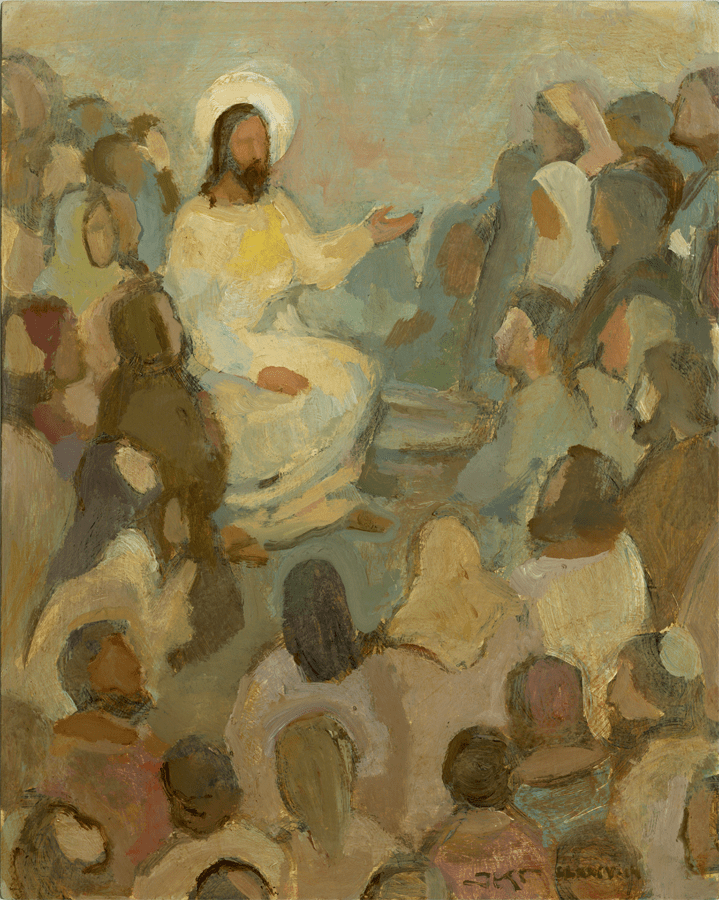
Jesus the Teacher by J. Kirk Richards

“I tell you, my friends, do not be afraid of those who kill the body and after that can do no more. But I will show you whom you should fear: Fear him who, after your body has been killed, has authority to throw you into hell. Yes, I tell you, fear him. Are not five sparrows sold for two pennies? Yet not one of them is forgotten by God. Indeed, the very hairs of your head are all numbered. Don’t be afraid; you are worth more than many sparrows.

“I tell you, whoever publicly acknowledges me before others, the Son of Man will also acknowledge before the angels of God. But whoever disowns me before others will be disowned before the angels of God. And everyone who speaks a word against the Son of Man will be forgiven, but anyone who blasphemes against the Holy Spirit will not be forgiven.

“When you are brought before synagogues, rulers and authorities, do not worry about how you will defend yourselves or what you will say, for the Holy Spirit will teach you at that time what you should say.” (New International Version)

A new resurrected life is a beautiful thing. And it can be a hard thing, at the same time.

Decades ago, I once preached in a church for morning and evening worship services. As I entered the church building for the evening sermon, one of the deacons greeted me by saying, “Man, did you ever stir the pot this morning!”

It turns out, because I did not stay behind the pulpit when I preached, but freely roamed around the sanctuary, many parishioners believed I was not being under the authority of God’s Holy Word. They took my actions as subversive, even rebellious. Others defended the action. The entire church became divided over it.

What I found so interesting about the whole affair is that I was simply and genuinely being myself – and it caused trouble to the point of families dividing and imploding in on themselves.

Sometimes people lose sight of what’s really important, and the gospel of grace ends up bringing division. Jesus tended to cause trouble in his earthly ministry, just by being himself – and a lot of folks didn’t take kindly to him exercising authority like God does.

Trouble tends to follow Christian mission and service. That may seem odd. Yet, God’s kingdom is an upside-down one. The way of resurrection and new life comes through a cross and a death; the way to succeed is to fail; the one who loses their life will find it.

We ought to expect opposition and trouble from the world.

Fortunately, nobody ever accused me of being in cahoots with the devil. But that happened to Jesus, on more than one occasion. (Matthew 10:24-25)

Christians are not above their Master – they will be treated as he was. Jesus didn’t want his followers to be surprised whenever they face opposition.

We don’t need to be afraid of getting into trouble.

Fear has to do with the unknown and about what is going to happen to us. Since we know opposition and trouble is expected, we can avoid living in dread. Early on in the church, Christians actually rejoiced in their suffering because they considered it a privilege to be walking in the way of Jesus.

We are given a promise that we’ll receive special help in times of adversity. Believers possess the Holy Spirit, given to us to be our helper and advocate for such difficult situations.

God sees all things. The Lord isn’t surprised by your hardship and will eventually deal with all that is wrong in this old fallen world. The wrath of God is to be much more feared than the wrath of people.

God observes all the details of our lives. If God cares and is attentive to the least little things in my life, then how much more will the big issues in my life be handled!?

Blaspheming (saying hard things against) the Holy Spirit is nothing more nor less than attributing the work of Satan to God.

We aren’t doomed to hell if we are crushed under a heavy load of distress and pressure. God won’t strike us with lightning if we make mistakes, mess up, or fail to live as we ought. The Lord will likely be sad, but fire and brimstone will not be in the picture.

You might be wondering how I handled the hubbub with the church who fractured over my preaching apart from the pulpit. I came back in the evening and purposely caused trouble by preaching the Beatitudes of Jesus while walking up and down the aisle.

After all, when somebody is secure in Christ, why not say and do what needs to be said and done?

Gracious God, your love is sufficient for us. May your guidance and wisdom hold us tightly, along with our brothers and sisters in Christ around the world. Guard the hearts and minds of believers in places of hardship, war, and persecution so that your church may stand strong in faith.

Although trouble may come, neither any person nor any power on this earth can take our souls from us. We belong to you. May your church stand strong in grace and love, being assured with the reality that Jesus Christ is Lord of all.

We pray for the day when we will all be together in worship and praise at the consummation of your benevolent kingdom. Until that day, may your love flow to all our persecuted brothers and sisters. May your blessed Holy Spirit strengthen and fill them with faith, hope, and love, through Jesus Christ your Son, our Lord. Amen