Reframe the Situation (Exodus 4:1-9)

But Moses protested again, “What if they won’t believe me or listen to me? What if they say, ‘The Lord never appeared to you’?”

Then the Lord asked him, “What is that in your hand?”

“A shepherd’s staff,” Moses replied.

“Throw it down on the ground,” the Lord told him. So Moses threw down the staff, and it turned into a snake! Moses jumped back.

Then the Lord told him, “Reach out and grab its tail.” So Moses reached out and grabbed it, and it turned back into a shepherd’s staff in his hand.

“Perform this sign,” the Lord told him. “Then they will believe that the Lord, the God of their ancestors—the God of Abraham, the God of Isaac, and the God of Jacob—really has appeared to you.”

Then the Lord said to Moses, “Now put your hand inside your cloak.” So Moses put his hand inside his cloak, and when he took it out again, his hand was white as snow with a severe skin disease. “Now put your hand back into your cloak,” the Lord said. So Moses put his hand back in, and when he took it out again, it was as healthy as the rest of his body.

The Lord said to Moses, “If they do not believe you and are not convinced by the first miraculous sign, they will be convinced by the second sign. And if they don’t believe you or listen to you even after these two signs, then take some water from the Nile River and pour it out on the dry ground. When you do, the water from the Nile will turn to blood on the ground.” (New Living Translation)

“When we are no longer able to change a situation, we are challenged to change ourselves.”

Victor Frankl

Moses needed a big-time reframing of his situation.

Reframing is a way to help see a situation from a different perspective.

For example, Moses seemed to say to himself, “I’m going to do horrible at communicating to the Israelites that God appeared to me. They’re never going to believe me that I saw God in a burning bush!”

Instead, Moses could reframe the circumstance by saying, “I saw God. I know God is going to deliver the Israelites from their slavery to the Egyptians. I’ve been thinking about this in the backside of the desert for the past 40 years. And God’s got my back to use me here. So, I’ve got this. I can do this!”

But, of course, Moses didn’t say that. He needed a reframing from God that came from some powerful illustrations of the Lord’s ability to change things.

The big reframe for Moses was this: If God can change a staff into a snake, and then turn it back again; and if God can change my hand to be white with leprosy, then turn it back to a healthy hand; then God can certainly change the minds and hearts of the Israelites to accept that I am the Lord’s chosen deliverer from Egyptian bondage.

Whenever we put the onus on our abilities, or lack thereof, in order to alter a situation, then we are likely to have little confidence and a negative outlook.

Yet, when we can do some reframing, and rightly put the emphasis on God’s power and God’s promise, then our faith is placed rightly and we can step forward with courage, knowing it’s ultimately about God, not me.

Moses contends with God about facing the Israelites and convincing them he’s the deliverer. He sees himself as a tongue-tied hick who is only good for moving sheep around. And yet, all these millennia later, we now remember Moses as the one who boldly and repeatedly spoke to Pharaoh and moved an entire nation from Egypt to the Promised Land.

The Lord helped reframe the situation for Moses. Instead of a backward shepherd who was no good at talking, Moses was a magnificently resilient person who was able to reinvent his life multiple times and thrive in each new situation.

Moses survived a murderous decree as a baby, grew up in the Egyptian court, moved to Midian in a completely different existence, and then became perhaps the greatest leader in Jewish history. All of that is the very definition of resilience.

I am willing to surmise that you also need some reframing of your circumstance or even your life. After all, you’ve made it this far in life, and you’re still here. That means you have some significant things going for you. No matter the situation you find yourself in, it’s likely that a good reframe may be needed.

In his book, From Death Camp to Existentialism, Victor Frankl writes of being in a Nazi concentration camp for three years. Everything was taken from him. Frankl’s wife, family, and most of his fellow inmates died. Yet, he survived. And, after the war, he became one of the great psychological healers of our time.

Victor Frankl kept reframing his horrible situation and using his mind for worthy purposes. He survived by using his suffering to help others find hope, to know that no other person or nation can steal his mind from him. Frankl could continually choose his attitude and mindset, irrespective of the circumstances.

“Everything can be taken from a man but one thing: the last of the human freedoms—to choose one’s attitude in any given set of circumstances, to choose one’s own way.”

Victor Frankl

There are always opportunities to experience life more fully, to become a more integrated and whole person, and to transform what seems daunting into a chance to improve one’s life or the lives of others.

Reframing is neither denial nor positive thinking. Rather, it is an invitation in learning to trust God, in the presence, promise, and power of the divine.

We all discover, like Moses, that life can turn out very differently than we might expect. And along the way, we also find that we reinvent ourselves more than once; and that we are transformed by the seasons of life which we all must pass through.

When we learn to trust the Lord, evermore with each and every adverse situation, we are less likely to be controlled or overcome by moods of pessimism, hopelessness, or resentment. Our prevailing attitude becomes optimistic, as our faith is exercised and proven in the difficult trials of life.

Through his several encounters with God – and then with the people and with Pharaoh – Moses found resources he didn’t know he had. By experiencing a reframe of his life, Moses became the sort of person and leader that we are still talking about 3,500 years later.

So, don’t close your heart and mind to the adversity in front of you. That only leads to bitterness and unhappiness. Instead, open yourself to God and trust the spiritual reality and resources you possess.

Hold It Loosely (Exodus 1:1-7)

When Jacob went to Egypt, his son Joseph was already there. So Jacob took his eleven other sons and their families. They were: Reuben, Simeon, Levi, Judah, Issachar, Zebulun, Benjamin, Dan, Naphtali, Gad, and Asher. Altogether, Jacob had 70 children, grandchildren, and great-grandchildren who went with him.

After Joseph, his brothers, and everyone else in that generation had died, the people of Israel became so numerous that the whole region of Goshen was full of them. (Contemporary English Version)

Exodus is the second book of the Bible, and the second of five books known as the “Pentateuch” by Christians, and the “Torah” by Jews. The first book, Genesis, ended with the story of Joseph – who was one of the 12 patriarchs. God established a covenant with Abraham, the father of Judaism, and promised him land and descendants – even though he did not have a son. God miraculously gave Abraham and Sarah a biological son, Isaac, who grew up to be the father of Jacob, or Israel, Joseph’s father.

The stories in Genesis surrounding Abraham, Isaac, Jacob, and Joseph were filled with wonderings of whether God’s promise would ever survive, or not. Yet, it did. Joseph, in the ultimate reversal of fortunes, went from the lowest person in Egypt to it’s highest official. Through Joseph, the brothers and their families ended up relocating to Egypt because of a severe famine.

Present-day land of Goshen, Egypt

As time moved on, Joseph, his brothers, and all that generation died. In contrast to the extended family of Jacob, 70 of them, who initially went to Egypt, the opening of of Exodus relays an exponential growth in numbers of Israelites.

God was faithfully and tirelessly preserving the covenant and the promise for Israel. When the people went to Egypt, God assured them they need not be afraid. The Lord will make them a great nation, will be with them, and shall lead them back out again. (Genesis 46:1-4)

The opening of Exodus not only connects us with events in the latter part of Genesis, but also hearkens back to it’s very beginning, when God spoke to the first human couple. The Lord gave them a five-fold blessing, consisting of commands to 1) be fruitful 2) multiply 3) fill the earth 4) subdue it, and 5) have dominion over it. (Genesis 1:28)

Following the Flood, God blessed Noah, repeating the commands to be fruitful, multiply, and fill the earth (Genesis 9:1). Later, God spoke to Abraham, promisingto make him fruitful (Genesis 17:5-9). Moving into Exodus, we see a fulfillment of the commands and the promise taking shape, stating that the descendants of Israel were fruitful and multiplying, so that the land was filled with them.

It was this very blessing of progeny, and the fertile increase of descendants, which sets up the entire book of Exodus. The great and growing numbers of Israelites became a source of concern and fear amongst the Egyptians. It wasn’t long before the Jews were seen as another source of slave labor.

Sometimes, we must bear in mind and remember that great blessing also has an underbelly of great blight. Only God and relationships last forever; everything else is temporary, including our earthly blessings.

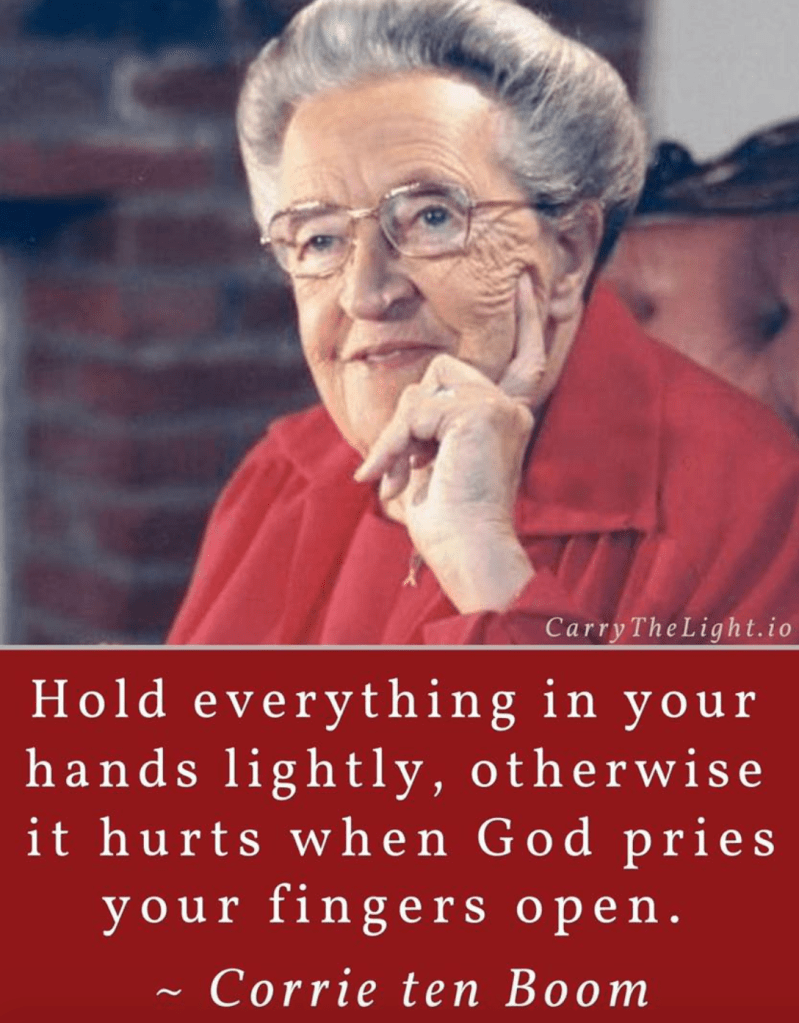
Therefore, it is wise to hold all things loosely, with open hands, and not with clenched fists that believes possessing things in this moment will be permanent. The following are some things to remember:

Remember who is in control

When things are going well, it may create the illusion that I am in charge of the blessing. But, in reality, it was given to you, and it can be taken away, as well.

The only thing you can control are your thoughts, feelings, emotions, choices, actions and the story you are telling yourself about what happened in the past, is happening now, and will happen tomorrow.

We all have our personal invisible backpacks to carry. That backpack is ours, and nobody else’s. Others have their own burdens to carry, which are individual to them. They aren’t yours to carry. Their stories aren’t yours to tell.

God is the Sovereign of the universe, and controls all things. That is God’s burden to carry. Not yours. Carrying the world on your shoulders isn’t your job. So, hold loosely whatever happens on this earth, whether for good or ill. 

Remember that life is both planning and improvisation

We have an agenda, make our plans, and put things in place. Yet, in the execution of doing it, we have to move with whatever circumstances and conditions arise – with whatever life throws our way – and then adjust our expectations.

Remember it’s both in planning and in improvising. The Israelites laid plans to go to Egypt, went there, and then had to deal with changing conditions once they were there. All planning and no improvising is unrealistic; and all improvisation with no plan is flying by the seat of your pants and living in a dream world which doesn’t exist.

What’s more, it might be your plan, or your group’s plan, but it’s not everybody’s plan. They have the freedom to say, “No thank you.” So, be careful to not marry yourself to a particular outcome. Release the urge to cling or obsess about certain expectations. Hold your plans loosely, and plan to improvise.

Remember to cooperate with God

In reality, there is a divine/human cooperative which exists on the earth. Ideally, we are to work together, me doing my part, and God handling the rest. And the both of us constantly must be in dialogue with each other.

When we align with this truth, and participate with God and integrate this cooperative into daily life, then we begin to relax, breathe, move with confidence, and speak with purpose. Head, heart, and gut are no longer disparate parts within me, but work together in a harmonious sync with the Lord.

If this is a challenge for you, set aside some time and be in nature. Look around you and observe all the life thriving right in front of you. Connecting with what is alive connects us to the universal Love which exists everywhere. And that Love can help us and heal us – if we will but let it.

I can hold things loosely because I know the internal pressure of “getting it right” isn’t mine to carry. I can cooperate with God, relax, do my best, and trust.

Blessings are wonderful and abound everywhere. Yet, adversity, acrimony, and even abuse still lurk about in this old fallen world. So, may you learn to hold all things loosely, and live as you know you can, and ought. Amen.

See the Big Picture (Genesis 41:37-57)

The proposal pleased Pharaoh and all his servants. Pharaoh said to his servants, “Can we find anyone else like this, one in whom is the spirit of God?” So Pharaoh said to Joseph, “Since God has shown you all this, there is no one so discerning and wise as you. You shall be over my house, and all my people shall order themselves as you command; only with regard to the throne will I be greater than you.” And Pharaoh said to Joseph, “See, I have set you over all the land of Egypt.” 

Removing his signet ring from his hand, Pharaoh put it on Joseph’s hand; he arrayed him in garments of fine linen and put a gold chain around his neck. He had him ride in the chariot of his second-in-command, and they cried out in front of him, “Bow the knee!” Thus he set him over all the land of Egypt. 

Moreover, Pharaoh said to Joseph, “I am Pharaoh, and without your consent no one shall lift up hand or foot in all the land of Egypt.” Pharaoh gave Joseph the name Zaphenath-paneah, and he gave him Asenath daughter of Potiphera, priest of On, as his wife. Thus Joseph gained authority over the land of Egypt.

Joseph was thirty years old when he entered the service of Pharaoh king of Egypt. And Joseph went out from the presence of Pharaoh and went through all the land of Egypt. During the seven plenteous years the earth produced abundantly. He gathered up all the food of the seven years when there was plenty in the land of Egypt and stored up food in the cities; he stored up in every city the food from the fields around it. So Joseph stored up grain in such abundance—like the sand of the sea—that he stopped measuring it; it was beyond measure.

Before the years of famine came, Joseph had two sons, whom Asenath daughter of Potiphera, priest of On, bore to him. Joseph named the firstborn Manasseh, “For,” he said, “God has made me forget all my hardship and all my father’s house.” The second he named Ephraim, “For God has made me fruitful in the land of my misfortunes.”

The seven years of plenty that prevailed in the land of Egypt came to an end, and the seven years of famine began to come, just as Joseph had said. There was famine in every country, but throughout the land of Egypt there was bread. 

When all the land of Egypt was famished, the people cried to Pharaoh for bread. Pharaoh said to all the Egyptians, “Go to Joseph; what he says to you, do.” And since the famine had spread over all the land, Joseph opened all the storehouses and sold to the Egyptians, for the famine was severe in the land of Egypt. 

Moreover, all the world came to Joseph in Egypt to buy grain, because the famine became severe throughout the world. (New Revised Standard Version)

Mosaic of Joseph overseeing the gathering of grain during the seven years of plenty, c.1275 C.E., St. Mark’s Basilica, Venice, Italy

It’s easy to get lost and miss the forest for the trees; we may become too involved in the details of a problem to look at the situation as a whole. Whenever we are in the middle of hard times, it can be difficult to see the big picture of what’s really going on.

Joseph had been in a peck of trouble. He literally found himself deep in trouble by being tossed into a dark hole of a well by his jealous brothers. Then, the same brothers turned around and pulled him up, only to sell him in slavery to a caravan heading for Egypt. (Genesis 37)

While in Egypt, Joseph became the head servant in the household of Potiphar, the captain of the guard for Pharaoh. But again, trouble found Joseph, even though the guy was diligent and squeaky clean in his moral living. Mrs. Potiphar had eyes for Joseph – who did not reciprocate her advances. There’s no wrath quite like a woman’s scorn, and off to jail Joseph went. (Genesis 39)

In prison Joseph waited… and waited. It seemed as though he had been forgotten. And although he had come to be in charge of his fellow inmates because the jail keeper trusted him so much, Joseph was still in the place of bondage. (Genesis 40) So, what would you do if you were in similar circumstances?

Blame others. Bellyache. Bully your way around with a chip on your shoulder. Become bitter about the ways you’ve been shafted and the brunt of injustice. Those are things that many of us might do in the throes of one injustice after another. But not Joseph.

Holy Scripture has no record of Joseph responding with complaint nor discouragement. Joseph seemed to have a sense that there were larger forces at work behind the scenes – that God could be trusted to work out the adverse situations for divine purposes.

So, when Joseph went from the bottom slug in a prison to the top dog in Egypt, the big picture became much more clear. From age 17 to age 30, Joseph labored as the right hand servant in charge of Potiphar’s household, and then as the right hand man to the jail keeper in prison. Now, Joseph becomes the right hand to Pharaoh, the administrator over all of Egypt.

All along, the Lord was getting Joseph ready for something supremely large – life and death sort of stuff. It turns out that, with Joseph in charge, tens of thousands of lives may have been spared because of his insight, foresight, and hindsight.

Joseph had divine insight as an interpreter of dreams – a gift which he acknowledged was given to him by God. He had the foresight and wisdom to take that insight and turn it into a solid administrative plan for saving many lives from a terrible famine. And Joseph continually had the benefit of hindsight in knowing who he was and where he came from – believing that he was part of a specially called family whom the Lord had a divine hand upon.

Every experience, each event, and the myriad mundane tasks which Joseph had to endure for 13 long years were like individual bricks being mortared together into a building which would eventually house enough life-learning to accomplish a life-saving governmental administration which kept food on the table for thousands of people.

Perhaps you and I don’t always get to see what’s going on above us, what is truly being worked out to bring help and justice to the world. Yet, we can rest assure that there is a God in heaven who sees, cares, and is planning salvation for people. And we are part of that large divine plan, if we have the faith to understand there is more going on than our present circumstances and physical eyes can see.

Righteous God and Father of all: Raise up among us people who keep faith alive, hope awakened, and love abundant. Guard our daily vocations and set them apart for your good purposes. Grant us the privilege of seeing our daily work accomplish the saving and blessing of many lives. Renew us in your mercy, sanctify us with your Spirit, and redeem our time so that we may serve you and steward well our lives, through Jesus Christ our Lord. Amen.

Some Needed Encouragement (Revelation 15:1-4)

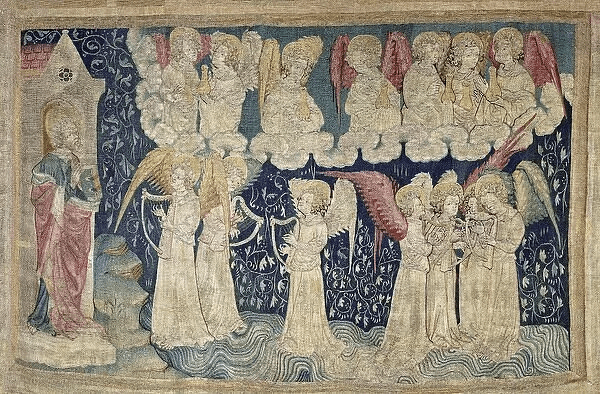
The Seven Last Plagues and the Harps of God, by Nicolas Bataille, c.1380 C.E.

I saw in heaven another great and marvelous sign: seven angels with the seven last plagues—last, because with them God’s wrath is completed. And I saw what looked like a sea of glass glowing with fire and, standing beside the sea, those who had been victorious over the beast and its image and over the number of its name. They held harps given them by God and sang the song of God’s servant Moses and of the Lamb:

“Great and marvelous are your deeds,
    Lord God Almighty.
Just and true are your ways,
    King of the nations.
Who will not fear you, Lord,
    and bring glory to your name?
For you alone are holy.
All nations will come
    and worship before you,
for your righteous acts have been revealed.” (New International Version)

Let’s keep in mind that the book of Revelation (also known as The Apocalypse of John) is a vision of the Apostle John about how things shake out in the end. The purpose of the vision is not for us to get lost in esoteric speculations about the future and try to figure out specific dates and times of God’s judgment.

Rather, John’s Revelation was primarily meant to give believers a future hope that their hardships and suffering will not last forever; there is a time coming, soon, when Judge Jesus will make all things right and all things new. In other words, the vision of John was designed to provide needed encouragement to followers of Jesus.

The believers needed a connection to their spiritual heritage – a way to see that they weren’t an isolated faith island in the middle of the world’s crud. The heavenly beings were singing a song of Moses and of the Lamb (Jesus). The two are connected, thus bringing together the saints of ages past with the struggling Christians of the present.

The song of Moses is a song of triumph, sung after the Israelites passed through the Red Sea unharmed and the Egyptian army was eradicated:

“I will sing to the Lord,
    for he is highly exalted.
Both horse and driver
    he has hurled into the sea.

“The Lord is my strength and my defense;
    he has become my salvation.
He is my God, and I will praise him,
    my father’s God, and I will exalt him.
The Lord is a warrior;
    the Lord is his name.
Pharaoh’s chariots and his army
    he has hurled into the sea.
The best of Pharaoh’s officers
    are drowned in the Red Sea.
The deep waters have covered them;
    they sank to the depths like a stone.
Your right hand, Lord,
    was majestic in power.
Your right hand, Lord,
    shattered the enemy.

Flee From Egypt, by Rev. Albert Lee Wagner, 1975

“In the greatness of your majesty
    you threw down those who opposed you.
You unleashed your burning anger;
    it consumed them like stubble.
By the blast of your nostrils
    the waters piled up.
The surging waters stood up like a wall;
    the deep waters congealed in the heart of the sea.
The enemy boasted,
    ‘I will pursue, I will overtake them.
I will divide the spoils;
    I will gorge myself on them.
I will draw my sword
    and my hand will destroy them.’
But you blew with your breath,
    and the sea covered them.
They sank like lead
    in the mighty waters.
Who among the gods
    is like you, Lord?
Who is like you—
    majestic in holiness,
awesome in glory,
    working wonders?

“You stretch out your right hand,
    and the earth swallows your enemies.
In your unfailing love you will lead
    the people you have redeemed.
In your strength you will guide them
    to your holy dwelling.
The nations will hear and tremble;
    anguish will grip the people of Philistia.
The chiefs of Edom will be terrified,
    the leaders of Moab will be seized with trembling,
the people of Canaan will melt away;
    terror and dread will fall on them.
By the power of your arm
    they will be as still as a stone—
until your people pass by, Lord,
    until the people you bought pass by.
You will bring them in and plant them
    on the mountain of your inheritance—
the place, Lord, you made for your dwelling,
    the sanctuary, Lord, your hands established.

“The Lord reigns
    for ever and ever.” (Exodus 15:1-18, NIV)

Throughout the millennia, this deliverance from harsh slavery to freedom is annually recalled and remembered in the Passover. The original Passover in Egypt involved a lamb being slain and it’s blood applied to the doorposts of each Jewish home. The avenging angel “passed over” those homes and instead dealt with the Egyptian houses which had no lamb’s blood over the door.

The song of Moses and the song of the Lamb (Jesus) are really the same song. Both the deliverance out of Egypt and through the Red Sea, as well as the deliverance from guilt and shame through the cross and resurrection, was real salvation from all that oppressed and hindered the people from living into their true selves.

This connection to salvation history was a great boon to the early believers undergoing their own brand of injustice, oppression, and persecution – just for being followers of Jesus.

So, we all need to apply the death of the Lamb to our present situations, so that we can endure through hardship and not give up and experience a failure of faith. We continually need a strengthening of faith, to recall and remember who we are and to whom we belong, so that we will sing our own song of hope and deliverance.

“Awake and Sing the Song,” by English hymnist William Hammond (1719-1783)

Awake, and sing the song
Of Moses and the Lamb;
Tune every heart and every tongue
To praise the Savior’s name.

Sing of His dying love;
Sing of His rising power;
Sing how He intercedes above
For those whose sins He bore.

Tell, in seraphic strains,
What He has done for you;
How He has taken off your chains
And formed your hearts anew.

His faithfulness proclaim
While life to you is given:
Join hands and hearts to praise His name
Till we all meet in heaven.

Amen.