
Micah 5:1-5a – The Shepherd Leader

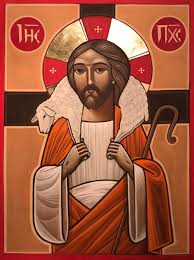
Coptic Church icon of Jesus the Good Shepherd

Jerusalem, enemy troops
    have surrounded you;
they have struck Israel’s ruler
    in the face with a stick.

Bethlehem Ephrath,
you are one of the smallest towns
    in the nation of Judah.
But the Lord will choose
one of your people
    to rule the nation—
someone whose family
    goes back to ancient times.
The Lord will abandon Israel
    only until this ruler is born,
and the rest of his family
    returns to Israel.
Like a shepherd
    taking care of his sheep,
this ruler will lead
    and care for his people
by the power and glorious name
    of the Lord his God.
His people will live securely,
and the whole earth will know
    his true greatness,
because he will bring peace. (CEV)

In Micah’s day there was no peace on earth, goodwill to all. In the eighth century B.C.E. the powerful Assyrian Empire came and conquered the northern kingdom of Israel, deporting many of the people and re-populating the cities with their own.

The Assyrian takeover of Israel not only left the northern kingdom in shambles but had a large impact on the southern kingdom of Judah.  All of Judah and Jerusalem were in extreme duress.  Even though Judah had not been conquered and was intact, they were still forced to pay tribute to the Assyrians to keep them at bay. 

The problem became even more exacerbated because the leadership of Judah sought to maintain their power and lifestyle.  The leaders neither looked to God for help nor looked out for the interests of the people.  Instead, they expected the already burdened poor to shoulder the burden of the tribute to the Assyrians.

What is more, thousands of refugees from Israel flooded into Judah and Jerusalem.  So, the already scant resources in Judah were pushed to the brink. Those in authority, the ones with resources who could make something of a difference, ended up taking advantage of the situation by buying fields and land at a fraction of its worth.  In some cases, they leveraged their power by simply pushing people of their land and taking it over. It was anything but a time of security, peace, and actions of goodwill.

Into this terrible situation of hardship and survival, Micah prophesied judgment upon the leaders who were oppressing the poor and displaced.  Micah’s message of hope was that a new kind of leader will come from humble origins, just like the common oppressed people of Judah.  The refugees, the displaced farmers, and the poor will have a champion.  He will feed and shepherd them, leading them to green pastures.  This leader will serve the people instead of the people serving the leader.

Christians see Jesus in Micah’s prophecy. Just as the ancient Jews needed hope and the promise of a different ruler, so today we, too, need hope and the anticipation of the leader who will come again using his power for security, peace, and goodwill.

Christ’s authority is different than earthly politicians and officials.  Israel and Judah had been so filled with bad kings and self-serving leadership over the centuries that Christ’s disciples could barely conceive of a different kind of rule. So, Jesus called his disciples together and said:

“You know that those who are regarded as rulers of the Gentiles lord it over them, and their high officials exercise authority over them.  Not so with you.  Instead, whoever wants to become great among you must be your servant, and whoever wants to be first must be slave of all.  For even the Son of Man did not come to be served, but to serve, and to give his life as a ransom for many” (Mark 10:42-43, NIV).

The people of Micah’s day needed to see beyond their terrible circumstances to hope of better days with food, peace, and protection.  We, too, feel insecure and anxious. We want leaders to be wise and just toward the vulnerable, the poor, and the displaced.  But while we look to our politicians and election cycles for our hope, the prophet Micah is jumping up and down, pointing us to a different leader – a shepherd leader.

Micah said the shepherd leader will come from Bethlehem.  When Micah proclaimed this, King David, the original shepherd king, had been dead for nearly three-hundred years. The people immediately made the connection between the coming leader and David.  There would be restoration and renewal!  A benevolent kingly reign is coming! 
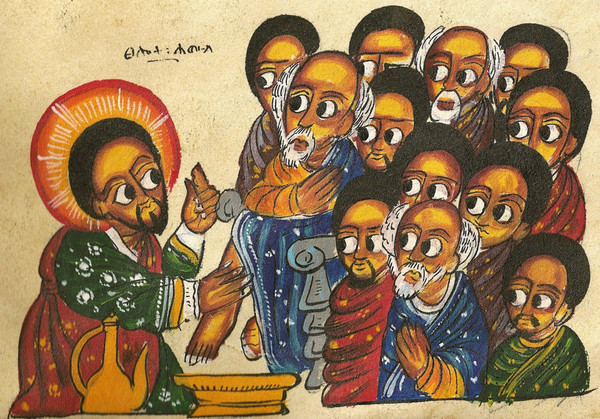
Ethiopian Orthodox Church depiction of Jesus the Bread of Life

“Bethlehem” is two Hebrew words put together: beth (“house”) and lechem (“bread”) thus being “House of Bread.” God was communicating that the coming shepherd leader would provide abundant food and care for them. God wanted, and still wants, a society that does not feed on itself, but is a house of bread for others. Jesus is the Bread of Life. Christ feeds us so that we will become a people who offer bread to others – both physical and spiritual bread.

Jesus is the bread for all the hungers we have in this life. We hunger for security in our world; satisfaction in our daily work; loved ones to be healthy and happy. In short, we hunger for peace. Our spiritual stomachs growl with hunger for spiritual food.  Many are spiritually starving because they are searching for peace and goodwill in places without food.

Satisfaction, contentment, and peace have come from the most unlikely places of Bethlehem and Nazareth. Can anything good come from villages in Judea that do not even show up on most maps of the ancient world?  Peace, hope, and goodwill can and do come from the least expected places and people. 

Christ was not born in the halls of power. Yet, through him there is peace, in the complete sense of the word. Jesus is the One who brings a full-orbed wholeness and wellness to life, no matter the situations around us. Jesus is our peace:

Like a shepherd, God will tend the flock; he will gather lambs in his arms and lift them onto his lap. He will gently guide the nursing ewes. (Isaiah 40:11, CEB)

“Yes, I will feed my flock, and I will lead them to a place of rest. I will search for the lost sheep. I will bring back the sheep that were scattered and put bandages on the sheep that were hurt. I will make the weak sheep strong, but I will destroy the fat and powerful shepherds. I will feed them the punishment they deserve.” (Ezekiel 34:15-16, ERV)

 “I am the Good Shepherd. I know my own sheep and my own sheep know me. In the same way, the Father knows me, and I know the Father. I put the sheep before myself, sacrificing myself if necessary. You need to know that I have other sheep in addition to those in this pen. I need to gather and bring them, too. They’ll also recognize my voice. Then it will be one flock, one Shepherd.” (John 10:14-16, MSG)

“I am the bread of life. He who comes to Me shall never hunger.” (John 6:35, NKJV)

When Jesus originally said those words, it was scandalous, unheard of rhetoric. So, Jesus, the stinker he could be, pressed it even more:

“I am the bread of life. Your ancestors ate the manna in the wilderness, yet they died. But here is the bread that comes down from heaven, which anyone may eat and not die. I am the living bread that came down from heaven. Whoever eats this bread will live forever. This bread is my flesh, which I will give for the life of the world… Very truly I tell you, unless you eat the flesh of the Son of Man… you have no life in you. (John 6:48-51, 53, NIV)

We are to ingest Jesus – to be filled with him. We need Jesus because he is our house of bread, our peace, our shepherd, and our king. Believing in him is to give our lives to him. The greatest Christmas gift we can give this season is the gift of our lives to Jesus Christ, the promised Messiah.

Lord Jesus, I have strayed far from your flock and taken matters into my own hands. I have chosen to feed in pastures that will never take care of my real hunger.  I need Your forgiveness. I believe You died on the cross for all the things I have done and left undone.  You rose from the grave to give me life. So, I want to stop going my own way and start going yours. Amen.

Isaiah 11:1-10 – All I Want for Christmas Is a Savior

Welcome, friends! Advent is upon us. May this season spark faith, increase hope, stir up love, and surprise the world with joy. Click the video below and let us acknowledge the coming of the Christ child…

Isaiah 11:1-10

For the Scripture set to song…

And for a traditional Advent hymn…

Come, Thou Long-Expected Jesus by Shannon Wexelberg

May the light of Christ lead us to the joy of his kingdom, now and for ever. Amen.

Isaiah 11:1-10 – All I Want for Christmas Is a Savior

The Lion and the Lamb by Aaron Spong

A shoot will come up from the stump of Jesse;
    from his roots a Branch will bear fruit.
The Spirit of the Lord will rest on him—
    the Spirit of wisdom and of understanding,
    the Spirit of counsel and of might,
    the Spirit of the knowledge and fear of the Lord—
and he will delight in the fear of the Lord.

He will not judge by what he sees with his eyes,
    or decide by what he hears with his ears;
but with righteousness he will judge the needy,
    with justice he will give decisions for the poor of the earth.
He will strike the earth with the rod of his mouth;
    with the breath of his lips he will slay the wicked.
Righteousness will be his belt
    and faithfulness the sash around his waist.

 The wolf will live with the lamb,
    the leopard will lie down with the goat,
the calf and the lion and the yearling together;
    and a little child will lead them.
The cow will feed with the bear,
    their young will lie down together,
    and the lion will eat straw like the ox.
The infant will play near the cobra’s den,
    and the young child will put its hand into the viper’s nest.
They will neither harm nor destroy
    on all my holy mountain,
for the earth will be filled with the knowledge of the Lord
    as the waters cover the sea.

In that day, the Root of Jesse will stand as a banner for the peoples; the nations will rally to him, and his resting place will be glorious. (Isaiah 11:1-10, NIV)

Christians believe Isaiah’s prophecy to speak of Jesus in whom all these virtues exist in wonderful perfection and practice. Jesus Christ has so clearly identified with us that we are in a vital union with him.  He still exists here on earth in the person of the Holy Spirit.  Jesus was sent by the Father.  With the Father and the Son, the Spirit was sent to press the redemptive events of Jesus into the believer’s heart.  This is basic Trinitarian theology.  Yet these are not abstract ideas.  Prayer, discernment, and listening are the pathways forward to discovering the wisdom, counsel, and knowledge we need to live and serve well as Christians.

In some quarters of Christianity, the church exists as a mere stump of its former existence. For many Christians, daily experience of the Spirit has been supplanted by individual ingenuity, hard work, and getting ahead through accumulation of more and more.  Basic Christian spirituality then becomes a mere shadow of its former influence.  If we desire the Spirit of the Lord to rest upon us, we will seek Christ as our foremost importance.  

Indeed, it is when we are worn down to a stump and have no ability to grow or sustain life anymore that God enters, specializing in giving hope to the hopeless, justice for the poor, wisdom to the confused, and peace to all who desire a harmonious world.

In the awful feelings of helplessness and hopelessness, there is a faint sign of life. A fresh shoot becomes discernible. Could there be possibility amidst such impossible circumstances? Can there be life again? Do I dare hope again? Will things really change, and do so for the better?

The answer is “yes.” For where the Spirit of the Lord blows there is the force of resurrection power, spiritual energy, and fresh courage. Where others see only three-dimensional impossibilities, the believer has the capacity of faith to see multi-dimensional possibilities. The Spirit’s force generates possibility where none existed before. When the breath of God whispers to the sprout in the stump, pessimistic despair turns to optimistic hope, even joy.

Jesus Christ is the Christian’s hope. In Christ, there is security, well-being, and life. With Jesus, there is a vision of justice in which all persons receive what they need to live, thrive, and flourish in God’s world. Christ operates to our advantage and on our behalf without the personal greed and indifference of so many earthly rulers. The weak and vulnerable have a champion in Jesus. Renewal and restoration become very real possibilities.

I have lately taken a liking to a show called “The Repair Shop,” a British television series in which family heirlooms which have sentimental value for their owners are carefully restored by experts. What captivates me about the show is how one person can take an old broken-down item (and by all appearances now a piece of junk) and restore it to its once glorious newness.

There is more to my captivation of the show. I am struck by the sheer pleasure the restorers take in handling the old object, enjoying the process. Just by the looks on their faces, I can tell they consider it a privilege to be restoring such a precious object of the past.

Artisan Steve Fletcher restoring an 18th century French clock

I am sure this is precisely how God feels with us. Rather than envisioning the Lord as some reluctant deity who feels put out with having to rescue a bunch of dumb and wayward people, God is One who has delight in taking this old stump of fallen damaged humanity and restoring us to our original luster and beauty. Transformation is God’s specialty, and the Lord goes about the process of restoration with great care and delight.

The impossible possibility of God’s new creation is poetically described in the peaceful co-existence of animals and creatures who are inconceivably together without fear or violence. There is a time coming when death will be no more, and so, the necessity in this life of hunter and prey shall be forever negated. No more snakes terrorizing women and children. No more big fishes eating little ones. No more human fat cats preying upon and striking poison on the smaller and vulnerable.

The presence of the godly Ruler means the world will be governed rightly, detoxified of its sinful impurities; a place where the poor, the weak, and the little lambs will indeed be safe and secure forever. There will be peace because of the Prince of Peace. All creation will be full of God, and thus, free of all malice.

This beautiful prophecy from Isaiah envisions a deep, radical, limitless transformation in which there will be no more appetite to injure another; no more desire to devour another; no more lust for selfish control of another; and no more destructive passion for domination over others.

It is a thorough renovation of the human heart, human institutions, the animal kingdom, and even every blade of grass in creation. The Apostle Paul had this grand vision of God in mind when he wrote to the Church at Rome:

The creation waits in eager expectation for the children of God to be revealed. For the creation was subjected to frustration, not by its own choice, but by the will of the one who subjected it, in hope thatthe creation itself will be liberated from its bondage to decay and brought into the freedom and glory of the children of God. We know that the whole creation has been groaning as in the pains of childbirth right up to the present time. Not only so, but we ourselves, who have the first fruits of the Spirit, groan inwardly as we wait eagerly for our adoption to sonship, the redemption of our bodies. (Romans 8:19-23, NIV)

The implication for us as humanity was voiced by Paul to the Colossian Church:

Now you must rid yourselves of all such things as these: anger, rage, malice, slander, and filthy language from your lips. Do not lie to each other, since you have taken off your old self with its practices and have put on the new self, which is being renewed in knowledge in the image of its Creator. Here there is no Gentile or Jew, circumcised or uncircumcised, barbarian, Scythian, slave or free, but Christ is all, and is in all. (Colossians 3:8-11, NIV)

The transformation is all-pervasive, impacting everything public while also being intimately personal. It is a gift from God; it is the impossible made possible. And it is this precise thing which we acknowledge, celebrate, and long for in the season of Advent. When the angel came to Mary and communicated that Isaiah’s vision was coming to reality through her womb, Mary astonishingly retorted:

“How will this be, since I am a virgin?”

The angel, with supreme confidence, answered Mary as a matter of fact:

“The Holy Spirit will come on you, and the power of the Most High will overshadow you. So, the holy one to be born will be called the Son of God…. For no word from God will ever fail.”

Mary’s response gives voice to our own desires and longings for the new order of things:

“I am the Lord’s servant. May your word to me be fulfilled.” (Luke 1:34-38, NIV)

This is our confession, too. I am the Lord’s servant. You are the Lord’s servant. May God’s word to us about the coming of Christ be fulfilled, just as Isaiah has said. The hopes and fears of all the years are met in Jesus on a bright starry night.

Advent

Annunciation by Chinese artist He Qi

I began my pastoral career several decades ago, paying little attention toward the season of Advent. It seems I needed to discover for myself that Advent is a special season anticipating the arrival of the Lord Jesus. So now, for the past many years, I have thoroughly embraced the season. I will tell you why Advent is of such significance to me.

I found in Advent a solution to the problem of secular Christmas vs. spiritual Christmas. Well, really, I did not find it because it was always there, recognized and celebrated by the Church for two thousand years. Christians recognize that Christmas is a time to celebrate the birth of Jesus. It is a holiday focusing on the meaning of the Incarnation. Yet, given the secular traditions of Christmas, we spend much of our time preparing, not for a celebration of the birth of Jesus, but for fulfilling the demands of the holidays.

We buy lots of presents for lots of people and make sure they are all wrapped and delivered. We attend and host holiday parties. We have relatives who come to visit, and/or we are the relatives who go elsewhere to visit.  Christmas cards need to get out, and the annual Christmas letter often turns into a project for next year. Our holiday season requires lots of planning and energy, and it can end up being downright exhausting. If we have younger children, we may very well spend hours trying to assemble gifts on Christmas Day that come with sketchy instructions which need to be read over more than once.

Christ can, ironically, get pushed out of Christmas, not by unchurched non-Christians, but by Christians themselves. It is Advent which helps us come back to God and put our focus and our delight where it rightly belongs in Jesus Christ, our Savior.

Embedded within the season of Advent are a message and a mission. The Gospel of John begins with the great proclamation, “The Word became flesh and made his dwelling among us.”  God entered human history in the person of Jesus.  It is a message of grace and hope, completely centering around Christ.  It is a story – the greatest ever told – of God loving humanity so much as to become one of them.  This redemption narrative gives shape to our own witness.  We simply observe and tell the story of God’s love to humanity through the sending of the Son, Jesus, to deliver us from sin, death, and hell and bringing us into a kingdom full of grace, joy, wholeness, and love.

So, how, then, do we keep our focus where it needs to be during the month of December and observe the Advent season?  We might (virtually) attend Advent services. In our observance, we can pay attention to the Advent Wreath and candles, the special readings, and all the heightened awareness of Christ’s coming. 

Another way to focus on Jesus is by enjoying Advent music. This sounds easy, yet not so much. There are hundreds of popular Christmas songs and carols, played everywhere during Advent, from churches, to gas stations and shopping centers. There are comparatively few Advent songs, though many songs and carols do touch upon Advent themes of waiting, hoping, and yearning for God. 

Other ideas for Advent may include putting together an Advent Wreath at home and/or using a Nativity scene with lots of pieces as an Advent Calendar, adding one character to the scene every day.

A practical way, in years past, I discovered in remembering Advent is standing in the long lines of stores during the holidays. I realize this year will likely not have this experience. We are more likely to have a long wait on the phone – much longer than a physical line in a store. A few years back I was going nuts waiting in a crazy long line with a cashier who was clearly seasonal help.  As my frustration mounted, God did what God often does with me, and asked a question.

“Tim, why are you so upset?” “Duh, God! This stupid line and slow cashier!” “Tim, what is my Advent really all about?”  Busted. As a Pastor, I tell others about the time of waiting and anticipation, but here I was selfishly impatient.

Go ahead and try it out this season.  Let the inevitable times of waiting on a customer service person, or even a family member, be a reminder that Advent is about patiently anticipating the coming of the Lord Jesus. 

Honestly, we already know we are going to have times of waiting, whether we like it, or not. If by God’s grace we avoid some long wait, we will probably end up in holiday traffic moving at a snail’s pace. But you and I have a choice.  Either the wait will form us for naught or for good. So, let us allow the time of waiting to bring a fresh Advent spirit into our lives this season so that our Christmas will be a glorious one.