Luke 1:68-79 – A Peaceful Life

Praise the Lord,
    the God of Israel!
He has come
    to save his people.
Our God has given us
    a mighty Savior
from the family
    of David his servant.
Long ago the Lord promised
by the words
    of his holy prophets
to save us from our enemies
and from everyone
    who hates us.
God said he would be kind
to our people
and keep
    his sacred promise.
He told our ancestor Abraham
that he would rescue us
    from our enemies.
Then we could serve him
    without fear,
by being holy and good
    as long as we live.

You, my son, will be called
a prophet of God
    in heaven above.
You will go ahead of the Lord
to get everything ready
    for him.
You will tell his people
    that they can be saved
when their sins
    are forgiven.
God’s love and kindness
    will shine upon us
like the sun that rises
    in the sky.
On us who live
in the dark shadow
    of death
this light will shine
to guide us
    into a life of peace. (Contemporary English Version)

This beautiful psalm and prophecy came from the old priest Zechariah. It is a praise to God for the Christ about to be born; and, a prediction of Zechariah’s own son, newly born, as one who will prepare the way for Jesus.  This benediction speaks of better days to come, pointing forward to peace (shalom) spiritually, politically, and relationally.

Zechariah and his wife Elizabeth were old and well past the childbearing years. In fact, Zechariah is portrayed earlier in Luke’s Gospel as something of a stereotypical grump. After being taken up to the temple in a golf cart because he could walk so well anymore, Zechariah was confronted by an angel and nearly lost his dentures out of fear.

The angel Gabriel told old Zechariah that his wife would bear a son who will prepare the way of Messiah.  Zechariah then gave a sort of “Hmpff!  That’s not likely, Sonny. Look at me and my wife. Are you sure you have the right couple, and the orders in heaven didn’t get screwed up?”

Zechariah the Priest and the Archangel Gabriel by Alexander Andreyevich Ivanov (1806-1858)

Gabriel was not very keen on being doubted, and it earned Zechariah losing his voice until John the Baptist was born. It was after Zechariah had nine months to think about that encounter, and experience watching a child grow in his wife’s womb that, after John’s birth, Zechariah was a changed man. 

Zechariah went from just one of many old priests in Israel, to being inspired by the Spirit and singing the praises of God. We can almost imagine him as an ancient version of Fred Astaire, picking up his cane and dancing with joy.

Our lives are not so different than Zechariah in this respect: We are a complex concoction of both fear and joy that could combust at any time in either direction.

We sway back and forth from fear and anxiety to joy and gratitude. Certain words can swing us to one extreme or the other: finances, pandemic, politics, religion, the future. They can create in us either immediate tension or smiling happiness; tomorrow they might do just the opposite. Zechariah went from anxious to elated, fearful to joyful.

We live in a toxic world filled with polarizing opposites and entrenched stereotypes of others. People vacillate between love and hate, pursed lips of anger and dispositions of peace. So, how do we rise above the heated rhetoric that exists in our world? How are we going to deal with all the disharmony and vitriol? By possessing the peace given to us in the prophecy and promise of Jesus. Our feet need to be guided in the path of peace.

Jesus came to give peace. All the words of Zechariah’s inspiration point toward the harmonious peace of salvation, rescue, and forgiveness. The time was finally coming when there would be peace in its fullest sense – wholeness and thriving in life which was unprecedented and unthinkable before Jesus. 

“True peace is not merely the absence of some negative force, tension or war – it is the presence of some positive force, justice, good will, brotherhood.”

Martin Luther King, Jr.

We are to live the Christian life and have a ministry in the church and the world without fear. Instead, we are to focus on what we are called to be and to do. Jesus rescues and delivers so that we will have forgiveness of sins which enables us to serve the Lord in holiness and righteousness, without fear.

Peace does not just magically appear out of thin air. Peace was bought at an agonizing price – the blood of Jesus. Peace must be pursued. Practices of peace must be engrafted into our lives if we are going to experience it on the daily practical level. Yes, obtaining peace is difficult.  Yet, we instinctively know it is worth it.

Spiritual health comes through cultivating the peace of God in our lives through:

  • Avoiding chronic negativity and embracing the positive.
  • Making things right with others and embracing a reconciling spirit.
  • Pursuing Jesus with heart, soul, mind, and strength.
  • Reframing our situations to a fresh vision of peace, wholeness, integrity, spiritual growth, and relational health, instead of focusing solely on problem-solving.

Zechariah, by means of the Holy Spirit, gave us a vision of a future full of peace, joy, and thriving. The name “Zechariah” means in Hebrew “God remembered.” God has not forgotten divine promises. The time has come to take hold of the vision God had from the very beginning to walk with humanity in continual fellowship and happiness in the garden, a place of abundant growth, beauty, and health.

Beginning ten years ago, a new kind of study has come from a task force put together by professionals across a wide spectrum of disciplines known as the World Happiness Report.  Every country in the world is ranked according to criteria such as the gross domestic product, social support, healthy lifestyles, freedom to make choices, lack of corruption, and both negative and positive outlooks on life. 

The United States has yet to make the top ten list on happiness. Even with America’s vast resources, we are, collectively speaking, a very unhappy people. I believe the most interesting finding from the World Happiness Report was their conclusion as to what makes one country happier than another. The Report consistently concludes that citizens of the happiest nations on earth continually find a steady stream of peace and joy in three sources: their families, their rituals/traditions, and their religion.

It will be hard to find joy in our lives through our Christianity if we are not experiencing the peace of Jesus Christ. Christian liturgical rituals and observances of seasons like Advent help remind us we have peace with God through our Lord Jesus Christ.

The birth of Jesus turned Zechariah’s world upside-down. Forgiveness of sins, spiritual peace, and human well-being can be found in Christ. Here are several practical ways we can implement the peace we have in Jesus Christ today:

  • Slow down, pause, breathe, and pray.

Do not worry about anything; instead, pray about everything. Tell God what you need and thank him for all he has done. Then you will experience God’s peace, which exceeds anything we can understand. His peace will guard your hearts and minds as you live in Christ Jesus. (Philippians 4:6-7, NLT)

  • Exchange fear for the presence of God.

For I, the Lord your God, hold your right hand; it is I who say to you, “Do not fear, I will help you.” (Isaiah 41:13, NRSV)

  • Listen to music, sing, or make music yourself.

Encourage each other with psalms, hymns, and spiritual songs. Sing and make music in your hearts to the Lord. (Ephesians 5:19, ERV)

  • Have a “go to” word, phrase, or Scripture verse.

The Lord is my shepherd. I lack nothing. (Psalm 23:1, CEB)

  • Unplug for a time from electronics and close your eyes.

We live by what we believe, not by what we can see. (2 Corinthians 5:7, NCV)

  • Try aromatherapy and activate your sense of smell.

Through us, God brings knowledge of Christ. Everywhere we go, people breathe in the exquisite fragrance. Because of Christ, we give off a sweet scent rising to God, which is recognized by those on the way of salvation—an aroma redolent with life. (2 Corinthians 2:14-15, MSG)

  • Set healthy boundaries.

Jesus went into a village. A woman named Martha welcomed him into her home. She had a sister named Mary. Mary sat at the Lord’s feet and listened to him talk. But Martha was upset about all the work she had to do. So, she asked, “Lord, don’t you care that my sister has left me to do the work all by myself? Tell her to help me.” The Lord answered her, “Martha, Martha! You worry and fuss about a lot of things. There is only one thing you need. Mary has made the right choice, and that one thing will not be taken away from her.” (Luke 10:38-42, GW)

May the peace of Christ guide you into the path of peace in this Advent season and be with you, now and forever. Amen.

Jeremiah 33:14-16 – Longing for Justice and Righteousness

Jeremiah by Marc Chagall, 1956

The Lord said:

I made a wonderful promise to Israel and Judah, and the days are coming when I will keep it.

I promise that the time will come
when I will appoint a king
    from the family of David,
a king who will be honest
    and rule with justice.
In those days,
    Judah will be safe;
Jerusalem will have peace
and will be named,
   “The Lord Gives Justice.” (Contemporary English Version)

Jeremiah is known as “the weeping prophet.” From the very beginning of his prophetic ministry, Jeremiah was given a message that Jerusalem and Judah would experience God’s wrath and be exiled to a foreign country. 

The prophet Jeremiah was faithful to his calling. Yet, he loved his homeland, and it grieved his heart to know that everything familiar around him would be either altered or destroyed. All would change because God’s judgment was coming.

The Lord gave Jeremiah an unpopular message, especially since Judah was enjoying a time of abundance, economic stability, and relative freedom from war. No one took Jeremiah seriously. Initially, when Jeremiah began to spread his message of gloom and doom, he was perceived as a kook, and no one took him seriously. 

But Jeremiah did not let up. The eye-rolling turned into annoyance, and then, over time, contempt. Judah’s king and the governing officials tried to silence Jeremiah as being subversive and unpatriotic. As a result, Jeremiah was imprisoned several times.

Jeremiah, in today’s Old Testament lesson, is under house arrest. The city of Jerusalem is under siege by the Babylonian army. Jeremiah’s prophecy is knocking at the door….

But the people are not listening, believing they’ll be delivered by God for two reasons:

1) They see the Babylonians are evil pagans who do not recognize the One true God, so, obviously, God would never use such an ungodly army to overthrow the people of God, right!?

2) They have the temple and the true worship of God, and God would never let the temple be desecrated, right!? 

So, the people of Jerusalem felt immune from any kind of terrible judgment, as if being God’s people with God’s temple would ward-off any disaster.

The siege against Jerusalem lasted over two years. During that time, the people of Jerusalem went from cocky and confident to having a very rude awakening. Horrible disaster was upon them. At their lowest point, with barely any food, and atrocities occurring throughout the city, Jeremiah’s word from God was a message of grace. 

The people would not be delivered from their inevitable fate. Yet, God would not wipe them off the map and destroy them forever. There is coming a day when there will be a Deliverer, a just and right Savior from the line of the greatest Israelite king ever, David.

The hardest reality for Jerusalem’s people to accept was that their way of life would never be the same again. It would forever change. Although they continued to practice all the rituals of the temple system and worship, over the generations it had simply become a rabbit’s foot for them – as long as they did their duty, they could walk away and do whatever they wanted. And they did.

That approach got God’s attention. Divine wrath came through the most unlikely of instruments: the pagan Babylonians led by the arrogant King Nebuchadnezzar.

The transition from one way of life to another was excruciating. 

Oftentimes change happens and it’s out of our control. However, what is within our influence is how we make the transition from the previous reality to the new reality. 

A biblical way to deal with difficult changes and transitions is by focusing on God’s promises. There are two pairs of the promise we have within the prophecy of Jeremiah: judgment and grace; justice and righteousness. 

“Justice and righteousness was never meant to be the work of only one person, or one part of society. It should be the foundation of how everyone stewards their lives, as well as an integral, normal part of all of society. Every aspect of this world needs God’s justice and righteousness.”

Jessica Nicholas

By looking ahead with hope to the new future of what God is doing and will accomplish, we then come to grips with present troubles.

Judgment and Grace

All of the Old Testament prophetic books have a rhythm of judgment and grace. The promise God gave to the people through Jeremiah was that judgment was coming; and, that grace would follow on its heels.

Proclaiming only a message of judgment without grace brings despair, death, and hell; there is hopelessness. Conversely, only speaking of grace apart from judgment is oxymoronic – it doesn’t exist because there is no need for grace if there is no judgment; grace is an undeserved mercy given freely by God in the face of our sinful selves.

The siege of Jerusalem was terribly horrific. The details are too graphic to mention. Even the most pious of believers who believed Jeremiah’s message were completely aghast at the level of cruelty and violence done to God’s people.

At the people’s darkest hour, the message of grace came to them….

Justice and Righteousness

A safe, secure, just, and peaceful future will be provided by God. The Lord will not forget the people. Better days are coming. A king will arise. His rule will be just and right, providing protection, peace, and prosperity. God’s people were to keep their heads up looking toward that future in order to help them now in the present.

This requires patience. They must wait.

While waiting, the people need to live in the way God intended before all this terror happened. They are to uphold justice and live righteously because that’s what the coming king is all about.

Justice and righteousness are often paired together in the Old Testament. They’re really two sides of the same coin. We may often think of justice in the punitive sense of giving lawbreakers what they deserve. Yet, biblical justice has more to do with giving someone what they need and deserve to live and thrive as human beings. 

To act justly means to provide essentials like clean drinking water, a safe environment, food to eat, a place to sleep, etc. Righteousness is the relational element to justice. To be righteous means to have right relationships, to connect with people, to move toward them and provide them with all the relational things that people need like respect, dignity, friendship, hospitality, fellowship, etc.

Justice and righteousness go together. Justice without righteousness is at best, impersonal, and, at worst, condescending. Righteousness without justice is a dead faith that wishes well but never delivers. Together, however, justice and righteousness brings love, peace, harmony, well-being, and human flourishing because all the basic necessities of life, physical and relational, are met in abundance.

This is what is meant in the Old Testament when Israel is referred to as “a land of milk and honey.”

Conclusion

For Christians, the time of abundance is here, in Christ. Yet, it’s not here in its fullness. We anticipate, wait, and hope for the Second Coming of our Savior and King. While we exercise patience, we long for better days. A true Advent spirit is a deep longing for justice and righteousness because King Jesus is just and right.

So, what do you long for today? 

I long for justice.

I long for broken spirits to be made right, for people’s healing of both body and soul. I long for the day when children with epilepsy will have no more seizures. I long for the day when individuals and families will not have to contend with cancer anymore. I long for the day when there will be no more depression, anxiety, mental illness, or dementia. I long for the day when people will be free of addictions. I long for the day when there will be no more sex trafficking, death from malnutrition, grinding poverty, corrupt governments, whole families and communities torn by the ravages of diseases, refugees with no place to call home, and devastating natural disasters. 

I long for righteousness.

I long for the day when women and girls across the globe will not be abused and become the victims of disordered power. I long for the day when nations, ethnicities, races, and everyone everywhere will no longer hate each other. I long for every individual to know forgiveness. I long for people to experience the exhilaration of new life in Christ. I long for my community to hear and believe the gospel. I long for peace, harmony, unity, equity, and an egalitarian spirit.

I long for God’s benevolent rule to come in all its fullness, freedom, joy, prosperity, peace, and happiness. I long for Christ’s coming! And I long to be doing justice and righteousness when Jesus arrives!

Maranatha, come Lord Jesus!

Christmas Eve – All I Want for Christmas is Faith

Luke 1:26-38 tells us what led to the observance of Christmas Eve, the holy night for Christians everywhere. Nothing is outside the power of God to accomplish the impossible. Click the videos below and we will remember and observe the coming of the Christ child…

Josh Groban – O Holy Night
Silent Night – Concordia Christmas Concerts, 2016

May the joy of the angels, the eagerness of the shepherds, the perseverance of the Magi, the obedience of Joseph and Mary, and the peace of the Christ child be yours this Christmas. And the blessing of God almighty, the Father, the Son, and the Holy Spirit, be upon you and remain with you always.  Amen.  

All I Want for Christmas Is Faith

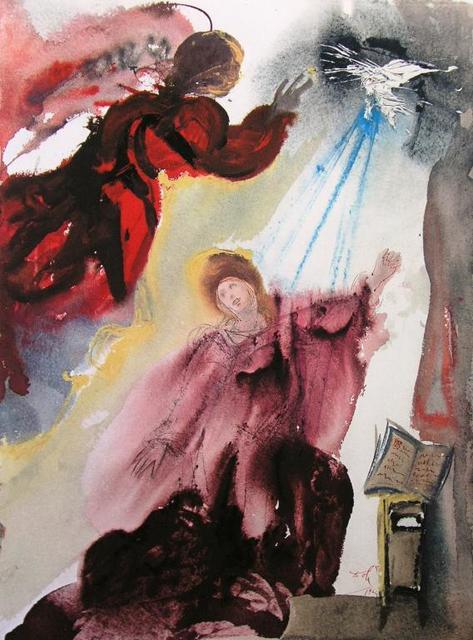
Annunciation to Mary by Salvador Dali, 1965

In the sixth month, God sent the angel Gabriel to Nazareth, a town in Galilee, to a virgin pledged to be married to a man named Joseph, a descendant of David.  The virgin’s name was Mary.  The angel went to her and said, “Greetings, you who are highly favored!  The Lord is with you.”

Mary was greatly troubled at his words and wondered what kind of greeting this might be.  But the angel said to her, “Do not be afraid, Mary, you have found favor with God.  You will be with child and give birth to a son, and you are to give him the name Jesus.  He will be great and will be called the Son of the Most High.  The Lord God will give him the throne of his father David, and he will reign over the house of Jacob forever; his kingdom will never end.”

“How will this be,” Mary asked the angel, “since I am a virgin?”

The angel answered, “The Holy Spirit will come upon you, and the power of the Most High will overshadow you.  So, the holy one to be born will be called the Son of God.  Even Elizabeth your relative is going to have a child in her old age, and she who was said to be barren is in her sixth month.  For nothing is impossible with God.”

“I am the Lord’s servant,” Mary answered.  “May it be to me as you have said.”  Then the angel left her. (Luke 1:26-38, NIV)

Most of life is lived in the mundane, even in a time of pandemic. For the most part our everyday lives involve going about our business and dealing with the daily grind. That is because we are common ordinary people. So, we can especially relate to Mary because she is quite plain. 

To put Mary’s life in our contemporary vernacular, at the time of this encounter with the angel, she is of junior high age but has never attended school. She wears mostly clothes from Goodwill, and occasionally can get some from Wal-Mart. She cannot read because girls of her day rarely did. Her parents make all the decisions that affect her life, including the one that she should be married to an older man named Joseph. We do not know if she even liked him. She lives in a small town that most people cannot point to on a map. 

One night, into the bedroom of this young girl comes the brightly beaming divine messenger Gabriel whose name means, “God has shown himself mighty.” Mary stands there in her ratty old flannel nightgown, her life very quickly moving from the ordinary to the extraordinary. The juxtaposition could not be more pronounced:  a mighty angel and a plain teen-ager; a messenger of the Most High God and a girl barely past puberty; a holy angelic light which beams in a simple candlelit bedroom; an awesome power encountering complete vulnerability.

Annunciation by Mexican painter Angel Zárraga (1886-1946)

Mary, compared to Gabriel, is defenseless, fragile, and overwhelmed. She is in way over her head. That is why we can relate to her. We can get our human arms around Mary. She is like us. She has faced life with little power to make it turn out the way she planned. Forces beyond her have rearranged her life and altered it forever. She is the Matron Saint of the Ordinary. We can totally understand why Mary responds the way she does.

Mary’s initial reaction was to be “greatly troubled.”  She was disturbed and shaking in her hand-me-down slippers. The angel confidently told Mary that she had found favor with God. In other words, Mary was literally “graced” by God. The situation was not that Mary had some extreme spirituality, but that God simply chose her to be the mother of Jesus. And Mary needed to come to grips with what was happening to her.  This was well beyond anything she could have expected.  Becoming pregnant with the Savior of the world was not even remotely on her radar. 

Mary immediately sensed the crazy disconnect between what was being told to her and who she was. After all, she was a plain ordinary girl from the hick town of Nazareth and was being told that she would raise a king.  Maybe somebody in heaven screwed up. Maybe Gabriel got the wrong girl. Maybe his Google map sent Gabriel on a wild goose chase. Relating to Mary, we can totally understand that she would question how in the world all this was going to happen.  Not only is Mary ordinary and far from royalty, but she is also very much a virgin.  Nothing about any of this made any sense.

But the angel let Mary know that God specializes in the impossible. English translators chose to phrase the original rendering of Gabriel’s words as “for nothing is impossible with God.” I rather prefer the more literal translation which is “for there is nothing outside of God’s power.” To me, that is beautiful. There is nowhere we can go, no place on earth, no situation whatsoever that is beyond God’s ability and reach to affect divine power.

We do not always get straightforward answers to our questions about God, but Mary asked a question and got a straight answer: She really can be pregnant with Jesus because the Holy Spirit will come upon her, will overshadow her with power. If the story were to end there it would be a great story. But to me the most astonishing part of the narrative is Mary’s response to what was happening to her.

Mary believed the message and submitted herself completely to God’s will. I think we would completely understand if Mary simply said in her ordinary way that she was not prepared for this. We would totally “get it” if Mary pushed back on what the angel said to her. We could relate if Mary just dismissed the angel’s presence, like Scrooge in the Christmas Carol, as if Gabriel were just “an undigested bit of beef, a blot of mustard, a crumb of cheese, a fragment of an underdone potato. There’s more of gravy than of grave about you, whatever you are!”

Yet, Mary not only believed; she also humbly submitted herself to what was happening. And this is what I believe we need to relate to most about Mary – not her being just a plain ordinary person in a non-descript village but stepping up to the calling she received. We, too, have received a calling in our lives. We, too, have been given the power of the Holy Spirit.  We, too, are ordinary people who have been given a very extraordinary task. 

Our response today can be the same as Mary: “I am the Lord’s servant; may it be to me as you have said.” The Church is pregnant with possibilities because of the Holy Spirit. We know the end of Mary’s story. She gave birth to Jesus. She raised him in her plain ordinary way. She watched him grow up. She saw him embark on his ministry to proclaim the kingdom of God has become near. Mary did not always understand what Jesus said or what he was doing. And she experienced every mother’s nightmare in seeing her beloved son killed in a terribly gruesome manner right in front of her eyes. 

Yet, just as the Holy Spirit was with the birth of Jesus, so the Spirit was with Jesus at his resurrection from the dead. Jesus lived an ordinary life in a very extraordinary way. Furthermore, today Jesus invites us to do the same. Because Christ accomplished his mission of saving people from their sins and establishing a kingdom that will never end, he has given us the same Holy Spirit to follow him forever and call other people to follow him, too. 

To trust and obey is God’s only way to live into the life of Jesus. The Christian life may often be difficult, but it is not complicated. It is rather simple, just like Mary. Mary responded to God’s revelation with faith, choosing to fully participate in what God was doing. “I am the Lord’s servant” is our confession, as well. Along with Mary we declare, “May it be to me as you have said.”