Some Wise Warnings (Proverbs 6:6-23)

Go to the ant, you sluggard!
    Consider her ways and be wise.
Which, having no guide,
    overseer, or ruler,
provides her bread in the summer,
    and gathers her food in the harvest.

How long will you sleep, O sluggard?
    When will you arise out of your sleep?
Yet a little sleep, a little slumber,
    a little folding of the hands to sleep—
so will your poverty come upon you like a stalker,
    and your need as an armed man.

A wayward person, a wicked man,
    walks with a perverse mouth.
    He winks with his eyes,
    he signals with his feet,
    he motions with his fingers;
    perversity is in his heart,
    he devises mischief continually, he sows discord.
Therefore his calamity will come suddenly;
    in a moment he will be broken without remedy.

These six things the Lord hates,
    yes, seven are an abomination to him:
        a proud look,
        a lying tongue,
        and hands that shed innocent blood,
        a heart that devises wicked imaginations,
        feet that are swift in running to mischief,
        a false witness who speaks lies,
        and he who sows discord among brethren.

My son, keep your father’s commandment,
    and do not forsake the instruction of your mother.
Bind them continually upon your heart,
    and tie them around your neck.
When you go, they will lead you;
    when you sleep, they will keep you;
    and when you awake, they will speak with you.
For the commandment is a lamp, and the law is light;
    and reproofs of instruction are the way of life. (Modern English Version)

A proverb is a short, pithy statement of experiential truth. In life, all things being equal, there are some predictable consequences to each decision and action we take.

To make idle, wicked, or adulterous decisions will result in disastrous outcomes – and the proverbial writer wants to help us steer clear of calamity. So, we have some sound and sage instruction which is meant for us to realize contentment and fulfillment in life and avoid the pitfalls of laziness, evil, and infidelity.

The Sluggard

We may typically think of the sluggard as a lazy person who just doesn’t want to work. That’s true, yet it runs even deeper and broader than that. A sluggard is someone always looking for the easy way out. Instead of persevering and being diligent in accomplishing large projects and demanding responsibilities, the sluggard tries to use their ingenuity to get the job done quickly.

The student who wants to take shortcuts, and doesn’t do the busywork of citing sources, or doing their due diligence in research, is a sluggard. The worker who cuts corners in order to move to another job they’d rather do, is a sluggard. The spouse who hastily buys some cheap flowers for their loved one from a street vendor, without even getting out of the car, is a sluggard. The minister who cuts and pastes some information from Google the night before teaching a lesson, is a sluggard.

And the results will likely be quite predictable: an “F” on the term paper; a punitive citation from the building inspector; the disappointment and anger from a wife; and the rebuke from a church. There’s no one to blame. All these sluggards will be out of a job and poverty will cozy up to them sooner than later.

What to do? Get some humility. Bend down and look at the busy ants. They work steadily, consistently, and carefully – and never lack.

The Wicked

The truly evil person enjoys creating chaos and upsetting folks through running their mouth off like a canon.

They get a kick out of poking the bear, sticking a hornets’ nest, and stirring the pot. And their chief means of doing it is their tongue. Damaging words are thrown about. Gaslighting, arguing, backbiting, slandering, and lying are the tools of their trade.

The wicked person might get what they want, in the short term; but in the long term, their end is sure. Brokenness and calamity will eventually catch up to them. They, like the sluggard, will have no one to blame for the consequences which overtake them; the ire of God will consume them.

What to do? Repent! Do a complete 180-degree turn from hubris to humility, lying to honesty, violent speech to encouraging words, disunity to harmony, separating to connecting, and from selfish behavior to working for the common good.

The Adulterer

The adulterer is one who is unfaithful. They make commitments and renege on them. The classic adulterer is one who cheats on their spouse and breaks their vow of marriage. Yet, there are various sorts of adultery that happen in this old fallen world.

The spiritual adulterer says they are committed to God, yet keep up a moonlighting affair with the world. The mental adulterer might never sleep with another, yet is committing deviant acts in their mind with others. The emotional adulterer gives a smooth line, yet is only trying to manipulate another into something the other person doesn’t want to do.

What to do? Come back to what you learned in childhood. Most parents, even if they fail to live up to their own instruction for their children, want what’s best for their kids. To nearly every adulterer, we can say, “I know your mama taught you better than that!”

Conclusion

An idle life, an evil tongue, and adulterous behavior will ultimately result in disaster, if left unchecked. The compiler of Proverbs is checking-in with us, making sure that we keep in sync with the good and beautiful way to live; and letting us know that the alternative to right living is some very calamitous consequences.

So, what will you choose?

Blessed and almighty God, take me to the place where I am saved from my pride and arrogance; where Christ’s humility becomes center-stage in my life; and where I’m lifting up clean hands and a pure heart in prayer. God and Parent of all, I bend my knee to receive truth; and I open my ears to receive counsel, and my heart to receive wisdom. Amen.

Matthew 5:27-36 – Lusting, Liquidating, and Lying

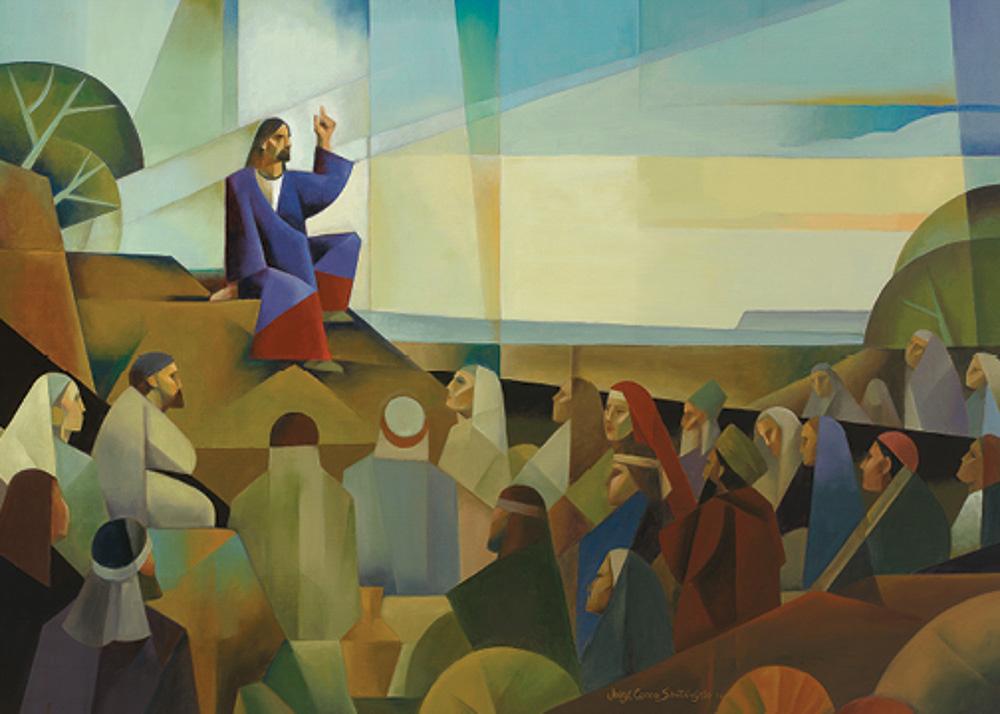
Sermon on the Mount by Argentine artist Jorge Cocco Santángelo

“You have heard that it was said, ‘You shall not commit adultery.’But I tell you that anyone who looks at a woman lustfully has already committed adultery with her in his heart. If your right eye causes you to stumble, gouge it out and throw it away. It is better for you to lose one part of your body than for your whole body to be thrown into hell. And if your right hand causes you to stumble, cut it off and throw it away. It is better for you to lose one part of your body than for your whole body to go into hell.

“It has been said, ‘Anyone who divorces his wife must give her a certificate of divorce. ’But I tell you that anyone who divorces his wife, except for sexual immorality, makes her the victim of adultery, and anyone who marries a divorced woman commits adultery.

“Again, you have heard that it was said to the people long ago, ‘Do not break your oath, but fulfill to the Lord the vows you have made.’ But I tell you, do not swear an oath at all: either by heaven, for it is God’s throne; or by the earth, for it is his footstool; or by Jerusalem, for it is the city of the Great King. And do not swear by your head, for you cannot make even one hair white or black. (New International Version)

Adultery. Divorce. Oaths. Jesus chose these topics from the Ten Commandments (7, 9, and 10) to uphold the ethical law of God.

In Christ’s Sermon on the Mount, Jesus gets to the heart of immorality and unethical behavior. The physical act of adultery arises from mental adultery. Divorce results from hardness of heart. Breaking oaths as a form of lying.

Adultery

Pornography is a 60 billion dollar a year industry, worldwide. It is the church’s problem, as well:

  • 53% of Christian men consume pornography.
  • 51% of pastors say porn is a temptation.
  • 69% of pastors started looking at porn out of curiosity.
  • 37% of pastors say it’s currently a struggle.
  • 35% of men have used pornography in the past month.
  • 4 in 10 of pastors looked at porn today.
  • There are 100,000 websites that offer illegal child pornography.
  • 90% of 8-16 year old’s have viewed porn online (most while doing homework).
  • 20% of men, and 13% of women, admit to viewing pornography at work.
  • 70 percent of all internet porn traffic occurs during the 9-to-5 workday.

Adultery initially occurs when someone feeds on mental sexual activity with another person. As with most of Christ’s solutions, he lays out a radical means of overcoming it.

Jesus is not condemning normal gender attraction, nor sex itself (which is a gift of God). Rather, Jesus condemns the leering upon another with sexual fantasy. All adulterous relationships and inappropriate sexual relations start with the “look.”

“Lust” is to intensely desire and burn for something, to seek mastery over another. The reason people stare, and lust, is not because of the other person’s manner or dress; it’s because they already have an adulterous heart. 

Whenever we are caught in physical or mental adultery, decisive and drastic action is needed. Jesus used hyperbole to drive his point home about the need of dealing with adultery. The approach is not applying a band aid; it is amputation.

The reason many men and women are snared by adultery, and seem unable to stop, is that they deal with it on their own. The radical action needed is accountability; confession must be offered.

Trying to manage lust on our own is like one individual attempting to contain a nuclear meltdown.

Jesus leaves no room to think it is okay to lust in the heart because I am not hurting anybody. Pornography enslaves its users and degrades women.

As powerful and addictive lust is, God’s grace is bigger and more powerful. There’s no need to be burdened with shame and guilt when the cross of Christ has already taken care of it.

There would not be a multi-billion dollar industry if there were not places in our hearts that are black. Now is the time for forgiveness, grace, and healing.

Sermon on the Mount by American artist Bill Bell

Divorce

Today in America more than one-third of all adults have experienced divorce.

Unfortunately, many divorced persons feel their faith community provided rejection rather than support and healing. There is a lot of room for improvement when to help families, and those having experienced divorce.

Please know Jesus condemns the cavalier divorce, and not all divorce. Anybody who doesn’t like their spouse doesn’t have ground for divorce. They entertain the thought of having a better spouse, even though there is no marital unfaithfulness. 

This is yet another form of mental adultery (and idolatry) which believes someone else can better meet my needs. 

Jesus clearly makes provision for divorce to occur in certain circumstances. Yet, he will not bend to liquidating a marriage over unhappiness with what God has joined together.

The intent of Old Testament legislation on divorce is to avoid a casual stance toward marriage (Deuteronomy 24:1-4). Over the centuries, people found creative ways of getting around the law. Although a divorce may be legal, it might not be ethical. Jesus wanted divorce practiced with concern for the woman, so that her rights and needs were considered.

Many took a loose view of divorce and focused solely on “indecency” as grounds for divorce. They did not interpret the term solely as sexual infidelity, as Jesus did, but had a broad understanding of indecency.

For example, if a husband did not like his wife, or, in the words of one rabbi, she continually burns the supper, he may “put her away” (divorce her). Jesus, however, insisted divorce must not happen because of a hard time getting along; or don’t love your spouse anymore; or that your spouse keeps irritating you. 

Being frustrated or unhappy are not biblical grounds for divorce. The answer to most marital problems does not lie in a new spouse, but in the hard work of identifying the idols of our hearts, overthrowing them, and re-connecting. Sin is crouching at the door, but you and I must master it.

Jesus said the ground for divorce is marital unfaithfulness, that is, any sexual activity outside the bounds of the marriage relationship. And, even in this case, divorce need not be an option, if the two people can reconcile.

Christ sought to defend women who are genuine victims. In biblical times, if a wife was given a certificate of divorce, she had four options: 1) Return to her family of origin; 2) Become a beggar; or 3) Become a prostitute to make ends meet; or, 4) Marry again, thus committing adultery if she was divorced because her husband didn’t like her. 

Jesus doesn’t take sides between spouses. Instead, he lifts the original intent of marriage: oneness. Divorce was never meant to be. Separating two people is damaging. However, it obviously occurs. (Matthew 19:1-12)

Divorce exists because of the heart’s hardness in one or both of the marriage partners. Divorce, really, is a legal testimony verifying that a separation has already occurred. It’s a recognition that disunity and non-oneness is already present. Legal divorce affirms that a terrible break already happened, damaging the people involved.

Just as God is one, two marital partners are to be one. Oneness is the primary goal of any marriage relationship. God did not institute marriage for people to live as roommates, but to be a new entity operating as one.

If God found it necessary to divorce his own covenant people, then it is inevitable divorce will occur among people (Jeremiah 3:1-8).  Therefore, let’s be discerning in how we handle each individual situation of marital difficulty.

Sermon on the Mount by Janice Elizabeth Steward

Oaths

“I swear on a stack of Bibles I won’t…” “I will, if I get around to it….” These are a few of the caveats we give when making a promise or oath. Oaths communicate our level or ability of getting it done, or not.

That’s fine. What isn’t fine is making excuses or false promises with no intention of doing what you say you will do. So, Jesus wants all the extraneous language out. Say “yes” or “no” and then follow through. And if you don’t, you’re a liar.

We often lie because we don’t want to do something to begin with. “Yes” and “no” are clear boundary words. Boundaries are needed so there is no oath-breaking.

Boundaries define where I end and someone else begins, leading me to a sense of ownership. Knowing what I am to take and not take responsibility for gives me freedom.

  • Boundaries keep the good in and the bad out. Setting boundaries involves taking responsibility for your choice of “yes” and “no” and living with the consequences.
  • Boundaries protect us from “gaslighting.” Gaslighting is a form of emotional abuse. The abuser manipulates another into doubting their thoughts, feelings, judgments, perceptions, and/or memories.
  • Boundaries hold people accountable for their words and actions. Without boundaries, we can easily feel used and mistreated.

Jesus wants us to clarify our values and live them out; make wise decisions; identify what we will accept and reject; and follow through on what we say we will do.

Conclusion

Adultery, divorce, and oaths are related. Boundaries – making and keeping promises – deals with outside forces trying to compromise our values. Accountability in naming our struggles mitigates covetousness.

Dissolved marriages and broken promises still happen. Yet, Jesus is there offering grace, not judgment. We may become emotionally damaged, however, there is healing available through the mercy of Christ. Amen.