Acceptance (Acts 7:17-40)

“As the time drew near for God to fulfill his promise to Abraham, the number of our people in Egypt had greatly increased. Then ‘a new king, to whom Joseph meant nothing, came to power in Egypt.’He dealt treacherously with our people and oppressed our ancestors by forcing them to throw out their newborn babies so that they would die.

“At that time Moses was born, and he was no ordinary child. For three months he was cared for by his family. When he was placed outside, Pharaoh’s daughter took him and brought him up as her own son. Moses was educated in all the wisdom of the Egyptians and was powerful in speech and action.

“When Moses was forty years old, he decided to visit his own people, the Israelites. He saw one of them being mistreated by an Egyptian, so he went to his defense and avenged him by killing the Egyptian. Moses thought that his own people would realize that God was using him to rescue them, but they did not. The next day Moses came upon two Israelites who were fighting. He tried to reconcile them by saying, ‘Men, you are brothers; why do you want to hurt each other?’

“But the man who was mistreating the other pushed Moses aside and said, ‘Who made you ruler and judge over us? Are you thinking of killing me as you killed the Egyptian yesterday?’ When Moses heard this, he fled to Midian, where he settled as a foreigner and had two sons.

Moses and the Burning Bush, by Marc Chagall

“After forty years had passed, an angel appeared to Moses in the flames of a burning bush in the desert near Mount Sinai. When he saw this, he was amazed at the sight. As he went over to get a closer look, he heard the Lord say: ‘I am the God of your fathers, the God of Abraham, Isaac and Jacob.’ Moses trembled with fear and did not dare to look.

“Then the Lord said to him, ‘Take off your sandals, for the place where you are standing is holy ground. I have indeed seen the oppression of my people in Egypt. I have heard their groaning and have come down to set them free. Now come, I will send you back to Egypt.’

“This is the same Moses they had rejected with the words, ‘Who made you ruler and judge?’ He was sent to be their ruler and deliverer by God himself, through the angel who appeared to him in the bush. He led them out of Egypt and performed wonders and signs in Egypt, at the Red Sea and for forty years in the wilderness.

“This is the Moses who told the Israelites, ‘God will raise up for you a prophet like me from your own people.’ He was in the assembly in the wilderness, with the angel who spoke to him on Mount Sinai, and with our ancestors; and he received living words to pass on to us.

“But our ancestors refused to obey him. Instead, they rejected him and in their hearts turned back to Egypt. They told Aaron, ‘Make us gods who will go before us. As for this fellow Moses who led us out of Egypt—we don’t know what has happened to him!’ (New International Version)
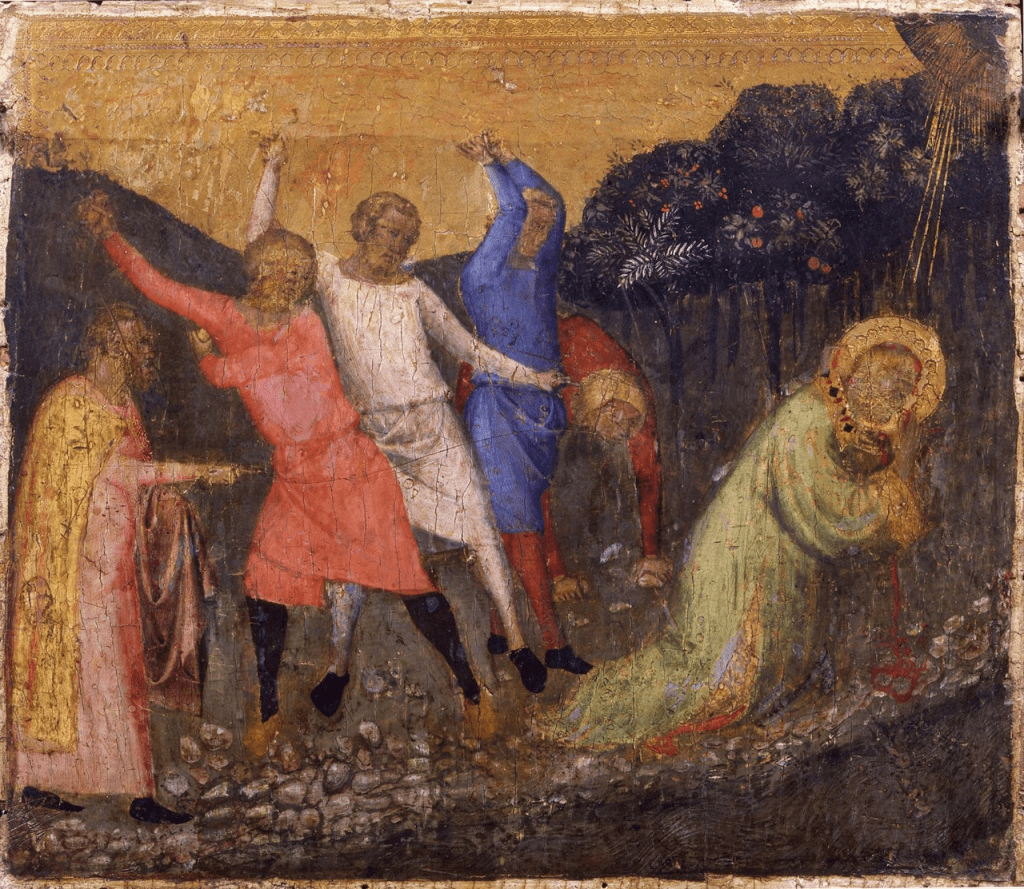
Martyrdom of St. Stephen, by Bernardo Daddi, 1345

We humans are a confusing paradox of sinner and saint. We are majestic people, created in the image and likeness of a good God.

And we are also profoundly fallen, touched by the power of sin in every area of our lives. Our hearts exist with both light and darkness, having the capacity for both incredible altruism as well as inexplicable evil.

So then, it will do no good to retreat into binary definitions of people as being either good or bad. No, we shine and shadow at the same time. The thing that really gets us into a terrible mess is when we ignore or deny our shadow selves. We then demonize the other while claiming purity for ourselves.

This is precisely what occurred with Stephen and a group of his fellow Jews who refused to acknowledge their shadow side. And it resulted in Stephen’s stoning and death. Whereas Stephen lifted and brought to light the unseemly aspects of their collective heritage, the people wanted nothing to do with it.

In our present day, the response might be something like, “Quit being so negative. We focus on the positive. Expel this recalcitrant troublemaker once and for all!”

Oy. Acceptance cuts two ways. We must accept both our blessings and our curses. And the acceptance of what is will not occur apart from a solid self-acceptance of who we are and how we are feeling in any given situation. On the practical level, it works something like the following story…

Several years ago, I went on a leadership retreat in the Canadian wilderness. We were so far out in the sticks that we needed special first aid training before leaving – because if someone got severely injured it would be hours before any medical attention could be received. There was no cell phone service, no towns, no anything except mile after square mile of wilderness. 

One day, it was very windy and several of us were on a lake canoeing to a destination. It was late May, which means the water was still ice cold in Canada. One of the canoes capsized and we had to act quickly and deliberately – which was no small feat in a stiff wind. More than fifteen minutes would result in hypothermia for the two people in the water.

I did not like being in that situation. In fact, I didn’t much like the Canadian wilderness. Too many black flies and giant mosquitoes for me. My shadow side was coming out. But here I was, and I had to accept the reality I was in. One of the lessons I learned in that moment was that acceptance can sit alongside other reactions and emotions.

For example, a person can be outraged by an injustice, as Stephen was, and accept that it is a reality. Acceptance does not mean complacency or giving up. We can accept something while at the same time trying to make it better.

I also needed to accept what was happening inside of me. I was cold and worried. Trying to push those feelings away would have only added to the stress of the situation. If I failed to accept what was true about myself, I would be less able to deal with the situation, and so, would compromise my ability to help two people at risk.

I needed to accept the whole circumstance, including myself. Accepting what is inside gave me more influence over the situation, not less. Self-acceptance became the key to acceptance of unwanted conditions, and more importantly, acceptance of one another as human beings.

In that moment of rescuing two people (which ultimately proved successful) I became aware of a part of myself – the part that gets afraid and irritated – and chose not to stuff it or deny its existence. I became the guy who talked to the panicked people in the water and kept them as calm as possible so that the others could get them out. I was able to do my part to help fearful people because I acknowledged and accepted my own fear.

Unlike my situation, however, Stephen’s experience ended in martyrdom. Just because we respond rightly is no guarantee that everything will work out for our benefit. Rather, we say and do the things we must say and do, while leaving the results to a sovereign Lord.

It is our responsibility to work on ourselves, not others. And acceptance is the path to get there, all of it, not just part of it.

Jesus, let your mighty calmness lift me above my fears and frustrations. By your deep patience, give me tranquility and stillness of soul in you. Make me in this, and in all things, more and more like you. Amen.

Put To Death (Acts 7:55-60)

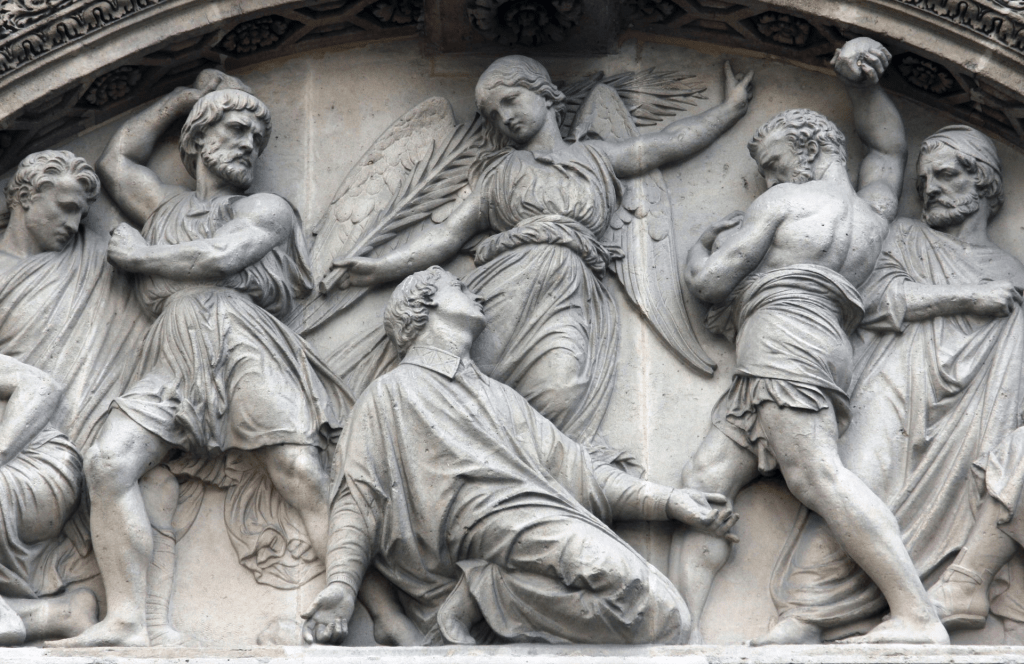
The Martyrdom of Stephen, by sculptor Gabriel-Jules Thomas (1824-1905)

But Stephen, full of the Holy Spirit, looked up to heaven and saw the glory of God, and Jesus standing at the right hand of God. “Look,” he said, “I see heaven open and the Son of Man standing at the right hand of God.”

At this they covered their ears and, yelling at the top of their voices, they all rushed at him, dragged him out of the city and began to stone him. Meanwhile, the witnesses laid their coats at the feet of a young man named Saul.

While they were stoning him, Stephen prayed, “Lord Jesus, receive my spirit.” Then he fell on his knees and cried out, “Lord, do not hold this sin against them.” When he had said this, he fell asleep. (New International Version)

Although I am a trained in biblical exegesis and hermeneutics (interpreting Scripture) I believe that most insights come from making simple observations about the text. So, I want to point out: Stephen was not martyred by the Romans, a religiously pagan group, nor Gentile people; he was martyred by those of his own ethnicity, by “God’s people.”

The religious authorities were more than just unhappy with Stephen. The Sanhedrin (the Jewish ruling council) were incensed with him, so mad that they were grinding their teeth at him. The council sincerely believed Stephen was a blasphemer of God, that what he was saying was so subversive and religiously radical, they could stone him to death with a clear conscience, as if this act were upholding God’s honor and God’s Law.

The result was not only the death of a humble man; it also sparked an intense persecution against the church which caused a new Christian diaspora (Acts 8:1-3). Many believers in Jesus found themselves as Christian refugees trying to eke out a living and worshiping Christ in foreign places.

I wish I could say the greatest opposition I’ve ever experienced as a Christian came from non-Christians who simply misunderstood and misinterpreted me. However, my most hurtful wounds have come from the hands of church folk, believing they were acting on God’s behalf by exacting an emotional martyrdom upon me with the stones of gossip, slander, backbiting, blame-shifting, and outright lying (and a few threats of violence).

Whenever I encounter persons who no longer attend church and have no intention of ever returning to any local congregation, I get it. I understand. Yet, although the church is sometimes like a woman of disrepute, I still love her, and will do whatever I can to edify her and not repay evil with evil.

Stoning a believer, either actually with physical rocks or virtually with verbal stones, is akin to persecuting Jesus himself. That’s because Christ so closely identifies with his people that it is as if he is a head, and his followers are a body – joined together in a vital union.

So, when Christ’s Body is subjected to what I call, “hermeneutical hubris,” in which one group of people insists there is only one way to interpret Scripture, and then uses their authority and structures of power to force compliance on another group, the result is persecution.

And that is precisely why Christians can abuse other Christians.

Rather than discerning that all Christians belong to God, one narrow-minded and small-hearted group excludes all other groups who disagree with them as blaspheming the name of Christ.

For example, insisting that a literal interpretation in the only means of understanding the Bible’s authority is to ignore and abuse the actual and real authority which exists with the Bible. I am in no way encouraging an “anything goes” type of approach to Holy Scripture that lets it say whatever you want it to say. 

What I am saying is that the biblical writers themselves employed different methods of interpretation, as well as the early church fathers (which is one reason I hold to the interpretive guides of the ancient Christian creeds, i.e. The Apostles’ Creed and Nicene Creed).

Far too often, churches stick to a particular interpretation because they believe they are keeping biblical fidelity. This is many times born of a fear that Christendom will be lost, and society will sink into an abyss of egregious sin. The irony is that many churches are sinking into forms of abusive and ungracious behavior by fighting battles that Scripture does not call them to fight.

The binary thinking of “I’m right and you’re wrong” is not an approach you’ll find in God’s Holy Word.

Even if the Sanhedrin in Stephen’s day intended on upholding the holiness of their God and the rightness of their cause, the impact it had on the church was martyrdom, death, and diaspora.

Unfortunately, throughout Christian history, the tables have too often turned with Christians persecuting Jews. I myself would like to avoid being the persecutor. If I kill anything, may it be putting to death my own sin – because that is what the Bible calls me to do.

Dear brothers and sisters, you have no obligation to do what your sinful nature urges you to do. For if you live by its dictates, you will die. But if through the power of the Spirit you put to death the deeds of your sinful nature, you will live.

The Apostle Paul (Romans 8:12-13, NLT)

Since, then, you have been raised with Christ, set your hearts on things above, where Christ is, seated at the right hand of God. Set your minds on things above, not on earthly things. For you died, and your life is now hidden with Christ in God. When Christ, who is your life, appears, then you also will appear with him in glory.

Put to death, therefore, whatever belongs to your earthly nature: sexual immorality, impurity, lust, evil desires and greed, which is idolatry. Because of these, the wrath of God is coming.You used to walk in these ways, in the life you once lived. But now you must also rid yourselves of all such things as these: anger, rage, malice, slander, and filthy language from your lips. 

Do not lie to each other, since you have taken off your old self with its practices and have put on the new self, which is being renewed in knowledge in the image of its Creator. Here there is no Gentile or Jew, circumcised or uncircumcised, barbarian, Scythian, slave or free, but Christ is all, and is in all.

Therefore, as God’s chosen people, holy and dearly loved, clothe yourselves with compassion, kindness, humility, gentleness and patience. Bear with each other and forgive one another if any of you has a grievance against someone. Forgive as the Lord forgave you. And over all these virtues put on love, which binds them all together in perfect unity.

Let the peace of Christ rule in your hearts, since as members of one body you were called to peace. And be thankful. Let the message of Christ dwell among you richly as you teach and admonish one another with all wisdom through psalms, hymns, and songs from the Spirit, singing to God with gratitude in your hearts. And whatever you do, whether in word or deed, do it all in the name of the Lord Jesus, giving thanks to God the Father through him. (Colossians 3:1-17, NIV)

Gracious God, as your Son humbled himself on this earth, so may your church walk continually in such humility that believers everywhere work together in unity for the sake of gospel of grace as a blessing to the world in the power of your Holy Spirit. Amen.

Speak Up In Faith (Acts 7:1-16)

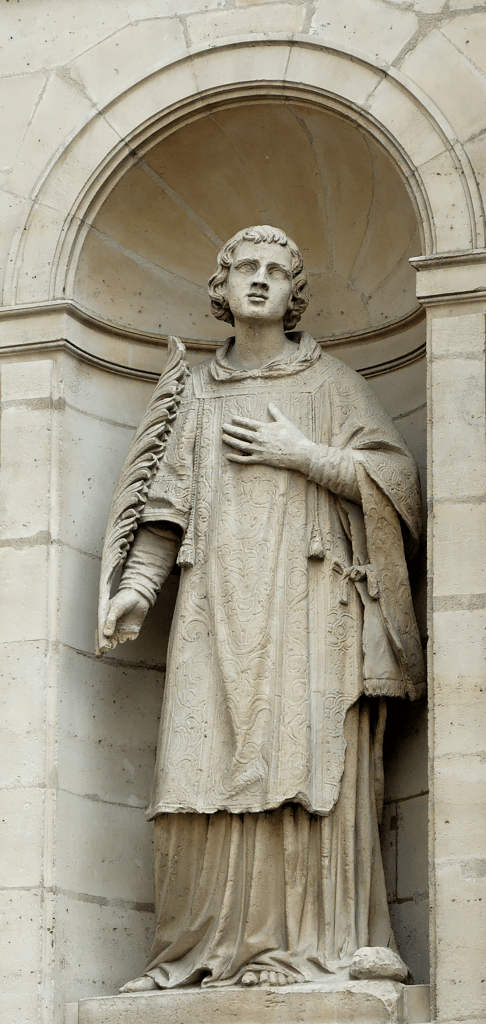
Statue of St. Stephen, by Joseph Marius Ramus (1805–1888) at the Saint-Étienne-du-Mont Church in Paris

Then the Chief Priest said, “What do you have to say for yourself?”

Stephen replied, “Friends, fathers, and brothers, the God of glory appeared to our father Abraham when he was still in Mesopotamia, before the move to Haran, and told him, ‘Leave your country and family and go to the land I’ll show you.’

“So he left the country of the Chaldees and moved to Haran. After the death of his father, he immigrated to this country where you now live, but God gave him nothing, not so much as a foothold. He did promise to give the country to him and his son later on, even though Abraham had no son at the time. God let him know that his offspring would move to an alien country where they would be enslaved and brutalized for four hundred years. ‘But,’ God said, ‘I will step in and take care of those slaveholders and bring my people out so they can worship me in this place.’

“Then he made a covenant with him and signed it in Abraham’s flesh by circumcision. When Abraham had his son Isaac, within eight days he reproduced the sign of circumcision in him. Isaac became father of Jacob, and Jacob father of twelve ‘fathers,’ each faithfully passing on the covenant sign.

“But then those ‘fathers,’ burning up with jealousy, sent Joseph off to Egypt as a slave. God was right there with him, though—he not only rescued him from all his troubles but brought him to the attention of Pharaoh, king of Egypt. He was so impressed with Joseph that he put him in charge of the whole country, including his own personal affairs.

“Later a famine descended on that entire region, stretching from Egypt to Canaan, bringing terrific hardship. Our hungry fathers looked high and low for food, but the cupboard was bare. Jacob heard there was food in Egypt and sent our fathers to scout it out. Having confirmed the report, they went back to Egypt a second time to get food. On that visit, Joseph revealed his true identity to his brothers and introduced the Jacob family to Pharaoh. Then Joseph sent for his father, Jacob, and everyone else in the family, seventy-five in all. That’s how the Jacob family got to Egypt.

“Jacob died, and our fathers after him. They were taken to Shechem and buried in the tomb for which Abraham paid a good price to the sons of Hamor. (The Message)

“What do you have to say for yourself?” conjures up for me women in a church basement with hands on hips, fingers pointing, staring at my 4-year-old self, after I ran through a bunch of old clothes at their annual rummage sale. And it wouldn’t be the last time I’d be asked that question throughout my life.

It’s a question that wants an accounting of something we’ve said or done. It’s not a polite question – more rhetorical than anything else.

Stephen was asked the question – and displayed a non-plussed presence that used the opportunity to turn it around back on his accusers and, indeed, of all humanity and human history.

Throughout Jewish history (and everyone else’s history, too!) there are human movements of good, inspired by divine initiatives; and alongside the good, there also are streams of resistant humanity who seek to thwart the good.

St. Stephen delivered a speech to the religious leaders, highlighting these two developments of human activity in the lives of two major figures in Jewish history.

Abraham

The patriarch of the Jewish people, Abraham, demonstrated faith by listening to the call of God to go to a country he knew nothing about. The Lord’s promises included both blessing and hardship. Although Abraham would be faithful to God’s covenant, his descendants would still find themselves as slaves in Egypt for four-hundred years.

Opposition to faith is always hanging in the shadows, ready to spring when there is an opportunity. Even though Abraham was a devoted follower of God, there were faithless people around him who had a different agenda than the Lord’s. His name continued into the New Testament with the faithless using it.

But invoking the ancient name of Abraham isn’t a protective amulet that makes everything okay. Doing the will of God is what really matters; and exhibiting faith like Abraham is the real issue.

“Produce fruit in keeping with repentance. And do not begin to say to yourselves, ‘We have Abraham as our father.’ For I tell you that out of these stones God can raise up children for Abraham. The ax is already at the root of the trees, and every tree that does not produce good fruit will be cut down and thrown into the fire.” (John the Baptist, Luke 3:8-9, NIV)

A good and right life comes through faith, and not by willpower nor in lifting up oneself by the bootstraps.

If, in fact, Abraham was justified by works, he had something to boast about—but not before God. What does Scripture say? “Abraham believed God, and it was credited to him as righteousness.” (Romans 4:2-3, NIV)

Joseph

Abraham, Isaac, and Jacob are the original pillars of Judaism. Jacob had twelve sons, known as the twelve patriarchs, from whom all Jews come from. The history of the brothers, like many families, is complicated. Joseph, next to the youngest of the brothers, was intensely disliked by several of the others.

Joseph found himself in Egypt because his brothers sold him into slavery. Like Abraham, Joseph had a robust faith, yet this did not inoculate him from trouble. Eventually, however, through a round-about turn of events, Joseph became in charge of the very empirical power that originally received him as a slave.

Through the eyes of faith, Joseph was not bitter, but understood why he needed to go through such terrible adversity. As administrator over all of Egypt, Joseph was able to handle severe years of drought with wisdom and confidence, thus saving many lives from hunger and starvation. And so, he was able to say to his brothers, many years later:

“You intended to harm me, but God intended it for good to accomplish what is now being done, the saving of many lives. “

(Genesis 50:20, NIV)

So, what do you have to say for yourself? Let you and I have the ability to say that we have been people of faith and patience. Let us be those who tenaciously hold to God, and steadfastly do good, speaking up in faith, no matter the situation, and regardless of faithless people who oppose us.

Because, in the end, the words of Jesus are true:

“So do not be afraid of them, for there is nothing concealed that will not be disclosed, or hidden that will not be made known. What I tell you in the dark, speak in the daylight; what is whispered in your ear, proclaim from the roofs. Do not be afraid of those who kill the body but cannot kill the soul. Rather, be afraid of the One who can destroy both soul and body in hell. Are not two sparrows sold for a penny? Yet not one of them will fall to the ground outside your Father’s care. And even the very hairs of your head are all numbered. So don’t be afraid; you are worth more than many sparrows.” (Matthew 10:26-31, NIV)

Just and right God, when we are faithless, you are faithful, because your very character is faithfulness. Help us to be faithful – not fearful – to the end, exhibiting the same commitment as your martyr Stephen, who fully entrusted himself to the Lord Jesus Christ, in whose name we are bold to pray. Amen.

Resist the World, the Flesh, and the Devil (Acts 6:8-15)

St. Stephen Before the Sanhedrin, by Mariotti di Nardo (1394–1424)

Now Stephen, a man full of God’s grace and power, performed great wonders and signs among the people. Opposition arose, however, from members of the Synagogue of the Freedmen (as it was called)—Jews of Cyrene and Alexandria as well as the provinces of Cilicia and Asia—who began to argue with Stephen. But they could not stand up against the wisdom the Spirit gave him as he spoke.

Then they secretly persuaded some men to say, “We have heard Stephen speak blasphemous words against Moses and against God.”

So they stirred up the people and the elders and the teachers of the law. They seized Stephen and brought him before the Sanhedrin. They produced false witnesses, who testified, “This fellow never stops speaking against this holy place and against the law. For we have heard him say that this Jesus of Nazareth will destroy this place and change the customs Moses handed down to us.”

All who were sitting in the Sanhedrin looked intently at Stephen, and they saw that his face was like the face of an angel. (New International Version)

Stephen was a squeaky clean guy – ethical, upright, above board, honest, spiritual – and a profoundly wise and devoted follower of Jesus. Because of his integrity, Stephen was acutely attuned to systemic evil in all its insidious institutional forms; alert and wise to the sinful nature of humanity; and aware of the devil’s evil intentions and machinations in the world.

And because Stephen had a well-developed Christian spirituality, it put him on the radar of the world, the flesh, and the devil – and ended up getting him killed as the first Christian martyr.

The big three enemies of every Christian are: 

  1. a sinful world system (1 John 2:15-16)
  2. the inherent sinful nature (Ephesians 4:22)
  3. the devil, who seeks to exploit the world and the sinful nature to tempt and move us into rebellion against God (1 Peter 5:8-9) 

However, the good news of Christianity is that Jesus Christ has obtained deliverance and freedom for people from each of those enemies. For this deliverance and freedom to be a practical reality in daily experience, each believer in Jesus must know and practice the truth.

In the original Fall of humanity, there was a passive response to the temptation of the serpent, along with an acceptance of doubt concerning God’s Word. There was also an acceptance of insinuations concerning God’s goodness and wisdom, and a deliberate choice to follow the suggestions of Satan and disobey God. 

The seriousness of that Fall into disobedience cannot be overemphasized. The Fall introduced the dimensions of sin, lust, depravity, slavery, ignorance, death and every form of evil into the human race. People became alienated from God and enslaved to the devil. 

The final effects of this sinful bondage will not be completely severed until the final judgment. The hold of the devil is so profound that it took the death and resurrection of Jesus Christ to break that hold and make it possible for humanity to be redeemed.

The descriptive titles given to Satan indicate his activity and what he is up to: 

  • Tempter (Matthew 4:3)
  • Deceiver (Revelation 12:9)
  • Accuser (Revelation 12:10)
  • Adversary (1 Peter 5:8)
  • Murderer and Liar (John 8:44)
  • The god of this world (Ephesians 2:2) 

Holy Scripture indicates that people can be significantly influenced – both personally and corporately – by Satan through: 

  • giving the devil a foothold (Ephesians 4:27)
  • lying (Acts 5:3)
  • physical and spiritual attacks (Job 1-2; 2 Corinthians 12:7)
  • deception (Revelation 12:9-10; 2 Corinthians 11:3)
  • temptation (1 Corinthians 7:5; 1 Thessalonians 3:5)
  • pride (1 Timothy 3:6)
  • corruption (2 Corinthians 11:3)
  • accusations (Revelation 12:10)
  • hypocrisy (Acts 5:1-11) 

People ignore the activity of Satan at their peril.

Just like the religious leaders trying to keep Stephen’s mouth shut, Satan’s purpose and aim is to keep each and every person from spiritual progress and maturity, and from the daily experience of living in faith, hope, and love. 

Unfortunately, the evidence of Satan’s success is all around us, even in the church. Whenever well-meaning Christians experience difficulty in prayer, in reading Scripture, in living for Christ, in overcoming sins, and in maintaining right fellowship with other believers, then this is a reminder of the subtle and powerful effect evil has upon us. 

It is imperative that we know and understand the provision we possess in overcoming the evil one.

Basic knowledge for combating the devil is this:

  • The crucifixion and resurrection the Lord Jesus Christ defeated Satan (Colossians 2:15) 
  • Jesus has destroyed the power of death and delivered those held in bondage (Hebrews 2:14-15) 
  • Christ came to this earth so that he might destroy the works of the devil (1 John 3:8) 
  • Through Christ’s ascension, Jesus is now seated in triumph over Satan (Ephesians 1:19-21; 2:5-6)

In order for this incredible access to become reality, there must be a complete and honest confession which repents and renounces past and present sins. 

If we confess our sins, he is faithful and just and will forgive us our sins and purify us from all unrighteousness.

1 John 1:9, NIV

There must be a complete and honest obedience to God in faith, hope, and love by standing with the truth (Ephesians 6:10-18); and there also needs to be an aggressive resistance of the work of Satan through constant vigilance by being rooted and established in truth. (1 Peter 5:8-9)

If you feel guilty, but don’t know what you’ve done or why you feel this way, then be aggressive about rejecting it. 

If you accuse yourself (“If you were really a Christian you would not be thinking a thought like that…”) then be pugnacious about refusing it. 

If your thoughts, emotions, and desires threaten to get out of hand – then take charge of them and bring them into subjection to Jesus – because you have the authority of Christ’s death, resurrection, and ascension behind you to reject and refuse all error and every satanic whisper.

Know the enemy’s lies and deceptions. Be hawkish about dealing with false guilt and unwarranted shame according to the truth of the gospel. 

Do not attempt to always do this alone; you are not an army of one. Seek the help and assistance of others who will, along with you, pray and practice the truth.

This is the sort of wisdom Stephen teaches us. So, let us learn from him and submit ourselves to the truth we know.

Almighty God, in you are hidden all the treasures of wisdom and knowledge. Open our eyes that we may see the wonders of your Word; and give us grace that we may clearly understand and freely choose the way of your wisdom; through Christ our Lord. Amen.