Acts 7:44-53 – Pickle Barrel Christians

“The Holy Tent where God spoke to our ancestors was with them in the desert. God told Moses how to make this Tent, and he made it like the plan God showed him. Later, Joshua led our ancestors to capture the lands of the other nations. Our people went in, and God forced the other people out. When our people went into this new land, they took with them this same Tent they had received from their ancestors. They kept it until the time of David, who pleased God and asked God to let him build a house for him, the God of Jacob. But Solomon was the one who built the Temple.

“But the Most High does not live in houses that people build with their hands. As the prophet says:

‘Heaven is my throne,
    and the earth is my footstool.
So do you think you can build a house for me? says the Lord.
    Do I need a place to rest?
Remember, my hand made all these things!’”

Stephen continued speaking: “You stubborn people! You have not given your hearts to God, nor will you listen to him! You are always against what the Holy Spirit is trying to tell you, just as your ancestors were. Your ancestors tried to hurt every prophet who ever lived. Those prophets said long ago that the One who is good would come, but your ancestors killed them. And now you have turned against and killed the One who is good. You received the law of Moses, which God gave you through his angels, but you haven’t obeyed it.” (New Century Version)

Every year it’s a guarantee that some folks will complain about the weather. In the summer it’s too hot; in the winter, too cold. Can’t wait for autumn to come, then when it’s here, the murmuring comes out about how the weekend weather won’t cooperate with personal plans.

No matter the season, no matter the weather, somebody will be grumbling about it.

A big reason why I personally hold to the Christian Calendar with its liturgical seasons is that it helps shape me spiritually so that I can avoid being a stubborn complaining fool.

It seems like some folks have been baptized in pickle juice and inhabit a church resembling a pickle barrel. They have something negative to say about everything. And even when they acknowledge they don’t really understand something, they’ll still give a stone-faced retort, “I’m against it.”

They’re, ironically, surprised when they find themselves in a pickle.

The liturgical calendar, when properly observed, keeps us grounded in faith, hope, and love. There are plenty of things in this old fallen world which can take our eyes off our calling as Christians. Pandemics, politics, poverty, and pain can mess with us.

If we aren’t on solid spiritual ground, all the misfortunes of this life can take a significant toll on us. And for all the tangible things we see which creates angst within us, we miss the invisible God because our spiritual eyes are blind from all that vinegar in the pickle barrel.

Like the ancient Israelites for whom Stephen railed against in our New Testament lesson for today, we might become stubborn, hard-headed, and inflexible. We get lost in doing things our own way, and wanting our way, to the neglect of what God wants. 

Whenever that happens, there is damage to God’s people, God’s name, and God’s law. Rather than tongues being used for praising the Lord and encouraging others, God’s prophets who are calling us to holiness are verbally decapitated.

Anytime someone believes they have piously figured out everything, they will soon find themselves fighting against God.

The Lord of All has not called us to figure out every mystery and nail down each uncertainty. Those who claim to have done it are living in a pickle barrel. Perhaps they will eventually discover how large and immense God really is – much bigger than our puny thoughts and misguided practices. 

How then shall we live?

Let go of our illusions of power and privilege.

Submit afresh to the Lord for whom we must bow in all things. 

Open our spiritual eyes so that we can see the God who made the universe.

Take up our holy calling as Christ’s ambassadors, instead of expecting Jesus to be the ambassador for us.

If we can do that, then we are well on our way to seeing the grand and immense God of all.

So be humble under God’s powerful hand. Then he will lift you up when the right time comes.

1 Peter 5:6, ERV

The following practices can help us become more spiritually flexible and open to the Spirit’s work:

  • Stretch your faith muscle. Physical muscles which get little to no use will atrophy – which is why people who are confined to bed or with limitations need physical therapists to help work the muscles. Spiritually, if we are rarely or never in positions which work our faith muscle, then that faith will diminish and eventually atrophy. Faith is not static, but dynamic. It needs to be worked.
  • Breathe deeply. Proper breathing is essential in using our bodies. The same is true spiritually. Fear, worry, and anxiety cause us to have shallow breathing and unable to think straight. When we are amped-up about something, focus on doing some breath prayers, i.e., breathing in saying, “More of you,” and breathing out saying, “Less of me.”
  • Avoid extreme positions. A hyper-extended muscle will tear and cause a lot of damage. An acceptance of limitations and an awareness of our body’s true capacity prevents us from trying to do something our body simply cannot do. Our faith will not support extreme positions which alienate people and put God to the test.
  • Move more. Getting in bodily shape does not have to be dramatic and involve triathlons. Most of us simply need to get out of our chairs and move a bit more and we would be a lot healthier. Faith is mostly lived in the mundane daily decisions of life. Consistently taking small steps of faith each day will go a long way toward our spiritual health and vitality – not to mention helping us see a big God at work.
  • Listen. It is always best to listen to your body— only push it as far as it can handle, even if it is little by little. Many people would be better served if they would just listen to their gut and the spirit God put within them – rather than pushing themselves and others beyond what they can handle. Behind the attempt at doing too much is typically an issue of wanting the kind of control God possesses.

To do the will of God, we must have a growing awareness of a big unlimited God who cannot be contained in a tent or a building; and a small, limited self who is dependent upon God.

This will take relaxing the puckered pickle face and opening to greater flexibility. If you are not in the habit of following the Christian Calendar through the year, now is a good time to start. After all, nobody wants to smell like they just crawled out of a pickle barrel.

Holy God, heaven is your throne and the earth your footstool. You cannot be kept within any one church or any single place.  You are much too big for that!  Forgive me for my small thoughts of you and my weak faith. I humble myself before you so that you can live in and through me for the sake of Jesus. Amen.

Acts 2:22-36 – From Flake to Fearless

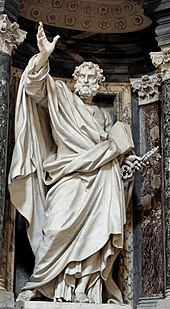
Statue of St. Peter in Rome

“Fellow Israelites, listen to this: Jesus of Nazareth was a man accredited by God to you by miracles, wonders and signs, which God did among you through him, as you yourselves know. This man was handed over to you by God’s deliberate plan and foreknowledge; and you, with the help of wicked men, put him to death by nailing him to the cross.But God raised him from the dead, freeing him from the agony of death, because it was impossible for death to keep its hold on him.David said about him:

“‘I saw the Lord always before me.
    Because he is at my right hand,
    I will not be shaken.
Therefore my heart is glad and my tongue rejoices;
    my body also will rest in hope,
because you will not abandon me to the realm of the dead,
    you will not let your holy one see decay.
You have made known to me the paths of life;
    you will fill me with joy in your presence.’

“Fellow Israelites, I can tell you confidently that the patriarch David died and was buried, and his tomb is here to this day. But he was a prophet and knew that God had promised him on oath that he would place one of his descendants on his throne. Seeing what was to come, he spoke of the resurrection of the Messiah, that he was not abandoned to the realm of the dead, nor did his body see decay. God has raised this Jesus to life, and we are all witnesses of it. Exalted to the right hand of God, he has received from the Father the promised Holy Spirit and has poured out what you now see and hear. For David did not ascend to heaven, and yet he said,

“‘The Lord said to my Lord:
    “Sit at my right hand
until I make your enemies
    a footstool for your feet.”’

“Therefore, let all Israel be assured of this: God has made this Jesus, whom you crucified, both Lord and Messiah.” (New International Version)

Throughout my ministerial life, there have been individuals who have come to me a bit discouraged because they have not experienced a changed life. After trying, time and again, to be different, they say to me, “Nobody ever really changes. We’re basically the same people throughout our whole lives.”

I couldn’t disagree more.

In the New Testament Gospels, the Apostle Peter was a flake. He sometimes was discerning and got it, and sometimes didn’t. 

Peter could understand Jesus was Messiah, but then turn around and refuse that Christ had to die on a cross. He would get bold and walk on water, but then also end up afraid, needing help from drowning. Peter stood tall for Jesus, ready to take on the world, and then turn around and deny the Lord three successive times.

However, when we come to biblical book of Acts, Peter is a completely changed man. Peter gets it. He is brave and fearless. He boldly confesses Christ. And all the while he does not falter, flinch, or back down. 

So, what in heaven’s name, happened and made the difference for Peter between the Gospels and Acts? 

The Holy Spirit, that’s what, or rather, who.

God’s Spirit comes upon Peter, and he is never the same again. He is a changed man. Peter goes from flake, to fearless.

Everything falls into place for Peter, who preaches with such boldness and effectiveness that thousands turn from their previous ways of thinking and living and turn to Jesus as the hope of the world. They changed, too.

Peter was all-in with a simple and straightforward message of good news, that God raised Jesus from death. He went on to insist, without wavering and with firm conviction, that this was so, because it was not possible for the Son of God to be held by anything, even death. The proof being the resurrection.

If it was impossible for death to keep a grip on Jesus, then there is absolutely nothing that can deter Jesus or hold him back from accomplishing what he wants to accomplish. 

Flaky believers are not going to frustrate Jesus or upset his plans; he’ll just send the Holy Spirit. 

We may too often imprison ourselves in self-made spiritual jail cells. Like the pre-Pentecostal Peter, we flake and flip-flop in the Christian life. Once-in-a-while we are spot-on, but cannot really explain why, like a golfer who hits an amazing shot but can’t reproduce it no matter how hard he tries. 

The truth is that Jesus has conquered sin, death, and hell. By faith, we have forgiveness of sins in him, and have the way opened to a new life in the Spirit. It isn’t a secret; it’s a new reality.

At the front end of the Christian season of Ordinary Time, we are reminded that God’s Holy Spirit is with us. We remember what good old Peter said so long ago, which is still relevant for us today:

We have everything we need to live a life that pleases God. It was all given to us by God’s own power, when we learned he had invited us to share in his wonderful goodness. God made great and marvelous promises, so his nature would become part of us. Then we could escape our evil desires and the corrupt influences of this world. (2 Peter 1:3-4, CEV)

The message Peter proclaimed was powerful, not only because it was inherently potent, but also that the gospel dwelled mightily in Peter and inhabited a central place within him.

We, too, have that same opportunity and privilege.

Loving Lord Jesus, I confess my faults, shortcomings, sins, and rebellious acts, and ask you to forgive me. I embrace you as my Savior and Lord. Thank you for your atoning death on the cross in obedience to your Father’s will to put away my sins. Be in charge of every part of my life. Indwell and empower me with your Holy Spirit, so that I may live as your faithful follower, now and forever. Amen.

Acts 2:1-21 – The Day of Pentecost

When Pentecost Day arrived, they were all together in one place. Suddenly a sound from heaven like the howling of a fierce wind filled the entire house where they were sitting. They saw what seemed to be individual flames of fire alighting on each one of them. They were all filled with the Holy Spirit and began to speak in other languages as the Spirit enabled them to speak.

There were pious Jews from every nation under heaven living in Jerusalem. When they heard this sound, a crowd gathered. They were mystified because everyone heard them speaking in their native languages. They were surprised and amazed, saying, “Look, aren’t all the people who are speaking Galileans, every one of them? How then can each of us hear them speaking in our native language? Parthians, Medes, and Elamites; as well as residents of Mesopotamia, Judea, and Cappadocia, Pontus and Asia, Phrygia and Pamphylia, Egypt and the regions of Libya bordering Cyrene; and visitors from Rome (both Jews and converts to Judaism), Cretans and Arabs—we hear them declaring the mighty works of God in our own languages!” They were all surprised and bewildered. Some asked each other, “What does this mean?” Others jeered at them, saying, “They’re full of new wine!”

Peter stood with the other eleven apostles. He raised his voice and declared, “Judeans and everyone living in Jerusalem! Know this! Listen carefully to my words! These people aren’t drunk, as you suspect; after all, it’s only nine o’clock in the morning! Rather, this is what was spoken through the prophet Joel:

In the last days, God says,
I will pour out my Spirit on all people.
    Your sons and daughters will prophesy.
    Your young will see visions.
    Your elders will dream dreams.
    Even upon my servants, men and women,
        I will pour out my Spirit in those days,
        and they will prophesy.
I will cause wonders to occur in the heavens above
    and signs on the earth below,
        blood and fire and a cloud of smoke.
The sun will be changed into darkness,
    and the moon will be changed into blood,
        before the great and spectacular day of the Lord comes.
And everyone who calls on the name of the Lord will be saved. (Common English Bible)

The Holy Spirit is the distinguishing mark of the believer in Jesus Christ.

Therefore, since the Spirit is given, the main responsibility of Christians is to receive. 

Christianity is distinctive in this sense – it is primarily a religion of receiving. The Christian life is lived by the power of the Holy Spirit, and not in our own strength. The function of faith is to receive what grace offers. 

We are saved and sanctified by grace alone through faith. God lives in and through us by means of the Spirit. The miraculous and the supernatural cannot, obviously, be done by any human person.  It can, however, be accomplished through the power of the Holy Spirit.

People tend to put a lot of pressure on themselves to be a certain way and to do certain things. The result? Tiredness. Discouragement. Imbalance. Lots of giving. Little receiving.

Christianity is not chiefly about giving but receiving. The Christian life is about putting oneself in a position to receive through prayer and humility. In Christianity, the opposite of receiving is not giving – it’s pride. 

Maybe this kind of talk makes you uncomfortable. I’m not talking about being passive or lazy. I’m highlighting the need of receiving grace from God by means of the Holy Spirit. Then, the Spirit to work in and through us. 

Jesus said we would do greater works than even he himself with the advent of the Spirit! (John 14:12-14)

The question then becomes: Will we let God be God? Will we allow the Spirit to do work in us?

The Spirit is elsewhere described in Holy Scripture as a gentle presence, an encourager, counselor, and comforter. Yet, not here at Pentecost – the Spirit is portrayed like a violent wind and an unusual fire.

The Holy Spirit on the Day of Pentecost was not some gentleman caller entering politely when invited. Instead, the Spirit appears more like a drunken sailor who bursts into the room and causes a big ruckus. There’s nothing subtle about the Spirit at Pentecost. The Spirit is electric, bombastic, and volcanic, causing a huge scene and upheaving the status quo.

Because of Pentecost, Christians are marked and defined by God’s Spirit living within them and being full of the Spirit. God wants to pour out the Spirit on all kinds of people to overflowing so that what comes out of them is “prophecy.” 

The prophet Joel and the Apostle Peter do not intend the word “prophecy” to mean predicting the future. Rather, they are referring to inspired speech coming from a heart overflowing with the Spirit. 

Just as an inebriated person says and does things they would not typically say or do because they are filled with alcohol, so the person filled with God’s Spirit says things and does things they would not typically say or do because their inspiration and courage come as a result of God within them.

Thus, we must cast off the unholy spirits of inebriation and receive the Holy Spirit of God.

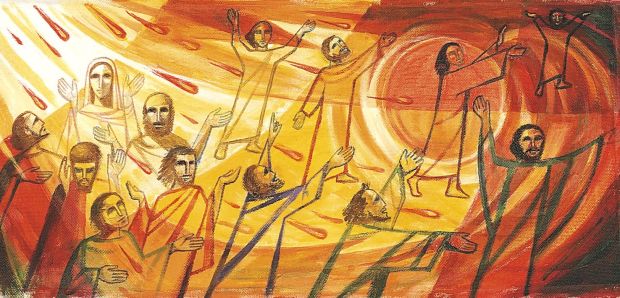
Descent of the Holy Spirit at Pentecost mosaic by Anna Wyner

God sobered-up the little band of Christ followers from learners to practitioners, sending them into the world with a mission.

Being on a mission from God is not really about ability; it’s about being filled and sent. 

First time parents may read and learn all they can about parenting before their child is born. Yet, when that little bundle comes into the world, and the hospital puts this kid in your arms and sends you out, you feel inadequate for the task. Parenting becomes a kind of supernatural affair where you pray and learn on the fly, finding out that you need something beyond yourself to get anywhere in raising this screaming, pooping, sleeping person who depends completely on you for everything. 

God sends us into the world to make disciples. And we may feel very inadequate for the task. However, this has more to do with receiving the Spirit. The Spirit comes looking to turn our lives upside-down with new life in Jesus Christ. 

Pentecost means that the Spirit came to shake things up and accomplish among God’s people what they could never do on their own.

Everyone who calls on the name of the Lord will be saved. 

The Church in the New Testament was not a country club for people to simply enjoy the perks of membership.  The community of the redeemed, the Church, is actually more like a place where the people seem drunk because they are all talking with inspired speech from the Holy Spirit. 

Maybe we don’t need to be saved in the sense that we have already called on the name of the Lord concerning forgiveness in Christ. Yet, maybe we need to call on the name of the Lord to be delivered from our misguided attempts to see the Christian life as a pleasant affair.

Perhaps we need deliverance from disordered priorities and misguided loves. We may need to be saved from ourselves so that we are open to the Holy Spirit with palms up receiving from God whatever it is the Spirit wants to do in and through us, rather than telling God how we think things ought to go. 

Prayer, then, is more about receiving the Spirit and God’s purposes for us rather than giving God an earful and expecting the Lord to bless our plans.

Pentecost is the launching pad of the church’s mission – it was explosive because the Spirit is a kind of wild man who fills people up to overflowing so that what comes out of them is inspired speech and missional actions.

If a language barrier cannot stop the Spirit from operating, then how much more can God transform us and use us in the lives of those around us?

Joel’s prophecy, quoted by Peter, is only partially fulfilled. Events have been set in motion by Pentecost for the complete fulfillment of God’s justice. So, there’s some urgency for people to fill their vacuous souls with the grace freely offered to them in Christ.

The outpouring of the Spirit is a sign: The end is near. And the generous giving of the Spirit is inclusive – there is room for all kinds of people. Through the Spirit, God saves all who call on the name of the Lord.

Today is not just another day on the calendar. It is the Day of Pentecost! 

Just as marriages occasionally need a spark and a fire and a fresh wind, so we need the Holy Spirit to breathe on us, comfort us, and inspire us.

May we be filled with the Spirit as we anticipate what our God will do now, and in the years to come.

Spirit of the living God, through the reading and proclamation of the Word, may you refresh our spirits, reshape our desires, recreate our hearts, and reform our ways so that we will shine with your enduring glory, through Jesus Christ, our risen and ascended Lord. Amen. 

Acts 1:1-11 – Ascension of the Lord

In my first book I told you, Theophilus, about everything Jesus began to do and teach until the day he was taken up to heaven after giving his chosen apostles further instructions through the Holy Spirit. During the forty days after he suffered and died, he appeared to the apostles from time to time, and he proved to them in many ways that he was actually alive. And he talked to them about the Kingdom of God.

Once when he was eating with them, he commanded them, “Do not leave Jerusalem until the Father sends you the gift he promised, as I told you before. John baptized with water, but in just a few days you will be baptized with the Holy Spirit.”

So, when the apostles were with Jesus, they kept asking him, “Lord, has the time come for you to free Israel and restore our kingdom?”

He replied, “The Father alone has the authority to set those dates and times, and they are not for you to know. But you will receive power when the Holy Spirit comes upon you. And you will be my witnesses, telling people about me everywhere—in Jerusalem, throughout Judea, in Samaria, and to the ends of the earth.”

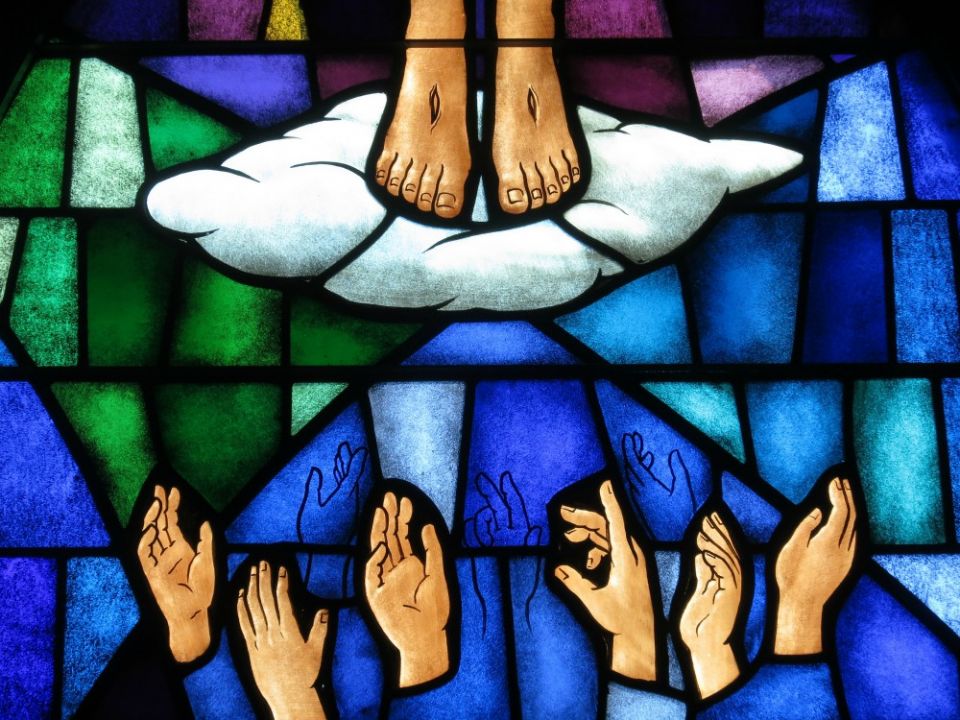
After saying this, he was taken up into a cloud while they were watching, and they could no longer see him. As they strained to see him rising into heaven, two white-robed men suddenly stood among them. “Men of Galilee,” they said, “why are you standing here staring into heaven? Jesus has been taken from you into heaven, but someday he will return from heaven in the same way you saw him go!” (New Living Translation)

“At his Ascension, our Lord entered Heaven, and he keeps the door open for humanity to enter.”

Oswald Chambers

Jesus was taken up to heaven in what Christians celebrate as the “Ascension of the Lord.” This is a hugely important event for followers of Jesus.

The Ascension means that Christ is now presently sitting at God’s right hand, offering continual prayers on our behalf to the Father. We have an advocate, a champion, who has gone before us and secured deliverance from sin, death, and hell.

On top of it all, Christ’s ascension means that Jesus is the universal ruler; he commands a kingdom that will never end. Yes, the Ascension of the Lord is a big deal.

So, why does a day set aside on the Christian Calendar celebrating the Lord’s mighty and redemptive ascension over all creation garner such scant attention from many churches?

Maybe the church has A.D.D. (Ascension Deficit Disorder).

Our clue to the inability to focus on such a grand redemptive event is the disciples’ response when Jesus ascended.

The picture St. Luke paints for us in the account of our Lord’s ascension, is a group of guys looking up into the sky slack-jawed and shoulders hunched.

It took a couple of angels to come along and ask them what in the world they were doing just standing there. Now is not the time to stand and gawk at the clouds, the angels insisted. Jesus will come back when he comes back. You aren’t going to know when. So, now is the time to get busy with what Jesus just told you to do two minutes ago: Tell everyone about me.

Christ’s ascension to heaven is a deeply theological event. It’s freighted with major implications for our prayer lives. And it means Christ is the King to whom we must obey.

Jesus is coming again. In the meantime, there’s to be no cloud-gawking. Instead, there is to be a well-developed and well-cultivated connection with Jesus which proclaims the good news that Christ died, rose from death, and ascended to heaven for mine and your forgiveness of sins and a new clean slate on life.

Trying to peer into the future about how the end of history will shake-out is, frankly, not the job we are called to do. Believers in Jesus aren’t supposed to stand and gawk at the clouds waiting for the Lord’s return, as if we are in some earthly holding tank until heaven. 

Rather, we are to bear witness about the person and work of Jesus. The Ascension of the Lord means we are God’s people blessed with deliverance from the realm of sin, and the hope of Christ’s coming again. The Church everywhere recognizes together the rule and reign of the Lord Jesus.

The world, as we know it, shall eventually come to an end. Until that time, Christians since the time of the ascension have been proclaiming Christ crucified, died, risen, ascended, and coming again.

This is a day of joy and celebration for us. Jesus is our ascended and glorified king! The fate of the earth is with the benevolent and mighty Ruler of all. Jesus is Lord, and no other human leader is. Thank you, Jesus.

The great Reformed Confession, the Heidelberg Catechism, question and answer 49, states:

Q: How does Christ’s ascension to heaven benefit us?

A: First, he is our advocate

            in heaven

            in the presence of his Father.

Second, we have our own flesh in heaven

            as a sure pledge that Christ our head

            will also take us, his members,

            up to himself.

Third, he sends his Spirit to us on earth

            as a corresponding pledge.

            By the Spirit’s power

                        we seek not earthly things

                        but the things above, where Christ is,

                                    sitting at God’s right hand.

Amen.