
Handling Opposition (John 8:48-59)

Christ and Pharisee, by Russian artist Ivan Filichev, 1993

The Jews answered him, “Aren’t we right in saying that you are a Samaritan and demon-possessed?”

“I am not possessed by a demon,” said Jesus, “but I honor my Father and you dishonor me. I am not seeking glory for myself; but there is one who seeks it, and he is the judge. Very truly I tell you, whoever obeys my word will never see death.”

At this they exclaimed, “Now we know that you are demon-possessed! Abraham died and so did the prophets, yet you say that whoever obeys your word will never taste death. Are you greater than our father Abraham? He died, and so did the prophets. Who do you think you are?”

Jesus replied, “If I glorify myself, my glory means nothing. My Father, whom you claim as your God, is the one who glorifies me. Though you do not know him, I know him. If I said I did not, I would be a liar like you, but I do know him and obey his word. Your father Abraham rejoiced at the thought of seeing my day; he saw it and was glad.”

“You are not yet fifty years old,” they said to him, “and you have seen Abraham!”

“Very truly I tell you,” Jesus answered, “before Abraham was born, I am!” At this, they picked up stones to stone him, but Jesus hid himself, slipping away from the temple grounds. (New International Version)

I am a recovering perfectionist. There was a time in my life when I believed that I could attain perfection in all things. And, what’s more, I thought that if I could be perfect in everything I said and did, I would never face any opposition.

It took me awhile to realize that Jesus, the perfect Son of God, handled life on this earth as well as anybody ever did or could, and yet he still faced continual opposition. Then, at the end of his life, Jesus was ridiculed, tortured, and killed by people who should have known better.

The religious leaders, at the time of Christ, leveled on Jesus their worst accusations by calling him a Samaritan and demon possessed. But Jesus handled it. He wasn’t surprised by it. Nothing they said threw him off.
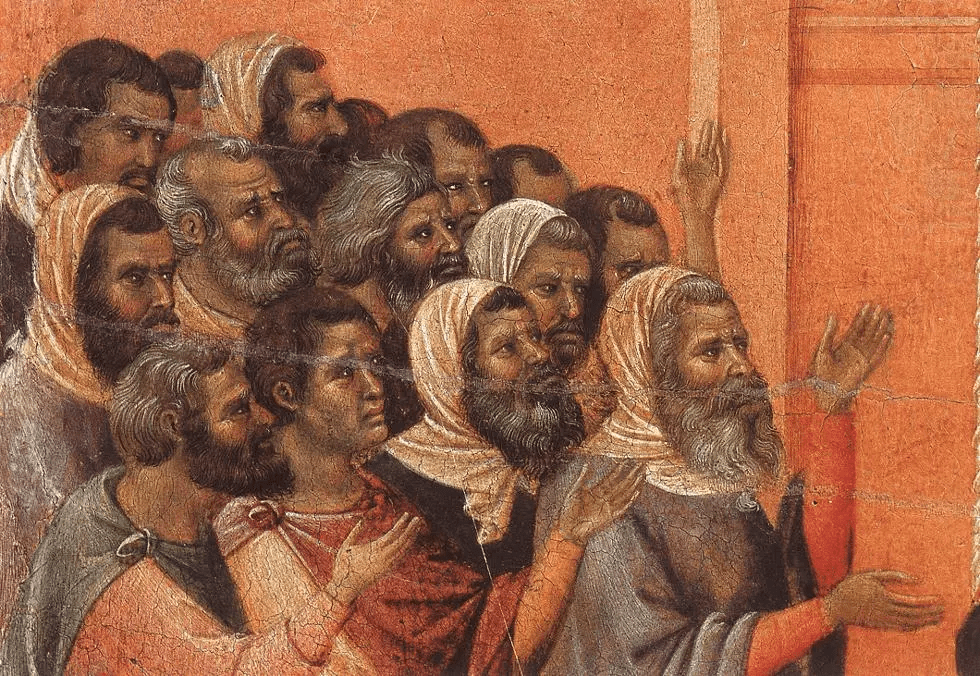
Christ Accused by the Pharisees, by Duccio di Buoninsegna, 1308

There is a way to deal with opposition. There’s a path to dealing effectively with the meanness of others. And there’s a way to face the trouble, as well as your Anfechtung (spiritual oppression and depression) about what’s happening.

The road ahead, however, may be counter-intuitive to how you think. And the way forward might be so far off your radar that you may dismiss what I’m about to say to you. Maybe you’ll even call me a Samaritan.

But before I get to that, I’ll say this: Opposition, even oppression, is endemic to the human condition. Everyone, at times, suffers this way; none of us are immune to affliction, nor can we insulate ourselves from pain. If you are not currently suffering in some way, it means you are either coming off a time of hardship, or are about to enter a new period of distress.

Holiness and godliness don’t keep suffering at bay. Just ask Jesus. In fact, the Lord Jesus himself promised that following him involves a sort of oppression that those who are not Christians will never face. (John 16:33) 

Christ’s disciple, Peter, came to understand the reality that since Jesus experienced opposition, so will his followers. (1 Peter 4:12).

The Lord’s brother, James, understood that everyone faces difficulty; and he wisely discerned that opposition is a teacher, from which we learn maturity, perseverance, and patience. (James 1:2). 

Jesus’ greatest follower, Paul, continually dealt with opposition from others, more than any follower of Jesus in history. And he insisted that anyone who belongs to Christ will have trouble;  and that suffering enables us to persevere and be in solidarity with Jesus. (2 Timothy 3:12; Romans 5:3-5; Philippians 1:29)

Yes, in this world you will have trouble. But take heart. Jesus has overcome the world. (John 16:33)

Now, back to the topic of handling opposition from others. Here’s the truth:

Dealing with opposition, oppression, and suffering comes through Christ, and not from us. And the practice of overcoming trouble doesn’t come from fighting against it, but by sitting with it and learning from it.

Stated differently: Jesus has overcome the world through his death, resurrection, and ascension. On the cross, he absorbed all the sin and suffering of everyone. This means that your suffering, no matter it’s source, will be subdued whenever you invite it to take a seat with you and have a conversation with it.

Said yet another way: Quit fighting against your suffering. Stop kicking and screaming long enough to look your feelings square in the face and learn from them.

The opposition is trying to tell us something. But if we keep taking the stance of a pugilist, trying to punch it away, it will just keep moving forward and never topple. 

Oppression isn’t something you beat; it’s something you learn from. Jesus already did the beating and the winning.

And we’ll only learn from suffering and overcome it when we embrace it. Therefore, the counter-intuitive, counter-cultural practice is: Submit to suffering. When we do that, like Jesus, we simply slip away from the oppressors. They no longer have any power over us.

Don’t hear what I’m not saying. I’m not an advocate for sanitizing your troubles or trauma with a positive spin. Evil is evil, bad is bad, and no amount of saying otherwise will change the leopard’s spots. 

And yet, only through submitting to the process of what opposition teaches us, can we hope to break its power over us.

Let’s liken our opposition to encountering a bear in the wilderness. The National Park Service gives us this advice if facing a bear while out hiking: “Once a bear has noticed you and is paying attention to you, these strategies can help prevent the situation from escalating:”

  • Identify yourself by talking calmly so the bear knows you are a human and not a prey animal. Remain still; stand your ground but slowly wave your arms. Help the bear recognize you as a human. It may come closer or stand on its hind legs to get a better look or smell. A standing bear is usually curious, not threatening.
  • Stay calm and remember that most bears do not want to attack you; they usually just want to be left alone. Bears may bluff their way out of an encounter by charging and then turning away at the last second. Bears may also react defensively by woofing, yawning, salivating, growling, snapping their jaws, and laying their ears back. Continue to talk to the bear in low tones; this will help you stay calmer, and it won’t be threatening to the bear. A scream or sudden movement may trigger an attack. Never imitate bear sounds or make a high-pitched squeal.
  • Hike and travel in groups. Groups of people are usually noisier and smellier than a single person. Therefore, bears often become aware of groups of people at greater distances, and because of their cumulative size, groups are also intimidating to bears.
  • If the bear is stationary, move away slowly and sideways; this allows you to keep an eye on the bear and avoid tripping. Moving sideways is also non-threatening to bears. Do not run, but if the bear follows, stop and hold your ground. Bears can run as fast as a racehorse both uphill and down. Like dogs, they will chase fleeing animals. Do not climb a tree. Both grizzlies and black bears can climb trees.

Fighting against someone’s oppression is about as useful as taking on a bear. Both bears and oppressors can be dangerous. We don’t blame bears if they act like bears. Likewise, let’s not be surprised when opposition arises.

I suggest we treat opposition as if we are facing a bear in the wilderness of trouble:

  • Calmly identify yourself. Doing the big freak-out is only going to encourage suffering to do damage. Oppression will pass, but you must be patient and calm. 
  • Talk in low tones to the opposition.
  • Remember who you are; you belong to God. 
  • Handle oppression as if it is curious about you. 
  • Walk with others. You’re not John Wayne. Community is necessary, not optional.
  • Keep your eye on opposition. Don’t ignore it, or pretend it isn’t there. Don’t run. Face it and keep it in front of you.

Jesus was calm, honest, and forthright. He was, therefore, able to speak and handle himself with wisdom in the face of opposition and trouble. Christ knew who he was, who the opposition was, and what his purpose was; and we can know those same things, as well.

Grant us patience, O Lord, to follow the road you have taken. Let our confidence not rest in our own understanding but in your guiding hand; let our desires not be for our own comfort, but for the joy of your kingdom; for your cross is our hope and our joy now and unto the day of eternity. Amen.

Dealing with Denial (Jeremiah 32:1-9, 36-41)

The Lord spoke to me in the tenth year that Zedekiah was king of Judah, which was the eighteenth year that Nebuchadnezzar was king of Babylonia. At that time, the Babylonian army had surrounded Jerusalem, and I was in the prison at the courtyard of the palace guards. Zedekiah had ordered me to be held there because I told everyone that the Lord had said:

I am the Lord, and I am about to let the king of Babylonia conquer Jerusalem. King Zedekiah will be captured and taken to King Nebuchadnezzar, who will speak with him face to face. Then Zedekiah will be led away to Babylonia, where he will stay until I am finished with him. So, if you people of Judah fight against the Babylonians, you will lose. I, the Lord, have spoken.

Later, when I was in prison, the Lord said:

Jeremiah, your cousin Hanamel, the son of your uncle Shallum, will visit you. He must sell his field near the town of Anathoth, and because you are his nearest relative, you have the right and the responsibility to buy it and keep it in the family.

Hanamel came, just as the Lord had promised. And he said, “Please buy my field near Anathoth in the territory of the Benjamin tribe. You have the right to buy it, and if you do, it will stay in our family.”

The Lord had told me to buy it from Hanamel, and so I did. The price was 17 pieces of silver, and I weighed out the full amount on a scale….

Jeremiah, what you said is true. The people of Jerusalem are suffering from hunger and disease, and so the king of Babylonia will be able to capture Jerusalem.

I am angry with the people of Jerusalem, and I will scatter them in foreign countries. But someday I will bring them back here and let them live in safety. They will be my people, and I will be their God. I will make their thoughts and desires pure. Then they will realize that, for their own good and the good of their children, they must worship only me. They will even be afraid to turn away from me. I will make an agreement with them that will never end, and I won’t ever stop doing good things for them. With all my heart I promise that they will be planted in this land once again. (Contemporary English Version)

Denial is a powerful mental force.

Disaster was about to befall Jerusalem and its inhabitants. Few were prepared for what was ahead. But they should have been ready. That’s because the prophet Jeremiah repeatedly told the king and the people about their need to live in justice and righteousness.

The dominant belief within the city was that judgment would never come to them. The people looked at their covenant with the Lord, and the presence of the temple, as some sort of rabbit’s foot or insurance policy that would keep invading armies at bay.

But they were in denial about what was actually occurring. The people lived as they wanted, giving Yahweh some temple time and a bit of worship, but then turned around and also worshiped other gods. Furthermore, they exploited the poor, took advantage of the needy, and engaged in unscrupulous business practices. So, the prophet Jeremiah was given a message by God to the people:

I brought you here to my land,
    where food is abundant,
but you made my land filthy
    with your sins.
The priests who teach my laws
    don’t care to know me.
Your leaders rebel against me;
your prophets
    give messages from Baal
    and worship false gods….

You, my people, have sinned
    in two ways—
you have rejected me, the source
    of life-giving water,
and you’ve tried to collect water
in cracked and leaking pits
    dug in the ground. (Jeremiah 2:7-8, 14, CEV)

The message was repeatedly ignored, along with warnings of judgment, if the people did not change their errant ways. The city’s denial was palpable, holding the false belief that the Babylonians could never take them, and that God was on their side.

Pay attention, people of Judah! Change your ways and start living right, then I will let you keep on living in your own country. Don’t fool yourselves! My temple is here in Jerusalem, but that doesn’t mean I will protect you. I will keep you safe only if you change your ways and are fair and honest with each other. Stop taking advantage of foreigners, orphans, and widows. Don’t kill innocent people. And stop worshiping other gods. Then I will let you enjoy a long life in this land I gave your ancestors. (Jeremiah 7:3-7, CEV)

The antidote to denial is acceptance – not necessarily accepting that a situation is okay, fine, or right – but that the situation is actually there; it’s true, and I’ve got to face it as it is, and not as I want it to be.

The Babylonians were at the city gate. Yet, even then, Jeremiah was getting the stiff arm from King Zedekiah and was in prison for preaching sedition. Nobody wanted to face the music – that a funeral dirge was about to play. But they needed to own up to what was happening and why they were in such a position.

It’s a sad scene. It’s hard to watch, whenever others refuse to listen, knowing what will happen if they keep to their denial. There were some things Jeremiah did and didn’t do when he was in this awkward and precarious position.

Jeremiah did not:

  • Give up and/or shut up. He didn’t give in to the temptation of being frustrated, throwing up his hands, and walking away; and he didn’t adopt their denial and stop talking.
  • Manipulate by resorting to shaming the people, or using Machiavellian tactics to force or leverage repentance out of them.
  • Say, “I told you so!” In fact, he did just the opposite; he grieved and lamented the unchanged hearts and the destruction which did happen.

Jeremiah did:

  • Connect with both God and the people. He was able to differentiate himself from the situation, while at the same time, remaining connected as a voice to the people.
  • Accept his role as prophet. He took responsibility for himself and his own particular calling – and nothing more than that. He focused on what needed to be said and done in the moment, and left the rest to God.
  • Kept living his life. He went and bought a relative’s field, keeping the land in the family, knowing he was still going to have a life after such devastation.

The Lord, as the Good Shepherd, isn’t going to herd cats – so we must follow as the sheep who trust in the Lord’s voice and actions, to say and do what we most need to hear and obey.

Just and right God, you invite us to give ourselves in service to others, equipped with justice and righteousness. Be with me as I choose each day to reflect your divine presence in our world. Give me the courage and generosity to respond to your love, and to your call. May all your people speak your message with bravery, humility, and skill. Open the minds and hearts of those in denial — that they may accept you and your words. Amen.

Don’t Lose Heart (2 Corinthians 4:1-12)

Therefore, since through God’s mercy we have this ministry, we do not lose heart. Rather, we have renounced secret and shameful ways; we do not use deception, nor do we distort the word of God. On the contrary, by setting forth the truth plainly we commend ourselves to everyone’s conscience in the sight of God. And even if our gospel is veiled, it is veiled to those who are perishing. The god of this age has blinded the minds of unbelievers, so that they cannot see the light of the gospel that displays the glory of Christ, who is the image of God. 

For what we preach is not ourselves, but Jesus Christ as Lord, and ourselves as your servants for Jesus’ sake. For God, who said, “Let light shine out of darkness,” made his light shine in our hearts to give us the light of the knowledge of God’s glory displayed in the face of Christ.

But we have this treasure in jars of clay to show that this all-surpassing power is from God and not from us. We are hard pressed on every side, but not crushed; perplexed, but not in despair; persecuted, but not abandoned; struck down, but not destroyed. We always carry around in our body the death of Jesus, so that the life of Jesus may also be revealed in our body. 

For we who are alive are always being given over to death for Jesus’ sake, so that his life may also be revealed in our mortal body. So then, death is at work in us, but life is at work in you. (New International Version)

We all face times of adversity and seasons of life which stretch our faith and press the limits of what we can handle. 

You will find no promise within Holy Scripture that believers will avoid trouble. In fact, it’s just the opposite. Jesus promised that those who follow him will experience trouble. (John 15:18-20; 1 John 3:13; 2 Timothy 2:12) 

The pressures of life can sometimes be so overwhelming that we may lose heart. We might blame ourselves for the adversity we’re experiencing and wish things were different. Or we may blame others for our troubles and believe that if they would just get their act together, all would be well with my soul. 

Yet, no matter the source or nature of the problem, believers need a point of focus to direct their troubled hearts. We all need to be reminded of the grace we possess in Jesus Christ.

The resurrection of Jesus from the dead is both a spiritual and a physical reality. If we believe this truth in our hearts we will be raised both spiritually and physically (Romans 10:9-10). This faith in Christ gives shape to the hope that, although we might be experiencing the effects of mortality and the fall of humanity, we are, at the same time, being spiritually renewed day by day. 

The same afflictions that cause our bodies to degenerate and dispirit us are the means to achieving a glorious, resurrected existence (2 Corinthians 4:13-18). There cannot be the glory of spiritual and bodily resurrection without a shameful death. The way of Jesus was to absorb the shame of the world’s violent ways on the cross so that we might be raised with him in his resurrection. 

However, this victory through Christ’s cross and resurrection does not mean that the church will never experience difficulty in this present life. In fact, daily spiritual renewal can and does happen through adverse circumstances. 

There must be suffering before glory, both for Jesus and for us. Just because we have spiritual deliverance, does not mean we are inoculated from daily stress and pressure. That’s because it’s the troubles of this life that teach us to trust God; it is the adversity which weans us from all that we have previously trusted upon to cope with those troubles. All of this begs several questions for each believer and every church: 

  • Do we give inordinate attention to either the tangibly physical or the intangible spiritual? 
  • How does the gospel impact us today? 
  • How do we interpret our earthly troubles? 
  • What place does faith in God have in our daily decisions? 
  • As we become older, are we being renewed in Christ? 
  • Does the Lord’s Table, as a tangible sign and seal of our intangible faith, shape our hope?

We must learn to embrace our troubles as the means of growing our faith. And the first step to this is by acknowledging those troubles. There is no accepting, coping, and transcending difficult circumstances apart from this awareness. Troubles only have power over us for ill if we ignore them or put up a false front to hide them. 

We do not want you to be uninformed, brothers and sisters, about the troubles we experienced in the province of Asia. We were under great pressure, far beyond our ability to endure, so that we despaired of life itself. Indeed, we felt we had received the sentence of death. But this happened that we might not rely on ourselves but on God, who raises the dead. (2 Corinthians 1:8-9, NIV)

The Apostle Paul wasn’t asking anything of the believers that he himself hadn’t already faced. Paul’s Christian experience sometimes resulted in beatings, stoning and shipwreck, hunger and poverty, danger and trouble, not to mention all the pressures of his concern for all the churches he established. Yet, through it all, Paul was transparent and named his troubles so he could apply the poultice of God’s grace to his afflictions. 

It is our brokenness, and not the pretension of having it all together, that shows the grace of God to others.

Over and over again, Paul described his life and ministry in apparent paradoxes: strength in weakness; glory through shame; life through death; riches through poverty. Although we experience the fallen nature of the world, God bends each situation for divine purposes so that what seems to be our downfall becomes the means to our spiritual renewal. 

Every church is inherently paradoxical, a strange amalgam of victory and defeat, faith and doubt, full of sorrow and joy. So, let us then embrace this reality and allow God to use whatever means to shape believers in Jesus for good and benevolent purposes. 

May it be so, to the glory of God.

I Am Sending You (Judges 6:11-24)

The Messenger of the Lord came and sat under the oak tree in Ophrah that belonged to Joash from Abiezer’s family. Joash’s son Gideon was beating out wheat in a winepress to hide it from the Midianites. The Messenger of the Lord appeared to Gideon and said, “The Lord is with you, brave man.”

Gideon responded, “Excuse me, sir! But if the Lord is with us, why has all this happened to us? Where are all the miracles our ancestors have told us about? Didn’t they say, ‘The Lord brought us out of Egypt?’ But now the Lord has abandoned us and has handed us over to Midian.”

The Lord turned to him and said, “You will rescue Israel from Midian with the strength you have. I am sending you.”

Gideon said to him, “Excuse me, sir! How can I rescue Israel? Look at my whole family. It’s the weakest one in Manasseh. And me? I’m the least important member of my family.”

The Lord replied, “I will be with you. You will defeat Midian as if it were only one man.”

Gideon said to him, “If you find me acceptable, give me a sign that it is really you speaking to me. Don’t leave until I come back. I want to bring my gift and set it in front of you.”

“I will stay until you come back,” he said.

Then Gideon went into his house and prepared a young goat and unleavened bread made with 18 quarts of flour. He put the meat in a basket and the broth in a pot. Then he went out and presented them to the Messenger of the Lord under the oak tree.

The Messenger of the Lord told him, “Take the meat and the unleavened bread, put them on this rock, and pour the broth over them.” Gideon did so. Then the Messenger of the Lord touched the meat and the bread with the tip of the staff that was in his hand. Fire flared up from the rock and burned the meat and the bread. Then the Messenger of the Lord disappeared. That’s when Gideon realized that this had been the Messenger of the Lord. So he said, “Lord God! I have seen the Messenger of the Lord face to face.”

The Lord said to him, “Calm down! Don’t be afraid. You will not die.” So Gideon built an altar there to the Lord. He called it The Lord Calms. To this day it is still in Ophrah, which belongs to Abiezer’s family. (God’s Word Translation)

Today’s story is familiar in more ways than one. It’s a typical interaction between the Lord and the individual. And it’s also the typical way people respond to God, even now in our contemporary world.

Notice how the interaction between the Lord and Gideon unfolds:

The message: The Lord is with you. You are brave.

The pushback: It doesn’t look like the Lord is with our people (and a purposeful ignoring of the bravery thing).

The message: The Lord is sending you (and a purposeful ignoring of the pushback).

The pushback: I’m too weak for that.

The message: The Lord is with you. You got this.

The pushback: It can’t be me. Give me sign.

The message: I will stay. I am with you.

The pushback: I am not acceptable. Here’s an offering.

The message: Chill, dude. You’re wound way too tight. I am with you. You got this.

The acceptance of the message: Here’s an altar to remind me that God is here, and God calms my fear.

Sound familiar? How many times have you had a similar sort of interaction with the Lord?

The message: “Don’t be afraid. The Lord is with you. You have everything you need.” (assurance and reassurance)

The pushback: “Huh!? If I had everything I need, why are my circumstances so hard? Every time I turn around, there’s another adversity staring me in the face!” (ignoring the presence of God)

The message: “Go and make disciples. Love God. Love your neighbor.” (ignoring the bunny trail)

The pushback: “I’m the least gifted person in the world to be doing that sort of ministry.” (goes off point)

The message: “I am with you always until the end of time.” (stays on point)

The pushback: “It can’t be me. Give me a sign.” (i.e. I can’t accept myself, so there’s no way that you do!)

The message: “You will receive power when the Holy Spirit comes upon you.” (a demonstration of the presence)

The pushback: “I’m not the acceptable person for this… Here, I’ll put something in the offering plate.” (having a hard time wrapping head and heart around God’s grace)

The message: “You are anxious and upset about a great many things. I am with you. You got this.” (still remains on point)

The acceptance of the message: “Here I am, Lord, a living sacrifice.” (now on the same page with the Lord)

Christian ministry is not the absence of doubt or fear; it is doing what the Lord calls us to do, despite the surrounding circumstances.

We are never promised anywhere in Holy Scripture that life will be a bowl of cherries, that somehow circumstances will always be smooth. Instead, we are continually reminded of the promise that God is with us.

It’s the presence of the Lord that makes all the difference. Our abilities, or lack thereof, have nothing to do with the equation. We are already in the image and likeness of God, created with the inner resources to do the will of God.

The Lord is my shepherd;
    I have everything I need. (Psalm 23:1, GNT)

We have everything we need to live a life that pleases God. It was all given to us by God’s own power. (2 Peter 1:3, CEV)

You already have God’s acceptance; you don’t need to earn it.

“I now realize that it is true that God treats everyone on the same basis. Those who fear him and do what is right are acceptable to him, no matter what race they belong to.” (Acts 10:34-35, GNT)

When God promised Abraham and his descendants that the world would belong to him, he did so, not because Abraham obeyed the Law, but because he believed and was accepted as righteous by God. (Romans 4:13, GNT)

Honor God by accepting each other, as Christ has accepted you. (Romans 15:7, CEV)

There’s a lot we don’t know. Yet, what we do know is that God is with us and God has accepted us. And that’s all we need to hang our hat on.