Go and Serve the Lord (Genesis 24:1-9)

Abraham was now a very old man. The Lord had made him rich, and he was successful in everything he did. One day, Abraham called in his most trusted servant and said to him, “Solemnly promise me in the name of the Lord, who rules heaven and earth, that you won’t choose a wife for my son Isaac from the people here in the land of Canaan. Instead, go back to the land where I was born and find a wife for him from among my relatives.”

But the servant asked, “What if the young woman I choose refuses to leave home and come here with me? Should I send Isaac there to look for a wife?”

“No!” Abraham answered. “Don’t ever do that, no matter what. The Lord who rules heaven brought me here from the land where I was born and promised that he would give this land to my descendants forever. When you go back there, the Lord will send his angel ahead of you to help you find a wife for my son. If the woman refuses to come along, you don’t have to keep this promise. But don’t ever take my son back there.” So the servant gave Abraham his word that he would do everything he had been told to do. (Contemporary English Version)

The Spirit of God operates through us, God’s people. Although the Lord could do everything without us, God chooses to use us as servants doing the divine will. All of life is really and ideally a divine/human cooperative of the Lord working in and through us to accomplish good and divine purposes.

The spotlight of today’s Old Testament lesson follows Abraham’s servant – which is a picture of the Holy Spirit’s work. God has given us the responsibility and privilege of being humble servants in the world. Much like Abraham’s faithful and trusted servant, we are to fulfill God’s expectations to leave and go do the Lord’s bidding.

We have both the duty and delight of giving ourselves to the task of going out and finding the person(s) for whom the Lord sends us to find.

Jesus once said to his disciples:

“If any of you wants to be my follower, you must give up your own way, take up your cross, and follow me. If you try to hang on to your life, you will lose it. But if you give up your life for my sake and for the sake of the Good News, you will save it.” (Mark 8:34-35, NLT) 

Blessing from God happens when we leave everything and follow Jesus. God is still holding out this promise of blessing that can be realized through leaving and going. As Abraham sent out his servant, the Lord sends out so that divine promises are realized and humanity is blessed. Consider some biblical examples:

  • In order to experience marital blessing, God said in the beginning that a man must “leave his mother and father and cleave to his wife.” (Genesis 2:24) 
  • The writer of Proverbs says that if we want to see blessing, to experience God’s presence and approval, you must “leave your simple ways.” (Proverbs 9:6) 
  • Jesus said that if you have relational problems and are getting ready to worship you must “leave your gift at the altar.” Then, “first go and be reconciled to your brother.” (Matthew 5:23-24)  
  • Christ stated that, as the Great Shepherd, he will leave the ninety-nine sheep to go after one lost one. (Luke 15:4) 
  • The Lord Jesus commissioned us to do the business of leaving: “Go, and make disciples of all nations.” (Matthew 28:19). 
  • Jesus also said, “If you want to be perfect, go, sell your possessions and give to the poor, and you will have treasure in heaven.”(Matthew 19:21) 
  • The invitation has gone out concerning God’s great banquet of blessing: “Go to the street corners and invite to the banquet anyone you find.” (Matthew 22:9)

Being sent, leaving and blessing, go together.

I “leave” you with some thoughts on stepping out of our friendly and familiar environment to know the blessing of God:

  1. Hang around with others who want the blessing of God. Spend time with those who are eager to do God’s will and be God’s servant. Light each other’s fire, and let the Holy Spirit kindle a fresh flame in your heart by being around passionate Christian people. Don’t be a lone ranger, but instead consult and collaborate with others.
  2. Walk across the room. God may not be calling all of us to leave this country and go to an unreached people-group, but he is calling us all to leave our seats and walk across the room to encourage another person in their faith; or across the street to strike up a spiritual conversation with a lost neighbor; or across town to a lonely or hurting elderly person; or down the street to hang out at the laundry mat to meet new people who need the good news of grace. And, by all means, we are to walk across the pages of Scripture to follow Jesus in obedience to the Holy Spirit’s promptings.
  3. Step out in faith, no matter who you are. We might all consider Mother Teresa, who died in 1997, to be a super-Christian. She once stated, “By blood, I am Albanian. By citizenship, an Indian. By faith, I am a Catholic nun. As to my calling, I belong to the world. As to my heart, I belong entirely to the Heart of Jesus. God still loves the world and He sends you and me to be His love and His compassion to the poor to quench His thirst for love and for souls.”  Yet, at the same time, Teresa struggled in her faith for most of her life and often felt like her own soul was desolate. She once confessed, “In my soul, I feel just the terrible pain of loss, of God not wanting me, of God not being God, of God not really existing.” Even in this, her dark night of the soul was still the salvation for thousands.
  4. Don’t talk it to death. There is always more research and information and counsel to obtain. At some point you need to act. We have no need to create a sub-committee to investigate the findings of that other committee in order to decide. Frederick Buechner said, “The place God calls you to is the place where your deep gladness and the world’s deep hunger meet.” Where does your passion and the world’s great need meet? Leave, and go there. 

We are servants, meant to fulfill the instructions of a God who is calling us and sending us to do good work in this world.

Lord Jesus Christ, you stretched out your arms of love on the hard wood of the cross that everyone might come within the reach of your saving embrace. Clothe us in your Spirit so that, reaching forth our hands in love, we may bring those who do not know you to the knowledge and love of you; for the honor of your Name. Amen.

Speak Up In Faith (Acts 7:1-16)

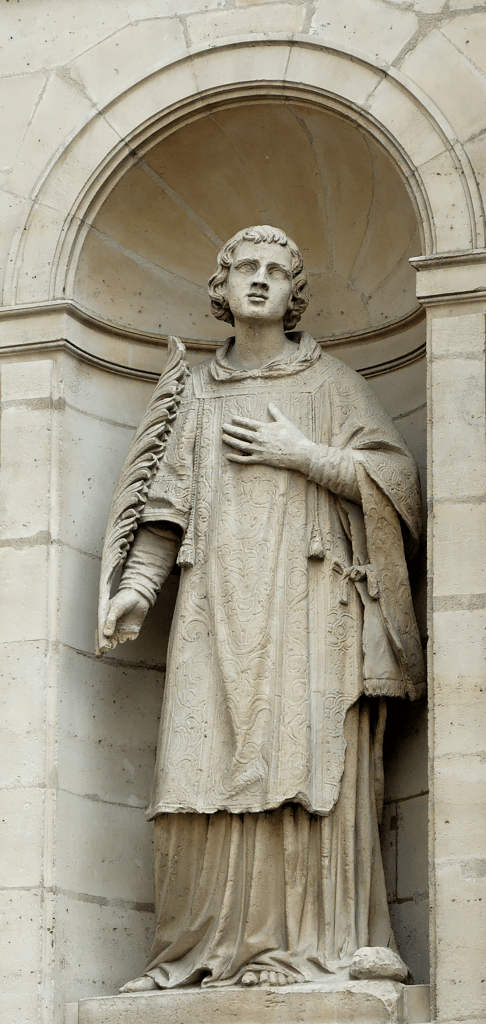
Statue of St. Stephen, by Joseph Marius Ramus (1805–1888) at the Saint-Étienne-du-Mont Church in Paris

Then the Chief Priest said, “What do you have to say for yourself?”

Stephen replied, “Friends, fathers, and brothers, the God of glory appeared to our father Abraham when he was still in Mesopotamia, before the move to Haran, and told him, ‘Leave your country and family and go to the land I’ll show you.’

“So he left the country of the Chaldees and moved to Haran. After the death of his father, he immigrated to this country where you now live, but God gave him nothing, not so much as a foothold. He did promise to give the country to him and his son later on, even though Abraham had no son at the time. God let him know that his offspring would move to an alien country where they would be enslaved and brutalized for four hundred years. ‘But,’ God said, ‘I will step in and take care of those slaveholders and bring my people out so they can worship me in this place.’

“Then he made a covenant with him and signed it in Abraham’s flesh by circumcision. When Abraham had his son Isaac, within eight days he reproduced the sign of circumcision in him. Isaac became father of Jacob, and Jacob father of twelve ‘fathers,’ each faithfully passing on the covenant sign.

“But then those ‘fathers,’ burning up with jealousy, sent Joseph off to Egypt as a slave. God was right there with him, though—he not only rescued him from all his troubles but brought him to the attention of Pharaoh, king of Egypt. He was so impressed with Joseph that he put him in charge of the whole country, including his own personal affairs.

“Later a famine descended on that entire region, stretching from Egypt to Canaan, bringing terrific hardship. Our hungry fathers looked high and low for food, but the cupboard was bare. Jacob heard there was food in Egypt and sent our fathers to scout it out. Having confirmed the report, they went back to Egypt a second time to get food. On that visit, Joseph revealed his true identity to his brothers and introduced the Jacob family to Pharaoh. Then Joseph sent for his father, Jacob, and everyone else in the family, seventy-five in all. That’s how the Jacob family got to Egypt.

“Jacob died, and our fathers after him. They were taken to Shechem and buried in the tomb for which Abraham paid a good price to the sons of Hamor. (The Message)

“What do you have to say for yourself?” conjures up for me women in a church basement with hands on hips, fingers pointing, staring at my 4-year-old self, after I ran through a bunch of old clothes at their annual rummage sale. And it wouldn’t be the last time I’d be asked that question throughout my life.

It’s a question that wants an accounting of something we’ve said or done. It’s not a polite question – more rhetorical than anything else.

Stephen was asked the question – and displayed a non-plussed presence that used the opportunity to turn it around back on his accusers and, indeed, of all humanity and human history.

Throughout Jewish history (and everyone else’s history, too!) there are human movements of good, inspired by divine initiatives; and alongside the good, there also are streams of resistant humanity who seek to thwart the good.

St. Stephen delivered a speech to the religious leaders, highlighting these two developments of human activity in the lives of two major figures in Jewish history.

Abraham

The patriarch of the Jewish people, Abraham, demonstrated faith by listening to the call of God to go to a country he knew nothing about. The Lord’s promises included both blessing and hardship. Although Abraham would be faithful to God’s covenant, his descendants would still find themselves as slaves in Egypt for four-hundred years.

Opposition to faith is always hanging in the shadows, ready to spring when there is an opportunity. Even though Abraham was a devoted follower of God, there were faithless people around him who had a different agenda than the Lord’s. His name continued into the New Testament with the faithless using it.

But invoking the ancient name of Abraham isn’t a protective amulet that makes everything okay. Doing the will of God is what really matters; and exhibiting faith like Abraham is the real issue.

“Produce fruit in keeping with repentance. And do not begin to say to yourselves, ‘We have Abraham as our father.’ For I tell you that out of these stones God can raise up children for Abraham. The ax is already at the root of the trees, and every tree that does not produce good fruit will be cut down and thrown into the fire.” (John the Baptist, Luke 3:8-9, NIV)

A good and right life comes through faith, and not by willpower nor in lifting up oneself by the bootstraps.

If, in fact, Abraham was justified by works, he had something to boast about—but not before God. What does Scripture say? “Abraham believed God, and it was credited to him as righteousness.” (Romans 4:2-3, NIV)

Joseph

Abraham, Isaac, and Jacob are the original pillars of Judaism. Jacob had twelve sons, known as the twelve patriarchs, from whom all Jews come from. The history of the brothers, like many families, is complicated. Joseph, next to the youngest of the brothers, was intensely disliked by several of the others.

Joseph found himself in Egypt because his brothers sold him into slavery. Like Abraham, Joseph had a robust faith, yet this did not inoculate him from trouble. Eventually, however, through a round-about turn of events, Joseph became in charge of the very empirical power that originally received him as a slave.

Through the eyes of faith, Joseph was not bitter, but understood why he needed to go through such terrible adversity. As administrator over all of Egypt, Joseph was able to handle severe years of drought with wisdom and confidence, thus saving many lives from hunger and starvation. And so, he was able to say to his brothers, many years later:

“You intended to harm me, but God intended it for good to accomplish what is now being done, the saving of many lives. “

(Genesis 50:20, NIV)

So, what do you have to say for yourself? Let you and I have the ability to say that we have been people of faith and patience. Let us be those who tenaciously hold to God, and steadfastly do good, speaking up in faith, no matter the situation, and regardless of faithless people who oppose us.

Because, in the end, the words of Jesus are true:

“So do not be afraid of them, for there is nothing concealed that will not be disclosed, or hidden that will not be made known. What I tell you in the dark, speak in the daylight; what is whispered in your ear, proclaim from the roofs. Do not be afraid of those who kill the body but cannot kill the soul. Rather, be afraid of the One who can destroy both soul and body in hell. Are not two sparrows sold for a penny? Yet not one of them will fall to the ground outside your Father’s care. And even the very hairs of your head are all numbered. So don’t be afraid; you are worth more than many sparrows.” (Matthew 10:26-31, NIV)

Just and right God, when we are faithless, you are faithful, because your very character is faithfulness. Help us to be faithful – not fearful – to the end, exhibiting the same commitment as your martyr Stephen, who fully entrusted himself to the Lord Jesus Christ, in whose name we are bold to pray. Amen.

Promise and Pilgrimage (Genesis 12:1-7)

The Lord said to Abram,

“Leave your land,
your relatives,
and your father’s home.
Go to the land that I will show you.
I will make you a great nation,
I will bless you.
I will make your name great,
and you will be a blessing.
I will bless those who bless you,
and whoever curses you, I will curse.
Through you every family on earth will be blessed.”

So Abram left, as the Lord had told him, and Lot went with him. Abram was 75 years old when he left Haran. Abram set out for Canaan. He took along his wife Sarai, his nephew Lot, and all the possessions they had accumulated and the servants they had acquired in Haran.

They arrived in Canaan, and Abram traveled through the land to the oak tree belonging to Moreh at Shechem. At that time the Canaanites were in the land. Then the Lord appeared to Abram and said, “I’m going to give this land to your descendants.” So he built an altar there to the Lord, who had appeared to him. (God’s Word Translation)

Abram (later having a name change to “Abraham”) knew quite a lot about new beginnings.

It isn’t every day that the Lord comes along and completely upends a person’s life. Abram had lived his entire life in the same city, Ur, in Chaldea (present day Iraq). By all accounts, Abram was completely fine living where he was living. He had neither the ambition nor need to leave his home city.

The Lord, however, had other plans for Abram. And they were radical plans. This was no rearranging of the furniture; it was a wholesale life-altering change. Ur was an important cosmopolitan city, a trade center, located at a pivotal point where the Tigris and Euphrates Rivers run into the Persian Gulf. Thus, Ur was a wealthy city, the citizens enjoying a level of comfort unknown in other parts of Mesopotamia.

Actor Eddie Albert as the out of place city lawyer trying to make it in the country on “Green Acres” which aired on CBS from 1965-1971

So, Abram being called to move from the city and go to some unknown place in the west would be something like growing up in Manhattan, New York and being called by God to head for Brewster, Nebraska – which is pretty much in the middle of nothing. It makes “Green Acres” look like a night out at the opera.

The Lord’s First Promise to Abram

It wasn’t all unknown change; there was a promise attached to the call. Having every family on earth blessed through you is a really big promise. There was a lot riding on Abram’s response.

Perhaps there was some pushback on Abram’s end of things. But we don’t have any record of it if it even happened. Instead, we get a simple statement telling us that he left, just as the Lord told him to do.

Lest we think Abram had some incredible relationship with the Lord before this call came, we need to think again:

“This is what the Lord God of Israel says: Long ago your ancestors, Terah and his sons Abraham and Nahor, lived on the other side of the Euphrates River and served other gods. But I took your ancestor Abraham from the other side of the Euphrates River. I led him through all of Canaan and gave him many descendants.” (Joshua 24:2-3, GW)

The One true God wasn’t even on Abram’s radar. He was merrily serving the pagan gods of Sumer, seemingly without a care in the world. It wasn’t as if Abram was bored watching old reruns of “Green Acres” and wishing for a change. And it sure wasn’t because he was attuned to knowing anything about Yahweh.

Whatever went down between Abram and the Lord was likely so compelling that Abram left willingly and without any pushback.

The Lord’s Second Promise to Abram

To travel from Ur of the Chaldees to the land of Canaan is an approximate distance of 800 miles. That’s slow going when you’re traveling in a caravan by donkey and camel. It took a while to get to the land that the Lord had in mind for Abram.

Once there, God gave Abram another promise: The land that he reached will be his home, the new land, the Promised Land. It would be yet another 500+ years before Abram’s descendants took full possession of that land and the promise realized.

Abram had a lot of time to consider and reflect on the Lord’s calling and promises. And that is precisely why pilgrimage is so very important. Yes, the destination is significant; yet it is the journey itself that really matters.

Pilgrimage

Those who put their strength in you are truly happy;
    pilgrimage is in their hearts. (Psalm 84:5, CEB)

Abram journeys into the unknown by Yoram Raanan

The way of pilgrimage is for all, like Abram, who walk in faith and patience, awaiting the fulfillment of God’s promises.

By faith Abraham obeyed when he was called to go out to the place which he would receive as an inheritance. And he went out, not knowing where he was going. 

By faith he dwelt in the land of promise as in a foreign country… for he waited for the city which has foundations, whose builder and maker is God…. Therefore from one man, and him as good as dead, were born as many as the stars of the sky — innumerable as the sand which is by the seashore.

These all died in faith, not having received the promises, but having seen them afar off were assured of them, embraced them and confessed that they were strangers and pilgrims on the earth. 

For those who say such things declare plainly that they seek a homeland. And truly if they had called to mind that country from which they had come out, they would have had opportunity to return. But now they desire a better, that is, a heavenly country. Therefore God is not ashamed to be called their God, for He has prepared a city for them. (Hebrews 11:8-16, NKJV)

Each day, we have the opportunity to be pilgrims, walking by faith, exercising patient hope, persevering in love for one’s fellow humanity.

Just because we live in a microwave society which values speed and customer service above all else, doesn’t mean our religion has to follow suit. The best things in life are slow in coming; they require a great deal of blood, sweat, and tears.

Go ahead and enjoy an episode or two of “Green Acres;” just remember to listen when the Lord calls and go to make disciples of all nations.

All-powerful God, you always show mercy toward those who you love, and you are never far away for those who seek you. Be with your servants on this pilgrimage and guide their way in accord with your will. Amen.

Law and Gospel (Galatians 3:6-14)

Nativity by He Qi

The Scriptures say that God accepted Abraham because Abraham had faith. And so, you should understand that everyone who has faith is a child of Abraham. Long ago the Scriptures said God would accept the Gentiles because of their faith. This is why God told Abraham the good news that all nations would be blessed because of him. This means everyone who has faith will share in the blessings given to Abraham because of his faith.

Anyone who tries to please God by obeying the Law is under a curse. The Scriptures say, “Everyone who doesn’t obey everything in the Law is under a curse.” No one can please God by obeying the Law. The Scriptures also say, “The people God accepts because of their faith will live.”

The Law isn’t based on faith. It promises life only to people who obey its commands. But Christ rescued us from the Law’s curse, when he became a curse in our place. This is because the Scriptures say that anyone who is nailed to a tree is under a curse. And because of what Jesus Christ has done, the blessing promised to Abraham was taken to the Gentiles. This happened so that by faith we would be given the promised Holy Spirit. (Contemporary English Version)

We are just a day away from the Nativity of the Lord, Christmas Eve, the night Christians everywhere observe the birth of Christ.

And just two days from now Christians throughout the world will have a grand celebration of Christ’s incarnation – God breaking into this old fallen world to be with us and redeem us.

Many will be show up at a church worship service on that day, perhaps especially because Christmas Day falls on a Sunday, in the year of 2022. All might be in the same place; yet they’re there for different reasons.

Some come to the worship service because that’s what they have done every Sunday throughout the year – and they wouldn’t think of being anywhere else.

Others choose to be a part of the gathering because they enjoy the specialness of the day, the beauty of the celebration, and the traditions which surround it all.

There are also those who show up because the season has been hard; while others may bask in the joy of Christmas, they’re just looking for something positive to get them through for a while.

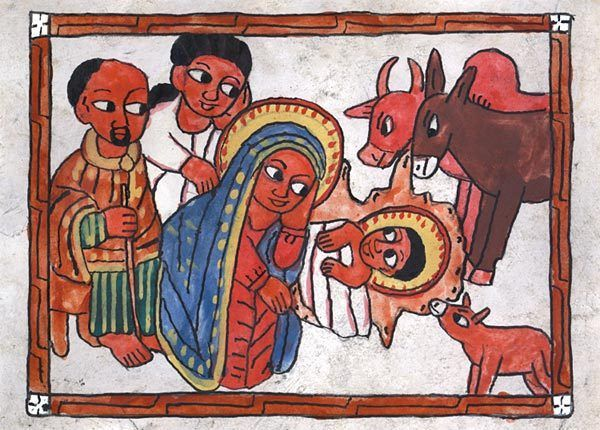
Ethiopian Orthodox icon of the Nativity of the Lord

And then there are those who enter the day for none of the previous mentioned reasons. No, they simply show up because they feel it is their duty to do so, or at the least, because they might receive some special spiritual Brownie points from God. In other words, they gather with the rest with the sheer motivation of Law.

Such an approach illustrates the “curse” of the Law. The Law itself is not bad. But if the rest of the equation isn’t factored into life, Law becomes a hard taskmaster and keeps the law-keeper in a terrible bondage without any delight to go with the duty.

People also need Gospel, the good news which fulfills all the requirements and demands of Law. Law is good, but by itself, apart from Gospel, it becomes an insidious tool of evil.

Whereas Law focuses solely on what we do, Gospel homes in on why we do it.

Law bosses us around and tells us what to do. Gospel frees us to embrace the spirit of Law to love God and neighbor.

It doesn’t take faith to obey the rules and regulations of Law. Gospel, however, can only be realized, internalized, and lived by faith.

It takes faith to receive grace and forgiveness – and to give it. Faith requires an acceptance of spiritual realities. It is the key to tapping into the power of love in the universe.

By faith, people throughout history, like Abraham, have listened with spiritual ears to the God of all. They step out, not merely because of Law, but because they rely on divine promises. Such faith enables them to wait patiently for the coming of eternal forces to take permanent residence on earth. Law can’t do that; only Gospel can.

Faith in the Bible is a complete trust in God, in who God is and what God has done. Because God has demonstrated faithfulness through steadfast love, people are gifted with faith to know the Lord and exhibit love through good works. 

God Is with Us by Hanna Varghese

In Christianity, the height of faith is to place one’s life completely in God’s hands, believing in the person and work of Jesus Christ.

Jesus said, “I assure you that if you have faith the size of a mustard seed, you could say to this mountain, ‘Go from here to there,’ and it will go. There will be nothing that you can’t do.” (Matthew 17:20, CEV)

The size of faith isn’t the issue – it’s in whom that faith is placed. The littlest of faith in Jesus can have massive results, whereas the biggest of faith in someone who cannot get you to where you need to go, is useless.

Outward rituals and observance of Law have their place; but they don’t deliver anyone from sin, death, or hell. Only faith can do that.

If you are a follower of Christ Jesus, it makes no difference whether you are circumcised or not. All that matters is your faith that makes you love others. (Galatians 5:6, CEV)

It’s one thing to be kind and love others during a holiday season; it’s quite another thing to have that be your default character throughout the entire year. Love for a season comes merely from Law. But Love for a lifetime grows from the rich soil of the Gospel.

And it’s the Gospel of Jesus Christ which we celebrate and give thanks.

Gracious God, we thank you for sending your Son. Even before we loved you, you loved us and gave us the gift of faith. Help us to love one another and to see all people in the same way you do – to love them even when they don’t love us back. Enable us by your Spirit to show continual love throughout the entire year, for the sake of Jesus Christ our Savior. Amen.