The Lord of Life (John 6:56-69)

Bread of Life, by Kennedy Paizs

“Those who eat my flesh and drink my blood abide in me and I in them. Just as the living Father sent me and I live because of the Father, so whoever eats me will live because of me. This is the bread that came down from heaven, not like that which the ancestors ate, and they died. But the one who eats this bread will live forever.” Jesus said these things while he was teaching in a synagogue at Capernaum.

When many of his disciples heard it, they said, “This teaching is difficult; who can accept it?” But Jesus, being aware that his disciples were complaining about it, said to them, “Does this offend you? Then what if you were to see the Son of Man ascending to where he was before? It is the spirit that gives life; the flesh is useless. The words that I have spoken to you are spirit and life. But among you there are some who do not believe.”

For Jesus knew from the beginning who were the ones who did not believe and who was the one who would betray him. And he said, “For this reason I have told you that no one can come to me unless it is granted by the Father.”

Because of this many of his disciples turned back and no longer went about with him. So Jesus asked the twelve, “Do you also wish to go away?” Simon Peter answered him, “Lord, to whom can we go? You have the words of eternal life. We have come to believe and know that you are the Holy One of God.” (New Revised Standard Version)

This is a hard teaching – which is why a fair number of Christ’s disciples unfollowed him, literally, and not just socially and virtually.

Perhaps they believed they were following a great moral teacher, only to find Jesus prattling-on about being bread from heaven and divinely related to God.

The late great C.S. Lewis commented on Jesus, saying this:

“I am trying here to prevent anyone saying the really foolish thing that people often say about Him: I’m ready to accept Jesus as a great moral teacher, but I don’t accept his claim to be God. That is the one thing we must not say. A man who was merely a man and said the sort of things Jesus said would not be a great moral teacher. He would either be a lunatic — on the level with the man who says he is a poached egg — or else he would be the Devil of Hell. You must make your choice. Either this man was, and is, the Son of God, or else a madman or something worse. You can shut him up for a fool, you can spit at him and kill him as a demon or you can fall at his feet and call him Lord and God, but let us not come with any patronizing nonsense about his being a great human teacher. He has not left that open to us. He did not intend to.” C.S. Lewis, Mere Christianity

It seems Jesus cares little about whether we think of him as a moral teacher or some monstrosity. But he does care about moving people to a spirit-filled confession, a settled claim of faith, and a bold proclamation of his person and work.

Indeed, Jesus Christ, Son of Humanity, Son of God, leads us to hear his own confession, claim, and proclamation: “I Am.”

The crowd of people listening to Jesus were having a hard time wrapping their heads around his message. There were simply no existing categories of thought to which they could put Jesus neatly into. Everyone was rather puzzled with Christ’s words.

Jesus was in the Capernaum synagogue, a village on the Sea of Galilee, 30 miles from where he grew up in Nazareth. Any talk of eating and drinking and religion within any faith community is likely to be a charged discussion. Typically the politics of faith is not for the faint of heart.

We are to abide in Christ, to be in vital union with him. To have Jesus close, to have his words and ways within us, is akin to eating a satisfying meal that goes throughout our entire body and effects our being. Connecting and remaining with Jesus is true living and abundant life.

But the synagogue crowd wasn’t having any of this crazy talk of eating flesh and drinking blood. The lines between meat and metaphor were severely blurred for them. They did not accept the wedding of the spiritual and the material, of word and flesh, of God and Jesus together as Father and Son.

Jesus was causing the men to fold their arms in disgust, and the ladies to squirm in their pews with agitation. They looked upon this Jesus in front of them as causing a religious scandal of the first degree.

Rather than back off the scandalous words, Jesus stuck with them. Furthermore, he intensified what he was saying. At the heart of it was a claim to be the ladder between heaven and earth, the one who is manna from above, given for the life of the people.

His flesh is bread, and his blood is drink. He is life itself. He is even spirit, the one who breathes new life into people. At this point, Jesus was being as scandalous as it gets for his audience in the synagogue.

All of Christ’s talk is meant to bring people to consider him, to contemplate God, and to come to a point of response. Because nobody encountered Jesus without deciding if he is a liar, a lunatic, or the Lord who is life itself.

Many of Christ’s own disciples bailed on him. The scandal was too much. They didn’t sign up for this. To stay with Jesus means to really stay, to abide, to believe and know who he is.

Throughout the New Testament Gospels, Jesus honors people with questions and choices – and does not simply bypass human dignity and worth. He asked his closest twelve disciples if they also wanted to retreat from the scandalous message and messenger they’d been following.

Peter, of course, still had to learn this lesson of respect; he answered for the entire group. Jesus is where, and in whom, he found life, along with the rest of them. They didn’t know how all of the scandalous talk was going to shake-out specifically, although I think each of them had a pretty good idea.

But it didn’t matter. The twelve disciples were stuck on Jesus. Or, to be more accurate, the eleven disciples. Perhaps it was at this point that Judas Iscariot no longer had to wonder what was going to happen, and what exactly Jesus was up to.

Abiding in a movement that did not include a Roman takeover and a glorious wealthy kingdom was something Judas was unwilling to invest in. Maybe it was here that he began considering his exit plan.

Recognizing Jesus as Son of Humanity, Son of God, and the Word made flesh for us, requires both belief and knowledge – because you must have the one to have the other. C.S. Lewis discovered this. So did I. And may you, as well, my friend. For Jesus is the Lord of life.

Gracious God, although we once were strangers, you receive us as friends and draw us home to you. Set your living bread before us so that, feasting around your table, we may be strengthened to continue the work to which your Son commissioned us. Amen.


Abide In Love (John 15:9-17)

As the Father has loved me, so I have loved you; abide in my love. If you keep my commandments, you will abide in my love, just as I have kept my Father’s commandments and abide in his love. I have said these things to you so that my joy may be in you and that your joy may be complete.

“This is my commandment, that you love one another as I have loved you. No one has greater love than this, to lay down one’s life for one’s friends. You are my friends if you do what I command. I do not call you servants any longer, because the servant does not know what the master is doing, but I have called you friends, because I have made known to you everything that I have heard from my Father. You did not choose me, but I chose you. And I appointed you to go and bear fruit, fruit that will last, so that the Father will give you whatever you ask him in my name. I am giving you these commands so that you may love one another. (New Revised Standard Version)

We Need Love

The world, in truth, spins on the axis of love. Without love, there is no beauty. Apart from love, we would all be living in a dystopian world of mere survival. But with love, there is life, hope, purpose, and meaning; there is fulfillment, satisfaction, and security. With love, our most basic needs as people are met.

So, love is a word that must be intentionally pursued and valued; because we cannot live without it.

The very word “love” gets used in various and different ways in our world. Jesus used the word in a sacrificial sense – that love willingly gives up one’s life for the benefit of another.

Love is large. It involves the whole person – body, mind, emotions, and spirit. Love in today’s Gospel lesson is used by Jesus as an action. And it’s even more than that. Christ defined love in the Upper Room to his disciples as a willingness to die – not necessarily for a spouse or a child – but for a friend, a fellow follower of Jesus.

It seems that for most Christians, giving up one’s life for another is not at the forefront of our idea of loving another. Yet, to love our neighbor as ourselves does involve the willingness to die so that another may live. To know precisely what this is like, we need look no further than the love which exists within God.

God is Love

Love is seen above all in the love of God the Father shown forth in God the Son. Because God so loves the people of this world, the Father sent the Son, Jesus, to give his life for us. And Jesus, embodying the very love of God, willingly gave himself on our behalf. It hearkens us to Christ’s earlier words about this:

“For God so loved the world that he gave his only Son, so that everyone who believes in him may not perish but may have eternal life.”

Jesus (John 3:16, NRSV)

Just as the Father loved the Son, and the Son loved us, so we are to love others with the same sort of sacrificial love which was graciously shown to us. The Apostle John made this plain in his first epistle:

God’s love was revealed among us in this way: God sent his only Son into the world so that we might live through him. In this is love, not that we loved God but that he loved us and sent his Son to be the atoning sacrifice for our sins. Beloved, since God loved us so much, we also ought to love one another. (1 John 4:9-11, NRSV)

Therefore, it is our privilege and responsibility to abide in this divine love and let it fill us to the full, so that God’s love moves powerfully in us and through us, for the life of the world.

Remain in Love

Love is the end result of an abiding relationship and close connection between Christ and his followers. We are to remain in the love of Christ, just as Christ remains in the love of God. Jesus asks nothing of us that he has not already modeled for us in his sacrificial service to the world. Living in union with Christ, loving Jesus, and keeping God’s commands are all a single package, bound up together in a mutual relationship.

We don’t need to wonder what God wants for us and from us: Love. The commands of Jesus are not general; they are focused and specific. Christ commands that we love one another. Our continuing work on this earth is to keep on loving people as Christ has loved us and gave himself for us.

No Greater Love

There is no greater love than that shown in the giving of one’s life for one’s friends. The power of God’s love is focused in Christ. It is confirmed in Christ’s resurrection from death. And it flows from Christ giving his life on the cross for us.

Yes, Christians are servants who are committed to serving others with sacrificial love. Yet, the disciples and all those who follow Christ are much more than servants; they are considered primarily as friends of Jesus.

Through the cross and resurrection of Christ, believers have discovered the divine power of love. There is no greater love than this. And it is this sort of love that binds Christians together as united in their mission to love as Jesus loved them.

We have been called, chosen, and appointed by Jesus to embody love’s mission and purpose. What’s more, we are equipped for the active work of love.

Whatever You Ask in Love

The very name of Jesus is love itself. So, whatever you ask, “in my name,” said Jesus, “the Father will give you.”

Because Christians are united to Christ, they are to remain in and abide with Christ. This relational connection opens up the power of prayer. And the content of those prayers – if we are truly in Christ – will always come from a place of love, be directed to love, and go to great lengths to accomplish love.

Prayer is an activity which is grounded in the abiding relationship of Father, Son, Spirit, and the Christian community. Love directs our prayers. And prayers are directed toward the action of love.

A confidence in the power of prayer is an abiding trust in the power of Love. With love animating our prayers and infusing our service, we are bold to ask God for what is right, just, and good in this world. Indeed, we pray that we will give love to each other with the love we have received from God.

Love and Joy

Being called and appointed by God to love is a privilege and a joy. There isn’t any begrudging service when love is involved. Perhaps one of the greatest prayers we can pray is to pray that our hearts be filled with love. If you don’t feel love for others, then pray for it. And be assured that you will receive it.

Love and joy go together like mashed potatoes and gravy, peanut butter and jelly, grits and honey. We know we are loving others if our joy is complete in doing so.

Jesus came to this earth so that we might experience an overflowing life of abundant love and joy. Christ longs for his joy to be in us, and for us to abide in his love. Our joy comes from knowing that we have been loved by God – chosen, called, and sent out into the world with love and for the purpose of love.

And it is this divine love that has the power to renew and transform everything – even the most troubling and stubborn of people and problems that you are presently facing. Indeed, if love is not the answer, then you are not asking the right question.

Creator God, by the mercies of your son, our Lord, Jesus, compel us to turn our hearts to his way of Love, so that we might follow Christ together as your faithful people. Dear Jesus, guide us in your way. Amen.

Remain In Me (John 15:1-8)

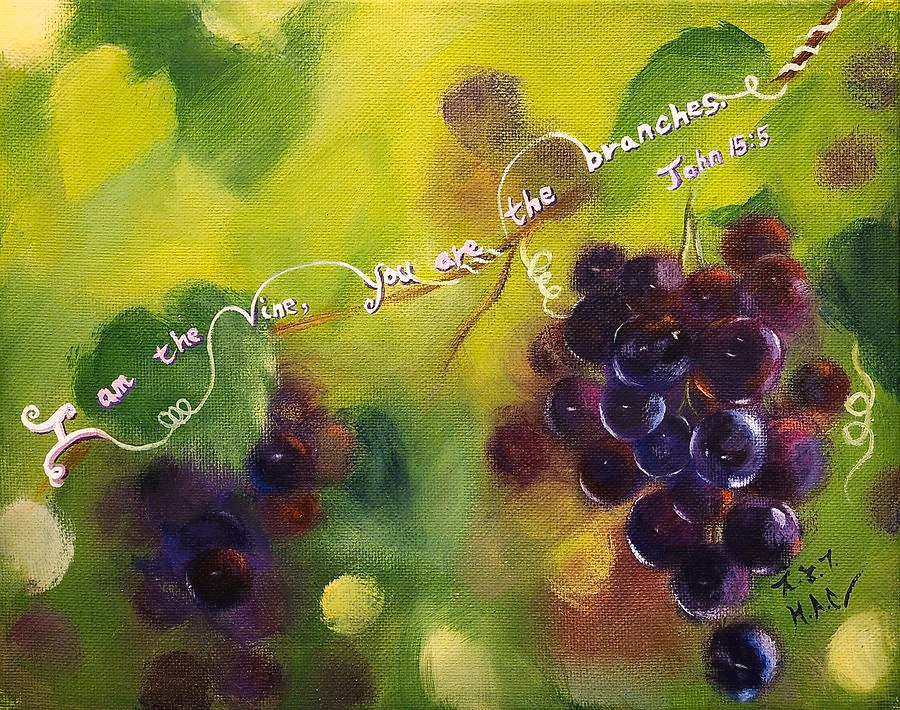
The Vine and the Branches, by Irene Thomas

I am the true vine and my Father is the gardener. He cuts off every branch in me that bears no fruit, while every branch that does bear fruit he prunes so that it will be even more fruitful. You are already clean because of the word I have spoken to you. Remain in me, as I remain in you. No branch can bear fruit by itself; it must remain in the vine. Neither can you bear fruit unless you remain in me.

I am the vine; you are the branches. If you remain in me and I in you, you will bear much fruit; apart from me you can do nothing. If you do not remain in me, you are like a branch that is thrown away and withers; such branches are picked up, thrown into the fire and burned. If you remain in me and my words remain in you, ask whatever you wish, and it will be done for you. This is to my Father’s glory, that you bear much fruit, showing yourselves to be my disciples. (New International Version)

In the New International Version of the Bible, the word “remain” is repeated 8 times in 8 verses. The original Greek word translated as “remain” is μένω (pronounced “men-oh”). It means to linger in the present moment; to be mindful to ourselves and our situations; to stay connected.

Remaining with Jesus means we that have continual unbroken connection of unity and fellowship with him.

In order to have a connection, there must be two ends to connect. The Jesus connection is always there. We are the other connection. And, frankly, we can be flaky – pulling away and coming close – which is why Jesus gave a repeated invitation to keep the connection.

Some other translations of John 15:4 may help to fill out an understanding of this invitation to remain in Christ (emphasis mine):

Stay joined to me, and I will stay joined to you. Just as a branch cannot produce fruit unless it stays joined to the vine, you cannot produce fruit unless you stay joined to me. (CEV)

Live in me, and I will live in you. A branch cannot produce any fruit by itself. It must stay attached to the vine. In the same way, you cannot produce fruit unless you live in me. (GW)

Abide in Me, and I in you. As the branch cannot bear fruit of itself, unless it abides in the vine, neither can you, unless you abide in Me. (NKJV)

Stay connected to me, and I will stay connected to you! A branch cannot produce fruit on its own but only if it has a vital connection to the vine. In the same way, there’s no way you can produce fruit at all, unless you have a meaningful connection with me. (my own translation)

The task of every Christian is to remain connected to Jesus. So, the question is: How do we keep the connection without breaking it? How can we be fruitful?

Focus on the Relationship

Christianity, at its core, is a living relationship with Jesus. Yes, doctrine is important; and it’s necessary to know the basic tenets of Christian faith. Yet, any knowledge we gain about Christianity is to be channeled into developing the relationship.

By Helian Cornwell

Bible trivia is only as good as the understanding we apply to build the relationship. Knowledge makes us proud of ourselves, while love makes us helpful to others. Knowledge makes us feel important, yet love strengthens the Church. Knowledge puffs up but love builds up. (1 Corinthians 8:1)

Christ’s redemption – his incarnation, holy life, death, resurrection, and ascension – are meant to restore the severed relationship with humanity. Only knowing doctrinal truth is not the same as using the doctrines to connect with God in a loving relationship.

It takes planning, dedication, time, and effort to grow and maintain our relationship with Jesus Christ. If we fail to use our time and energy on that relationship, then the leaves on the branch begin to wither.

Scripture, silence, solitude, community, prayer, giving, and fasting have always been at the center of Christian practices designed to put us in a position to hear and receive from God.

Relate Well to the Other Branches

The Church is a living growing community. Christ and the Church have a vital union with each other. I used to live in a place where there was a tree that had grown up next to an old fence post. The tree grew tall and engulfed the post to the degree that now you can only see part of the fence post.

To remove the post, you would have to remove the tree; the two have become one. Not only are we connected to the trunk, but we’re also connected to each other. We are all part of the same vine; we aren’t separate vines. So, we all need to do our part in the vine’s system.

Keep Close to the Vine

My grandmother had a grapevine in her backyard when I was a kid. I have firsthand understanding that the sweetest, juiciest, biggest, and best tasting grapes are found in the middle, securely next to the vine’s stem.

The sour grapes are found at the end of the branches. Show me a sourpuss Christian, and I’ll show you a Christian who is not close to Christ. Show me a sweet Christian and I’ll show you a believer who daily works at their close connection with Jesus.

Pruning is Necessary

Healthy vines need pruning, at least once a year; ideally, twice a year, in the Spring before budding, and in Autumn, after the harvest. Without pruning, the vine’s ability to produce good and abundant grapes is compromised. The grapevine’s branches need to be kept short because the nutrients are concentrated in and near the vine stem.

Pruning hurts. From the perspective of us branches, pruning feels like judgment. But it isn’t. Even though pruning is painful, it makes us healthier and tastier.

It’s better to do a few things well, rather than try and do a lot of things for which there is limited time and energy. So, do some spiritual pruning twice a year!

Know Why You are Connected

Yes, Christians have a connection with Jesus so that we are saved from sin, death, and hell. And, yes, we are connected to experience abundant life. Yet, the goal of that connection is to produce succulent fruit.

If there are no grapes on the vine, the vine is useless. Grapevines exist to produce grapes. Christians and Churches exist for the life of the world, to produce the fruit of righteousness consistent with our Christ-connected union: love, joy, peace, patience, kindness, goodness, faithfulness, gentleness, and self-control. (Galatians 5:22-23)

The Church is not an end in itself, but exists for the life of the world. Using other metaphors, Jesus said:

“You are the salt of the earth. But if the salt loses its saltiness, how can it be made salty again? It is no longer good for anything, except to be thrown out and trampled underfoot.

“You are the light of the world. A town built on a hill cannot be hidden. Neither do people light a lamp and put it under a bowl. Instead, they put it on its stand, and it gives light to everyone in the house. In the same way, let your light shine before others, that they may see your good deeds and glorify your Father in heaven.” (Matthew 5:13-16, NIV)

Pray

If we live in union with Christ – with the words and ways of Jesus powerfully within us—then ask for anything, and it will be done. Prayer is both an event that anyone can do, as well as a spiritual practice that needs growth and development.

The words of Jesus are the nutrients for our spiritual life. When those words find a home within us, there is a divine/human conversation. Christ promises that if we just ask, we’ll receive.

As the relationship with Christ grows, we learn to be thoughtful about our asking. Flippantly or selfishly asking for things disrespects the connection we enjoy with God. Claiming or demanding answers to prayer demeans the relationship. We can also dishonor God by simply not asking, at all.

Prayer is the delivery system for receiving our nutrients; and is also the means of delivering fruitful blessing so that the world might live. Jesus modeled a prayer for us that is grounded in connection and unity with the Father:

I am not praying just for these followers. I am also praying for everyone else who will have faith because of what my followers will say about me. I want all of them to be one with each other, just as I am one with you and you are one with me. I also want them to be one with us. Then the people of this world will believe that you sent me.

I have honored my followers in the same way that you honored me, in order that they may be one with each other, just as we are one. I am one with them, and you are one with me, so that they may become completely one. Then this world’s people will know that you sent me. They will know that you love my followers as much as you love me.

Father, I want everyone you have given me to be with me, wherever I am. Then they will see the glory that you have given me, because you loved me before the world was created. Good Father, the people of this world don’t know you. But I know you, and my followers know that you sent me. I told them what you are like, and I will tell them even more. Then the love that you have for me will become part of them, and I will be one with them. (John 17:20-26, CEV)

We must live and pray consistent with who we are, and what our mission is. The Church is to be one as God is One. Christians are to pray for unity because the triune God is always united. Believers everywhere need to remain in Christ through a vital connection of loving God and loving their neighbors. Amen.

Prayer Is the Heartbeat of the Church (Acts 1:12-17, 21-26)

“The Forerunners of Christ with Saints and Martyrs” by Italian painter Fra Angelico (1395-1455)

Then the apostles returned to Jerusalem from the hill called the Mount of Olives, a Sabbath day’s walk from the city. When they arrived, they went upstairs to the room where they were staying. Those present were Peter, John, James and Andrew; Philip and Thomas, Bartholomew and Matthew; James son of Alphaeus and Simon the Zealot, and Judas son of James. They all joined together constantly in prayer, along with the women and Mary the mother of Jesus, and with his brothers.

In those days Peter stood up among the believers (a group numbering about a hundred and twenty) and said, “Brothers and sisters, the Scripture had to be fulfilled in which the Holy Spirit spoke long ago through David concerning Judas, who served as guide for those who arrested Jesus. He was one of our number and shared in our ministry….”

Therefore it is necessary to choose one of the men who have been with us the whole time the Lord Jesus was living among us, beginning from John’s baptism to the time when Jesus was taken up from us. For one of these must become a witness with us of his resurrection.”

So they nominated two men: Joseph called Barsabbas (also known as Justus) and Matthias. Then they prayed, “Lord, you know everyone’s heart. Show us which of these two you have chosen to take over this apostolic ministry, which Judas left to go where he belongs.” Then they cast lots, and the lot fell to Matthias; so he was added to the eleven apostles. (New International Version)

So, what do you do when you don’t know what to do? And what do you do when you have a problem or challenge?

Good old American ingenuity, the Protestant work ethic, and fixing things is the reflexive response of many people. In the belief that we can solve anything, what typically gets left out of the equation is seeking God’s presence and power in order to rightly discern next steps.

But that wasn’t the response of the earliest church. When faced with their small numbers and a large mission to accomplish, they prayed. They more than prayed. They continually got together, just to pray. Prayer was the air they breathed. The believers understood they needed God (not simply to rubber stamp their plans) for moving forward in mission and ministry.

Christians need the vision and imagination that can only come through consistent daily prayer. Otherwise, they will not choose wisely and find themselves in a quandary of their own making.

Imagine not having to purchase what you need the most today.

Maybe you’re in a real pinch. Your financial budget isn’t budging. Perhaps you’re wondering what items you need to do without for a while. It could be that the bills aren’t all getting paid. Or maybe you’re concerned with how in the world you’re going to buy Christmas presents for the family.

Imagine having all the love you need today without working to earn it.

Maybe you have a strained relationship. It might be that you’re hurt from a marriage or a love that has gone sour. Perhaps a friendship is on the rocks, or a family member won’t talk to you. You’re wondering if it will ever be better, wondering if love will find you again.

Imagine continually having a church experience of being full of the grace of Jesus, the love of God the Father, and the power of the Holy Spirit.

Maybe your church has a legalistic bent. Perhaps the church is withdrawn into cliques and special interest groups. It could be that the Spirit hasn’t shown up since 1959. You’re tired, weary of the chronic sameness and status quo of a stagnant place.

For all these things, and so many more of life’s problems and situations, there is good news… really good news!

Prayer is the currency to what you need most, the means of receiving and giving love, and the path to a gracious and powerful Christian and Church life.

Prayer is the heartbeat of the church. The promise of prayer still stands. God gives. We receive. But we must ask!

You didn’t choose me, but I chose you. I have appointed you to go, to produce fruit that will last, and to ask the Father in my name to give you whatever you ask for. (John 15:16, GW)

Sometimes God just gives without us asking. That’s great. Yet, God wants so much more for you and me and our faith communities. God longs for us to be vitally connected to Christ, and that connection happens through prayer. We can bank on the answers to our prayers when we:

  • Stay joined to Jesus (John 15:4)
  • Let Christ’s teachings become part of you (John 15:7)
  • Remain faithful to Christ’s love for you (John 15:9)
  • Obey Jesus (John 15:10)

Imagine having your will align with the perfect will of God.

Stay joined to me and let my teachings become part of you. Then you can pray for whatever you want, and your prayer will be answered. (John 15:7, CEV)

Perhaps you are skeptical. You’ve prayed a long time with nothing happening. You’re discouraged and feel like prayer doesn’t work, or that something is wrong with you. 

There is a mysterious and mystical aspect to prayer that we will never quite understand. However, I do know that Jesus didn’t put a timetable on the answers – they will come when they come. And they will come. 

Maybe we’ll discover that what we want and need the most is to let God’s will and way be done in us, no matter what it is. Perhaps the point is to change us, and not always to change our circumstances.

We have an incredible privilege; we get to ask, without having to buy answers to prayer.

We don’t have to do backflips to get God’s attention. We simply ask. 

We don’t have to try and work to earn God’s favor. We don’t have to draw up detailed plans like some sort of architectural design to see a fruitful, loving, and powerful church. We just ask and remain closely connected to Jesus. 

O Lord, grant me to greet the coming of this day in peace. 

Help me in all things to rely upon Your holy will. 

In every hour of the day, reveal your good and holy will to me. 

Bless my dealings with all who surround me. 

Teach me to treat all that comes to me throughout the day with peace of soul and with the firm conviction that your will governs all. 

In all my deeds and words, guide my thoughts and feelings. 

In unforeseen events, let me not forget that all situations, no matter what, are sent by you. 

Teach me to act firmly and wisely, without embittering and embarrassing others. 

Give me the strength to bear the fatigue of this day with all that it shall bring. 

Direct my will; teach me to pray; pray you yourself in me. Amen.

 –A Prayer from St. Philaret of Moscow (1782-1867)