The Pleasing Aroma of Worship (Exodus 30:1-10)

The Altar of Incense, by Erhard Altdorfer (1480-1561)

“Make an altar of acacia wood for burning incense. It is to be square, a cubit long and a cubit wide, and two cubits high—its horns of one piece with it. Overlay the top and all the sides and the horns with pure gold, and make a gold molding around it. Make two gold rings for the altar below the molding—two on each of the opposite sides—to hold the poles used to carry it. Make the poles of acacia wood and overlay them with gold. Put the altar in front of the curtain that shields the ark of the covenant law—before the atonement cover that is over the tablets of the covenant law—where I will meet with you.

“Aaron must burn fragrant incense on the altar every morning when he tends the lamps. He must burn incense again when he lights the lamps at twilight so incense will burn regularly before the Lord for the generations to come. Do not offer on this altar any other incense or any burnt offering or grain offering, and do not pour a drink offering on it. Once a year Aaron shall make atonement on its horns. This annual atonement must be made with the blood of the atoning sin offering for the generations to come. It is most holy to the Lord.” (New International Version)

Worship is intended to engage the whole person, including our five senses. That’s why God instructed Moses to oversee construction of an altar for burning incense. Smells and aroma matter. We associate certain smells with particular times, places, or people. Inhaling the incense signifies and reminds people that God is with us.

Included in the instructions about the altar of incense is about when and where to burn it. The incense was to be utilized just outside the great curtain that veiled the Holy of Holies – which was the place where God met with Aaron the high priest.

The people not only smelled the incense, but could also see the smoke rise – and so be reminded of the great pillar of cloud that went before the Israelites in the exodus from Egypt. The cloud was a visible manifestation and reminder of God’s presence with the people.

Experiencing the smell of the incense and the visual smoke were comforting. It was a spiritual encounter that reinforced and strengthened the faith needed to keep on living for the Lord.

At the same time, the incense smoke highlighted the Holy of Holies curtain in front of the worshiper. Although God is close and near to the people, God is also distant and unreachable.

The Lord is both immanent and transcendent – able to meet us where we are and know our intimate needs. Yet, God is also so far above us – the high and holy God – so as to see the big picture of the world. The Lord knows us and our troubles, and has the perspective and power to do something about it.

The altar of incense with its billowing smoke and sweet smelling aroma was not only pleasing to the people, but also to God. Whenever worshipers present their offerings with joy and gladness on the altar of sacrifice, then the Lord is pleased with their faithfulness.

For example, Noah built an altar to the Lord and provided burnt offerings on it. God smelled the pleasing aroma and was stirred to say:

“Never again will I curse the ground because of humans, even though every inclination of the human heart is evil from childhood. And never again will I destroy all living creatures, as I have done.”

“As long as the earth endures,
seedtime and harvest,
cold and heat,
summer and winter,
day and night
will never cease.” (Genesis 8:21-22, NIV)

Incense and pleasing aromas are not so much the point, but what the smell represents. If we miss this, then worship becomes mechanical, and a primitive way of trying to appease an angry deity. But if we see and smell with spiritual eyes and nose, then we discern and know that our senses are a doorway to connection with God.

Our offerings are acceptable and pleasing when they are offered with sincerity of heart, integrity of spirit, and faithfulness to the God who cares not only about what we do, but why we do it.

A heart inclined toward disobedience, a mind with a bad attitude, and feet that would rather be elsewhere than at the altar, are a noxious smell to God; it is odious to the Lord. But the greatest and sweetest incense is the life offered in faith and devotion to God. In the New Testament, the Apostle Paul commented on the offerings of God’s people:

I now have plenty and it is more than enough. I am full to overflowing because I received the gifts that you sent from Epaphroditus. Those gifts give off a fragrant aroma, an acceptable sacrifice that pleases God. (Philippians 4:18, CEB)

The altar of incense giving off its smell also clued-in the worshiper to the ultimate offering to come. The Apostle Paul pictured the cross of Christ as the greatest and sweetest fragrance of all:

You are God’s dear children, so try to be like him. Live a life of love. Love others just as Christ loved us. He gave himself for us—a sweet-smelling offering and sacrifice to God. (Ephesians 5:1-2, ERV)

All of the offerings in the sacrificial system were designed to be temporary, preparatory, and anticipatory – foreshadowing the day when a final sacrifice and the sweetest fragrance of all would come; a sacrifice to end all sacrifices.

Jesus Christ was the aroma so sweet, so compelling, that we can now offer our incense of faith, hope, and love to the Son of God by taking up our cross and following him.

O Lord, listen to me as I pray. Please hurry and help me! Accept my prayer like a gift of burning incense, the words I lift up like an evening sacrifice. Help me control what I say. And don’t let me say anything bad. Take away any desire to do evil. Keep me from joining the wicked in doing wrong. My Lord God, I look to you for help. I look to you for protection. Amen. (Psalm 141:1-4, 8)

Face Reality (Numbers 20:22-29)

Aaron’s Death, by David Roberts, 1842

The whole community of Israel left Kadesh and arrived at Mount Hor. There, on the border of the land of Edom, the Lord said to Moses and Aaron, “The time has come for Aaron to join his ancestors in death. He will not enter the land I am giving the people of Israel, because the two of you rebelled against my instructions concerning the water at Meribah. Now take Aaron and his son Eleazar up Mount Hor. There you will remove Aaron’s priestly garments and put them on Eleazar, his son. Aaron will die there and join his ancestors.”

So Moses did as the Lord commanded. The three of them went up Mount Hor together as the whole community watched. At the summit, Moses removed the priestly garments from Aaron and put them on Eleazar, Aaron’s son. Then Aaron died there on top of the mountain, and Moses and Eleazar went back down. When the people realized that Aaron had died, all Israel mourned for him thirty days. (New Living Translation)

There is a tendency for us “enlightened” humans to believe that we are far more advanced than our ancestors – who did not know all that we very smart people today know.

Such a mental stance only demonstrates that perhaps we are getting more stupid as the centuries and the millennia wear on.

Despite all of our accumulated knowledge and research, and incredible technical advances, we have (in my humble opinion) strayed rather far from a wise understanding of anthropology and theology. In other words, many people in this contemporary world have little to no idea about who they are, why they are here, and what to do when life and death happens.

The death of Aaron the priest happened over 3,500 years ago. Yet, here I am, referencing it. Why? Because there is meaning to it. The ancients have a great deal to teach us, that is, if we have the spiritual and emotional ears to hear, and eyes to see. Notice just some of the lessons they continue to teach us…

The Need to Accept Death

Just as we have all been born into this world, we shall all die someday. If we are such an enlightened people, it would seem to me that we all might have highly developed coping skills, strategies, and ways of honoring and accepting the inevitable death of another – not to mention having adequately prepared for our own demise.

And yet, we go on, day after day, as if we will live forever. Then, when someone we care about dies, it’s as if we cannot believe it has happened. But there is only one sure event in this life, and that is death. It is inexorably coming, whether we like it, or not.

It also seems to me that a great deal of contemporary religious piety is shallow, and does not plumb the depths of real spiritual substance. The irony of it, for many, is that they long for heaven, but ignore death. This is nothing but the denial of reality. Our very real lives here and now must be contended with, including the inevitable death to come.

Reality is the one substantial door that must be acknowledged, experienced with all of our senses and emotions, and passed through – not denied. Only through complete acceptance of this world can the greater reality of the world to come be truly known.

Fantasy and endless gospel songs about heaven can only lead us astray. We picture a future of our own imaginations, which deludes and dulls us of how to actually pass from one dimension to another.

Death was a daily reality amongst the Israelites in their forty years of desert wandering. They understood that each individual passing was inextricably connected to the whole of the community.

John Donne was an Anglican priest and poet in seventeenth century England. He was insistent that all humanity is connected, that whatever happens to one of us, happens to all of us. I take some liberties in contemporizing his Old English language written in 1627:

“No one is an island, entirely independent. Every person is a piece of the continent, a part of the main body of land. If a clod of dirt happens to be washed away by the sea, the whole land mass is the less, just as if an entire peninsula fell off into the water. Whether a friend dies, or anyone in the world dies, it diminishes me because I am involved in the whole of humanity. Therefore, never question to know for whom the bell of death tolls; it tolls for you.”

John Donne (1572-1631)

The Need for Bereavement

A story is told of an old Sufi mystic who visited a sheikh in Baghdad. He found the sheikh gazing into a bowl filled with water. So, he inquired about this odd practice. The sheikh replied that he was watching the moon in the basin. To which the Sufi mystic cried out:

“Unless you have a boil on the back of your neck, lift up your head and look at the sky! There you will see the moon as it is, and not in this basin. Why are you leaning over basins, when all you are really doing is depriving yourself of what you are really looking for?”

Sufi Master, 13th century

As a Pastor and Chaplain who engages in a lot of grief support for those who have lost loved ones to death, and who has dealt with hundreds of people with significant emotional issues, I can say that a lot of people’s grief goes unattended. A good many people go looking for comfort, all by themselves, in staring into a bowl of water.

Death is real. And when someone close to us dies, it hurts like hell. It’s as if somebody came along and pulled the rug out from underneath us. We are flat on our backs and unable to get up.

The only way we can get back up is with the help of others. When Aaron died, the entire community mourned for a full month. Perhaps nothing speaks more to the modern delusion of death and grief than of taking a day or two off work, then expecting to return as if nothing ever happened. No wonder so many people end up in significant depression and anxiety.

The Need for God

Ignoring God is what got the Israelites in their predicament of desert wandering in the first place. And it is also what got both Aaron and Moses a refusal by the Lord to enter the Promised Land.

God isn’t some genie in a bottle that we can control, or a divine Santa to receive presents from. Like death, God is a reality that must be contended with. To go your own way, and decide which commands and instructions you’d like to keep, and which one’s you’ll discard, will not end well – not to mention simply stating that there is no God at all.

Humans are creatures, formed by their Creator. Obedience to God is vital, not optional, because the Lord’s presence is much like the unseen and constant force of gravity. You ignore it at your own peril.

Although we have a lot of freedom in how we can live our lives, and the choices we can make, there yet remains a basic way of existence for everyone. And that way is meant for good, not evil; it has its foundation in the character of God. The Lord is pure love, justice, righteousness, and goodness.

Therefore, as people in God’s image and likeness, we too, are to live in a way that is just, right, good, and loving. To not live in this way would be like walking off the roof of your house because you don’t believe in gravity – then blaming God for your broken body (and soul).

The Need for Ritual in Transition

Israel was transitioning from desert wandering to entering the Promised Land. They were also transitioning leadership from Aaron to Eleazar. And it was all acknowledged with rituals to help people make those transitions.

The community did not simply get an email from Moses informing them of a new priest and welcoming Eleazar to the company. There was an extended time of mourning the loss of Aaron, and a meaningful ritual that demonstrated the change of leaders.

Transitions can be hard. But with every change there is a transition time that must be faced and walked through. Rituals can help us with that. If we ignore this reality, we will find ourselves unable to navigate changes that we personally never asked for. 

The following are some things that I have found helpful in handling change and dealing with the transition from one reality to another:

  1. Maintain personal spiritual rituals. If the change is one that I did not choose, then having regular times of silence and solitude, prayer and bible reading, fasting and journaling help me make sense of what is happening and put it in proper perspective.
  2. Maintain personal health rituals. Freaking out by burning the candles at both ends, forgetting to eat sensibly, and ignoring exercise only exacerbates the change and makes the transition time unbearable.  Instead, take the time necessary to remain healthy through proper sleep, nutrition, and activity.
  3. Grieve and ritualize your losses. Lament, I would argue, is a spiritual practice – a necessary one. It is also biblical.  To focus on next steps without acknowledging transition is to set oneself up for later emotional difficulty and/or trauma. Unpack the heart and allow yourself to feel the loss.
  4. Be patient. Rituals cannot be hurried. The Lord cares more about our spiritual growth and character development than avoiding painful transitions. Let God teach you all that you need to learn.

Institutions and faith communities are sometimes notorious for being inflexible and allergic to change. But, after all, they are made up of real flesh and blood people. To struggle with change is to be human.

Let’s first help ourselves to know how to cope with needed transitions so that we can do the important work of transitioning others from one spiritual place to another. 

It’s high time for us to face the reality that the ancients have much to teach us – including ancient literature such as the Bible.

Facing Racism (Numbers 12:1-9)

Moses and his wife Zipporah, by Flemish painter Jacob Jordaens, c.1650

When they were in Hazeroth, Miriam and Aaron criticized Moses on account of the Cushite woman whom he had married—for he had married a Cushite woman. They said, “Has the Lord spoken only through Moses? Hasn’t he also spoken through us?” The Lord heard it. Now the man Moses was humble, more so than anyone on earth.

Immediately, the Lord said to Moses, Aaron, and Miriam, “You three go out to the meeting tent.” So the three of them went out. Then the Lord descended in a column of cloud, stood at the entrance of the tent, and called to Aaron and Miriam. The two of them came forward. He said, “Listen to my words: If there is a prophet of the Lord among you, I make myself known to him in visions. I speak to him in dreams. But not with my servant Moses. He has proved to be reliable with all my household. I speak with him face-to-face, visibly, not in riddles. He sees the Lord’s form. So why aren’t you afraid to criticize my servant Moses?” The Lord’s anger blazed against them, and they went back. (Common English Bible)

I have three observations about today’s Old Testament lesson I want us to notice and lift-up, because they are crucial considerations for us in our present world.

First, the older siblings of Moses – Miriam the eldest and Aaron the other brother – had a problem with their sister-in-law (whose name was Zipporah). She was a Cushite. Cush was an ancient country which encompassed present day northern Sudan and much of Ethiopia in Africa. In other words, Zipporah was black, and Miriam and Aaron were critical of their little brother for marrying her.

Second, although having a black sister-in-law was the real issue, Miriam and Aaron confronted Moses not about this, but went after him concerning his role as a prophet. In other words, the siblings engaged in the age-old practice of ostensibly presenting a concern which was not really the matter on their hearts.

Third, the omniscient God knew what was happening. God was fully cognizant of Miriam and Aaron’s cloak-and-dagger attack at Zipporah through her husband Moses. The Lord was incensed with this coup attempt because it was unjust, unfair, ungodly, and frankly, racist. And so, the text states that God, with divine anger aroused, “immediately” addressed the situation.

Racism is insidious. It tends to get expressed most often through the methods similar to those used by Miriam and Aaron by criticizing another somewhat related issue. So, I offer the following questions with as much humility from Moses I can muster:

  • Are we aware of our own inheritance of centuries, and even millennia, of dominance language which keeps other human beings docile and subservient to another’s authority?
  • Have we chosen to challenge points of order and procedure in the attempt to marginalize certain persons?
  • Are we detached from our own needs, and so, unable to listen well?
  • Is there secret fear in our hearts, believing that we must maintain our hegemony, or else there will be chaos?
  • Is the goal for others to become like us, as if we were the Borg who talk about how resisting us is futile?
  • Are we willing to do the hard work of pulling out our own roots of racial segregation and injustice?
  • Do we want cheap diversity or true solidarity?
  • Will we work toward creating a new liberated humanity, championing equity in all things for all people, instead of attempting to sanitize existing systems?

For far too long, too many individuals, institutions, and even faith communities, have relied upon individualism and anti-structuralism; and it has not served us well in addressing our contemporary problems. Individualism sees only individual racist words and actions and is blind to systemic issues. It views social problems as merely a reflection of broken relationships, and, so, again, makes it impossible to see the systemic nature of our racialized society.

Anti-structuralism (not addressing racism as an organizing structure) is the assumption that racism is only individual racial prejudice and hatred. Thus, the approach in dealing with racism is to always be on the lookout for “bad racists.” This avenue, however, diverts attention from upholding biblical justice, forming policies of liberation, and establishing equitable care and opportunity for the common good of all persons.

As a historian, I tend to view things through historical lenses. So, I resonate deeply with the late twentieth-century essayist James Baldwin when he said, “White people are still trapped in a history which they do not understand; and until they understand it, they cannot be released from it.”

I want my history to be with Moses and freedom. I want God to show up and put racism to an end. I want to be part of the solution, and not the problem. I want justice and fairness to flow like a river that never runs dry.

Lord, Jesus Christ, you reached across ethnic boundaries between Samaritans, Romans, and Jews. In your earthly ministry you offered fresh sight to the blind and freedom to captives. Gracious Savior, help us to break down walls and barriers in our community; enable us to see the reality of racism and bigotry; and free us to challenge and uproot it from ourselves, our faith communities, our society, and our world. Amen.

Who Is On the Lord’s Side? (Exodus 32:15-35)

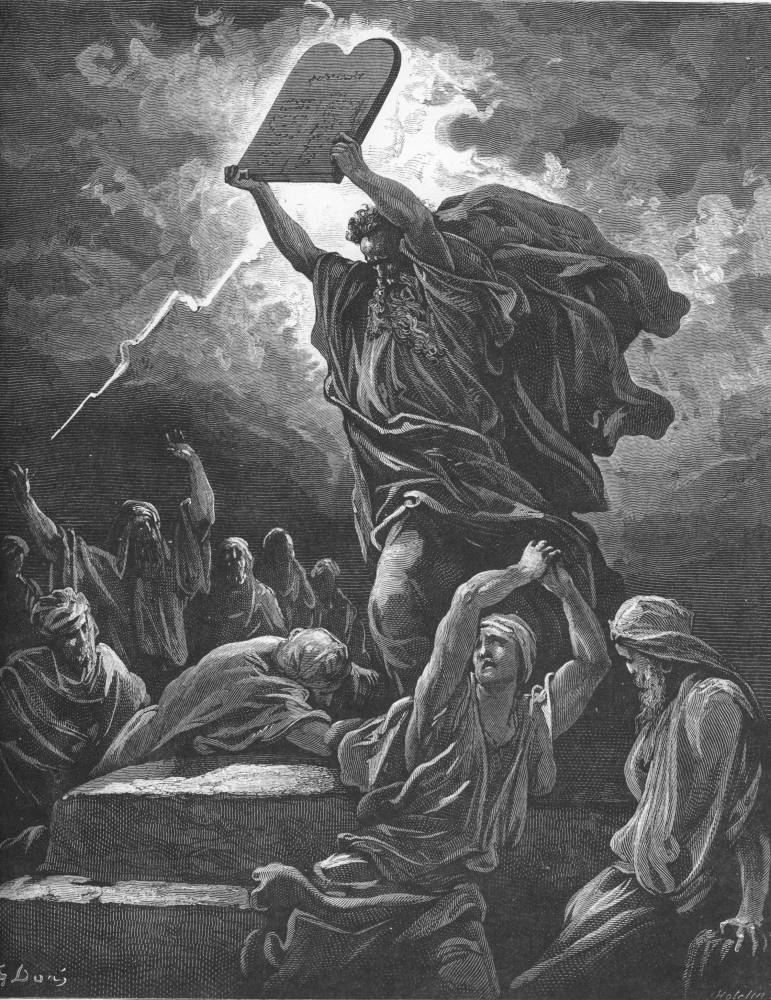
Moses breaks the tablets of the Law, by Gustave Doré (1832-1883)

Then Moses turned and went down from the mountain, carrying the two tablets of the covenant in his hands, tablets that were written on both sides, written on the front and on the back. The tablets were the work of God, and the writing was the writing of God, engraved upon the tablets. When Joshua heard the noise of the people as they shouted, he said to Moses, “There is a noise of war in the camp.” But he said,

“It is not the sound made by victors
or the sound made by losers;
it is the sound of singing that I hear.”

As soon as he came near the camp and saw the calf and the dancing, Moses’s anger burned hot, and he threw the tablets from his hands and broke them at the foot of the mountain.He took the calf that they had made, burned it with fire, ground it to powder, scattered it on the water, and made the Israelites drink it.

Moses said to Aaron, “What did this people do to you that you have brought so great a sin upon them?” And Aaron said, “Do not let the anger of my lord burn hot; you know the people, that they are wicked. They said to me, ‘Make gods for us, who shall go before us; as for this Moses, the man who brought us up out of the land of Egypt, we do not know what has become of him.’ So I said to them, ‘Whoever has gold, take it off’; so they gave it to me, and I threw it into the fire, and out came this calf!”

When Moses saw that the people were out of control (for Aaron had lost control of them, prompting derision among their enemies), then Moses stood in the gate of the camp and said, “Who is on the Lord’s side? Come to me!” And all the sons of Levi gathered around him.He said to them, “Thus says the Lord, the God of Israel: Put your sword on your side, each of you! Go back and forth from gate to gate throughout the camp, and each of you kill your brother, your friend, and your neighbor.” 

The sons of Levi did as Moses commanded, and about three thousand of the people fell on that day. Moses said, “Today you have been ordained for the service of the Lord, each one at the cost of a son or a brother, and so have brought a blessing on yourselves this day.”

On the next day Moses said to the people, “You have sinned a great sin. But now I will go up to the Lord; perhaps I can make atonement for your sin.” So Moses returned to the Lord and said, “Alas, this people has sinned a great sin; they have made for themselves gods of gold. But now, if you will only forgive their sin—but if not, please blot me out of the book that you have written.” 

But the Lord said to Moses, “Whoever has sinned against me I will blot out of my book. But now go, lead the people to the place about which I have spoken to you; see, my angel shall go in front of you. Nevertheless, when the day for punishment comes, I will punish them for their sin.”

Then the Lord sent a plague on the people because they made the calf—the one that Aaron had made. (New Revised Standard Version)

Honestly, this is just a sad story. The ancient Israelites were certainly not at their best. With Moses up on the mountain for about six weeks, there was a large leadership vacuum. Aaron, along with Hur, were to fill that space, keeping things on the straight and narrow while Moses was occupied receiving the commandments of God. That clearly didn’t happen.

Part of the reason for the people getting so out of hand with their sin was the absence of good solid leadership. There is a big contrast between Moses as leader and his brother Aaron as the interim leader.

Moses exhibited himself as a self-differentiated leader. That means, in short, that a leader cannot be overly identified with the group they lead; or else they will not have the needed perspective to make hard decisions. In other words, leaders need to have clearly defined boundaries.

Good leaders need to be in touch with the ideas and emotions of others but not dominated by them. The opposite of being a self-differentiated leader is one who tries to make everyone happy and has a hard time making unpopular decisions. Hence, the difference between the leadership of Moses and that of Aaron.

Who is on the Lord’s side? Which leader is following God’s words and ways? Notice the following distinctions between Moses the self-differentiated leader, and Aaron the leader without boundaries between himself and the people, as evidenced in today’s Old Testament lesson:

  • Moses maintained relational connections with the Levites and others who sought to uphold God’s covenant, when making decisions of conviction.
  • Aaron threw personal convictions aside in order to avoid conflict and keep everyone happy (which, by the way, isn’t even possible).
  • Moses avoided blame-shifting when dealing with the problem, but took ownership of what was going on when speaking with God.
  • Aaron just gave some lame excuses for why things went sideways.
  • Moses faced trouble and walked into the difficulty to make a difference and make things right.
  • Aaron put on a gas mask in the toxic culture and avoided dealing with the people’s sin.
  • Moses was a responsible leader who sought healthy honest relationships with God and others.
  • Aaron was an irresponsible leader who tried to create an unhealthy triangle in order to take the focus off of his poor decisions and actions.
  • Moses directly confronted the sinful situation when confronted with it.
  • Aaron procrastinated dealing with the people’s sin by simply giving them what they wanted.
  • Moses immediately acted when he saw there was a group of saboteurs in the camp.
  • Aaron hesitated in dealing with the unruly persons among the Israelites, with disastrous consequences.

By removing all the rabble rousers in the camp, Moses saved the people. Yet, even then, there was a devastating consequence from God; a divine plague was sent because of the golden calf which Aaron had made.

“Apis” was the most important and highly regarded bull deity of ancient Egypt. The Lord had judged the bull god – along with the other Egyptians gods – within the series of ten plagues which led to Israel’s deliverance. By making a detestable image that looked a lot like Apis, the Israelites, too, experienced a plague of divine judgment. The God who shows no favoritism deals with sin no matter who it is.

Maybe this awful scene could have been avoided – if there was some competent self-differentiated leadership in the absence of Moses. But we will, sadly, never know.

Holy God, forgive us for our idolatry, and help us to stop divinizing and revering creatures and created things in place of you, instead of your actual self and presence which is among us, through Jesus Christ our Lord in the power of the Holy Spirit. Amen.