


But as for you, continue in what you have learned and firmly believed, knowing from whom you learned it and how from childhood you have known sacred writings that are able to instruct you for salvation through faith in Christ Jesus. All scripture is inspired by God and is useful for teaching, for reproof, for correction, and for training in righteousness, so that the person of God may be proficient, equipped for every good work.
In the presence of God and of Christ Jesus, who is to judge the living and the dead, and in view of his appearing and his kingdom, I solemnly urge you: proclaim the message; be persistent whether the time is favorable or unfavorable; convince, rebuke, and encourage with the utmost patience in teaching. For the time is coming when people will not put up with sound teaching, but, having their ears tickled, they will accumulate for themselves teachers to suit their own desires and will turn away from listening to the truth and wander away to myths. As for you, be sober in everything, endure suffering, do the work of an evangelist, carry out your ministry fully. (New Revised Standard Version)
It’s only human in wanting to hear only those things we like to hear. Rarely do any of us purposely seek to listen to another voice which is contrary to our likings. This may be why we exist in such a polarized world; we simply have no intention of listening to any sort of opposing view on anything.
We put our fingers in our ears to stop hearing things we don’t want to hear; and conversely, we surround ourselves only with people who tell us what we want to hear.
The Apostle Paul would say that we like our ears tickled.
One of the hardest things to hear is that sometimes we need to hear hard things.
There is no spiritual growth, and no Christian maturity, apart from the willingness to hear what we need to hear, rather than to always hear what we want to hear. All of us need to keep developing our listening skills.
I would argue that one of the reasons there are umpteen Protestant denominations in this world is that groups of people don’t really want to listen to one another. We’d much rather insulate ourselves; label ourselves as right; and declare that everyone else is worldly and wrong, or an antichrist and a terrorist.
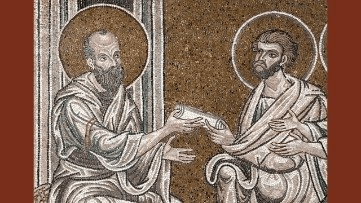
But that sort of thinking will not do for the Apostle Paul. It’s one of the reasons he took the time to write to his young protégé Timothy.
Paul’s letter to Timothy is filled with exhortations and warnings about making sure the church is ethical with their words; avoids useless and profane speech; holds to sound biblical talk; and stays away from speaking erroneously about apostolic teaching.
In other words, church folk must keep their life, their doctrine, and their speech in line with the words and ways of Jesus – even when we encounter hard words from our Lord and his apostles.
Listening to what we need to hear, instead of always what we want to hear, is a significant way of maturing in the Christian life.
We choose to listen to hard things, and things we don’t necessarily want to hear in order to connect with God and others; and to compassionately understand what they’re saying to us.
We need not be at the mercy of our own reactivity. Knee jerk reactions only breed ignorance, not spiritual growth.
Since listening is a skill to develop, that means we need a lot of practice doing it. We can begin by listening to Scripture; embracing the sort of faith which it advocates; and following the examples of godly persons, like the Apostle Paul.
In Timothy’s case, faith was learned and nurtured through the examples of his mother Eunice and grandmother Lois (2 Timothy 1:5). Their compassionate and beloved way of life displayed an embodied source of sound teaching.
There was a whole lot more going on with the godly examples than catechism classes and Sunday School lessons. Their teaching effected a deep and enduring desire to follow the example of godly living.
Every believer needs helpful examples and models, whether they are family or not. The truly Christian person is one who allows the inspiration of Holy Scripture to manifest itself in their life in profoundly powerful ways which brings transformation, not just information.
And whenever these godly persons are together, making up a Christian community, then there is wise discernment in carefully listening to what is right, true, good, and just. Gossip is jettisoned. Lack of evidence is not ever entertained. Rather, encouragement and spiritual nurture take hold.
Christians with the inspired text in the very marrow of their souls faithfully call out deviations and departures from godly scriptural speech. They hold to righteousness and embrace the good. They love mercy and exhibit humility in all things.
Holy Scripture was not a collection of facts for Timothy, but was engrafted into his mind and heart so that what came out of him was faith, hope, and love. Christians like Paul and Timothy had a well-rounded spirituality which was attuned to following Jesus and nurturing the faith of others.
Paul lovingly and confidently exhorted Timothy (and his congregation) to go diligently after Scripture, so that it could do its work within them. They were to speak out the gospel of grace, no matter the situation.
Believers are to liberally use apostolic teaching to convince, rebuke, and encourage each other toward the righteousness of God.
Everyone is to work together in practicing holiness, proclaiming grace, and promoting a way of life rooted in the life of Christ.
Everyone is to avoid flocking to leaders who only tell them what they want to hear. They are to instead flock toward humble and wise leadership who possess time-tested teaching – not pithy slogans and promotions of hate.
Reliable true-blue teaching understands perseverance, long-suffering, honesty, and fidelity to Christ’s words. The truth is stated plainly, and thinks of others. There’s no get-down-and-dirty pride; no posturing nor slick salesmanship.
Timothy cared nothing about getting as many social media followers as he could. And he wasn’t so insecure as to want everyone in his congregation to like him. But neither was he calloused by forcing his way on everyone. Paul taught him better than that.
Paul’s instruction took hold with Timothy by cultivating a genuine spiritual growth that is organic and patient, rooted in love, that can always hearken back to the faithfulness of Christ and the apostles.
It is profoundly sad to me how many persons have left the church. And yet, I understand why. There are too many pastors and elders and deacons who are driven by their own selfish desires for power, control, money, and personal followers. That stuff is a sure prescription for people to get hurt and disillusioned with Christianity, let alone the church.
The Apostle Paul wanted to see leadership which reflects the grace by which he himself had been saved. Furthermore, Paul was devoted to being a mentor in helping others like Timothy and Titus to live in ways which exhibit the grace and mercy of Christ.
A hard teaching is really only hard wherever there exists a hard heart. We all need ever-expanding and softening hearts which are receptive to the voice of Holy Scripture.
What’s more, we need non-itchy ears which listen to the voice of God and the voice of hurting people who need the gospel of grace.
We need godly leadership who knows the difference between truth and being a jerk.
Where are you in your own faith walk?
O God, Spirit of righteousness, you temper judgment with mercy. Help us to live out the covenant which is written on our hearts so that when Christ returns we may be found worthy to receive your gracious presence. Amen.




 Rev. Tim Ehrhardt