This Is No Time for Bitterness (2 Samuel 3:31-38)

David at the tomb of Abner, by Unknown Artist, 1850

Then David said to Joab and all the people with him, “Tear your clothes and put on sackcloth and walk in mourning in front of Abner.” King David himself walked behind the bier. They buried Abner in Hebron, and the king wept aloud at Abner’s tomb. All the people wept also.

The king sang this lament for Abner:

“Should Abner have died as the lawless die?
    Your hands were not bound,
    your feet were not fettered.
You fell as one falls before the wicked.”

And all the people wept over him again.

Then they all came and urged David to eat something while it was still day; but David took an oath, saying, “May God deal with me, be it ever so severely, if I taste bread or anything else before the sun sets!”

All the people took note and were pleased; indeed, everything the king did pleased them. So on that day all the people there and all Israel knew that the king had no part in the murder of Abner son of Ner.

Then the king said to his men, “Do you not realize that a commander and a great man has fallen in Israel this day? (New International Version)

To put it succinctly, Abner was a rascal. He was smart and savvy, as well as self-centered and treacherous. Abner was the general of Israel’s armies. In his shrewdness, Abner knew that King David of Judah would eventually win out.

So, he set things up to sell-out his position with Ish-Bosheth, the king of Israel, and bring all of Israel and Judah together as one people. Then, he would be the general in a united kingdom under David.

However, Abner had burned some bridges in his day, and created some enemies. Joab was one of them, David’s general. What’s more, Joab was loyal to King David and did not have intentions like those of Abner. All of this (and more) stirred within Joab, as Abner and David talked through a transition plan.

Joab was a bitter man. He and his brother Abishai did not like their king consorting with Abner. Abner had killed their brother Asahel in the battle at Gibeon. Bitterness turned Joab into a myopic person who could only see his own perspective. So he and his brother murdered Abner without David’s knowledge. Abner was a stinker in a lot of ways. But he didn’t go around murdering people, and he himself didn’t deserve to be murdered.

When David found out, he chose not to channel his anger into another murder. Instead, he wisely focused on grieving the loss of Abner and demonstrating to all Israel and Judah what sort of king he really was.

“Many people suffer because of the false supposition on which they have based their lives. That supposition is that there should be no fear or loneliness, no confusion or doubt. But these sufferings can only be dealt with creatively when they are understood as wounds integral to our human condition.” Henri Nouwen

Far too many people allow their spiritual and emotional wounds to fester – eventually poisoning their own character. With the illness of bitterness, someone is always bound to get hurt.

We all have to contend with adverse situations and hard circumstances. Our doubts, wonderings, hurts, and suffering may be legitimate, yet if addressed in an illegitimate way, those things become emotional wounds that seek to wound others.

Make every effort to live in peace with everyone and to be holy; without holiness no one will see the Lord. See to it that no one falls short of the grace of God and that no bitter root grows up to cause trouble and defile many. (Hebrews 12:14-15, NIV)

David had no picnic for a life. Saul had tried to repeatedly kill him, hunting David down like an animal. After Saul was killed in battle, there were all sorts of shenanigans going on with people like Abner and Joab. This was no idyllic setting for David to set up a kingdom.

And yet, David made it work by not succumbing to the bitterness which was so easy for others. King David did something different. He seemed to understand that his own woundedness, sufferings, and doubt was the place for personal and spiritual growth – a way of connecting with God.

The hurts which David acquired in his life never became a source of shame to him. Instead, those things became a source of healing – which made him a wounded healer who was able to rule Israel and Judah with mercy, wisdom, and justice.

For us, the same thing can happen. All of the stuff we’ve been through, from people who intended harm for us, doesn’t have to end with being poisoned by bitterness. Our actual woundedness can become the place where we bless the world.

Indeed, ‘tis our weaknesses which give us our true strength.

Bitterness, on the other hand, may fuel some anger and give us a false sense of strength; but it’s only really a matter of time until we implode. And before that happens, the bitter person will likely take down others with the inevitable spit of poison which is vomited up from the pit of their serpentine belly.

We are, like David, to take a different path in dealing with the troubles brought upon us by others:

And do not grieve the Holy Spirit of God, with whom you were sealed for the day of redemption. Get rid of all bitterness, rage and anger, brawling and slander, along with every form of malice. Be kind and compassionate to one another, forgiving each other, just as in Christ God forgave you. (Ephesians 4:30-32, NIV)

The road to a better life is full of twists and turns, and fraught with severe potholes and downed trees. But the road to a bitter life is quite easy, straight and paved perfectly smooth with asphalt. The problem is that it is a one way highway to the cemetery.

The clock is ticking, and it’s no time for bitterness. Which road will you take?

Blessed God and Father of our Lord Jesus Christ, please don’t let our appropriate anger morph into destructive revenge. Don’t let our raw hurts become a festering and putrid abscess of the soul, which is bent on getting even—repaying harm for harm, evil for evil, and death for death.

Holy Spirit, our Companion and Counselor, don’t let our hearts become gardens for the roots of resentment, growing into bushes of bitterness. Give us, instead, the desire to forgive others. May redemption and restoration have their way in us, through Christ our Lord. Amen. 

Who Would You Follow? (2 Samuel 3:1-12)

There was a long war between the house of Saul and the house of David; David grew stronger and stronger, while the house of Saul became weaker and weaker.

Sons were born to David at Hebron: his firstborn was Amnon, of Ahinoam of Jezreel; his second was Chileab, of Abigail the widow of Nabal of Carmel; the third was Absalom son of Maacah, daughter of King Talmai of Geshur; the fourth was Adonijah son of Haggith; the fifth was Shephatiah son of Abital; and the sixth was Ithream, of David’s wife Eglah. These were born to David in Hebron.

While there was war between the house of Saul and the house of David, Abner was making himself strong in the house of Saul. Now Saul had a concubine whose name was Rizpah daughter of Aiah. And Ishbaal said to Abner, “Why have you gone in to my father’s concubine?” 

The words of Ishbaal made Abner very angry; he said, “Am I a dog’s head for Judah? Today I keep showing loyalty to the house of your father Saul, to his brothers, and to his friends and have not given you into the hand of David, yet you charge me now with a crime concerning this woman. So may God do to Abner and so may he add to it! For just what the Lord has sworn to David, that will I accomplish for him: to transfer the kingdom from the house of Saul and set up the throne of David over Israel and over Judah, from Dan to Beer-sheba.” And Ishbaal could not answer Abner another word because he feared him.

Abner sent messengers to David where he was, saying, “To whom does the land belong? Make your covenant with me, and I will give you my support to bring all Israel over to you.” (New Revised Standard Version)

Our basic inner character as people is a combination of:

  1. What we do (actions and inactions)
  2. Why we do it (attitudes and motives)
  3. How we go about doing it (means and methods)

We can observe one’s personal character by the reactions and responses to their life events and situations. In addition, Holy Scripture is also concerned and attentive to all of our actions, interactions, inactions, and reactions in the world.

Stories in the Old Testament are largely designed to help us, as readers and listeners, to compare and contrast the mindsets, motivations, and morals of the principal actors in those narratives. We are meant to understand the difference between godly and ungodly people through how the story shakes out.

Three leaders are paraded before us in today’s Old Testament lesson. The story is arranged so that we will take a look at their manner of life. The lesson invites us to implicitly ask ourselves, “Which of the three characters would I follow?”

David

King David was the sort of leader who inquired of God continually, listened to God’s voice, and used his authority to extend kindness and justice, like God does. Because of David’s character, his reign became stronger and stronger.

David was also the sort of leader who had no intentions nor plans to annihilate all of Saul’s heirs as rivals to this throne. Neither did David set out to make their lives miserable – despite the fact that most people of the time would actually expect him to do that.

Ish-Bosheth

Whereas David was initially ruling only over Judah, Ish-Bosheth was a son of Saul and king of Israel. But he was a mere figurehead. Abner, the army’s general, was the one really calling the political shots in Israel.

Ish-Bosheth was too fearful to challenge Abner, and so, never exerted a significant influence in Israel. Instructive for us as readers, is the absence of this king’s prayers or efforts to do anything helpful or constructive for the Israelite people.

The name “Ish-Bosheth” essentially means “Master,” a dignified word which is meant to communicate respect. The incongruence between Ish-Bosheth’s ascribed name, and his actual attitudes and lack of action, betrays a double-minded person, divided in decision-making, not knowing quite what to do. And so, he pretty much did nothing, at least nothing that truly helped anyone in the kingdom.

Contrasting Ish-Bosheth with David, we can clearly see that David was no figurehead, but was the leader of his people. Unlike Ish-Bosheth, David was also no washrag, and no one’s puppet. Instead, David took charge of situations by inquiring of God, then acting.

Confidence comes from knowing the Lord and stepping out in faith, which is precisely what David’s pattern of kingship was like – and exactly what the reign of Ish-Bosheth was not like.

Abner

Israel’s general, Abner, was neither like David nor Ish-Bosheth. Although Abner had qualities of confidence and initiative, unlike David, he was a self-serving leader.

Abner used his position to gain for himself power and prestige. He was willing to quickly switch his loyalties when it was no longer helpful for him, personally. Although Abner did right by working toward uniting the kingdoms of Israel and Judah (a good thing) he did it for all the wrong reasons (a bad thing).

Compared to David, Abner had only self-interest, and not the common interest of all citizens in mind. He acted for what he could personally get out of it – which is just the opposite of David, who had an eye which scanned the horizon to do what was best for the common good of all the kingdom’s subjects.

Conclusion

When we read today’s story, the guided narrative wants us to arrive at the conclusion of saying, “I don’t want to become, or follow, somebody like Ish-Bosheth or Abner. I want to become and to follow someone like King David.”

David listened to God, prayed to God, and acted with justice and kindness because of God. There’s likely no better approach to the spiritual life than that.

Grant us, Lord God, a vision of our world as your love would make it: a world where the weak are protected, and none go hungry or poor; a world where the benefits of abundant life are shared, and everyone can enjoy them; a world where different races and cultures live in tolerance and mutual respect; a world where peace is built with justice, and justice is guided by love. And give us the inspiration and courage to build it. Amen.

2 Samuel 7:18-29 – A Model Prayer

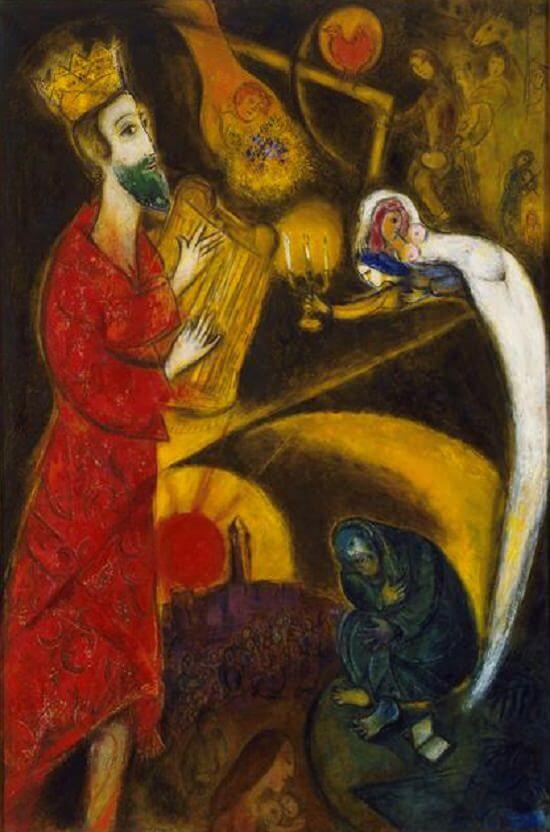
King David by Marc Chagall, 1962

Then King David went in and sat before the Lord, and he said:

“Who am I, Sovereign Lord, and what is my family, that you have brought me this far? And as if this were not enough in your sight, Sovereign Lord, you have also spoken about the future of the house of your servant—and this decree, Sovereign Lord, is for a mere human!

“What more can David say to you? For you know your servant, Sovereign Lord. For the sake of your word and according to your will, you have done this great thing and made it known to your servant.

“How great you are, Sovereign Lord! There is no one like you, and there is no God but you, as we have heard with our own ears. And who is like your people Israel—the one nation on earth that God went out to redeem as a people for himself, and to make a name for himself, and to perform great and awesome wonders by driving out nations and their gods from before your people, whom you redeemed from Egypt? You have established your people Israel as your very own forever, and you, Lord, have become their God.

“And now, Lord God, keep forever the promise you have made concerning your servant and his house. Do as you promised, so that your name will be great forever. Then people will say, ‘The Lord Almighty is God over Israel!’ And the house of your servant David will be established in your sight.

“Lord Almighty, God of Israel, you have revealed this to your servant, saying, ‘I will build a house for you.’ So, your servant has found courage to pray this prayer to you. Sovereign Lord, you are God! Your covenant is trustworthy, and you have promised these good things to your servant. Now be pleased to bless the house of your servant, that it may continue forever in your sight; for you, Sovereign Lord, have spoken, and with your blessing the house of your servant will be blessed forever.” (New International Version)

“The whole reason why we pray is to be united into the vision and contemplation of God to whom we pray.”

Julian of Norwich (1343-1416)

Perhaps you wish you had a better prayer life. To pray, as with most things in life, requires both motivation and how to do it. So, it’s appropriate to find answers about prayer by observing the biblical models of prayer contained in Holy Scripture.

Today’s Old Testament lesson is King David’s prayer in response to God’s revelation to him about fulfilling covenant promises. Looking at David’s prayer, there is a three-fold division which models for us a good way to approach God.

The Present: Gratitude for God’s Grace

David began his prayer with an attitude, posture, and words of humility, recognizing and affirming the relationship between himself and God. Although David is the king over all Israel and Judah, he repeatedly refers to himself as a servant (10 times).

God didn’t have to communicate anything to David about the future. Yet, the Lord graciously made known that it would be through David’s descendants that all of God’s good promises will be fulfilled. And David is overwhelmed with such gracious words. It comes tumbling out of him in a heartfelt prayer of gratitude and thanksgiving.

It is good for us to think about the spiritual blessings we have received from God. Not only can prayers of thanksgiving be uttered at any time to the Lord, but we can also write our gratitude in a journal as a prayer offering to God.

It’s also good to be specific about the circumstances and the praises. In the future, whenever there are discouraging situations, we can look back to what we wrote and remember the ways in which God showed up and encouraged us with very great and precious promises.

The Past: Praise for God’s Actions

David affirms there is no one and no god which can compare to Yahweh, the great I Am. It is the Lord God almighty who displayed divine power and presence in redeeming the Israelites out of Egyptian slavery and into the Promised Land.

Any greatness which arises from humans is the direct result of God’s greatness. Apart from God, there is no distinctive way of living. God’s presence makes all the difference:

Then Moses said to him [Yahweh], “If your Presence does not go with us, do not send us up from here. How will anyone know that you are pleased with me and with your people unless you go with us? What else will distinguish me and your people from all the other people on the face of the earth?” (Exodus 33:15-16, NIV)

The Lord specializes in bending hopeless situations to divine purposes, transforming people to new life, and turning systemic evil on its head so that the humble, meek, and penitent will be first, not last.

The Future: Prayer for God to Fulfill Divine Promises

King David already knew God’s promises to the Israelites. Now, however, David understands how he personally fits into the Lord’s plan.

Courage arises whenever God’s people know God’s promises and then discern how to fit into God’s plan. Confident assurance and settled peace cannot simply be ginned-up through positive thinking; bold faith needs a foundation of truth – a rock solid base which cannot be moved and is always there.

King David found his ultimate motivation in life in God’s revelation. His basis of prayer was God’s Word. Biblical prayers, like David’s, are there for us to model our own prayers.

Accept, O Lord, our thanks and praise for all that you have done for us. We thank you for the splendor of the whole creation, for the beauty of this world, for the wonder of life, and for the mystery of love. We thank you for the blessing of family and friends, and for the loving care which surrounds us on every side. We thank you for setting us at tasks that demand our best efforts, and for leading us to accomplishments that satisfy and delight us. We thank you also for those disappointments and failures that lead us to acknowledge our dependence on you alone.

Above all, we thank you for your Son Jesus Christ; for the truth of his Word and the example of his life; for his steadfast obedience, by which he overcame temptation; for his dying, through which he conquered death; and for his rising to life again, in which we are raised to the life of your kingdom. Grant us the gift of your Spirit, that we may know Christ and make him known; and through him, at all times and in all places, may give thanks to you in all things. Amen.

2 Samuel 15:13-31 – Unflagging Trust

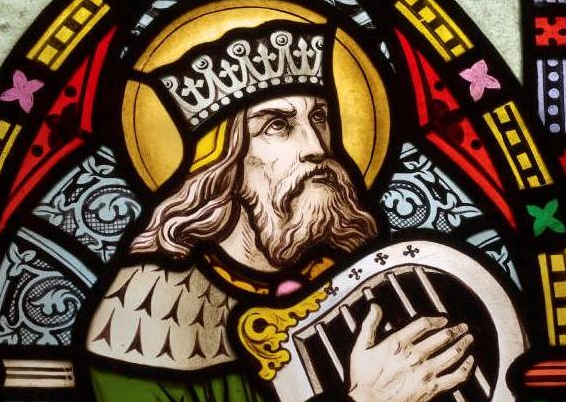
Stained glass of King David, Fringford, England church

A messenger came and told David, “The hearts of the people of Israel are with Absalom.”

Then David said to all his officials who were with him in Jerusalem, “Come! We must flee, or none of us will escape from Absalom. We must leave immediately, or he will move quickly to overtake us and bring ruin on us and put the city to the sword.”

The king’s officials answered him, “Your servants are ready to do whatever our lord the king chooses.”

The king set out, with his entire household following him; but he left ten concubines to take care of the palace. So, the king set out, with all the people following him, and they halted at the edge of the city. All his men marched past him, along with all the Kerethites and Pelethites; and all the six hundred Gittites who had accompanied him from Gath marched before the king.

The king said to Ittai the Gittite, “Why should you come along with us? Go back and stay with King Absalom. You are a foreigner, an exile from your homeland. You came only yesterday. And today shall I make you wander about with us when I do not know where I am going? Go back and take your people with you. May the Lord show you kindness and faithfulness.”

But Ittai replied to the king, “As surely as the Lord lives, and as my lord the king lives, wherever my lord the king may be, whether it means life or death, there will your servant be.”

David said to Ittai, “Go ahead, march on.” So Ittai the Gittite marched on with all his men and the families that were with him.

The whole countryside wept aloud as all the people passed by. The king also crossed the Kidron Valley, and all the people moved on toward the wilderness.

Zadok was there, too, and all the Levites who were with him were carrying the ark of the covenant of God. They set down the ark of God, and Abiathar offered sacrifices until all the people had finished leaving the city.

Then the king said to Zadok, “Take the ark of God back into the city. If I find favor in the Lord’s eyes, he will bring me back and let me see it and his dwelling place again. But if he says, ‘I am not pleased with you,’ then I am ready; let him do to me whatever seems good to him.”

The king also said to Zadok the priest, “Do you understand? Go back to the city with my blessing. Take your son Ahimaaz with you, and also Abiathar’s son Jonathan. You and Abiathar return with your two sons. I will wait at the fords in the wilderness until word comes from you to inform me.” So Zadok and Abiathar took the ark of God back to Jerusalem and stayed there.

But David continued up the Mount of Olives, weeping as he went; his head was covered, and he was barefoot. All the people with him covered their heads too and were weeping as they went up. Now David had been told, “Ahithophel is among the conspirators with Absalom.” So, David prayed, “Lord, turn Ahithophel’s counsel into foolishness.” (New International Version)

“Faith is taking the first step even when you don’t see the whole staircase.”

Martin Luther King, Jr.

It’s an understatement to say that King David had family drama.

Maybe that’s because he had a lot of wives and even more kids. Or it could be that being a king didn’t transfer well to being a father. And it just might be that his experience was mostly about simply living in a fallen world, full of icky relational dynamics and human conflict.

David seemed to be at his best when at his lowest. His son, Absalom, carefully designed a conspiracy to take over the kingdom. And it was looking as though he might just do it. David, and those loyal to him, fled Jerusalem to avoid being overthrown and killed. They were between a rock and a hard place, to put it mildly. David was literally running for his life.

If we put ourselves in David’s sandals, how would we respond? 

I suppose, at the least, we would likely complain. Who is Absalom that he should dishonor his father in such a way as this? Then, we may try and find ways to maintain power, and get back at Absalom for being a rebellious and destructive son. 

I am humbled by David’s unflagging trust in God. Like the suffering Job centuries before him, David was willing to receive anything from the hand of God, whether for good or evil. He wholesale accepted whatever seemed good to God, without attempting to force anything on the Lord. “Let God do to me what seems good to him,” was the faith affirmation of David.

Yet, at the same time, David was aware and in touch with his emotions as he left the city and ascended the Mount of Olives. He wept and lamented over the situation he and all those with him had to experience. 

A thousand years later, Jesus took the same trek out of the city in great sorrow because of people who conspired against him. Christ faced the agony of the cross through the machinations of sinful humanity who did not want him as Lord over their lives.

Our confidence must rest in the God who is never caught unaware of our situations and always knows how to respond. We must rely on our prayers to the Lord as we navigate the difficulties of this life. 

Humility goes a long way toward letting the will of God rule the day.

O Lord, please turn the plans and the counsel of evil persons into foolishness. Do not let the sinfulness of people have its way and run roughshod over my life.  I trust in you to bend a bad situation toward your own good purpose through Jesus Christ my Lord.  Amen.