God Is Good, Idols Are Bad (2 Kings 17:7-20)

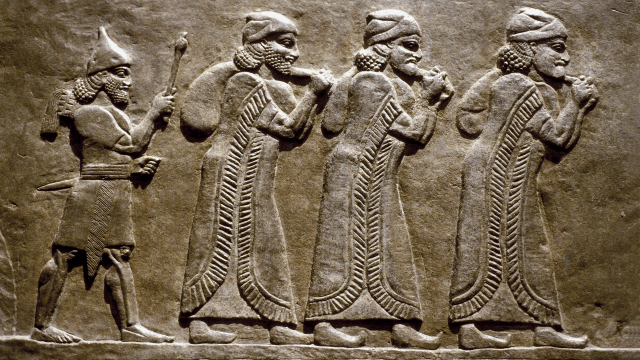
 An Assyrian solider deporting people from their land (From the Southwest Palace of Tiglath-Pileser III at Nimrud, ca. 730-727 B.C.E.; British Museum.)

The Israelites sinned against the Lord their God, who brought them out of Egypt and rescued them from the power of Pharaoh (the king of Egypt). They worshiped other gods and lived by the customs of the nations that the Lord had forced out of the Israelites’ way. They also did what their kings wanted them to do.The Israelites secretly did things against the Lord their God that weren’t right:

They built for themselves illegal places of worship in all of their cities, from the smallest watchtower to the largest fortified city.

They set up sacred stones and poles dedicated to the goddess Asherah on every high hill and under every large tree.

At all the illegal places of worship, they sacrificed in the same way as the nations that the Lord had removed from the land ahead of them.

They did evil things and made the Lord furious.

They served idols, although the Lord had said, “Never do this.”

The Lord had warned Israel and Judah through every kind of prophet and seer, “Turn from your evil ways, and obey my commands and decrees as I commanded your ancestors in all my teachings, the commands I sent to you through my servants the prophets.” But they refused to listen. They became as impossible to deal with as their ancestors who refused to trust the Lord their God. They rejected his decrees, the promise he made to their ancestors, and the warnings he had given them. They went after worthless idols and became as worthless as the idols. They behaved like the nations around them, although the Lord had commanded them not to do that. They abandoned all the commands of the Lord their God:

They made two calves out of cast metal.

They made a pole dedicated to the goddess Asherah.

They prayed to the entire army of heaven.

They worshiped Baal.

They sacrificed their sons and daughters by burning them alive.

They practiced black magic and cast evil spells.

They sold themselves by doing what the Lord considered evil, and they made him furious.

The Lord became so angry with Israel that he removed them from his sight. Only the tribe of Judah was left. Even Judah didn’t obey the commands of the Lord their God but lived according to Israel’s customs. So the Lord rejected all of Israel’s descendants, made them suffer, handed them over to those who looted their property, and finally turned away from Israel. (God’s Word Translation)

The Flight of the Prisoners, by James Tissot, 1898, depicting the Babylonian exile from Jerusalem

The prophets had warned the northern kingdom of Israel; but they did not listen, nor did they heed the prophetic utterance. Israel then stood as an example and a warning to the southern kingdom of Judah; yet they, too, refused to learn from their brother’s downfall.

And even before the kingdom was split between Israel in the north and Judah in the south, the ancient Israelites had a troubling tendency to buck the Lord’s instructions and find other more and creative ways of expressing themselves spiritually.

Every generation of people are responsible for their own spirituality and their own actions in life. We, in our contemporary time and place, need to learn the lessons of the past – for we also are not an exception in history, as if we can do whatever we want without attending to the common good of all persons and worshiping in any sort of way we want.

The trouble with the ancient worshipers of Yahweh is that they decided to pick and choose whatever commands they wanted to follow, or not. They went through continual times of idolatry and forgot about God and God’s Word to them.

To respect and revere the Lord is to obey God’s instructions. To worship Yahweh is to have an undivided allegiance to God and God’s commands. The failure to obey is really a failure of faith.

The prophets Amos, Hosea, Micah, and Isaiah specifically called out the sinful practices of the people and their negligence in upholding basic social and economic justice for everyone. They condemned violence and oppression of the poor; and expressed the divine displeasure with taking advantage of the disadvantaged.

How to treat people and live well were explicitly spelled out in the entirety of God’s Law. Yet, the leaders and the people, as a whole, decided to go another way. They kept introducing idolatrous and unhealthy forms of worship and living. And it led to their ruin.

The ancient people were continually offered grace if they would only accept it. They could return to the Lord and come back to the true worship and obedience of the God who had rescued them from trouble again and again. Turning from their unholy practices, and turning back to Yahweh, would reverse God’s impending judgment. Yet, tragically, the people did not listen.

Idolatry is a failure to trust God, and to rely instead on something else which is not able to sustain a life. Unfortunately, those who create a god according to their own liking end up becoming like the thing they worship, that is, worthless.

The tragedy of the Israelites is that they were to be God’s people, the Lord’s treasured possession, a kingdom of priests, and a holy nation which brings blessing to the earth. Instead, they traded their meaning and purpose in life to imitate everyone else around them.

Sadly, people have felt throughout history, and even we ourselves today, that there is something else, other than God, that we need in order to be happy – something more important to your heart than the Lord – whether it is human acceptance and approval, social reputation, political power and control, or financial advantage and privilege.

Idolatry creates an ignoring of the divine in our life. We might even have the chutzpah to think we can challenge God, like some small yippee pup who growls and takes on the big dog, who knows that with an effortless paw across the body, could toss the prideful pup away.

Like a mother bird who scours the land for food to sustain the babies, and brings it back to their gaping mouths, God longs to provide us with a good and beautiful life – if we will but only receive it.

Listen, my people, I’m warning you!
    If only you would listen to me, Israel.
There must be no foreign god among you.
    You must not bow down to any strange deity.
I am the Lord your God,
    who brought you up from Egypt’s land.
    Open your mouth wide—I will fill it up! (Psalm 81:8-10, CEB)

O Lord, as you gave us the greatest commandment, to love you with all our heart, soul, strength and mind, help us to love you above all else, putting you above the potential idols in our lives, including success, fame and wealth. May your benevolent kingdom come, and your moral and ethical will be done, here on this earth for this time, as it is always done in your heaven. Amen.


Slow Down (2 Kings 2:1-12)

Not long before the Lord took Elijah up into heaven in a strong wind, Elijah and Elisha were leaving Gilgal. Elijah said to Elisha, “The Lord wants me to go to Bethel, but you must stay here.”

Elisha replied, “I swear by the living Lord and by your own life that I will stay with you no matter what!” And he went with Elijah to Bethel.

A group of prophets who lived there asked Elisha, “Do you know that today the Lord is going to take away your master?”

“Yes, I do,” Elisha answered. “But don’t remind me of it.”

Elijah then said, “Elisha, now the Lord wants me to go to Jericho, but you must stay here.”

Elisha replied, “I swear by the living Lord and by your own life, that I will stay with you no matter what!” And he went with Elijah to Jericho.

A group of prophets who lived there asked Elisha, “Do you know that today the Lord is going to take away your master?”

“Yes, I do,” Elisha answered. “But don’t remind me of it.”

Elijah then said to Elisha, “Now the Lord wants me to go to the Jordan River, but you must stay here.”

Elisha replied, “I swear by the living Lord and by your own life that I will never leave you!” So the two of them walked on together.

Fifty prophets followed Elijah and Elisha from Jericho, then stood at a distance and watched as the two men walked toward the river. When they got there, Elijah took off his coat, then he rolled it up and struck the water with it. At once a path opened up through the river, and the two of them walked across on dry ground.

After they had reached the other side, Elijah said, “Elisha, the Lord will soon take me away. What can I do for you before that happens?”

Elisha answered, “Please give me twice as much of your power as you give the other prophets, so I can be the one who takes your place as their leader.”

“It won’t be easy,” Elijah answered. “It can happen only if you see me as I am being taken away.”

Elijah and Elisha were walking along and talking, when suddenly there appeared between them a flaming chariot pulled by fiery horses. At once, a strong wind took Elijah up into heaven. Elisha saw this and shouted, “Israel’s cavalry and chariots have taken my master away!” After Elijah had gone, Elisha tore his clothes in sorrow. (Contemporary English Version)

“For fast-acting relief from stress, try slowing down.”

Lily Tomlin

In placing today’s Old Testament lesson of Elijah ascending to heaven in a whirlwind next to yesterday’s New Testament lesson of Christ’s ascension, the Revised Common Lectionary wants us to consider the relationship between the two.

What goes up, must come down. Two people ascending to heaven will eventually descend back to the earth.

But why all this elapsed time? If there’s something left yet to be done, why not just do it then? Or right now?

Ah, but there’s the issue. In asking such questions, I (we) betray our modern Western mindset of being governed by the god of speed.

The archenemy of faster is to be slow. And, believe me, slow is seen as a sin by most Westerners. For example, because I have a bum back, I tend to walk slow. More than once, I’ve walked from the parking lot into a store and had cars honk at me, and even some drivers swear and flip the bird at me – just for not hurrying along and making them wait a precious few seconds.

Or take the case of the stereotypical boss who is ready to pounce on an employee who shows up a minute late for work (of which I’ve observed a hundred times over my career). I’m sure you have your own examples.

In God’s kingdom, the slow will inherit the earth – not the speedy ones. That’s because God, at least from a human perspective, is slow. Yet, that’s more of a subjective matter and an issue of perspective. Christ ascended to heaven two thousand years ago. And still no Jesus, no Second Coming. What’s “up” with that? Because many people aren’t “down” with it.

But do not forget this one thing, dear friends: With the Lord a day is like a thousand years, and a thousand years are like a day. The Lord is not slow in keeping his promise, as some understand slowness. Instead he is patient with you, not wanting anyone to perish, but everyone to come to repentance. (2 Peter 3:8-9, NIV)

Far from being a sin, slowness is actually a virtue. Spiritual maturity can only result with the element of time – lots of it. There’s no quick way to becoming whole and integrated. Bible Cliff’s Notes aren’t going to get you very far. Most things cannot be rushed – especially when it comes to our words. Running our mouths never ends well.

You must understand this, my beloved brothers and sisters: let everyone be quick to listen, slow to speak, slow to anger, for human anger does not produce God’s righteousness. (James 1:19-20, NRSV)

Elijah will come. So will Jesus. In the meantime, we need to embrace being an Elisha character who learns the unforced rhythms of grace and discerns the power in slowness.

We are to take time in learning from a trusted mentor… time in sitting with difficult emotions, like sorrow, and time in allowing God to be God so that untimely shenanigans like pulling up the wheat when trying to rid the field of weeds doesn’t happen.

People have a job to do while we wait – to bear witness of the things we have seen and heard. Power is given to those who await God’s gracious gift. Pentecost is just around the corner. Be patient.

Gracious and patient God, slow me down so that I may see you in this fast paced life. Give us all a listening heart and contemplative eyes, so that we might hear your voice may see you in our active world, through Christ our Lord. Amen.

2 Kings 23:15-25 – Repent, Renew, and Reform

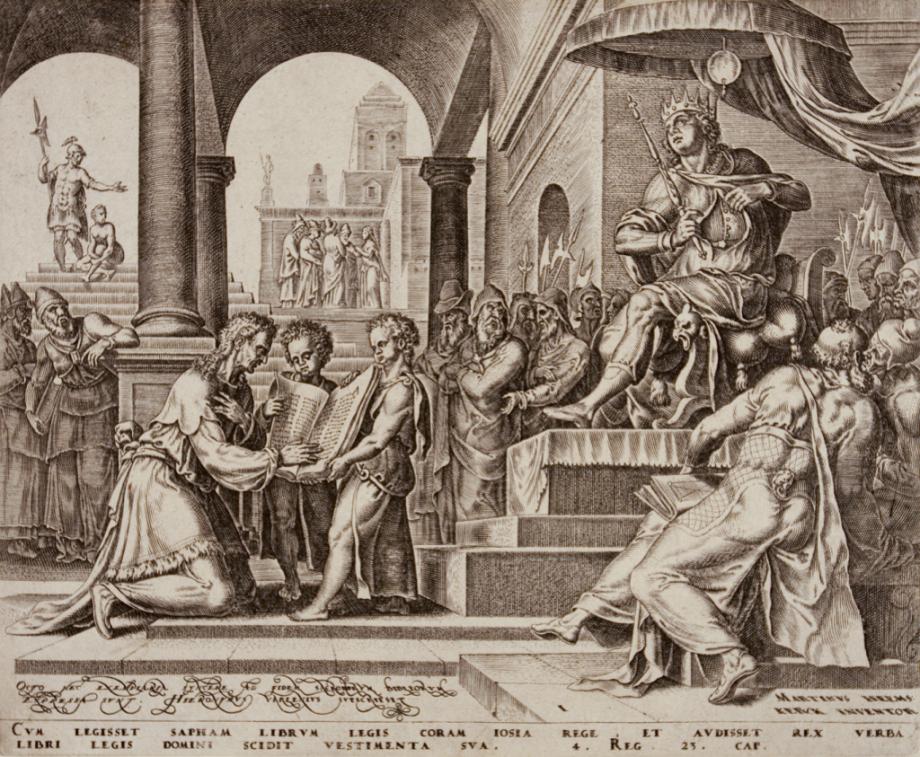
The Book of the Law, Read to King Josiah by Dutch artist Maerten van Heemskerck, c.1569

The king smashed all the altars to smithereens—the altar on the roof shrine of Ahaz, the various altars the kings of Judah had made, the altars of Manasseh that littered the courtyard of The Temple—he smashed them all, pulverized the fragments, and scattered their dust in the Valley of Kidron. The king proceeded to make a clean sweep of all the sex-and-religion shrines that had proliferated east of Jerusalem on the south slope of Abomination Hill, the ones Solomon king of Israel had built to the obscene Sidonian sex goddess Ashtoreth, to Chemosh the dirty-old-god of the Moabites, and to Milcom the depraved god of the Ammonites. He tore apart the altars, chopped down the phallic Asherah-poles, and scattered old bones over the sites. Next, he took care of the altar at the shrine in Bethel that Jeroboam son of Nebat had built—the same Jeroboam who had led Israel into a life of sin. He tore apart the altar, burned down the shrine leaving it in ashes, and then lit fire to the phallic Asherah-pole.

As Josiah looked over the scene, he noticed the tombs on the hillside. He ordered the bones removed from the tombs and had them cremated on the ruined altars, desacralizing the evil altars. This was a fulfillment of the word of God spoken by the Holy Man years before when Jeroboam had stood by the altar at the sacred convocation.

Then the king said, “And that memorial stone—whose is that?”

The men from the city said, “That’s the grave of the Holy Man who spoke the message against the altar at Bethel that you have just fulfilled.”

Josiah said, “Don’t trouble his bones.” So, they left his bones undisturbed, along with the bones of the prophet from Samaria.

But Josiah hadn’t finished. He now moved through all the towns of Samaria where the kings of Israel had built neighborhood sex-and-religion shrines, shrines that had so angered God. He tore the shrines down and left them in ruins—just as at Bethel. He killed all the priests who had conducted the sacrifices and cremated them on their own altars, thus desacralizing the altars. Only then did Josiah return to Jerusalem.

The king now commanded the people, “Celebrate the Passover to God, your God, exactly as directed in this Book of the Covenant.”

This commanded Passover had not been celebrated since the days that the judges judged Israel—none of the kings of Israel and Judah had celebrated it. But in the eighteenth year of the rule of King Josiah this very Passover was celebrated to God in Jerusalem.

Josiah scrubbed the place clean and trashed spirit-mediums, sorcerers, domestic gods, and carved figures—all the vast accumulation of foul and obscene relics and images on display everywhere you looked in Judah and Jerusalem. Josiah did this in obedience to the words of God’s Revelation written in the book that Hilkiah the priest found in The Temple of God.

There was no king to compare with Josiah—neither before nor after—a king who turned in total and repentant obedience to God, heart and mind and strength, following the instructions revealed to and written by Moses. The world would never again see a king like Josiah. (The Message)

The Book of the Law Found, Unknown artist, 1913

To say that King Josiah cleaned house is a significant understatement. Having found the Book of the Law, which was lost for generations deep within the temple, Josiah took its words to heart and set about a campaign of reformation like no king before him. 

Indeed, Josiah was determined to restore and implement the Law in the life of the nation of Judah. His zeal knew no bounds. Josiah was doggedly relentless and actively radical in returning the Jews to the true worship of Yahweh.

Josiah did more than reinstitute the Passover and other festivals of the Lord. The king first upended the alternative pagan worship which had become embedded in Judah like a death-dealing cancer. Josiah surgically removed it with ruthless precision. 

King Josiah made ashes out of Asherah poles; put pagan priests out of business permanently; and did away with everything contrary to the worship of the One true God, including spiritual mediums, household gods, and sacrificial high places. In order to turn his heart fully to God, he did away with all competing gods.

Repentance, renewal, and reformation requires a two-fold process: 1) Turning away from what is false; and 2) Turning toward what is true.

Turning from spiritually unhealthy ways of living – without turning to God – is merely a half repentance. Furthermore, turning to God – without turning one’s back on damaging lifestyles – is a form of denial and is dangerous. 

We are to put off the old clothes of spiritual insensitivity and social injustice. We are to put on the new clothes of righteousness and peace. We are to forsake the old inner person of shame in order to embrace the new life of freedom and joy. 

There needs to be a radical removal of sin, so as to replace it with what is just and right. And, keep in mind, that none of this is pretty or romantic. Repentance and renewal is a messy ugly process of dispelling darkness and letting light shine. It is not for the faint of heart.

Where to begin? Make a fierce, brutally honest spiritual inventory of your life. No one can turn from something they are not really aware of. So, create in your schedule some time in the week to connect with God and do the following: 

  • Identify some areas for change, then list the obstacles to turning away from them (e.g., fear, despair, financial repercussions, etc.). Face those obstacles honestly and forthrightly. 
  • Form a rudimentary plan to forsake the old ways and embrace new paths of righteousness. This is only a beginning. Let God take that process and direct it in redemptive and purifying ways.

Holy God, you are jealous for your own glory. Today, I decide to identify and put away all that is contrary to your righteousness and will for my life. And I choose to turn to you with all my heart. In body, soul, and spirit I belong to you. Amen.

2 Kings 22:11-20 – Humble Yourself

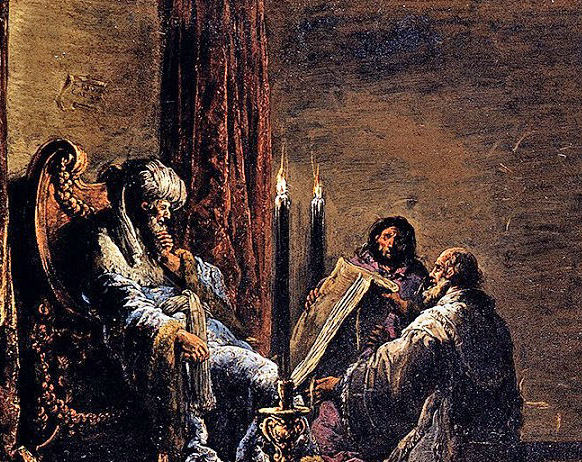
The Scribe Shaphan Reading The Book Of Law To King Josiah by Leonaert Bramer (1596-1674)

When Josiah heard what was in The Book of God’s Law, he tore his clothes in sorrow. At once he called together Hilkiah, Shaphan, Ahikam son of Shaphan, Achbor son of Micaiah, and his own servant Asaiah. He said, “The Lord must be furious with me and everyone else in Judah, because our ancestors did not obey the laws written in this book. Go find out what the Lord wants us to do.”

The five men left right away and went to talk with Huldah the prophet. Her husband was Shallum, who was in charge of the king’s clothes. Huldah lived in the northern part of Jerusalem, and when they met in her home, she said:

You were sent here by King Josiah, and this is what the Lord God of Israel says to him: “Josiah, I am the Lord! And I will see to it that this country and everyone living in it will be destroyed. It will happen just as this book says. The people of Judah have rejected me. They have offered sacrifices to foreign gods and have worshiped their own idols. I cannot stand it any longer. I am furious.

“Josiah, listen to what I am going to do. I noticed how sad you were when you read that this country and its people would be completely wiped out. You even tore your clothes in sorrow, and I heard you cry. So, I will let you die in peace before I destroy this place.”

The men left and took Huldah’s answer back to Josiah. (Contemporary English Version)

It is hard to fathom that things spiritually degenerated so much in the kingdom of Judah that the Book of Law, God’s Word to Israel, was completely lost. The Law was tucked so far back in the temple, and had gathered so much dust, that everyone simply forgot it existed. 

Maybe we in the Western world can relate to this more than we think. When a plethora of Bibles and translations exist, yet they gather dust on the shelf, and we have not cracked it open since….?

We are approaching the end of the Christian Year which annually culminates in Christ the King Sunday. As we journey with Jesus and ascend his holy hill, we anticipate corporately acknowledging Christ’s lordship. A good and biblical way to do so is through penitent humility. 

King Josiah’s officials found the Book of the Law and brought it to him. After they read the words, which had not been uttered for a very long time, the king was completely undone with humble repentance. He realized the life of the nation did not revolve around the majesty and kingship of God, and it cut him to the core of his being.  

An appropriate response to the realization of God’s sovereignty and Christ’s lordship is humility. Without humility, there is no going forward; there is only the ghastly state of remaining stuck in one place with ancient dust accumulating on our static hearts. However, with humility there is repentance; and with repentance there opens up the grand vistas of hope, new life, and fresh beginnings.

“It was pride that changed angels into devils; it is humility that makes men as angels.”

St. Augustine

I (humbly) ask that you try something quite different from your regular experience today. Put on some old clothes then carefully read the words of today’s Old Testament Scripture lesson. Take the time to acknowledge a sin of omission in your life. Then, tear your clothes; yes, rip your shirt. 

Allow yourself to feel, like Josiah, the realization of missing the mark. Yet do not remain in this condition. Drink in the grace of God in Christ and receive the forgiveness that is yours in Christ. The trajectory of our Christian lives is determined by the depth of humility we experience and filling the hole with mercy.

It’s difficult to be submissive. To acknowledge, without denial, that we are in a bad place and will reorient our lives takes a lot of courage and humility. If pride and arrogance are the original sin, then the remedy to that malady is a meek and obedient spirit. 

No matter who we are, people are meant and designed by their Creator to live a humble life of submission to the moral and ethical will of God.

Humility is the cornerstone to every good thing in this life.  Jesus said:

“Blessed are the poor in spirit, for theirs is the kingdom of heaven… Blessed are the meek, for they will inherit the earth.” (Matthew 5:3, 5 NIV)

The door of God’s kingdom swings-open on the hinges of humility. The Apostle Paul, seeking to follow his Master Jesus in his teaching and humility said:

“Since God chose you to be the holy people he loves, you must clothe yourselves with tenderhearted mercy, kindness, humility, gentleness, and patience.” (Colossians 3:12, NLT)

Basic human relations are to be firmly grounded in humility. The old prophet made his expectations clear:

“He has told you, O mortal, what is good; and what does the Lord require of you but to do justice, and to love kindness, and to walk humbly with your God?” (Micah 6:8, NRSV)

Life is truly life when it is based in humility. We live with the confidence of the psalmist:

“God leads humble people to do what is right, and he teaches them his way.” (Psalm 25:9, GW)

In the end, we are to bow to the God of the Word, for the Word is life.

Awesome God, although I might not always perceive your majesty and sovereignty, you stand above all creation as the Lord whom I am to submit to in all things.  I come to you in great humility of heart and vow to obey everything I read in your Holy Word through Jesus Christ, my King. Amen.