


So the king of Israel and Jehoshaphat king of Judah went up to Ramoth Gilead. The king of Israel said to Jehoshaphat, “I will enter the battle in disguise, but you wear your royal robes.” So the king of Israel disguised himself and went into battle.
Now the king of Aram had ordered his thirty-two chariot commanders, “Do not fight with anyone, small or great, except the king of Israel.” When the chariot commanders saw Jehoshaphat, they thought, “Surely this is the king of Israel.” So they turned to attack him, but when Jehoshaphat cried out, the chariot commanders saw that he was not the king of Israel and stopped pursuing him.
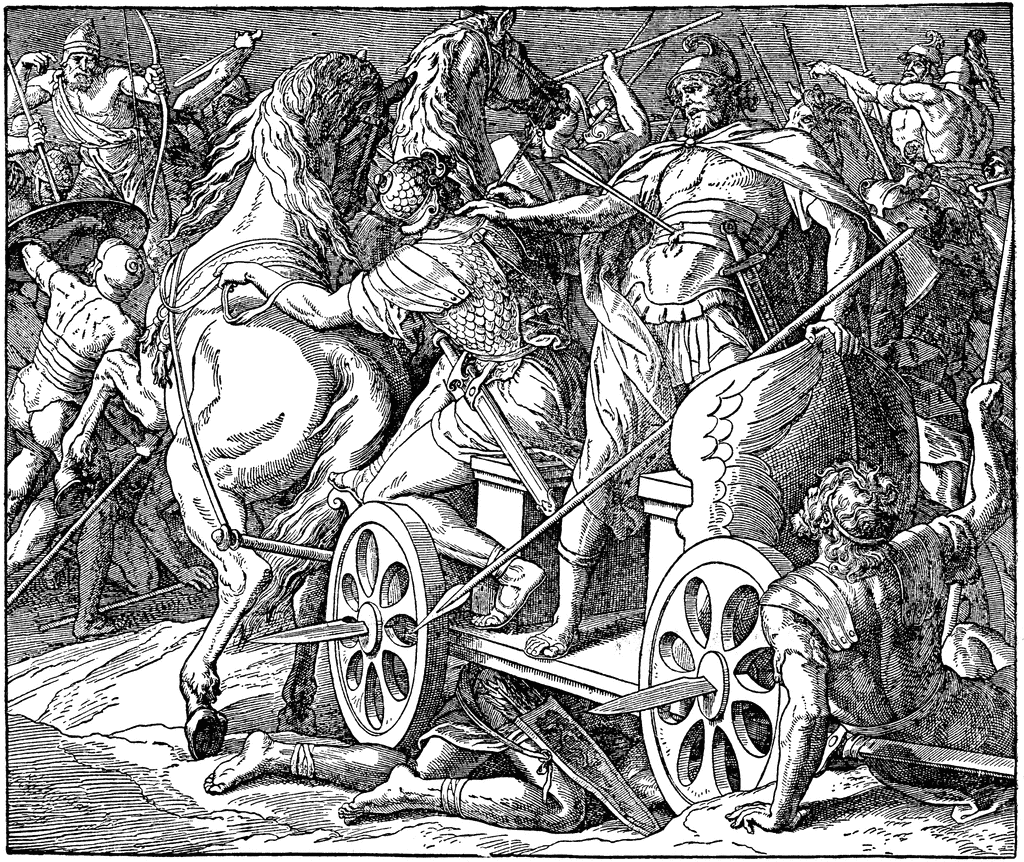
But someone drew his bow at random and hit the king of Israel between the sections of his armor. The king told his chariot driver, “Wheel around and get me out of the fighting. I’ve been wounded.” All day long the battle raged, and the king was propped up in his chariot facing the Arameans. The blood from his wound ran onto the floor of the chariot, and that evening he died. As the sun was setting, a cry spread through the army: “Every man to his town. Every man to his land!”
So the king died and was brought to Samaria, and they buried him there. They washed the chariot at a pool in Samaria (where the prostitutes bathed), and the dogs licked up his blood, as the word of the Lord had declared.
As for the other events of Ahab’s reign, including all he did, the palace he built and adorned with ivory, and the cities he fortified, are they not written in the book of the annals of the kings of Israel? Ahab rested with his ancestors. And Ahaziah his son succeeded him as king….
Ahaziah son of Ahab became king of Israel in Samaria in the seventeenth year of Jehoshaphat king of Judah, and he reigned over Israel two years. He did evil in the eyes of the Lord, because he followed the ways of his father and mother and of Jeroboam son of Nebat, who caused Israel to sin. He served and worshiped Baal and aroused the anger of the Lord, the God of Israel, just as his father had done. (New International Version)
Whenever someone ignores or tries to get around reality, we call such a person “delusional.” It seems that the more power and authority a person possesses, the easier it is to delude themselves into thinking they can manipulate events in their favor. They then tend to listen only to what they want to hear.
King Ahab of Israel was delusional. He, like so many kings before and after him, was focused on the externals of personal power, accumulating more wealth, and exploring alternative religions. It all led to a twisted view of reality, as well as a prophetic demise.
Identifying so much with externalities, to the detriment of the internalities, is the ultimate bogus approach to life. It never ends well. Instead of exploring the image of God within himself and others, ensuring justice for all his subjects, and using his power to provide for the common good of all Israel, King Ahab went the spiritually and emotionally insecure route of listening to the wrong people.
Insecure and delusional people only listen to what is positive; and they eschew any negatives in their life. This is why the biblical prophets throughout Old Testament history typically found themselves at loggerheads, in prison, or at the end of a spear from those in power.
Ahab feigned wanting to hear what is true, but when hearing any negative aspects, he wrongly believed he could get around reality through his earthly authority and personal ingenuity. But he couldn’t. No one can outdo the stronger unseen forces in this world. (1 Kings 22:1-28)
So, Ahab laid a delusional plan to disguise himself as an ordinary soldier in battle. But although he chose to go against prophetic truth, there was no way to ignore the reality of it.
The providence and purposes of God prevail in any and all circumstances – no matter what they are. Today’s story highlights a seemingly random arrow from an enemy solider, hitting Ahab in the precise spot which could penetrate his armor.
The king was wounded and had to leave the battle. Yet, Ahab stuck to his delusional world, having his men prop him up in his chariot so that he could watch events unfolding in front of him.
Even in his powerlessness, King Ahab could not bring himself to believe that things could be different than he planned. He died at the end of the day, still stuck in his delusional and insecure world.
The editor of the Book of Kings summarized Ahab’s reign by mentioning impressive external improvements to his palace and fortified cities. Yet, these are mere incidentals. The real – and not delusional – assessment of the king’s life is that he was a religious apostate and a moral reprobate.
In the end, Ahab was nothing more than a weak and insecure individual who compromised God’s ethical law and sought to control events for his own misguided purposes. He followed Yahweh only if it aligned with his own plans.
Furthermore, it’s sad that Ahab’s approach to life, and his behavior toward others, was reflective of the Israelite nation as a whole (2 Kings 17:7-17). His own death eerily foreshadowed the death of Israel.
In our own era of incompetent leadership, morally inferior leaders, and delusional administrations, it behooves every concerned and pious believer to pray for all those in authority.
This side of heaven, there will always be cultural and societal pressures to conform to external pride, wealth, and success. But this is not the believer’s call, to take it’s cues from worldly power. Our focus is on consistently and patiently doing what is good, right, and just – accepting the unseen real over the seen delusion.
Rather than trying to continually manipulate events for our own shortsighted purposes, we must persevere in spurring-on one another to love and good deeds (Hebrews 10:24). For only together, as the one people of God, can we resist and subvert the machinations of delusional leaders.
O Lord God, Ruler of all, and whose glory exists in all the world: We commend nations and their leaders to Your divine providence, so that we may dwell secure in Your peace.
Grant to everyone in authority everywhere the wisdom and strength to know and do Your will. Fill them with the love of truth and justice; and make them mindful of their calling to serve all people with respect and reverence; through Jesus Christ our Lord, who lives and reigns with You and the Holy Spirit, one God, world without end. Amen.


 Rev. Tim Ehrhardt