The Wealth and Wisdom of Solomon (2 Chronicles 9:29-31)

King Solomon, by British artist Simeon Solomon, c.1874

Everything else Solomon did while he was king is written in the records of Nathan the prophet, Ahijah the prophet from Shiloh, and Iddo the prophet who wrote about Jeroboam son of Nebat. After Solomon had ruled 40 years from Jerusalem, he died and was buried in the city of his father David. His son Rehoboam then became king. (Contemporary English Version)

The life of King Solomon can be found in the biblical books of 1 Kings (chapters 1-11) and 2 Chronicles (chapters 1-9). Solomon is also traditionally viewed as the author of three biblical books: Ecclesiastes, Proverbs, and Song of Songs.

Solomon was the son of Bathsheba and King David. He is most known for building the first Jerusalem Temple, as well as his immense wealth, wisdom, and numbers of wives.

Although his reign as king was marked by peace and prosperity, it fell apart after his death. Late in his life Solomon succumbed to worshiping many other gods, which the biblical editor connects with the split of the kingdom under his son Rehoboam.

King Solomon presides over the Old Testament as a sort of larger than life individual. He reigned over a united kingdom of Israel and Judah nearly a thousand years before Christ.

Coming to the throne after his father’s death, Solomon carried out a purge. He cunningly did away with his older brother Adonijah, and the commander of the army Joab. Both of them were characters only concerned with themselves and not the overall good of the kingdom. (1 Kings 2:13-46)

Once firmly ensconced in power, Solomon famously asked God for wisdom – after the Lord came to him in a dream and offered to grant the king any wish he wanted. In asking for wisdom instead of riches, glory, or long life, God was pleased to give him a great degree of discerning wisdom that no one before or since would ever have. (1 Kings 3:5-15)

The Judgment of King Solomon, by Frans Floris, c.1547

The proof of King Solomon’s wisdom came in many forms, including the rendering of justice. The biblical story is told of two women who came before the king, both claiming to be the mother of a baby. Solomon called for a sword and said the solution to the dilemma would be to cut the baby in two, and give each half to each woman.

One woman finds the solution agreeable, but the other woman protested, stating that she would give up the child rather than see the baby killed. King Solomon therefore concluded that this woman, not the other, was the child’s mother. (1 Kings 3:16-28)

King Solomon engaged in many building projects, but none more great than the Temple. To this day, Jerusalem continues as the center of Jewish prayer and worship. Indeed, Solomon’s impact is felt all these millennia later.

And then there were the wives. Lots of them. According to scripture, Solomon had 700 wives and 300 concubines (a concubine was a lesser wife who was not born of royalty or nobility). Many of his wives worshiped gods other than the Lord, which is why Solomon eventually allowed idols into the city.

A famous encounter with Solomon included the Queen of Sheba, which is a story told in both 1 Kings and 2 Chronicles. The country of Sheba, in the south of the Arabian peninsula, heard about Solomon’s renown. The queen decided to travel to Jerusalem with a large entourage in order to meet him for herself.

The Visit of the Queen of Sheba to King Solomon, by Edward Poynter, 1890

The queen was overwhelmed with what she saw and experienced; and was so impressed with Solomon’s wisdom and wealth that she gifted him with spices, precious gems, and gold from her own country. All sorts of various Jewish stories came out of this original biblical account.

The many wives of Solomon included women from the nations God commanded the Israelites not to marry, because they would lead their husbands astray to worship foreign gods. And that is exactly what happened, even to the wisest man in the world.

Because of this, we get some different takes on Solomon’s spiritual commitment in scripture and according to tradition. On the one hand, Solomon is presented as fully devoted to God, and careful to worship the Lord and communicate divine precepts. Yet, on the other hand, the Bible doesn’t hedge from stating that Solomon committed evil in God’s sight and was not loyal like his father David.

In truth, we are all a bit of a mix of sinner and saint, showing steadfast loyalty in many ways, along with a curious bent toward indulging our desires and letting them carry us to unfaithful places.

Yet, no one can doubt King Solomon’s influence and legacy on the religious world. His writings and collection of wise sayings, along with the colorful stories, are still read and retold by Jews and Christians to this day.

The biblical text tells us that after ruling for four decades, King Solomon was laid to rest in Jerusalem. He was the last ruler of a united Jewish kingdom. Because of this, and his legendary wisdom and wealth, Solomon’s reign is remembered by many as a golden era in history.

But whatever you think about the story of Solomon’s life, his legacy of proverbial sayings and experiential truth can continue to inform and teach us. Our lives will never come close to Solomon’s material riches, but perhaps we can gain something of the immaterial blessings through his wisdom.

Almighty God, I humbly ask that You grant me wisdom to make sound choices and decisions. Open my eyes to see Your truth clearly. Give me spiritual discernment to distinguish right from wrong. Help me not rely solely on my own limited understanding, but trust in Your wisdom to guide my steps. Grant me a heart eager to gain wisdom from Your Word and wise counselors. Let Your wisdom shape my thoughts, words, and actions each day. Amen.

Spiritual Spring Cleaning (2 Chronicles 29:1-11, 16-19)

Hezekiah became king when he was twenty-five years old and was king in Jerusalem for twenty-nine years. His mother was Abijah daughter of Zechariah. In God’s opinion he was a good king; he kept to the standards of his ancestor David.

In the first month of the first year of his reign, Hezekiah, having first repaired the doors of The Temple of God, threw them open to the public. He assembled the priests and Levites in the court on the east side and said, “Levites, listen! Consecrate yourselves and consecrate The Temple of God—give this much-defiled place a good housecleaning.

Our ancestors went wrong and lived badly before God—they discarded him, turned away from this house where we meet with God, and walked off. They boarded up the doors, turned out the lights, and canceled all the acts of worship of the God of Israel in the holy Temple. And because of that, God’s anger flared up and he turned those people into a public exhibit of disaster, a moral history lesson—look and read! This is why our ancestors were killed, and this is why our wives and sons and daughters were taken prisoner and made slaves.

“I have decided to make a covenant with the God of Israel and turn history around so that God will no longer be angry with us. Children, don’t drag your feet in this! God has chosen you to take your place before him to serve in conducting and leading worship—this is your life work; make sure you do it and do it well….”

The priests started from the inside and worked out; they emptied the place of the accumulation of defiling junk—pagan rubbish that had no business in that holy place—and the Levites hauled it off to the Kidron Valley. They began the Temple cleaning on the first day of the first month and by the eighth day they had worked their way out to the porch—eight days it took them to clean and consecrate The Temple itself, and in eight more days they had finished with the entire Temple complex.

Then they reported to Hezekiah the king, “We have cleaned up the entire Temple of God, including the Altar of Whole-Burnt-Offering and the Table of the Bread of the Presence with their furnishings. We have also cleaned up and consecrated all the vessels which King Ahaz had gotten rid of during his misrule. Take a look; we have repaired them. They’re all there in front of the Altar of God.” (The Message)

Hezekiah Destroys the Idols, by Maerten de Vos, 1585

This is the time of year when many of us begin to plan for some Spring housecleaning. And it’s definitely needed! All the rooms of the house, along with the garage, are in need of going through all the contents contained in them, as well as a good old fashioned scrubbing down and thorough cleaning.

And that is really what the Christian season of Lent is intended for on the spiritual level of things. We seek to identify any and all hindrances to living the Christian life and get rid of them; spruce up the things we keep that are helpful to us; and do the hard work of scraping off all the encrusted barnacles on our hearts.

Hezekiah was a faithful king, having come from a long line of faithless ones. In the beginning of his reign, Hezekiah’s first act of royal business was to thoroughly cleanse the Temple. And did it ever need a serious cleaning!

The evil kings who reigned before him did not treat the Temple as a sacred space devoted specifically to the prayer and worship of the one true God, Yahweh. Instead, they defiled it by introducing all sorts of unhealthy practices from other gods. As a result, the holy implements used in the Temple, as well as the structure itself, fell into terrible neglect.

Therefore, Hezekiah assembled an impressive team of people, and tasked them with getting the Temple in shape again with a complete and thorough purification that would make any German house frau proud. Hezekiah sought to restore things so that the Temple could once again be used as it ought. 

The team of Levites meticulously took their time and worked diligently to consecrate the Temple and give it a good and sacred cleaning, tossing everything unholy into the Kidron Valley – the garbage dump.

Perhaps there is no better passage of Scripture than today’s Old Testament lesson, in order to embody what the season of Lent is really all about. We are to do the holy work of carefully consecrating our hearts, so that our lives are prepared and ready for the new life of Easter. 

This task of spiritual Spring cleaning and heart purification is hard and courageous work. Just as Hezekiah had the bravery to uphold the Temple’s true purpose through cleansing it, so we are to bravely enter the shadowy places of our hearts, bring out the sin within, and toss it in the metaphorical incinerator. It’s definitely not a pretty process, but a necessary one.

One of the greatest needs that many believers have today is the courage to be vulnerable, to expose and bring into the light our besetting sins, so that they can be carried away and tossed into the dump. 

Instead of spending inordinate amounts of energy and time trying to hide our true selves, it is much better to let the example of Hezekiah clear a path forward by confronting the darkness within.

Holy God, my life is a Temple of your Holy Spirit. I invite you to come in and do the sort of cleansing work that needs to be done so that my words and actions are thoroughly consecrated to you. Help me have the courage to go to the places within that frighten me, for the sake of Jesus, my Lord. Amen.

2 Chronicles 20:1-22 – Praying in Desperate Times

Photo by cottonbro on Pexels.com

The armies of Moab and Ammon, together with the Meunites, went to war against Jehoshaphat. Messengers told Jehoshaphat, “A large army from Edom east of the Dead Sea has invaded our country. They have already reached En-Gedi.”

Jehoshaphat was afraid, so he asked the Lord what to do. He then told the people of Judah to go without eating to show their sorrow. They immediately left for Jerusalem to ask for the Lord’s help.

After everyone from Judah and Jerusalem had come together at the Lord’s temple, Jehoshaphat stood in front of the new courtyard and prayed:

You, Lord, are the God our ancestors worshiped, and from heaven you rule every nation in the world. You are so powerful that no one can defeat you. Our God, you forced out the nations who lived in this land before your people Israel came here, and you gave it to the descendants of your friend Abraham forever. Our ancestors lived in this land and built a temple to honor you. They believed that whenever this land is struck by war or disease or famine, your people can pray to you at the temple, and you will hear their prayer and save them.

You can see that the armies of Ammon, Moab, and Edom are attacking us! Those are the nations you would not let our ancestors invade on their way from Egypt, so these nations were not destroyed. Now they are coming to take back the land you gave us. Aren’t you going to punish them? We won’t stand a chance when this army attacks. We don’t know what to do—we are begging for your help.

While every man, woman, and child of Judah was standing there at the temple, the Lord’s Spirit suddenly spoke to Jahaziel, a Levite from the Asaph clan. Then Jahaziel said:

Your Majesty and everyone from Judah and Jerusalem, the Lord says that you don’t need to be afraid or let this powerful army discourage you. God will fight on your side! So, here’s what you must do. Tomorrow the enemy armies will march through the desert around the town of Jeruel. March down and meet them at the town of Ziz as they come up the valley. You won’t even have to fight. Just take your positions and watch the Lord rescue you from your enemy. Don’t be afraid. Just do as you’re told. And as you march out tomorrow, the Lord will be there with you.

Jehoshaphat bowed low to the ground, and everyone worshiped the Lord. Then some Levites from the Kohath and Korah clans stood up and shouted praises to the Lord God of Israel.

Early the next morning, as everyone got ready to leave for the desert near Tekoa, Jehoshaphat stood up and said, “Listen my friends, if we trust the Lord God and believe what these prophets have told us, the Lord will help us, and we will be successful.” Then he explained his plan and appointed men to march in front of the army and praise the Lord for his holy power by singing:

“Praise the Lord!
    His love never ends.”

As soon as they began singing, the Lord confused the enemy camp. (Contemporary English Version)

King Jehoshaphat and Judah were about to be attacked. War was imminent. Anxiety was high. The people were on edge. What were they going to do in the face of a combined army that seemed as if they’d steamroll over the nation of Judah? 

Here’s what Jehoshaphat did: He admitted his fear, sought the Lord for help, and proclaimed a national fast for everyone in Judah. Then, the king prayed, and God responded.

A most unconventional method of defeating the enemy was put into motion. The king and the people of Judah put together a praise team and a worship gathering to go before the army; they believed God was good for divine promises and would deliver them.

The king’s prayer was a deeply felt and sincere belief that God could and would answer, according to ancient promises to the people. The meat of the prayer affirmed both the powerlessness of their situation and the power of God to transcend even the most difficult of circumstances. They didn’t know how deliverance was going to come; they simply believed it was going to happen. 

This is, indeed, the kind of prayer God delights to answer! It was a prayer born of great need and desperation – a prayer upholding the name of God and discerning that unless the Lord showed up, all would be lost.

The foundational basis of all prayer to God is the recognition that we do not know what to do, other than look to the Lord. 

We pray because we desperately need God to show up and do for us what we cannot do for ourselves. 

We cry out to God in our affliction and believe that the gracious ears of the Lord will hear and save us from our terrible plight. 

And once we pray, we are to stand firm, hold our position, and see the salvation from God on our behalf. 

If we need some inspiration for prayer and find ourselves in need of faith to believe what God can do, then take the time to read carefully and prayerfully over today’s Old Testament lesson several times. 

Then, let the prayers arise to the God of deliverance so that our stressful and worrisome pressure is transformed into praise for the Lord’s steadfast love.

Almighty God, you rule over all the nations of the earth. In your hand are power and might, so that none are able to withstand you. My eyes are fixed on looking for you to act on my behalf so that I might declare that your steadfast love endures forever, through Jesus Christ, my Savior. Amen.

2 Chronicles 34:1-7 – Getting Rid of Idolatry

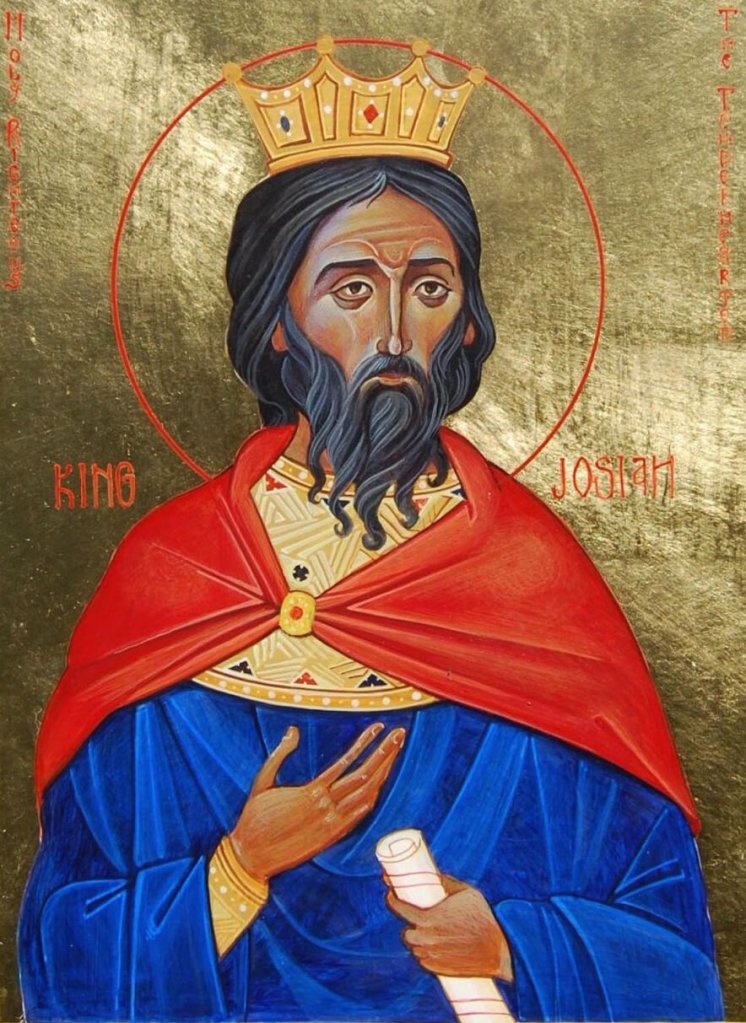
Russian Orthodox icon of Judah’s King Josiah (640-609 B.C.E.)

Josiah was eight years old when he became king of Judah, and he ruled thirty-one years from Jerusalem. He followed the example of his ancestor David and always obeyed the Lord.

When Josiah was only sixteen years old he began worshiping God, just as his ancestor David had done. Then, four years later, he decided to destroy the local shrines in Judah and Jerusalem, as well as the sacred poles for worshiping the goddess Asherah and the idols of foreign gods.He watched as the altars for the worship of the god Baal were torn down, and as the nearby incense altars were smashed. The Asherah poles, the idols, and the stone images were also smashed, and the pieces were scattered over the graves of their worshipers. Josiah then had the bones of the pagan priests burned on the altars.

And so, Josiah got rid of the worship of foreign gods in Judah and Jerusalem. He did the same things in the towns and ruined villages in the territories of West Manasseh, Ephraim, and Simeon, as far as the border of Naphtali. Everywhere in the northern kingdom of Israel, Josiah tore down pagan altars and Asherah poles; he crushed idols to dust and smashed incense altars.

Then Josiah went back to Jerusalem. (Contemporary English Version)

Josiah started out as a boy king. Evidently, he had some good training because by the time he became a teenager, Josiah was raring and ready to exercise his kingship in the best sense of leadership. 

After generations of kings before him who followed other gods and gave the stiff-arm to the Lord, as well as to justice and righteousness, Josiah committed himself fully to Israel’s one true God.  And, as a twenty-year old king, he showed the real muster of his reign.

Josiah took responsibility and initiative to do what was right in the eyes of God – no matter the consequences. 

King Josiah continually performed the dual action of worshiping God and aggressively taking active steps to rid the kingdom of all the ubiquitous false gods. 

The king did much more than simply stick his toe in the water to test what the response might be to removing a high place of Baal worship or an Asherah pole. Instead, Josiah jumped right in and put his entire kingship on the line. 

All of the power brokers who were dealing in false gods could not have been happy about this turn of events in Judah. But any kind of pushback did nothing to prevent Josiah from doing what was right in the eyes of the Lord by thoroughly eradicating idol worship.

“Let us all be the leaders we wish we had.”

Simon Sinek

Josiah had a clear sense of purpose. That sense of vocational direction ordered his kingly steps. It led him to do the things he did. Josiah was determined and devoted to leading the people back to God. 

This desire and determination for spiritual revival directed toward the worship of the Lord is not limited to the ancient world. God is still in the kingdom business of bringing all creation under a divine and benevolent rule. 

Therefore, there still remains an abiding purpose to lead others, caught in a web of unhealthy routines and habits of living through idolatrous practices, back to the one true God. 

Like the ancients before us, there is still a need to exercise courage and confidence in following the Lord by making disciples who will worship God with all their heart, soul, mind, and strength. 

So, reconnecting with our overarching purpose in life is imperative for taking bold steps of faith in this idolatrous world which worships at the altar of exorbitant eating, shopping, and drinking.

It is no wonder the current zeitgeist of so many of our communities is full of anxiety, discouragement, and anger. There is no justice in the public square. Competing voices, other than the merciful words and ways of Jesus, drown the divine regulations for living a good life of integrity, wholeness, peace, and joy in the Holy Spirit.

It is almost as if the collective efforts of idolatrous people have surgically removed the spiritual spine of society. We are now bereft of genuine support, spineless and unable to move toward a life of truth, justice, and a courageous concern for the common good of all persons.

King Josiah shows us a better way. We must radically remove all that is toxic and damaging to our souls. We need a clear purpose in life, to go hard after God and rediscover how the Divine fits into all of life and gives us meaning.

Any old fool can complain about how bad things are in the world. But the one determined to make a difference amidst all the surrounding crud and helps to make things better – that is the wise person who is in touch with their own spirit, who is able to see the spiritual within others.

So, how then will you live?

May your living be in a healthy spiritual groove of loving God and loving neighbor so that worshiping the banal becomes a thing of the past.

Holy God, you are the Sovereign of the universe. Expose the things in my life that I might be trusting in, other than you. Wean me away from evil and bend my heart and mind to truth, justice, and goodness. Help me to be aggressive in my Christian walk so that I steadfastly follow Jesus Christ in the power of the Holy Spirit, leading others to faith along the way. Amen.