1 Corinthians 3:10-23 – The Ultimate Sacred Space

According to the grace of God given to me, like a skilled master builder I laid a foundation, and someone else is building on it. Each builder must choose with care how to build on it. For no one can lay any foundation other than the one that has been laid; that foundation is Jesus Christ. Now if anyone builds on the foundation with gold, silver, precious stones, wood, hay, straw—the work of each builder will become visible, for the Day will disclose it, because it will be revealed with fire, and the fire will test what sort of work each has done. If what has been built on the foundation survives, the builder will receive a reward. If the work is burned up, the builder will suffer loss; the builder will be saved, but only as through fire.

Do you not know that you are God’s temple and that God’s Spirit dwells in you? If anyone destroys God’s temple, God will destroy that person. For God’s temple is holy, and you are that temple.

Do not deceive yourselves. If you think that you are wise in this age, you should become fools so that you may become wise. For the wisdom of this world is foolishness with God. For it is written, “He catches the wise in their craftiness,” and again, “The Lord knows the thoughts of the wise, that they are futile.”

So, let no one boast about human leaders. For all things are yours, whether Paul or Apollos or Cephas or the world or life or death or the present or the future—all belong to you, and you belong to Christ, and Christ belongs to God. (NRSV)

You have an incredibly special position and status which no one can ever take away.

We were made by and for God. In the beginning, the creative activity of God achieved its pinnacle in the formation of a man and a woman. Only humanity carries within them the image and likeness of God. People are unique, special, and set apart as the creatures who can enjoy a close relational fellowship with their Creator.

However, humanity fell into disobedience, which introduced sin and death into God’s good world. Ever since that time, God has been on a rescue mission. The Holy Scriptures are an unfolding drama of redemption in which a heart-stricken God goes out of the way to make and keep promises to a sinful people. The Israelites, a people set apart from all other people, were meant to be devoted to God in such a way that the world would be drawn to their relationship with the Lord and with the created order.

Yet again, even with an impressive temple where people met God in sacred rituals and activities, the people went astray and followed their ancestors into worshiping other gods. God, ever the gracious Lord who does not forget the divine covenant of love, sent his Son, Jesus, as the ultimate fulfillment of all the good promises made.  Through the redemptive events of Christ’s cross, resurrection, and ascension the deliverance from all that is wrong and broken in this world is reversed. We are blessed with pardon and redemption from the slavery of sin.  We are given a renewed status as God’s people.

If this were not enough, God has given us the Spirit to help us. Christians, followers of Jesus Christ, are never alone. A merciful God makes us a holy people and the temple where the Lord dwells by means of the Spirit. In the Old Testament, the sacred space of worship was a physical building. Approaching the holy God meant entering a holy temple, set apart for connection between the divine and the human. The midpoint of history in which all events hinge is the cross of Christ. His redeeming work has transformed the world. 

Now, we are the temple of God, the sacred place where God meets with us. The glory of God is to be found, once again, in human beings. It is in this rich understanding of God’s activity and humanity’s new status that the Apostle Paul appealed to with a pointed rhetorical question: “Do you not know that you are God’s temple and that God’s Spirit dwells in you?”

“The church is not a religious community of worshippers of Christ but is Christ himself who has taken form among people.”

Dietrich Bonhoeffer

The Corinthian church was in grave danger of doing the thing that all lost humanity had done through the ages.  They were breaking down into divisions and conflicts and were not thinking of others as God’s special people.  Paul named them collectively as God’s temple. They were not individual temples but one holy sacred temple together. This theology and anthropology were meant to teach, persuade, chastise, and encourage the Christians that there was no place for special-interest groups in the church; no room for following pet teachers and preachers; and no reason to ostracize others who didn’t agree exactly as you do.

Believers in Jesus Christ are collectively the people of God, the temple in which God dwells. This makes them a holy people, set apart for the exclusive worship of the triune God. We are to live up, not down, to who we are in Christ, in the Spirit, in the realm of God’s kingdom.

We are meant to return to the foundation of the temple. If the foundational works of this great temple of God are the redemptive events of Jesus, with Christ himself as the chief cornerstone of the structure, then we are meant to return in this great season of Lent to Jesus. With meekness and humility, we are to come to God in Christ by the Spirit and confess our many sins, repent of them all, and return to God as the special, holy, and loved people we are.

For far too long Paul’s letter to the Corinthians has been used to poke at people for smoking or drinking too much or generally not caring for our physical bodies. This was not so much Paul’s understanding. He was thinking much more along the lines of church unity, harmony, mutual love, grace, encouragement, and making decisions which are best for the common good of all. To break down Paul’s instruction to individual habits which harm the body is a woefully truncated view of his teaching. 

Instead, we are to have a high view of one another. We, together, are the people of God. We, together, are meant for holy worship of the triune God. We, together, are the complex expression of God’s creative action – a temple set in the middle of a watching world. 

Therefore, we are to be concerned for one another. We are to act as one holy people of God. We are to reflect the love, unity, and fellowship of the Holy Trinity in our life together. Let us then encourage each other toward love and good deeds; upholding the common good; and extending grace in all circumstances. For this is what temple living looks like.

Holy God, you have set us apart together as your holy people. Help so to live up to our status as your beloved creatures that we are continually mindful of you, one another, and the grace you give for all circumstances.  May our foundation be strong in the person and work of Jesus Christ, your Son, our Savior, as the Spirit dwells in us together. Amen.

An Embodied Spirituality

By Unknown artist

It is normal to feel guilty at this time of year about our bodies. Some of the more common goals for a new year are to lose weight, stop smoking, get in shape, have better sleep hygiene, and generally learn better self-care.  I am not going to add to the burden of guilt but emphasize something important: Our bodies are the vehicle given to us to glorify God. Our spirituality is quite embodied. (1 Corinthians 6:19-20)

One of the reasons we fail our bodies is that we do not always make the biblical connection of seeing our material selves with the same importance as the immaterial.  The Apostle Paul brought up a discussion about the body to the Corinthian Church because Corinth was a Greek city thoroughly imbibed with a Platonic philosophy of life.  At the core of Plato’s view of humanity was that the immaterial and the spiritual were of higher value than the body.  For Plato, the body is a necessary evil.  He referred to our souls as being imprisoned within the flesh.  When we die the soul is released and is freed from its bodily prison.

Western civilization has been significantly influenced, even today, by Plato’s view of humanity. Yet, that is not a biblical view of the body.  Instead of being a prison, the body is a temple, a sacred place which is no better and no worse than the soul.  When we die, we will not be disembodied souls, but will experience a bodily resurrection at the end of the age.  Eternity will be spent existing in a real glorified body free from sin. (1 Corinthians 15)

Since the body is sacred, and we glorify God with our bodies, then we must steward them just like we would steward any other physical material possession we own.  We have bought into Platonic philosophy when we treat our cars better than we treat our bodies.  If a warning light comes on in our cars, we get it checked by the mechanic.  He fixes the issue and tells us what we need to do to prevent it from happening again, and we listen to him. 

Far too often, when warning lights go off in our bodies, we ignore them until our bodies literally break down and we must go to the doctor.  And even then, the doctor tells us to do something, and we do not do it.  We never avoid the advice of our mechanic, and yet we do it with our doctor.  We need to adopt the biblical wisdom of glorifying God on this earth through our bodies. 

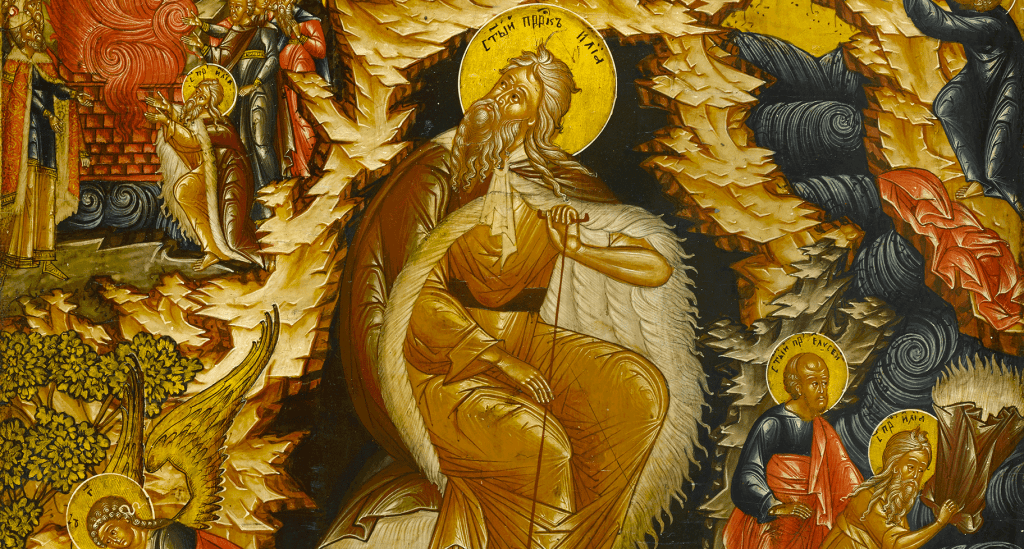
God’s care for our bodies can be found, for example, in the Old Testament prophet, Elijah. After Elijah experienced a great spiritual victory, he became the target of evil Queen Jezebel.  Elijah ran for his life and was severely burned-out from intense spiritual struggles with the queen’s prophets of Baal (1 Kings 19:1-3).  At that point, God did not come to Elijah and give him a sermon or exhortations about getting over it.  No, God restored Elijah’s body. And the Lord wants to restore our bodies, as well.

19th century Russian Orthodox icon of the prophet Elijah in the wilderness

First, Elijah needed sleep (1 Kings 19:5-6).  Millions of Americans are sleep deprived and live with a significant sleep debt (thus being continually cranky and out of sorts).  Insurance companies know this is a major issue because improper sleep habits have caused various auto accidents and fatalities. I once kept a crazy schedule with not many hours for sleep.  One day, during rush hour, I drove through a downtown expressway in bumper-to-bumper traffic and fell asleep.  I woke up about two minutes later and was still alive driving down the highway.  I sincerely believe God graciously drove the car for me.  That was my “wake up” call to change the way I was treating my body.

Second, Elijah needed to eat well (1 Kings 19:6-8).  For us, that means eating healthy.  One source of being overweight is failing to make the connection that eating is a spiritual activity.  Food is important to the kingdom of God.  It was eating that got us into trouble to start with and resulted in the fall of humanity.  Eventually, we will come full circle with eating being the activity we engage in at the end of the age – a redeemed view of food and eating together with Jesus at the marriage supper of the Lamb (Revelation 19:1-10).  God cares about food – what we eat and how much of it we consume.  He cares because we do not own our bodies – we steward them for God.

Third, Elijah needed some vigorous exercise (1 Kings 19:8-9).  He walked all the way to Mount Horeb, which was over a month’s travel.  But that exercise was essential to his well-being, both physically and spiritually.  It was only after he slept, ate well, and walked that Elijah was ready to meet with God in a powerful experience.

Our physical fitness is a spiritual issue, and so, needs prioritization.  I am under no illusions or delusions about the difficulty of this. I prefer brownies to broccoli and rather like sleeping instead of exercise. Yet, I work at being physically fit and caring for my body.  I am personally motivated toward health because I love God and want to please the Lord with my body. After all, my body was important enough to be redeemed through the Cross of Christ.

This is not about willpower – it is about Christian stewardship. I look at my body the same way I look at borrowing something from another person: I return it in the best condition I can. When the Lord takes me someday, I do not want it to be because I hastened my own death through disregard of my God-given body.

If I were God, donuts would be health food, sitting back in the recliner would build muscle, and two hours of sleep at night would be sufficient. But I am not God, so I submit to doing what it takes to have an embodied spirituality. We are to enjoy life through making the connection between the spiritual and the physical because that is the way God created us.

It is never too late to be a proper steward of the body.  Our physical anatomy is an amazing work of God and incredibly receptive to healthy choices. Here are a few of the choices we can make…

Remember the positives

Remember that care of the body is worth it.  Being fit feels great and equips us for the will of God.  Keep the long view in mind.  Sacrificing a temporary pleasure is worth the eventual gain.

Start small

I will not be doing any triathlons anytime soon, or ever. We need to be realistic and set appropriate goals without comparison to others. Start small and build up over time with slow incremental change. The place to begin is by rearranging our schedules so that our bodies become a priority.  Maybe it is time to make that doctor’s appointment you have been putting off.

Join others

Accountability and fun can and ought to go together. For example, preparing meals together is a chance to connect with a friend or family member. Discover and maintain a consistent rhythm of health that works for you and is enjoyable.

Reframe it

People often give up their best laid plans because they are disconnected from the rest of their lives. Reframing our view of the body as a spiritual activity helps connect and align our mind, body, and spirit in the wholeness God designed for us.

Start today

It takes time for something to become a habit. All good things are a process of realization. Consider and plan today, asking for God’s direction. Get the Lord in on it from the beginning and let it be an offering to him.

May you find the joy, contentment, and satisfaction of living with a body properly cared for and ready for use to the glory of God.

1 Corinthians 14:20-25 – Becoming Spiritually Mature

To be perfectly frank, I’m getting exasperated with your infantile thinking. How long before you grow up and use your head—your adult head? It’s all right to have a childlike unfamiliarity with evil; a simple no is all that’s needed there. But there’s far more to saying yes to something. Only mature and well-exercised intelligence can save you from falling into gullibility. It’s written in Scripture that God said,

In strange tongues
    and from the mouths of strangers
I will preach to this people,
    but they’ll neither listen nor believe.

So where does it get you, all this speaking in tongues no one understands? It doesn’t help believers, and it only gives unbelievers something to gawk at. Plain truth-speaking, on the other hand, goes straight to the heart of believers and doesn’t get in the way of unbelievers. If you come together as a congregation and some unbelieving outsiders walk in on you as you’re all praying in tongues, unintelligible to each other and to them, won’t they assume you’ve taken leave of your senses and get out of there as fast as they can? But if some unbelieving outsiders walk in on a service where people are speaking out God’s truth, the plain words will bring them up against the truth and probe their hearts. Before you know it, they’re going to be on their faces before God, recognizing that God is among you. (MSG)

Throughout the history of Christianity there have been faithful saints committed to the cause of Christ, and there also has been professing believers who are inconsistent and irresponsible in their observance of faith. In other words, the church always has been a mix of spiritually mature and immature people.

The Apostle Paul wrote his letter to the Church at Corinth precisely because there was a large chunk of people who were just flat out childish. He wanted them to grow up. We anticipate babies are going to cry, poop, sleep, and have others caring for their basic needs. When adults act like babies, it is unacceptable and, well, offensive. We expect better. We need them to pull their weight and be responsible.

Paul addressed the Corinthian’s lack of unity, paucity of wisdom, too much worldliness, inattention to each other, abuse of freedom, and impropriety in worship. To correct this, he pointed them squarely toward love, the one permanent attribute that binds all things together. (1 Corinthians 13)

So, when it came to worshiping together, the church needed a more mature way of handling their meetings. The last thing they needed was worship which made no sense to most people. “I would rather speak five intelligible words that makes sense than ten thousand words in a language other people don’t know,” Paul said. (1 Corinthians 14:19, CEV)

Ministry is to be done guided by love and concern for another’s well-being. Spiritual gifts are not given for one’s own benefit but are provided for the encouragement and edification of others. The exercise of speaking plain truth with exorbitant love to each other does this; and it influences outsiders looking on from the margins. Sensitivity to the needs of those foreign to the church was a premium concern for Paul.

However, there is more to the outsider than simply observing what Christians are doing – the other will speak into the life of the believer. This, of course, ought to surprise no one. After all, God can speak through whomever or whatever, including people from all kinds of ethnic groups (Acts 2:1-12) and even a donkey (Numbers 22:28).

The New Testament lesson for today concerns respecting persons both within the church and outside. For fellow believers, we are to continually speak and act in ways which build up the entire Body of Christ. And, for those who are alien to the church, we are to pay attention to them and have a healthy repartee with them which acknowledges their inherent worth as fellow persons created in the image of God.

Churches and faith communities tend to be full of “insiders.” If they fail to listen to the “outsiders” then ultimately a similar situation to the Corinthian Church will occur. No one group of people have all the answers, so we all need to take a posture of humility and listening with genuine attention and loving focus. This honors the other and demonstrates basic kindness and respect.

Christian maturity is realized when spiritual growth is sustained over time and produces the fruit of wisdom and love. Wherever you find a group of folks who listen well, are attentive to those on the outside, and have an orientation to serving others in a spirit of love and grace, there you will find the Holy Spirit energizing and empowering people toward good deeds on behalf of both church and world.

May it be so, to the glory of God.