

For the Common Good of All (1 Corinthians 12:4-13)

There are different spiritual gifts, but the same Spirit gives them. There are different ways of serving, and yet the same Lord is served. There are different types of work to do, but the same God produces every gift in every person.

The evidence of the Spirit’s presence is given to each person for the common good of everyone. The Spirit gives one person the ability to speak with wisdom. The same Spirit gives another person the ability to speak with knowledge. To another person the same Spirit gives courageous faith. To another person the same Spirit gives the ability to heal. Another can work miracles. Another can speak what God has revealed. Another can tell the difference between spirits. Another can speak in different kinds of languages. Another can interpret languages. There is only one Spirit who does all these things by giving what God wants to give to each person.

For example, the body is one unit and yet has many parts. As all the parts form one body, so it is with Christ. By one Spirit we were all baptized into one body. Whether we are Jewish or Greek, slave or free, God gave all of us one Spirit to drink. (God’s Word Translation)

Being given a gift from someone is rightly associated with joy, celebration, goodness, and the possibility of what the gift is and how it might be used.

Unpacking Our Spiritual Gifts

And this is why we unpack gifts with curiosity and abandon. It would be weird if we were given a gift, then let it sit unopened. Instead, we typically receive the gift, rip it open, and express gratitude for the thoughtfulness. Then, we explore it, enjoy it, and use it.

The Spirit, likewise, has been marvelously given to God’s people. Each individual Christian is specially provided a gift to open, use, and enjoy. Spiritual gifts graciously given to us are meant for the common good of all. And this use for the common good is where the gift is different than Christmas presents or birthday gifts.

Spiritual gifts are designed by God to be acts and words of service, dispersed for the benefit of others. Yes, they are meant for us to enjoy them. Yet, they are not meant solely for personal satisfaction.

Using Our Spiritual Gifts

So, if a person’s spiritual gift is teaching, they do not stand in front of a mirror and talk at themselves. Rather, they jump into the fray of learning and explaining, and do it in such a gracious and loving way that the enablement of the Spirit is evident.

If a person’s gift is faith, they do not merely step out and act with unusual courage for the purpose of personal betterment in a holy belief from God. They also demonstrate faithfulness to God’s people and to God’s world. The gift is for the common good of all persons.

The accumulation of wisdom and knowledge is meant for the strengthening of faith in others. Spiritual gifts are intended by God to be shared freely for the common good of all people so that people are strengthened in faith and supported for the rigors of daily life in the world.

Therefore, we really need to take some initiative in identifying our gift(s), unpacking them, and indiscriminately using them. Spiritual health and wholeness can only truly be realized through everyone’s active participation in distributing their God-given abilities.

Stewarding Our Spiritual Gifts

Spiritual gifts are neither to be hoarded, nor miserly dealt to only people I like or my own little world of groupies and friends. Any and every ability comes from God, and is therefore, given for the benefit of all persons. Underprivileged groups need the giftedness of others, as well as discovering their own resources so that everyone is built up in a society of redeemed persons.

What’s more, spiritual mavericks are not so helpful here. The Lone Ranger is not a good model for us. Christians are the Body of Christ, meant to function as one. Just as the Holy Trinity of divine persons – Father, Son, and Spirit – work together in unity of purpose and harmony of being, so persons of the Church are to unify and act as one in the mission of God.

Diversity of gifts are to be expressed in unity of building up others and extending Christ’s love to the world. When we harmoniously coordinate our joint efforts in utilizing our collective spiritual gifts, the world is turned upside-down with kingdom grace and ethics.

Goodness, joy, and possibility become alive when people unpack their gifts and use them for the common good of everyone.

Spiritual Gift Envy

Sometimes, we might succumb to “gift envy.” We observe the talented gift of another and secretly wish it for ourselves. The proper remedy to such a malady is gratitude. When we give thanks to God for the gift(s) we truly possess, then envy has nowhere to reside and slithers away.

None of God’s gifts are “sexy” in the sense that they come easily without effort and always look appealing. On the contrary, our gifts are meant to be received and developed with lots of daily mundane work so that we live into the special endowment bestowed upon us.

In reality, this takes a lifetime of development. That’s because the Spirit’s gifts are so generously large – much bigger than we originally observe at first glance. Like an engagement ring in a tiny box, receiving the gift and putting it on will involve commitments and challenges we cannot at the time perceive.

Whatever it is you do well, do it to the glory of God. Allow God to activate it and energize it for the prevailing needs of a church and a world which is in want of seeing spiritual fruit manifested in kindness, goodness, and love.

O Lord, you have taught me that without love, whatever I do is worth nothing. Send your Holy Spirit and pour into my heart your greatest gift, which is love, the true bond of peace and of all virtue, without which whoever lives is accounted dead before you. Grant this for the sake of your only Son Jesus Christ, who lives and reigns with you and the Holy Spirit, one God, now and forever. Amen.

Living in the Spirit (1 Corinthians 12:1-3)

What I want to talk about now is the various ways God’s Spirit gets worked into our lives. This is complex and often misunderstood, but I want you to be informed and knowledgeable. Remember how you were when you didn’t know God, led from one phony god to another, never knowing what you were doing, just doing it because everybody else did it? It’s different in this life. God wants us to use our intelligence, to seek to understand as well as we can. For instance, by using your heads, you know perfectly well that the Spirit of God would never prompt anyone to say, “Jesus be damned!” Nor would anyone be inclined to say, “Jesus is Master!” without the insight of the Holy Spirit. (The Message)

Summer is nearly upon us. In Christianity, this means we are entering the longest season in the Christian Year. By it’s sheer length alone, it behooves us to give it some recognition. We can only do that if we realize where we’ve come from so far.

The Christian Year

The Christian Year began with Advent – a time of anticipating Christ’s incarnation and remembering that Jesus will come again in a second advent.

We have celebrated the twelve days of Christmas, the birth of the Christ child, leading to the season of Epiphany. We kept up the celebration through rejoicing in God’s revelation to the entire world – all peoples everywhere – in having Christ’s earthly ministry of teaching and healing on our behalf.

Lent has come, beginning with Ash Wednesday and moving through six weeks of focusing on spiritual disciplines which prepared us for Christ’s death, and hopefully, our own death to sin, as well.

Then, we rejoiced in the Lord’s resurrection on Easter Sunday, and experienced a fifty day observance of Eastertide, including the Ascension of the Lord.

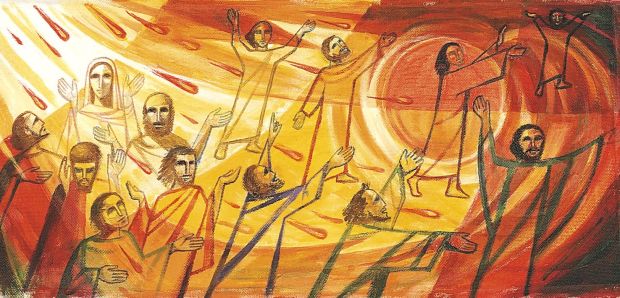
The Day of Pentecost has come, as we celebrated the gift of the Holy Spirit and the birth of the church, acknowledging our personal and communal spiritual power.

Now, we revel in this season of Pentecostal power, known as “Ordinary Time” or “Proper Time.” It is a time of engaging in the ongoing work of the church to spread the gospel of Jesus Christ. This is the Christian’s “proper” and “ordinary” work of ministry.

The Christian Life

All of the work of Jesus in securing redemption for us is directed toward using the spiritual gifts given to us for the life of the church and the world. There’s no going back. We move forward, utilizing everything provided for a godly life in this present difficult age.

Now we develop our ability to walk and live in the Spirit for the rest of our lives – working out our salvation with reverence and respect.

What I’m getting at, friends, is that you should simply keep on doing what you’ve done from the beginning. When I was living among you, you lived in responsive obedience. Now that I’m separated from you, keep it up. Better yet, redouble your efforts. Be energetic in your life of salvation, reverent and sensitive before God. That energy is God’s energy, an energy deep within you, God himself willing and working at what will give him the most pleasure. (Philippians 2:12-13, MSG)

What the Apostle Paul was getting at with the Corinthian Church was that inspired speech from God always exalts the Lord Jesus – and doesn’t point to someone else, especially the speaker.

In their pre-Christian days, many of the Corinthian believers were involved in pagan worship practices which also involved some inspired speech. But the issue for Paul is less about the speaker and more about the direction of the speech. If the inspirational talk only points to self, or someone else other than Christ, then that speech isn’t from God’s Spirit. Any true divine utterance will clearly point to Jesus.

In a society which was continually angling for personal display and a sort of one-upmanship, the Corinthians were prone and/or tempted to fall back into old ways of drawing attention to themselves. But the entire point of spiritual gifts is that that they are given by God to be used for helping others center their lives around the Lord Jesus. Anything short of that is simply non-Christian.

The Christian Commitment

Which is why I bring us back once again to the Christian Year with its seasons that follow the life and ministry of Jesus. Christian time revolves around Christ. Christian commitment centers in Christ. In Christianity, literally everything has Christ in the middle of it. To do otherwise is something other than Christianity.

We may not (and do not) all hold to the liturgical year as Christians, and that’s okay. Yet what isn’t okay is going off to do your own thing by making salvation something you made the choice to have, giving some of your time, money, and abilities at your leisure, as if you’re really the one in control, not God.

The demands of Christian discipleship are complete and total. Christianity is a life, not a hobby. Christians are followers of Christ’s words and ways, not fans cheering him from a distance without getting their hands dirty in Christian service and love.

“Cheap grace is the preaching of forgiveness without requiring repentance, baptism without church discipline, Communion without confession, absolution without personal confession. Cheap grace is grace without discipleship, grace without the cross, grace without Jesus Christ, living and incarnate.”

Dietrich Bonhoeffer, The Cost of Discipleship

Everything we have is a gift given by a gracious God to be stewarded well for the glory and exaltation of the Lord Jesus Christ. Our penultimate gift is the Holy Spirit, who helps complete a renovation of the heart so that it revolves thoroughly around Christ.

Almighty God and Father, who gave your only Son to die for our sins and to rise for our justification: Give me grace so to put away selfishness and wickedness so that I may always serve you in holiness and truth, through Jesus Christ my risen and ascended Lord, who lives with you and the Holy Spirit, one God, now and forever. Amen.