The Parable of the Good Samaritan (Luke 10:25-37)

Good Samaritan, by Olga Bakhtina

An expert in the law stood up to test Jesus. “Teacher,” he said, “what must I do to inherit eternal life?” 

He said to him, “What is written in the law? What do you read there?” 

He answered, “You shall love the Lord your God with all your heart and with all your soul and with all your strength and with all your mind and your neighbor as yourself.” 

And he said to him, “You have given the right answer; do this, and you will live.”

But wanting to vindicate himself, he asked Jesus, “And who is my neighbor?” 

Jesus replied, “A man was going down from Jerusalem to Jericho and fell into the hands of robbers, who stripped him, beat him, and took off, leaving him half dead. Now by chance a priest was going down that road, and when he saw him he passed by on the other side. So likewise a Levite, when he came to the place and saw him, passed by on the other side. 

“But a Samaritan while traveling came upon him, and when he saw him he was moved with compassion. He went to him and bandaged his wounds, treating them with oil and wine. Then he put him on his own animal, brought him to an inn, and took care of him. The next day he took out two denarii, gave them to the innkeeper, and said, ‘Take care of him, and when I come back I will repay you whatever more you spend.’ 

“Which of these three, do you think, was a neighbor to the man who fell into the hands of the robbers?” 

He said, “The one who showed him mercy.”

Jesus said to him, “Go and do likewise.” (New Revised Standard Version)

The Good Samaritan, by Paula Modersohn-Becker

Let’s establish upfront that the chief point of Christ’s parable is mercy shown from one person to another. Mercy is at the heart of Holy Scripture. Mercy is the very heart of Christ – even more than routine obedience:

“Go and learn what this means, ‘I desire mercy, not sacrifice.’” (Matthew 9:13; 12:7; Hosea 6:6)

The message of the Old and New Testaments of the Bible continually reinforces mercy to those who are in need – mercy to immigrants, strangers, the poor, the infirmed, and foreigners.

Therefore, any system – no matter whether church, neighborhood, or government – which seeks to ignore, round up, or get rid of those in need of mercy, is in direct contradiction to the instruction of Jesus, the message of the prophets, and the consistent teaching of the early church fathers (and mothers).

We get in trouble whenever we distinguish between people who “deserve” our help from those who don’t. In truth, there is no such thing. Everyone needs mercy and deserves mercy, simply because they are created in the image and likeness of God.

There are no exceptions. And if we think there ought to be, we are playing the judge and trying to take the reins of decision-making away from God, so that we ourselves can execute our own standard of who deserves mercy and who deserves judgment.

In today’s Gospel lesson, the expert in the law started out by testing Jesus. Then, he changed tactics by trying to justify himself as one who deserves to be recognized as worthy of mercy. He believed that, as one who strictly observes the law and obeys the commandments, he is more deserving than others who are less observant.

It’s this privileged mentality which continually connects adjectival words to humans, and even Christians – when, in truth, there are no adjectives to being a human and/or a Christian.

But, in order to justify ourselves, many people like their adjectives, so they can make sure to distinguish before God who is worthy and right, and who is not. The following are just a smattering of adjectives I’ve heard in the church throughout the years:

  • Backslidden Christian
  • Lukewarm Christian
  • Weak Christian
  • Liberal Christian
  • Conservative Evangelical Christian
  • Real Christian
  • Born Again Christian
  • Committed Christian
  • Fairweather Christian
  • Christmas and Easter Christian
  • True Christian
  • Baptized Christian

Yet, in reality, a Christian is a Christian. If we feel the need to add adjectives in describing how less or more of a Christian they are, then we are no longer describing Christianity at all.

When it comes to the word neighbor, there are a plethora of adjectives that we might use to describe our neighbors. Again, all the words are meant to distinguish between “us” and “them.”

I once lived in a very diverse neighborhood. One day I was outside praying, and looking at all the various houses. I prayed for my neighbors by affixing adjectives to them: my black neighbor; my nerdy neighbor; my lesbian neighbors; my single neighbor; my agnostic neighbor; my mean obnoxious neighbor.

On and on I went, until I heard that still small voice of God whisper to me saying, “Tim, these are not your neighbors with adjectives. They are just your neighbors.”

I got the message. I was praying on my holy hill for all these other folks who were different than me, using my adjectives to keep separate from them. My neighbors, however, are simply my neighbors. We live together in the same neighborhood. We are neighbors – nothing more, nothing less.

Even though my neighbors have many differences about them, we all share the need for receiving mercy and giving mercy. Without mercy, neighborliness vanishes.

My sacrificial offerings of prayer for my neighbors didn’t make me better. But both my attitude of mercy and my actual extensions of mercy toward my neighbors, no matter how little, meant a great deal to them.

The priest and the Levite who passed by the man in need, likely only saw that they would become unclean by helping this needy person. “Besides,” they may have pondered, “there’s nothing in it for me.”

There was no way for the man lying in the ditch to reciprocate or pay back the priest or the Levite. A Samaritan (despised by both priests and Levites) ended up being the one to show mercy to the man.

It didn’t matter who helped the victimized person – whether it was a priest, a Levite, or a Samaritan. It didn’t matter how any of them might describe the other. Only mercy mattered.

I admit that I desperately want to see my national government have at least a little neighborly sense. When I observe the opposite, it’s hard for me to live with. I find myself not wanting to see any mercy extended to them, to the current administration.

Yet just because politicians may not show mercy, doesn’t infer that I should withhold it from them. I really do want to take my cues from Jesus by loving my enemies and doing good to them – even if they ignore, mistreat, or oppress others.

God will sort out the judgment thing. As for me, I’m called to a gospel of grace, not a gospel of judgment.

Nobody can justify themselves. In Christianity, only God can justify the person.

Christ’s mercy is not dependent on what kind of people we are but is based simply on need. God graciously gives us the gift of faith and the mercy of deliverance.

Divine Judge, You framed the earth with love and mercy, declaring it good. Yet we, desiring to justify ourselves, judge others harshly without knowledge or understanding. Keep us faithful so that we may be filled with the knowledge of Your will, and not ignore or pass by another’s need, but plumb the depths of love in showing mercy. Amen.

The Fruit of the Spirit

The fruit of the Spirit is love, joy, peace, patience, kindness, goodness, faithfulness, gentleness, and self-control. (Galatians 5:22-23, CEB)

It takes little effort to have a bad attitude; to slip a bit of gossip into the day; or to go along with the crowd in a divisive conversation. However, it takes a good deal of humility, energy, and commitment in order to live into the fruit of the Spirit.

On the one hand, the believer in Jesus Christ has been graciously given such fruit; we possess it by means of the Spirit. On the other hand, it feels as if we still need this fruit to be given to us, because our daily experience of it is such a struggle.

For me, experiencing the fruit of the Spirit is a bit like buying something from Ikea; I have it, but it needs to be put together. And I’m not so good at making sense of the directions and actually getting the thing in working condition.

Yes, there will be some frustration tapping into our spiritual reservoir and accessing the fruit provided for us. Yet, it’s totally worth it. In fact, the nine elements of spiritual fruit mentioned in the New Testament book of Galatians are experiences people really want to have – whether they are Christian, or not.

One of the reasons folks may become overwhelmed with the Spirit’s fruit is that they look at those nine words as nine different “fruits.” However, the grammar of the text is clearly not plural but singular. In other words, the “fruit” of the Spirit is one packaged piece.

It may be tempting to relieve ourselves of any responsibility or accountability with this fruit by saying, “I’m good at being kind and good, but I really have problems with patience and self-control.”

But the text doesn’t allow for such thinking. To not possess any one of the nine words is to not have the entire nine. The Holy Spirit of God is not divided; when the Spirit gives, it’s the whole kit-and-caboodle.

After all, the believer in Jesus seeks to be a person of integrity and wholeness, being aligned fully in all aspects of life around the person and work of Christ. Any fragmentation belies the reality that one, no matter how apparently peaceful or gentle, is attempting to manifest spiritual fruit on one’s own power.

There is a big difference  between trying to control the process of Christian sanctification (becoming holy) and exercising self-control. And there is an even wider chasm between accessing and using the accepted spiritual fruit, and trying to go on a self-improvement project that is disconnected from God’s given grace.

In truth, believers already have everything they need for life and godliness in this present evil age (2 Peter 1:3). The seed has been firmly planted within the soul. We possess the fruit. Yet, that fruit must grow and mature before it is ripe enough to eat. There is still the work of cultivating and nurturing to do, so that we might flower and flourish.

We only need the essential conditions to grow. Any seed – no matter what kind – will grow and produce a harvest if it has the proper amounts of sun, rain, and good soil. Then, we never need to wonder what will happen; the seed will grow.

As spiritual farmers, we need to be daily working in the field our soul, keeping the weeds and the critters out, so that there is no obstacle or impediment to the growth and maturity of our precious fruit.

If we need to build a fence, we build it. If we must buy or borrow a hoe, we do it. Whatever needs to happen to guard what we possess, we are committed to doing it.

None of us ever produces a seed. Not even in this modern age of genetically modified seeds can we do this. The scientist only manipulates what is already there; he cannot create a seed ex nihilo.

So, we have this tremendous spiritual fruit, graciously given to us by means of God’s Spirit. Perhaps the million dollar question is:

How do I access this grace? How can I realize the fruit of love, joy, peace, patience, kindness, goodness, faithfulness, gentleness, and self-control in my life?

We have no further to look than to the very words of the Lord Jesus himself:

Very truly I tell you, unless a kernel of wheat falls to the ground and dies, it remains only a single seed. But if it dies, it produces many seeds. Anyone who loves their life will lose it, while anyone who hates their life in this world will keep it for eternal life. Whoever serves me must follow me; and where I am, my servant also will be. (John 12:24-26, NIV)

We must die to ourselves. There is no other way. Christ demonstrated the way by dying and being placed in the earth. Only then could he rise from death. And only then could his disciples have their faith come to fruition, spreading gospel seed throughout the world.

For one cannot have a resurrection unless there is first a crucifixion. There must be suffering before glory.

That, my friend, is the cost of discipleship. It’s the cost of realizing the spiritual fruit that you and I long for in our lives. This is the struggle we must go through to experience the life that is truly life.

Heavenly Father, in you I live and move and have my being. I humbly pray You so to guide and govern me by your Holy Spirit, that in all cares and occupations of my life I may not forget You, but remember I am ever walking in Your sight, exhibiting Your fruit; through Jesus Christ my Lord. Amen.

Who Are You Listening To? (2 Kings 1:1-12)

After Ahab’s death, Moab rebelled against Israel. Now Ahaziah had fallen through the lattice of his upper room in Samaria and injured himself. So he sent messengers, saying to them, “Go and consult Baal-Zebub, the god of Ekron, to see if I will recover from this injury.”

But the angel of the Lord said to Elijah the Tishbite, “Go up and meet the messengers of the king of Samaria and ask them, ‘Is it because there is no God in Israel that you are going off to consult Baal-Zebub, the god of Ekron?’ Therefore this is what the Lord says: ‘You will not leave the bed you are lying on. You will certainly die!’” So Elijah went.

When the messengers returned to the king, he asked them, “Why have you come back?”

“A man came to meet us,” they replied. “And he said to us, ‘Go back to the king who sent you and tell him, “This is what the Lord says: Is it because there is no God in Israel that you are sending messengers to consult Baal-Zebub, the god of Ekron? Therefore you will not leave the bed you are lying on. You will certainly die!”’”

The king asked them, “What kind of man was it who came to meet you and told you this?”

They replied, “He had a garment of hair and had a leather belt around his waist.”

The king said, “That was Elijah the Tishbite.”

Then he sent to Elijah a captain with his company of fifty men. The captain went up to Elijah, who was sitting on the top of a hill, and said to him, “Man of God, the king says, ‘Come down!’”

Elijah answered the captain, “If I am a man of God, may fire come down from heaven and consume you and your fifty men!” Then fire fell from heaven and consumed the captain and his men.

At this the king sent to Elijah another captain with his fifty men. The captain said to him, “Man of God, this is what the king says, ‘Come down at once!’”

“If I am a man of God,” Elijah replied, “may fire come down from heaven and consume you and your fifty men!” Then the fire of God fell from heaven and consumed him and his fifty men. (New International Version)

King Ahaziah lies on his deathbed as Elijah prophesies, by Henry Pierce Bone (1779-1855)

Whomever you go to when looking for help says a lot about the person.

The king of Israel, Ahaziah, injured himself in a fall and feared that he might die. His response to the predicament was to seek help from the Canaanite god Baal, rather than Israel’s God, Yahweh.

This, by no means, went unnoticed by the Lord. Ahaziah’s brazen religious apostasy is an affront to Yahweh, especially from the ruler of the Israelite people. Therefore, God sent the prophet Elijah to communicate a message to the king.

Elijah’s prophetic message to Ahaziah minced no words: The king won’t get up from his bed; he will die in it.

Ahaziah’s couriers did not even make it to Philistia to ask for Baal’s help, the place where you would go to find the best pagan prophets. Elijah had them intercepted; the message from Yahweh was given to the Ahaziah’s messengers to relay to the king.

Since Ahaziah had far removed himself from the worship of God, we can sense that he will not respond well to Elijah’s interloping. And he didn’t. As is typical with bad leaders who don’t like what they hear, the king ordered an army captain with fifty soldiers to go and take out the messenger, instead of dealing with the message.

The prophet Elijah was not easily intimidated. Once the soldiers found him, he had no intention of going along with them, knowing full well what they were up to.

Even though a fiery judgment of God enveloped the men, Ahaziah refused to back down, but instead sent even more soldiers, in a desperate attempt to wipe out Elijah. It’s a sad state of affairs whenever a king of Israel seeks to do away with a prophet sent from Israel’s God.

This scenario happened multiple times; Ahaziah would not get the clue that he could not have his way. Sadly, he never quite seemed to connect that he was fighting against Yahweh and not Elijah.

Continued bad leadership is evidenced in Ahaziah’s policy of just sending in more troops to deal with something he didn’t like. Puny attempts at power and arm-twisting, in order to get our way, are at the least, just pathetic, and at most, gets a lot of people killed.

Posturing and intimidation are very poor tools in dealing with problems. Such approaches belie listening to the wrong sort of people (and the wrong sort of gods!).

God is still God, no matter what we do or don’t do, say or don’t say. Any efforts to silence what is right and just, or to simply avoid unwanted messages altogether, get us nowhere – except maybe to get God’s attention in ways we may not want.

Don’t be like this people,
    always afraid somebody is plotting against them.
Don’t fear what they fear.
    Don’t take on their worries.
If you’re going to worry,
    worry about The Holy. Fear God-of-the-Angel-Armies. (Isaiah 8:12-13, MSG)

Any national leader who believes they can act with impunity, as if they are in control of everything, will eventually come up against the real Ruler of all. If such a leader listens only to themselves, and merely gathers sycophants around them who say things the leader wants to hear, then the only thing the “leader” can expect is a hard fall from the One who is truly in charge.

King Ahaziah sought the counsel of Baal prophets, not unlike his ancestor King Saul who consulted with the land’s mediums and spiritists instead of God. Both kings came to an ignominious and inglorious end.

Who do you listen to, my friend? Whom we seek for counsel, and who we choose to listen to, makes a big difference in our lives.

Listening to talk show hosts who claim to have all the answers, political pundits who only like to talk, marginal preachers seeking self-glory, and ignorant neighbors serving as armchair quarterbacks, is foolish and stupid. No one has the corner on truth, except the One who sees and knows all things.

God awaits us, wants to listen to us, and eagerly desires to answer good prayers for us offered in faith, hope, and love. I am, personally, okay disappointing others; I only want to remain faithful and true to the source of life, truth, and justice.

O God, you made us in your own image and redeemed us through Jesus your Son: Look with compassion on the whole human family; take away the arrogance and hatred which infect our hearts; break down the walls that separate us; unite us in bonds of love; and work through our struggle and confusion to accomplish your purposes on earth; so that, in your good time, all nations and races may serve you in harmony around your heavenly throne; through Jesus Christ our Lord. Amen.

Real vs. Delusional (2 Kings 22:29-40, 51-53)

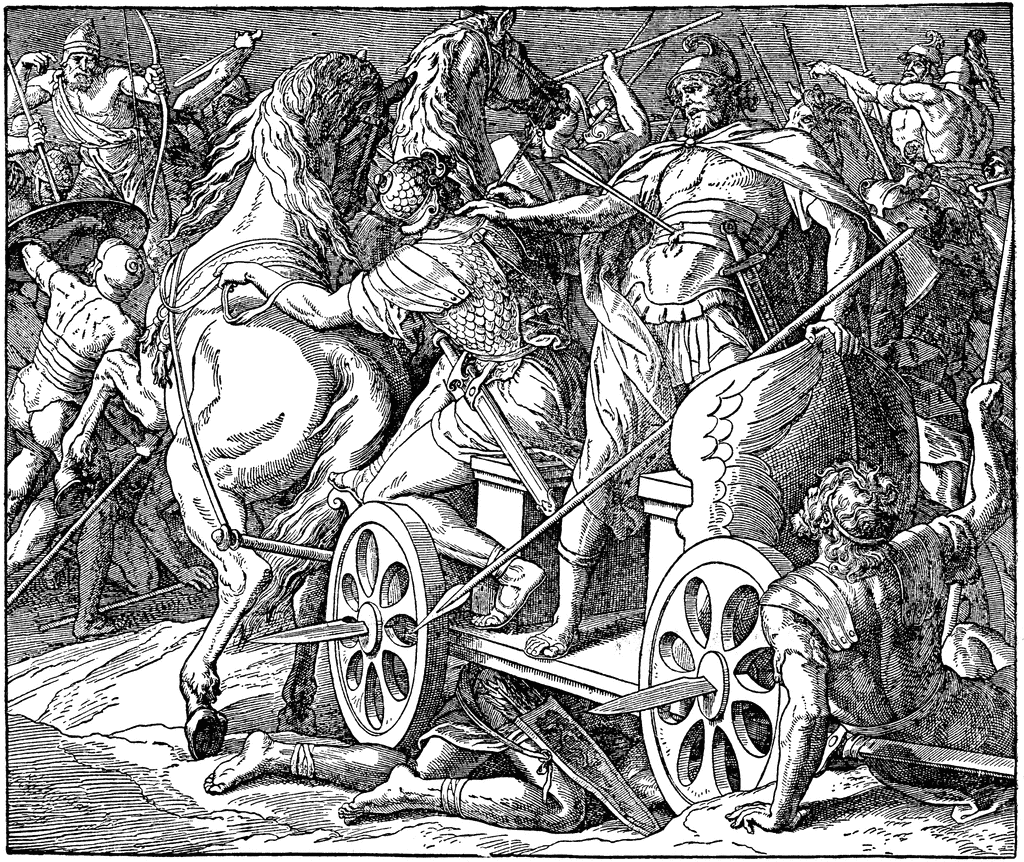
So the king of Israel and Jehoshaphat king of Judah went up to Ramoth Gilead. The king of Israel said to Jehoshaphat, “I will enter the battle in disguise, but you wear your royal robes.” So the king of Israel disguised himself and went into battle.

Now the king of Aram had ordered his thirty-two chariot commanders, “Do not fight with anyone, small or great, except the king of Israel.” When the chariot commanders saw Jehoshaphat, they thought, “Surely this is the king of Israel.” So they turned to attack him, but when Jehoshaphat cried out, the chariot commanders saw that he was not the king of Israel and stopped pursuing him.

But someone drew his bow at random and hit the king of Israel between the sections of his armor. The king told his chariot driver, “Wheel around and get me out of the fighting. I’ve been wounded.” All day long the battle raged, and the king was propped up in his chariot facing the Arameans. The blood from his wound ran onto the floor of the chariot, and that evening he died. As the sun was setting, a cry spread through the army: “Every man to his town. Every man to his land!”

So the king died and was brought to Samaria, and they buried him there. They washed the chariot at a pool in Samaria (where the prostitutes bathed), and the dogs licked up his blood, as the word of the Lord had declared.

As for the other events of Ahab’s reign, including all he did, the palace he built and adorned with ivory, and the cities he fortified, are they not written in the book of the annals of the kings of Israel? Ahab rested with his ancestors. And Ahaziah his son succeeded him as king….

Ahaziah son of Ahab became king of Israel in Samaria in the seventeenth year of Jehoshaphat king of Judah, and he reigned over Israel two years. He did evil in the eyes of the Lord, because he followed the ways of his father and mother and of Jeroboam son of Nebat, who caused Israel to sin. He served and worshiped Baal and aroused the anger of the Lord, the God of Israel, just as his father had done. (New International Version)

The Death of Ahab, by Julius Schnoor von Carolsfeld (1794-1872)

Whenever someone ignores or tries to get around reality, we call such a person “delusional.” It seems that the more power and authority a person possesses, the easier it is to delude themselves into thinking they can manipulate events in their favor. They then tend to listen only to what they want to hear.

King Ahab of Israel was delusional. He, like so many kings before and after him, was focused on the externals of personal power, accumulating more wealth, and exploring alternative religions. It all led to a twisted view of reality, as well as a prophetic demise.

Identifying so much with externalities, to the detriment of the internalities, is the ultimate bogus approach to life. It never ends well. Instead of exploring the image of God within himself and others, ensuring justice for all his subjects, and using his power to provide for the common good of all Israel, King Ahab went the spiritually and emotionally insecure route of listening to the wrong people.

Insecure and delusional people only listen to what is positive; and they eschew any negatives in their life. This is why the biblical prophets throughout Old Testament history typically found themselves at loggerheads, in prison, or at the end of a spear from those in power.

Ahab feigned wanting to hear what is true, but when hearing any negative aspects, he wrongly believed he could get around reality through his earthly authority and personal ingenuity. But he couldn’t. No one can outdo the stronger unseen forces in this world. (1 Kings 22:1-28)

So, Ahab laid a delusional plan to disguise himself as an ordinary soldier in battle. But although he chose to go against prophetic truth, there was no way to ignore the reality of it.

The providence and purposes of God prevail in any and all circumstances – no matter what they are. Today’s story highlights a seemingly random arrow from an enemy solider, hitting Ahab in the precise spot which could penetrate his armor.

The king was wounded and had to leave the battle. Yet, Ahab stuck to his delusional world, having his men prop him up in his chariot so that he could watch events unfolding in front of him.

Even in his powerlessness, King Ahab could not bring himself to believe that things could be different than he planned. He died at the end of the day, still stuck in his delusional and insecure world.

The editor of the Book of Kings summarized Ahab’s reign by mentioning impressive external improvements to his palace and fortified cities. Yet, these are mere incidentals. The real – and not delusional – assessment of the king’s life is that he was a religious apostate and a moral reprobate.

In the end, Ahab was nothing more than a weak and insecure individual who compromised God’s ethical law and sought to control events for his own misguided purposes. He followed Yahweh only if it aligned with his own plans.

Furthermore, it’s sad that Ahab’s approach to life, and his behavior toward others, was reflective of the Israelite nation as a whole (2 Kings 17:7-17). His own death eerily foreshadowed the death of Israel.

In our own era of incompetent leadership, morally inferior leaders, and delusional administrations, it behooves every concerned and pious believer to pray for all those in authority.

This side of heaven, there will always be cultural and societal pressures to conform to external pride, wealth, and success. But this is not the believer’s call, to take it’s cues from worldly power. Our focus is on consistently and patiently doing what is good, right, and just – accepting the unseen real over the seen delusion.

Rather than trying to continually manipulate events for our own shortsighted purposes, we must persevere in spurring-on one another to love and good deeds (Hebrews 10:24). For only together, as the one people of God, can we resist and subvert the machinations of delusional leaders.

O Lord God, Ruler of all, and whose glory exists in all the world: We commend nations and their leaders to Your divine providence, so that we may dwell secure in Your peace.

Grant to everyone in authority everywhere the wisdom and strength to know and do Your will. Fill them with the love of truth and justice; and make them mindful of their calling to serve all people with respect and reverence; through Jesus Christ our Lord, who lives and reigns with You and the Holy Spirit, one God, world without end. Amen.