Deuteronomy 9:1-5 – A Reality Check

Jordan River by Ilan Szekely, 1944

Listen, Israel! Today you will cross the Jordan River to enter and take possession of nations larger and more powerful than you, along with huge cities with fortifications that reach to the sky. These people are large and tall—they are the Anakim. You know and have heard what people say: “Who can stand up to the Anakim?” Know right now that the Lord your God, who is crossing over before you, is an all-consuming fire! He will wipe them out! He will subdue them before you! Then you will take possession of their land, eliminating them quickly, exactly as the Lord told you.

Once the Lord your God has driven them out before you, don’t think to yourself, It’s because I’m righteous that the Lord brought me in to possess this land. It is instead because of these nations’ wickedness that the Lord is removing them before you. You aren’t entering and taking possession of their land because you are righteous or because your heart is especially virtuous; rather, it is because these nations are wicked—that’s why the Lord your God is removing them before you, and because he wishes to establish the promise he made to your ancestors: to Abraham, Isaac, and Jacob. (Common English Bible)

When my kids were small, I dealt with the issue of sharing, as every parent has to do. Once, two of my girls were fighting over a doll. As I entered the room, one of them quickly said, “She has my doll!” So, I sat her down with me and calmly asked, “Whose doll is it?” “It’s mine!” my daughter cried.

I asked again, “Whose doll is it?” Again, the answer came, “It’s my doll!” I asked yet a third time, “Whose doll is it?” Because this was not our first rodeo together about fighting over dolls and toys, my daughter bowed her head, gave a big sigh, and quietly said, “It’s God’s doll.”

“Yes, it’s God’s doll,” I said. “God is just letting you borrow it for a while and expects you to take good care of it and share his stuff with others.”

Kids often need a reality check of where things come from and who really owns it all. Many times, adults need the very same reality check.

We big people grow up and tend to think we are bigger than we really are. Over the years, we gain misguided notions of our possessions and accomplishments. We believe we did it all through our own skills and character.

Maybe you recognize some of these common notions about our life, work, and ministry:

  • “I worked a long time for my money. I’m not giving it to so-and-so.”
  • My church has a lot of people because we preach the Bible, not like other churches.”
  • “The government takes too much of my hard earned money.”
  • “Here, you can have this couch. I was going to throw it away, anyway. My couch is a nice new one.”
  • “I made a lot of sacrifices for my job. I’m not letting anyone steal my position from me.”
  • “I raised my kids and they’re all doing very well in life. They wouldn’t have made it without me.”
  • “Hey, that’s my yard. Your dog can’t be on it.”
  • “This is my time.”
  • “It’s my car. Don’t touch it.”
  • My way or the highway.”

Those are actual statements Christians have said to me over the years. In their extreme individualism, they believed they were the masters of their own goodness and achievements. In other words, they gave themselves more credit than they really deserved.

A person is proud and selfish not for pursuing their own good but for neglecting their neighbor’s.

It’s far too easy to chalk-up our positions, titles, degrees, jobs, and the good things which come with them as of our own doing. We then believe we are the true owners of all our stuff. Some can even take the next step of believing that if others would just do what I do and think the way I think, then all would be well in the world.

That’s pretty much how Lucifer thought about things. And even after getting cast from heaven, he still exists with the delusion that he didn’t deserve it, as if he were above ever getting treated any other way than like God does.

The reality, however, is that everything and everyone belongs to God. The Lord is the rightful ruler of the universe, and we are not. Every good and perfect thing we have in this life is a gift from a gracious heavenly Father.

Stupidity doesn’t come from a lack of brains or smarts; it’s a result of pride taking over one’s thinking.

Indifference doesn’t have its source in a lack of caring; it comes from believing certain people don’t deserve to have my attention, my stuff, or my time.

Arrogance isn’t an inbred personality trait; it’s the logical end of the successful person’s life who is convinced that everyone ought to adopt their particular set of societal mores, cultural values, political views, and personal disciplines.

Conversely, a person in humble circumstances with little to their name is not necessarily lazy or unwilling to work. And when they have giants in their lives, they can trust the God who specializes in taking down the stupid, the indifferent, and the arrogant.

All things are a gift from the Lord, even the difficult people and hard circumstances we face. They are really opportunities for God to show up and give us precisely what we need.

Everything is a trust from God that we are to steward well, whether it is people, things, or money. They are given to us, not because of any superior spirituality on our part or righteous ingenuity, but because God simply gives it. We have what we have because of God, period.

The appropriate way of stewarding our resources, as well as expressing thanks to God, is through sharing our stuff, our money, our time, and our love with others.

Whose life is it?

We do not presume to come to your Table, O merciful Lord, trusting in our own righteousness, but in your abundant and great mercies. We are not worthy so much as to gather up the crumbs under your table; but you are the same Lord whose character is always to have mercy. Grant us, therefore, gracious Lord, so to eat and drink that our sinful bodies may be made clean by his body, and our souls washed through his most precious blood, and that we may evermore dwell in him, and he in us. Amen.

Leviticus 5:1-13 – The Problem of Guilt

“‘If anyone sins because they do not speak up when they hear a public charge to testify regarding something they have seen or learned about, they will be held responsible.

“‘If anyone becomes aware that they are guilty—if they unwittingly touch anything ceremonially unclean (whether the carcass of an unclean animal, wild or domestic, or of any unclean creature that moves along the ground) and they are unaware that they have become unclean, but then they come to realize their guilt;or if they touch human uncleanness (anything that would make them unclean) even though they are unaware of it, but then they learn of it and realize their guilt; or if anyone thoughtlessly takes an oath to do anything, whether good or evil (in any matter one might carelessly swear about) even though they are unaware of it, but then they learn of it and realize their guilt—when anyone becomes aware that they are guilty in any of these matters, they must confess in what way they have sinned. As a penalty for the sin they have committed, they must bring to the Lord a female lamb or goat from the flock as a sin offering; and the priest shall make atonement for them for their sin.

“‘Anyone who cannot afford a lamb is to bring two doves or two young pigeons to the Lord as a penalty for their sin—one for a sin offering and the other for a burnt offering. They are to bring them to the priest, who shall first offer the one for the sin offering. He is to wring its head from its neck, not dividing it completely, and is to splash some of the blood of the sin offering against the side of the altar; the rest of the blood must be drained out at the base of the altar. It is a sin offering. The priest shall then offer the other as a burnt offering in the prescribed way and make atonement for them for the sin they have committed, and they will be forgiven.

“‘If, however, they cannot afford two doves or two young pigeons, they are to bring as an offering for their sin a tenth of an ephah of the finest flour for a sin offering. They must not put olive oil or incense on it, because it is a sin offering. They are to bring it to the priest, who shall take a handful of it as a memorial portion and burn it on the altar on top of the food offerings presented to the Lord. It is a sin offering. In this way the priest will make atonement for them for any of these sins they have committed, and they will be forgiven. The rest of the offering will belong to the priest, as in the case of the grain offering.’” (New International Version)

“Indifference is the sign of sickness, a sickness of the soul more contagious than any other.”

Elie Wiesel

Guilt comes in two forms: overt speech or action which wrongs another person; or the failure to speak or act when it was necessary to do so.

Oftentimes we think of sin as exclusively wrongdoing – an overt act of disobedience or evil. Yet, sin primarily manifests itself through indifference. The sinner is mostly one who doesn’t get involved. He walks on the other side of the road to avoid unwanted entanglements.

What’s more, sins of the tongue are much more common and prolific than sins of the body. Although hurtful words abound in this fallen world, it is also the absence of speaking up and naming falsehood for what it is that is an egregious sin before God.

The Lord will hold responsible those who are silent in the face of observing injustice.

And, if later, someone becomes aware they were complicit with an injustice through a failure to speak up, they are also guilty.

The Old Testament book of Leviticus is all about maintaining the purity and holiness of God’s people. So, the book is filled with detailed prescriptions on how to handle guilt. Going through a specific and laborious process of dealing with guilt, communicated to the people that this is important. It’s a big deal.

We need, however, to ensure we aren’t using the terms guilt and shame interchangeably.

Guilt is a function of our conscience. It lets us know when we have said or done something wrong or hurtful, or failed to provide help. It’s specific to a particular action or lack of action.

Shame, however, is a function of the “inner critic.” It interprets bad words or actions as we ourselves being bad. It focuses not on actions but on our very personhood in the form of judgmentalism leveled at myself.

Whereas guilt says, “I have done something bad,” shame says, “I am bad.” Guilt serves a redemptive purpose through alerting us that we need to deal with a wrong. Shame, however, damages our spirits through telling us we are flawed and unworthy of love and connection with others.

Because guilt and shame are not the same, they need to be dealt with in different ways:

  • Guilt, if not faced and dealt with, becomes gangrene of the soul. Over time it festers and poisons our spirits, leading to significant emotional and sometimes physical problems. Forgiveness is the primary tool in dealing with guilt. It begins with self-forgiveness and then offering an apology to another and asking for forgiveness.
  • Shame is a vampire that lives in the shadows and feeds on secrets. If shame persists, we withdraw from others and experience grinding loneliness. Therefore, the path out of shame is to openly name our shame and tell our stories. This takes power away from shame and gives it to yourself. In other words, the practice of vulnerability erases shame.

For the Christian, Jesus is the once for all sacrificial offering which forever takes away both our guilt and our shame.

Since we have a great High Priest who rules over God’s house, let us go right into the presence of God with sincere hearts fully trusting him. For our guilty consciences have been sprinkled with Christ’s blood to make us clean, and our bodies have been washed with pure water. (Hebrews 10:21-22, NLT)

We must never stop looking to Jesus. He is the leader of our faith, and he is the one who makes our faith complete. He suffered death on a cross. But he accepted the shame of the cross as if it were nothing because of the joy he could see waiting for him. And now he is sitting at the right side of God’s throne. (Hebrews 12:2, ERV)

“See, I lay a stone in Zion,
    a chosen and precious cornerstone,
and the one who trusts in him
    will never be put to shame.” (1 Peter 2:6, NIV)

Guilt and shame are not erased by either ignoring them or by dismissing them as negative emotions. They are handled through the person and work of Jesus Christ. It is grace which grants us amnesty from shortcomings, failures, and sins.

Thanks be to God! Believe this gospel and live in its peace.

Holy and merciful God, in your presence we confess our sinfulness, our shortcomings, and our offenses against you. You alone know how often we have sinned in wandering from your ways, in wasting your gifts, in forgetting your love. Have mercy on us, O Lord, for we are sorry for all we have done to displease you. Forgive our sins, and help us to live in your light and walk in your ways, for the sake of Jesus Christ, our Savior. Amen.

1 Samuel 24:1-22 – How to Handle An Enemy

David and Saul in the Cave by James J. Tissot (1836-1902)

After Saul returned from pursuing the Philistines, he was told, “David is in the Desert of En Gedi.” So, Saul took three thousand able young men from all Israel and set out to look for David and his men near the Crags of the Wild Goats.

He came to the sheep pens along the way; a cave was there, and Saul went in to relieve himself. David and his men were far back in the cave. The men said, “This is the day the Lord spoke of when he said to you, ‘I will give your enemy into your hands for you to deal with as you wish.’” Then David crept up unnoticed and cut off a corner of Saul’s robe.

Afterward, David was conscience-stricken for having cut off a corner of his robe. He said to his men, “The Lord forbid that I should do such a thing to my master, the Lord’s anointed, or lay my hand on him; for he is the anointed of the Lord.” With these words David sharply rebuked his men and did not allow them to attack Saul. And Saul left the cave and went his way.

Then David went out of the cave and called out to Saul, “My lord the king!” When Saul looked behind him, David bowed down and prostrated himself with his face to the ground. He said to Saul, “Why do you listen when men say, ‘David is bent on harming you’? This day you have seen with your own eyes how the Lord delivered you into my hands in the cave. Some urged me to kill you, but I spared you; I said, ‘I will not lay my hand on my lord, because he is the Lord’s anointed.’ See, my father, look at this piece of your robe in my hand! I cut off the corner of your robe but did not kill you. See that there is nothing in my hand to indicate that I am guilty of wrongdoing or rebellion. I have not wronged you, but you are hunting me down to take my life. May the Lord judge between you and me. And may the Lord avenge the wrongs you have done to me, but my hand will not touch you. As the old saying goes, ‘From evildoers come evil deeds,’ so my hand will not touch you.

“Against whom has the king of Israel come out? Who are you pursuing? A dead dog? A flea? May the Lord be our judge and decide between us. May he consider my cause and uphold it; may he vindicate me by delivering me from your hand.”

When David finished saying this, Saul asked, “Is that your voice, David my son?” And he wept aloud. “You are more righteous than I,” he said. “You have treated me well, but I have treated you badly. You have just now told me about the good you did to me; the Lord delivered me into your hands, but you did not kill me. When a man finds his enemy, does he let him get away unharmed? May the Lord reward you well for the way you treated me today. I know that you will surely be king, and that the kingdom of Israel will be established in your hands. Now swear to me by the Lord that you will not kill off my descendants or wipe out my name from my father’s family.”

So, David gave his oath to Saul. Then Saul returned home, but David and his men went up to the stronghold. (New International Version)

Sometimes reconciliation is neither possible nor wise.

King Saul was unstable. Although initially appreciative of David’s service, Saul became jealous. And that jealousy eventually grew into suspicion, then paranoia.

It became so bad that David had to flee and went on the run. Saul was convinced David wanted his kingship, so he hunted him like an animal. He wanted him out of the limelight and out of the way – permanently.

There are times in everyone’s life that another person actively and intentionally seeks to do us harm. How do we handle such a situation? How might we respond in a way that gives us peace of mind?

David continually had enemies throughout his life. And the vast number of those who opposed him, did so despite the fact that David didn’t deserve it.

“We retaliate instead of reflect, and we burn hot in the flames of revenge rather than cool our heels in the pool of patience.”

Craig D. Lounsbrough

Saul came looking for David with an army five-times the size of David’s rag-tag group of men. Yet, Saul had no idea that he had ambled into being a sitting duck.

What would you do in that kind of situation?

Picture the person who gives you the most grief. Maybe they purposely speak bad about you or try and oppose you at any opportunity. Perhaps there is a boss or someone in authority who seeks to undermine you every chance they get.

And now, the tables are turned. You have the chance to publicly put them in their place. You can put an end to the madness. What are you going to do?

In David’s situation, his men made the logical assumption that God ordained the turn of events. So, go ahead and off Saul. Become the king. After all, God already told you that you would be king. Now he’s giving you the opportunity. It’s right there. Take it, man.

“Retaliation is a dog chasing its tail.”

Libba Bray

But David didn’t take advantage of having the upper hand. He didn’t kill Saul because he was convinced it wasn’t the right thing to do. In fact, David felt terrible for even considering the idea. He wasn’t going to take matters into his own hands.

So, David left it in the hands of God. Since God anointed him as the next king, David reasoned, then God would make it happen. He didn’t need to do God’s job for him. David’s theological perspective was this: God is my defender; God will take care of me; God will judge another’s sinful behavior.

Today’s Old Testament lesson is a story in the importance and necessity of non-retaliation. What’s more, it’s a lesson in treating all people with respect, even if they don’t seem to deserve it, at all.

This lesson in no way infers that we sit idly by and refuse to hold another accountable for their actions. It just means we aren’t the judge, jury, and executioner.

Once Saul realized he had been a sitting duck, he repents… or does he? He admits to his wrong, even emotionally reacts to it. But here’s the bottom line to all overtures of repentance: It must result in a change of attitude and behavior. And Saul didn’t offer that.

So, the story ends pretty much as it began. There’s no reconciliation because there’s no true repentance on the part of Saul. The disturbed and paranoid king ends up continuing his murderous pursuit of David. *Sigh*

Folks like Saul have no intention of changing. They only want to hold onto their power and control. They’re only happy if others are giving them accolades and kudos. And if they’re not getting recognition, there’s hell to pay.

Beware of false repentance. Don’t be fooled by a person who has a pervasive pattern of self-interest, then, all of a sudden, feels sorry. It’s likely they’re doing that because they don’t have the upper hand – and they desperately want it back.

More importantly, don’t play their game. Instead, live by the ethics of God’s kingdom. You’ll be glad you did.

O God: Give me strength to live another day. Let me not turn coward in the face of its difficulties. Let me not lose faith in other people. Keep me sweet and sound of heart, in spite of ingratitude, treachery, or meanness. Preserve me from harm and keep me from harming others. Help me to keep my heart clean, and to not become disheartened by the evil of others. Open wide the eyes of my soul that I may see the good in everything. Inspire me with the spirit of joy and gladness and make me a conduit of your blessing to others, in the name of the strong Deliverer, our Lord and Savior, Jesus Christ. Amen.

Genesis 33:1-17 – Reconciled

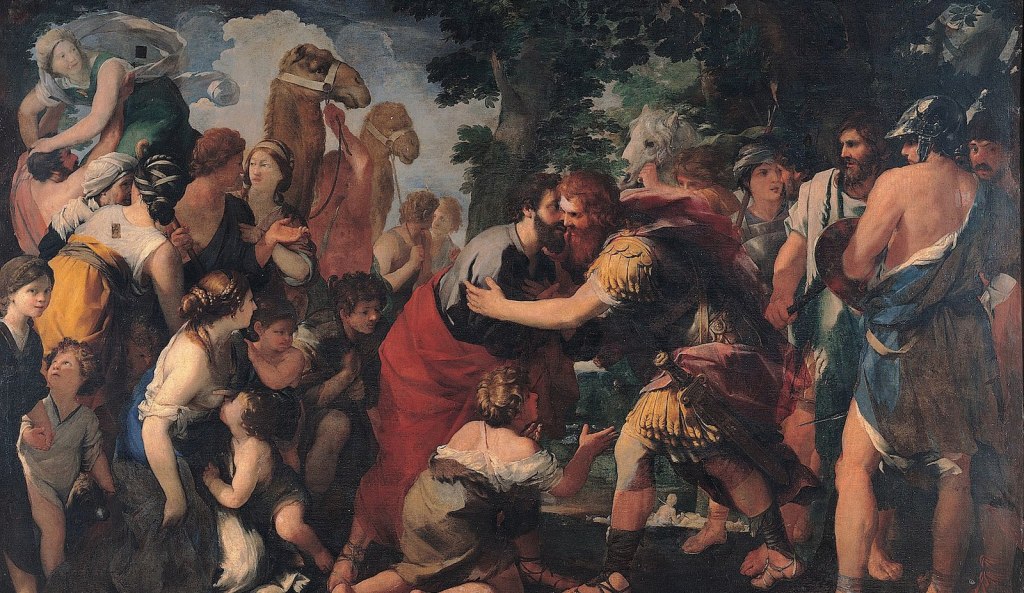
Meeting Between Jacob and Esau by Italian painter Bottalla Raffaellino (1613-1644)

Later that day Jacob met Esau coming with his four hundred men. So, Jacob had his children walk with their mothers. The two servant women, Zilpah and Bilhah, together with their children went first, followed by Leah and her children, then by Rachel and Joseph. Jacob himself walked in front of them all, bowing to the ground seven times as he came near his brother.

But Esau ran toward Jacob and hugged and kissed him. Then the two brothers started crying.

When Esau noticed the women and children he asked, “Whose children are these?”

Jacob answered, “These are the ones the Lord has been kind enough to give to me, your servant.”

Then the two servant women and their children came and bowed down to Esau. Next, Leah and her children came and bowed down; finally, Joseph and Rachel also came and bowed down.

Esau asked Jacob, “What did you mean by these herds I met along the road?”

“Master,” Jacob answered, “I sent them so that you would be friendly to me.”

“But, brother, I already have plenty,” Esau replied. “Keep them for yourself.”

“No!” Jacob said. “Please accept these gifts as a sign of your friendship for me. When you welcomed me and I saw your face, it was like seeing the face of God. Please accept these gifts I brought to you. God has been good to me, and I have everything I need.” Jacob kept insisting until Esau accepted the gifts.

“Let’s get ready to travel,” Esau said. “I’ll go along with you.”

But Jacob answered, “Master, you know traveling is hard on children, and I have to look after the sheep and goats that are nursing their young. If my animals travel too much in one day, they will all die. Why don’t you go on ahead and let me travel along slowly with the children, the herds, and the flocks. We can meet again in the country of Edom.”

Esau replied, “Let me leave some of my men with you.”

“You don’t have to do that,” Jacob answered. “I am happy, simply knowing that you are friendly to me.”

So, Esau left for Edom. But Jacob went to Succoth, where he built a house for himself and set up shelters for his animals. That’s why the place is called Succoth. (Contemporary English Version)

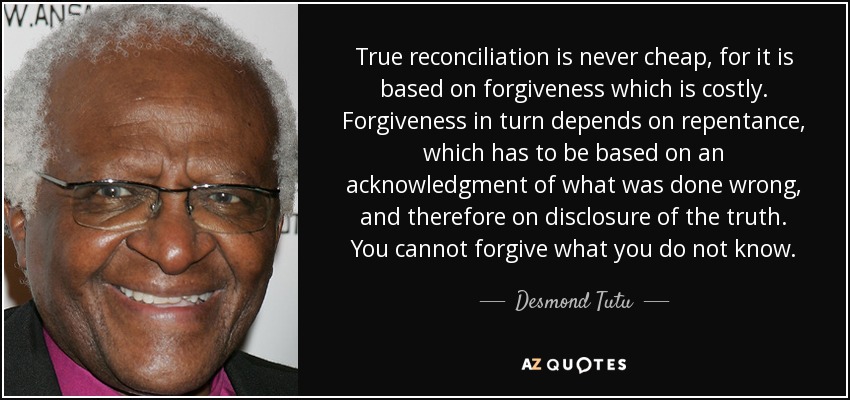
Repentance includes more than saying sorry. It also involves admitting wrong and making things right. Turning from erroneous thinking and forsaking past hurtful actions, lays the groundwork for an earnest attempt at reconciliation. 

For example, the Christian does more than a simple acceptance and acquiescence of Jesus, as if merely adding a bit of Christ to life will dash it up and make it better. Rather, we are invited into the very life of Christ. This life turns us upside-down and inside-out in a new and radical allegiance.

Repentance and reconciliation are a way of life. They are necessary skills requiring development through continual practice and use.

Broken relationships are the stuff of life. So, we need gracious approaches to deal with them so that bitterness does not take root in our souls. Connection and peace between two people are a beautiful thing. They bring emotional health, spiritual wholeness, and life enrichment.

From the get-go, twin brothers Jacob and Esau in the Old Testament book of Genesis had a contentious relationship. Their relations became so bad that Esau had homicidal ideation toward his brother. Neither Esau nor Jacob handled things well. Jacob ended up leaving, finding a wife, growing a family, and becoming wealthy.

Twenty years passed before they came together again.

Jacob, knowing he was about to meet his brother, had an encounter with God. It changed his identity from the old deceiver to the new Israel (Genesis 32:22-31).  In a demonstration of his new identity as Israel, Jacob worked at making amends for his old cheating ways. He sought to give the blessing he had stolen from his brother.

Jacob understandably had some dread in meeting Esau. He had connived and manipulated to take the family birthright and blessing from his brother. Fresh from wrestling with God, Jacob demonstrated a newfound courage and humility. He offered Esau respect, gifts, and honor – reversing his past pattern of disrespect, stealing, and dishonor.

True repentance is making things right. Merely having feelings of remorse is not repentance. To repent involves genuine sorrow; an earnestness to make restitution and reconciliation; an indignation over what happened; and, perhaps most importantly, a deep concern for the person(s) harmed by our wrongdoing (2 Corinthians 7:8-11).

The reconciliation between the brothers was a surprise. Jacob was not expecting Esau’s response. It seems Jacob was bracing for the worse, which explains his high anxiety before the encounter.

Esau’s gracious response was an answer to Jacob’s prayer.  For Jacob, seeing Esau’s face was like seeing the face of God. In fact, he saw both faces and lived! Jacob likely would not have seen his brother’s face until he had first seen God’s. His divine experience prepared the way for the human encounter.

We all experience times when relationships unravel and need to be mended. Jacob procrastinated for twenty years before working at reconciliation with his brother. What made the difference for Jacob was trusting God, who always works out divine promises, despite our human foibles. 

May you know and experience the God who reconciles and restores, and in so doing, extend that same earnestness to others.

Merciful God, I confess that I have sinned against you and against others through my own fault by thought, word and deed in things done and left undone. Especially I confess that I have _____.  I therefore repent; for these and all my sins I am terribly sorry and pray for forgiveness. I firmly intend to make amends and seek for help. I ask for strength to serve you in newness of life through Jesus Christ, my Lord, in the power of your Holy Spirit. Amen.