Acts 9:32-35 – Healed

St. Peter heals Aeneas, 12th century mosaic in Palermo, Italy

As Peter traveled about the country, he went to visit the Lord’s people who lived in Lydda. There he found a man named Aeneas, who was paralyzed and had been bedridden for eight years. “Aeneas,” Peter said to him, “Jesus Christ heals you. Get up and roll up your mat.” Immediately Aeneas got up. All those who lived in Lydda and Sharon, saw him and turned to the Lord. (New International Version)

The early church was growing. Both in numbers and in faith, the new believers following the words and ways of Jesus could be found everywhere in Judea. The Apostle Peter, therefore, decided to get out of Jerusalem and visit some of these folks in the town of Lydda, on the Mediterranean coast.

Back when Peter was following Jesus around in his earthly ministry, the Lord told the disciples that they will do the works he did, and, what’s more, they will do even greater things than Jesus himself. (John 14:12-14)

Peter emulated the example of his Lord. He simply stated that Christ is the one who heals you, Aeneas, so get up, take your mat, and go on home. (Mark 2:10-12; John 5:1-8)

The act of healing the paralyzed man, Aeneas, was a sign that the merciful saving ministry of Jesus was in effect, even when Jesus isn’t bodily present. Christ made it clear that the Holy Spirit would be the continuing presence of God on this earth. (John 16:1-15)

We, too, have this same Spirit.

The work of ministry is always done to the glory of God. People hear the good news, see the miracle, and believe in Jesus.

There are some who examine today’s New Testament lesson and expect that they (and all other believers) ought to be able to do exactly what Peter did: heal another miraculously.

Then, there are others who look at the same account and relegate it to some bygone era in which only the original apostles, like Peter, could do that sort of thing – if it even happened like that, at all.

To expect a dramatic physical healing, every time, all the time, is not consistent with healing narratives in Holy Scripture. And to never expect a miraculous healing is equally inconsistent with the biblical data.

It seems to me we need to reject both extremes. That’s because healing comes in all sorts of different forms.

An event which causes the need for healing and health, or a condition which prevents good health, isn’t limited to the body. A person’s mind, emotions, and spirit can also be damaged and need healing, as well. In fact, whenever there is trauma to the physical body, it profoundly effects the person’s thinking, feeling, and praying.

We need to beware of desiring the fast solution of dramatic and miraculous healing because of not wanting to deal with our emotions.

Perhaps you, like me, have had the experience of going to work or church when experiencing a difficult time in life. There is an emotional heaviness because of a strained, broken, or lost relationship. Or maybe there is emotional pain from an unexpected or unwanted situation.

Yet, when someone asks how you are doing, the response “Oh, fine!” tumbles automatically out of your mouth. But you are anything but fine. Inside, down in your heart, or painfully present in your head, the hurt dominates your thoughts and feelings.

Healing is for people. Fixing is for things and machines. It would be weird if I said I was going to heal a tractor. It is equally strange to try and fix people. To heal is to straighten what is broken. We cannot fix our emotions because, when hurt or damaged, they need healing – a process of restoration – and it usually doesn’t happen overnight.

Our emotional healing is like walking a slow journey. Along that path, our emotions are crying out for us to pay attention to three things:

  1. Grief. Grieving is the normal emotional reaction to any significant change or loss. To grieve our painful situations, whatever they may be, is necessary to healing our emotions. Putting a lid on our grief and sucking it up in a delusional show of strength at best prolongs our healing, and, at worst, brings further damage.
  2. Grace. Grace is an act of bestowing honor or forgiveness to a person. It is not dependent upon whether one deserves it, or not. Grace is the opposite of being judgmental. It chooses not to hold something over or against another, even oneself.
  3. Gratitude. Gratitude is a deliberate act of thankfulness for a specific act. It is both an attitude and an emotion. Gratitude comes from a heart of appreciation. Habits of gratitude creates new ways of being with others. And creating new experiences is one of the best ways of helping to heal the bad experience we just went through.

Embracing those three elements of grief, grace, and gratitude sets us on a healing path. Also, there are practices which we can utilize with each of those three which promote their healing work in our lives. For me, some of those practices include humor and laughter; meditation and other spiritual practices; walking the dog; watching cartoons; and journaling.

Healing is an art. It takes time, lots of practice, and plenty of love. Healing comes from God, which is a good thing, because the Lord knows exactly the kind of healing we need.

God of all comfort and healing, our help in time of need: We humbly ask you to relieve the suffering of your sick servants everywhere. Look upon them with the eyes of your mercy; comfort them with a sense of your goodness; preserve them from the temptations of the enemy; and give them patience in their afflictions. In your good time, restore them to health, and enable them to glorify your most holy name and dwell with you forever in the land of the living, through Jesus Christ our Lord. Amen.


Psalm 100 – Know That the Lord is God

Shout for Joy by Lucy Adams

Shout for joy to the Lord, all the earth.
    Worship the Lord with gladness;
    come before him with joyful songs.
Know that the Lord is God.
    It is he who made us, and we are his;
    we are his people, the sheep of his pasture.

Enter his gates with thanksgiving
    and his courts with praise;
    give thanks to him and praise his name.
For the Lord is good and his love endures forever;
    his faithfulness continues through all generations. (New International Version)

The worship of God cannot be contained with one dimension of a person – their spirit. Worshiping God requires the body, mind, and emotions, as well. Anything less, is withholding praise. We are to worship with our entire being.

The original use of today’s psalm was for the ancient Israelites approaching the temple to worship God.  Before worshipers ever came into the presence of the Lord, they were preparing themselves to encounter God through giving thanks, using this very psalm.

When King David and other Hebrew writers penned their poetic songs, they centered what they most wanted to draw attention to in the middle, so that what came before it and after it pointed to that central message. The center of the psalm is:

Know that the Lord is God. Knowing God is to experience the divine through a close relationship. It means we have a place and a purpose. It is a knowing and belonging which exists deep down in our gut.

We get to know God by how he has worked in people’s lives, as well as our own. So, gatherings of believers (whether physical or virtual) are an opportunity to reinforce collective values, strengthen faith, and encourage the discouraged.

Faithful worshipers deeply desire to focus on who God is and what God has done, remembering and rehearsing divine qualities and deeds. Through this activity, we help one another know the Lord. And knowing God is what real life is all about. The Lord is worthy of all the praise, adoration, and worship we can give.

There are three imperatives (commands) that come before the middle phrase to know that the Lord is God; and three imperatives coming after it.  All six imperatives are meant to help us know God better, to give our proper praise to the Lord.

Shout for joy to the Lord, all the earth. Declaring loudly of God’s gracious and loving character, expressed through right, just, and fair actions.

Worship the Lord with gladness. Kneeling and prostrating before God in humble reverence, awe, and adoration.

Come before the Lord with joyful songs. Approaching God’s throne with confidence and boldness.

Those are the three imperatives which lead us to know the Lord. 

The following three imperatives point back to know that the Lord is God:

Enter the Lord’s gates with thanksgiving. Immersing oneself in the presence of God.

Give thanks to the Lord. Giving voice in gratitude to God

Praise the name of the Lord. Declaring God’s holy name with heartfelt expression.

We belong to God. God’s people celebrate this tremendous experience of belonging with deliberate actions that put us in a position to know God better.

I keep asking that the God of our Lord Jesus Christ, the glorious Father, may give you the Spirit of wisdom and revelation, so that you may know him better. (Ephesians 1:17, NIV)

One of my all-time favorite verses in the Bible has to do with knowing God:

I want to know Christ—yes, to know the power of his resurrection and participation in his sufferings, becoming like him in his death.

Philippians 3:10, NIV

Everything in our lives, whether good or bad, is designed to help us know God better. Shared experiences with each other encourage Christians to keep living for Jesus. All of life, from a Christian perspective, points us to the mid-point of history, Jesus Christ, and him crucified, risen, and coming again.

And this is eternal life, that they may know you, the only true God, and Jesus Christ whom you have sent. (John 17:3, NRSV)

So, let us express gratitude today for all the gracious ways of God’s self-revealing and reaching out to save such ones as us.

I pray that out of his glorious riches he may strengthen you with power through his Spirit in your inner being, so that Christ may dwell in your hearts through faith. And I pray that you, being rooted and established in love, may have power, together with all the Lord’s holy people, to grasp how wide and long and high and deep is the love of Christ, and to know this love that surpasses knowledge—that you may be filled to the measure of all the fullness of God.

Now to him who is able to do immeasurably more than all we ask or imagine, according to his power that is at work within us, to him be glory in the church and in Christ Jesus throughout all generations, for ever and ever! Amen. (Ephesians 3:16-21, NIV)

Gracious and almighty God, the One who works on my behalf, give me grace to put away the rootless existence of someone who has no place; and help me to experientially know your radical acceptance and inclusion into the dance of the Trinity – Father, Son, and Spirit – one God, now and forever. Amen.

Grace and peace be yours in abundance through the knowledge of God and of Jesus our Lord. (2 Peter 1:2, NIV)

Amen. Soli Deo Gloria.

Enduring Love

Welcome, friends! Our help is in the name of the Lord who made heaven and earth. Grace and peace to you from God our Father and the Lord Jesus Christ.

Revelation 7:9-17 is a vision of the end and a glimpse of the enduring and unending love which will be in place forever. Until that time, however, we need God’s present love to help us endure and persevere to the end. Click the videos below and be encouraged with the ways we can spiritually thrive and flourish till the end…

Pastor Tim Ehrhardt, Revelation 7:9-17

Revelation 7:9-17 – Enduring Love

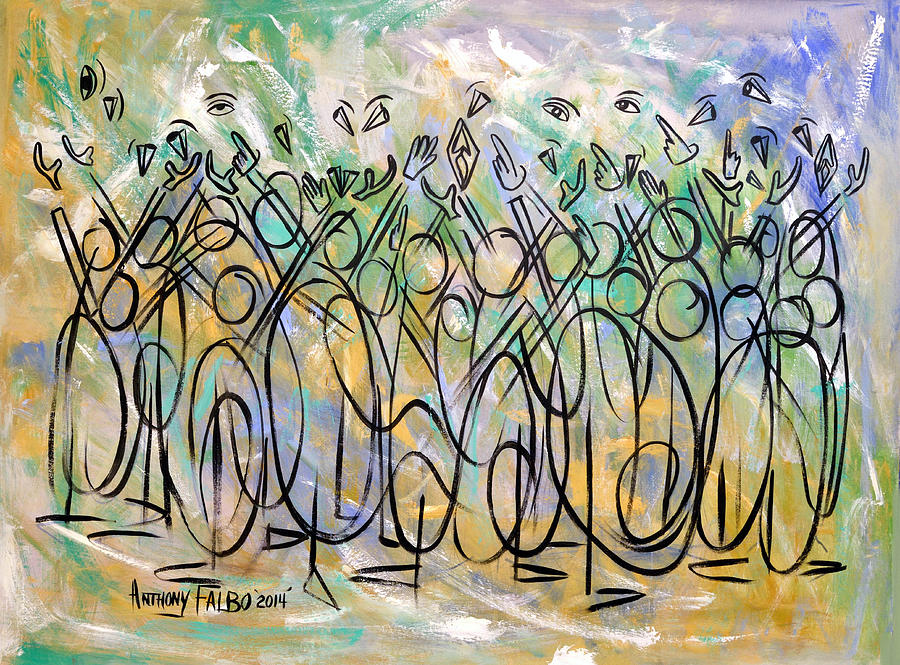
Look He’s Coming with the Clouds by Anthony Falbo, 2014

After this I looked, and there before me was a great multitude that no one could count, from every nation, tribe, people and language, standing before the throne and before the Lamb. They were wearing white robes and were holding palm branches in their hands. And they cried out in a loud voice:

“Salvation belongs to our God,
who sits on the throne,
and to the Lamb.”

All the angels were standing around the throne and around the elders and the four living creatures. They fell down on their faces before the throne and worshiped God, saying:

“Amen!
Praise and glory
and wisdom and thanks and honor
and power and strength
be to our God for ever and ever.
Amen!”

Then one of the elders asked me, “These in white robes—who are they, and where did they come from?”

I answered, “Sir, you know.”

And he said, “These are they who have come out of the great tribulation; they have washed their robes and made them white in the blood of the Lamb. Therefore,

“they are before the throne of God
    and serve him day and night in his temple;
and he who sits on the throne
    will shelter them with his presence.
‘Never again will they hunger;
    never again will they thirst.
The sun will not beat down on them,’
    nor any scorching heat.
For the Lamb at the center of the throne
    will be their shepherd;
‘he will lead them to springs of living water.’
    ‘And God will wipe away every tear from their eyes.’” (New International Version)

A simple observation of today’s text: There can only be a great multitude of people if there are a great multitude of mothers. The great multitude in the Apostle John’s vision of the end of time, had just come out of the great tribulation. And God does for them what any good mother would do: Never lets any of their children go hungry or thirsty; gets them out of harm’s way and protects them; and bends down to wipe their tears away and let them know that everything is going to be okay.

There is a day coming when followers of Jesus will see him face to face. Believers will serve the Lord continually. God’s very presence will be their permanent shelter. It will be a glorious time of unending peace, harmony, and rest.

There shall be no more worrying about how to make ends meet, no more wondering where we are going to get our needs met, and no more anxiety about the future. Injustice will be a thing of the past. Unending love and light will replace it.

First, however, before this permanent Sabbath, there will be trouble, hardship, trial, and even martyrdom. There is presently pain and suffering. Like a woman in labor, this must take place before there is the glory of new life. 

Sometimes the difficult circumstances of life seem to have no end. Yet, they will eventually pass, and we must continually keep this in mind. Christians have the hope of God’s pastoral presence forever guarding and keeping our lives if we endure to the end.

Perseverance, endurance, and pushing through hard situations are necessary to realize new and eternal life. We are not meant to just sit here on earth in some sort of holding pattern, waiting for the end to occur. Just as a pregnant woman changes her lifestyle to carry the child within, so we as Christians need to carry our souls, utilizing all kinds of spiritual practices that will help us do that well, until Jesus returns.

The Apostle John’s vision was given to believers in hardship who needed to persevere when things were tough. Giving them a glimpse of the glorious ending was one way of helping them in the present to live for Jesus Christ, despite the pain.

There’s nothing quite like a mother’s love. With the security of that love, we can live in healthy ways, enduring and persevering through difficulty and adversity. God’s love enables us to live securely in five ways:

  1. Not being afraid to fail.

That’s because, for the believer, we know the ending. We may, at times, feel like colossal failures, yet because the Lord is with us, we have nothing to fear. Being secure in our identity as God’s people enables us to step out and engage the world.

“It is not the critic who counts; not the man who points out how the strong man stumbles, or where the doer of deeds could have done them better. The credit belongs to the man who is actually in the arena, whose face is marred by dust and sweat and blood; who strives valiantly; who errs, who comes up short again and again, because there is no effort without error and shortcoming; but who does actually strive to do the deeds; who knows great enthusiasms, the great devotions; who spends himself in a worthy cause; who at the best knows in the end the triumph of high achievement, and who at the worst, if he fails, at least fails while daring greatly, so that his place shall never be with those cold and timid souls who neither know victory nor defeat.”

Theodore Roosevelt

When I am afraid,
    I put my trust in you.
I trust God, so I am not afraid of what people can do to me!
    I praise God for his promise to me. (Psalm 56:3-4, ERV)

2. Taking small steps of faith.

We can incrementally improve ourselves daily through our growth in grace. We don’t need to always do big things for God. We can do small acts of kindness with big love. That is likely what your own mother modeled for you. All big things come from small beginnings. The seed of every habit is a single, tiny decision. As that decision is repeated, over and over, a habit sprouts and grows stronger.

Continue to grow in the grace and knowledge of our Lord and Savior Jesus Christ. To him be the glory, now and forever! Amen. (2 Peter 3:18, GNT)

Love the Lord your God with all your heart, all your soul, all your mind, and all your strength. ’The second most important command is this: ‘Love your neighbor the same as you love yourself.’ These two commands are the most important. (Mark 12:30-31, ERV)

3. Being able to identify resistance.

With an awareness of God with us, we are able to name the obstacles, impediments, and challenges to perseverance. Acknowledging what hinders us, gives us the power to choose how to handle it. Our very survival depends on our ability to stay awake, to adjust to new ideas, to remain vigilant and to face the challenge of change.

We should remove from our lives anything that would slow us down and the sin that so often makes us fall. We must never stop looking to Jesus. He is the leader of our faith, and he is the one who makes our faith complete. (Hebrews 12:1-2, ERV)

4. Practicing good self-care.

The body, mind, emotions, and spirit are our vehicles to doing the will of God. So, it is imperative we steward these precious gifts of humanity with care. The only way we will make it over the long haul of our lives is through paying attention to how we carry stress in our bodies, learn to listen to it’s message, and following what we hear. Nearly everything works again if we unplug it for a few minutes… including us!

God has made us what we are. In Christ Jesus, God made us new people so that we would spend our lives doing the good things he had already planned for us to do. (Ephesians 2:10, ERV)

Surely you know that you are God’s temple and that God’s Spirit lives in you! (1 Corinthians 3:16, GNT)

5. Connecting with why you are persevering.

Losing connection with why we do what we do leads to dropping out and giving up. Yet, when we can remain vigilant to what is most important to us, it helps us push through all the sticky points of our lives. We all get stuck. And love is always the answer to getting unstuck. People don’t care what we believe; they care about why we believe it.

So, if you eat, or if you drink, or if you do anything, do it for the glory of God. (1 Corinthians 10:31, ERV)

Whatever you do, whether in speech or action, do it all in the name of the Lord Jesus and give thanks to God the Father through him. (Colossians 3:17, CEB)

Persevering and enduring throughout our lives can only be done with a great deal of encouragement – which means generous rhythms of giving love and receiving love. It’s what God does. It’s what our mothers taught and modeled for us. It’s enduring love.

Patient God, you tediously work until your plans and purposes are accomplished. As you are slowly bringing your kingdom to the world, strengthen me so that I do not give up. Help me to persevere, living and loving like Jesus, to his glory. Amen.