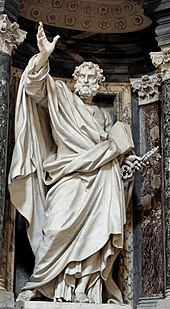
Ephesians 3:14-21 – A Prayer for Every Believer

A mosaic of the Apostle Paul in St Isaac’s Cathedral, St. Petersburg, Russia

For this reason, I fall on my knees before the Father, from whom every family in heaven and on earth receives its true name. I ask God from the wealth of his glory to give you power through his Spirit to be strong in your inner selves, and I pray that Christ will make his home in your hearts through faith. I pray that you may have your roots and foundation in love, so that you, together with all God’s people, may have the power to understand how broad and long, how high and deep, is Christ’s love. Yes, may you come to know his love—although it can never be fully known—and so be completely filled with the very nature of God.

To him who by means of his power working in us is able to do so much more than we can ever ask for, or even think of: to God be the glory in the church and in Christ Jesus for all time, forever and ever! Amen. (Good News Translation)

In Jesus Christ, the believer has been given incredible blessings – adoption into God’s family and belonging with God, redemption through Christ’s cross and experiencing freedom from the power of sin, and intimacy and help by means of God’s own Spirit.

Today’s New Testament lesson is a prayer of the Apostle Paul for the Church. After three chapters of describing who we are and what we have in Christ as Christians, he goes to prayer, asking that the new life we have in Christ will be pressed firmly into our heads and our hearts so that this reality of spiritual blessings will be practically realized for the believer.

Here’s a quick remedial grammar lesson: a “verb” expresses an action between two things; a “participle” or “participial phrase” is a word or group of words which help describe the action of the verb.

There are two main verbs Paul uses: “I ask (pray)” for God “to give.” The participles all explain or modify the action of pray and give. In other words, the following actions are what Paul deeply desires that God will do for us as believers in Jesus….

To Become Mighty Through the Spirit

God grants us all the blessings of being in Christ. We are delivered from sin, death, and hell so that we will live into God’s purposes for this new life of freedom.

We live into the Christian life, on a practical level, as our faith is strengthened, and our inner person becomes powerful. This is the Spirit’s work in us – to strengthen our spiritual spine so that we can bear and carry our cross in this life, despite whatever the adversity or difficulty.

We are not alone. The Spirit is with us always. God is present. The believer is never promised that life will be a bowl of cherries and that being a Christian is all rainbows and unicorns. However, the believer is assured that God will be with us through the trouble – which is why we need a strong and robust faith.

You set a table for me
    right in front of my enemies. (Psalm 23:5, CEB)

To Dwell In Christ Through Faith

The “heart” in the New Testament is a reference not to the physical muscle in our chest but the seat or center of our inner person.

Paul’s prayer is that God gives or plants the seeds of the gospel in the hearts of people. Those good seeds then take root and become anchored firmly in the soul. They grow and mature, producing a harvest of love.

Not only do those roots grow down and deep, but they also grow out and connect with all other believers everywhere.

To Grasp God’s Love in Christ Through the Spirit

Enjoying this mystical union with Christ and connection with Christians, we come to experientially grasp together the vast dimensions of God’s love for us. God’s love is a multiverse of blessing. In fact, an eternity in heaven will never reach the bottom or top of the God who is Love itself.

When God our Savior made his kindness and love for humanity appear, he saved us, but not because of anything we had done to gain his approval. Instead, because of his mercy he saved us through the washing in which the Holy Spirit gives us new birth and renewal. God poured a generous amount of the Spirit on us through Jesus Christ our Savior. (Titus 3:4-6, GW)

To be filled with all the fullness of Love, is to be filled thoroughly with God – because God is Love.

My dear friends, we must love each other. Love comes from God, and when we love each other, it shows we have been given new life. We are now God’s children, and we know him. God is love, and anyone who doesn’t love others has never known him. (1 John 4:7-8, CEV)

Conclusion

Prayer is a gift. Like a little child bursting into her daddy’s office at work and crawling up on his lap, so we have the wondrous privilege of coming to God without hindrance and asking for whatever we need and want.

And what God wants and enjoys hearing, is us asking for spiritual strength, faith, and love. Because it is these things which create a thriving inner person who blesses others.

May it be so, to the glory of God, for the edification of the Church, and in the proclamation of the gospel. Amen.

Amos 5:10-17 – Work It Out In the Public Square

People hate this kind of talk.
    Raw truth is never popular.
But here it is, bluntly spoken:
    Because you run roughshod over the poor
    and take the bread right out of their mouths,
You’re never going to move into
    the luxury homes you have built.
You’re never going to drink wine
    from the expensive vineyards you’ve planted.
I precisely know the extent of your violations,
    the enormity of your sins. Appalling!
You bully right-living people,
    taking bribes right and left and kicking the poor when they’re down.

Justice is a lost cause. Evil is epidemic.
    Decent people throw up their hands.
Protest and rebuke are useless,
    a waste of breath.

Seek good and not evil—
    and live!
You talk about God, the God-of-the-Angel-Armies,
    being your best friend.
Well, live like it,
    and maybe it will happen.

Hate evil and love good,
    then work it out in the public square.
Maybe God, the God-of-the-Angel-Armies,
    will notice your remnant and be gracious.

Now again, my Master’s Message, God, God-of-the-Angel-Armies:

“Go out into the streets and lament loudly!
    Fill the malls and shops with cries of doom!
Weep loudly, ‘Not me! Not us, Not now!’
    Empty offices, stores, factories, workplaces.
Enlist everyone in the general lament.
    I want to hear it loud and clear when I make my visit.”

God’s Decree. (The Message)

I believe an honest hearing of the prophet Amos would change the world.

I’m not talking about angry ranting which works people into a frenzy of fear and suspicion. I am referring to giving Amos a serious hearing, just like we give the Apostle Paul our focused attention.

Too bad so many people are unfamiliar with this prophet and his message. This unawareness, or even purposeful ignorance, could be one reason why the ancient message of Amos appears as fresh today as it was so long ago.

Poverty has always been with us – but that doesn’t mean we ought to only shrug our shoulders and say, “Meh, what’s a guy to do?” Instead, we can determine to address the issues which create a large class of poor people to begin with. Those issues include malevolence, materialism, and militarism.

Malevolence

The moral compass of many of the earth’s nations is askew, even broken. It needs to be recalibrated to the true north of biblical justice.

Back in the prophet’s day, bullying, bribery, and backstabbing were tools used for malevolent purposes. Those same implements are still being used by some today.

You must not pervert justice or show favor. Do not take a bribe, for bribes blind the eyes of the wise and distort the words of the righteous. (Deuteronomy 16:19, NET)

Those who plant injustice will harvest disaster,
    and their reign of terror will come to an end. (Proverbs 22:8, NLT)

But why would people be so unjust to other people? What would motivate someone to purposefully harm another in this way?…

Materialism

Whenever people have an exorbitant amount of stuff, generosity is typically not their first impulse (Ecclesiastes 5:10). Rather, the extremely rich among us have an equally extreme temptation to hold on tight to their wealth – so much so that money and acquiring more stuff becomes their religion. That’s why Scripture is replete with warnings about money.

Jesus said:

“No one can serve two masters. Either you will hate the one and love the other, or you will be loyal to the one and have contempt for the other. You cannot serve God and wealth.” (Matthew 6:24, CEB)

“Be on your guard against all kinds of greed, for one’s life does not consist in the abundance of possessions.” (Luke 12:15, NRSV)

It’s bad enough when individuals, families, and corporate companies devote themselves to a bloated materialism without regard to the poor; it’s even worse when entire nations, governments, and regions do it. From their perspective, what is the most effective way for them to protect all that stuff and self-interest?

Militarism

Pouring significant amounts of money into maintaining armies to safeguard resources – and the way of life which created those resources – puts the focus off the poor and onto the interests of wealth. It also diverts money which could address problems of poverty and puts it into a massive defense budget.

Throughout the Old Testament, militarism was seen as fundamentally not trusting in God. And the prophets have a well-known term for this: idolatry.

The Lord doesn’t care about
the strength of horses
    or powerful armies.
The Lord is pleased only
with those who worship him
    and trust his love. (Psalm 147:10-11, CEV)

Make sure to not build up a war machine, amassing military horses and chariots. (Deuteronomy 17:16, MSG)

Please don’t hear what I’m not saying. A standing military is a must – I’m just pointing out that we need to know precisely what we’re defending. Are we truly defending the rights of the poor, the disadvantaged, and the needy? Or are we defending someone’s exorbitant wealth?

Work It Out In the Public Square

Policies need to reflect values. Greed can and is legislated as a politic of indifference, whereas generosity can be ensconced with a politic of caring for the common good of all, not just some. This is not namby-pamby liberal drivel – it is paying attention to the biblical text.

Addressing poverty means removing the obstacles of malevolence, materialism, and militarism. And it begins with practicing lament.

The very presence of systemic racism and poverty, ecological devastation, healthcare disparities, economic policies which do not benefit all persons, and distorted notions of nationalism requires not only virtuous policy making, but also demands public lamentation.

Why lament? Because the Lord, the One who observes and sees all the wrong against the most vulnerable of the earth, demands that it be done.

Wherever there is injustice, we need people who will champion the cause of the needy through voicing aloud the deep grief from being squished by the powerful, as well as affirming trust in the Lord.

I’ll never forget the trouble, the utter lostness,
    the taste of ashes, the poison I’ve swallowed.
I remember it all—oh, how well I remember—
    the feeling of hitting the bottom.
But there’s one other thing I remember,
    and remembering, I keep a grip on hope:

God’s loyal love couldn’t have run out,
    his merciful love couldn’t have dried up.
They’re created new every morning.
    How great your faithfulness!
I’m sticking with God (I say it over and over).
    He’s all I’ve got left. (Lamentations 3:19-24, MSG)

O Creator of all living things: We are all hungry in a world full of abundance. The possibilities of food for bodies and souls overflow on this earth. We ask for the grace to see the abundance of our world and enough awareness to acknowledge our sins of greed and fear.

Give us openness of soul, courageous spirits, and willing hearts to be with our sisters and brothers who are hungry and in pain, through Jesus Christ our Lord, who with you and the Holy Spirit are One God, now and forever. Amen.

Matthew 25:31-46 – Meeting Jesus

On a bright Sunday morning, Lefty and his wife Goatrude were sitting at home enjoying a leisurely cup of coffee together. Lefty was slowly going through some of his emails.

And then, it happened.

“Oh, my goodness, look at this!” said Lefty to Goatrude. “I got an e-mail from Jesus! It says he will be here at 10am on Sunday. Egad! That’s any minute now!”

“The house is a mess! Hurry! Let’s get this all picked up.” said Goatrude. “And, for God’s sake, where is that big Bible? It needs to be here on the coffee table when Jesus gets here!”

“I think I know where that Bible is….” said Lefty. After rummaging around a junk closet, Lefty found the Bible dusted it off, and placed it prominently on the coffee table as the centerpiece of the living room.

As Goatrude and Lefty were hurriedly trying to make everything just right for Jesus, there was a knock at the door.

“That must be Jesus!” said Goatrude. “Answer it, Lefty. And, for goodness sake, stand up straight and be polite. We want Jesus to see us at our best.”

Lefty answered the door, surprised to see a ragged looking young man on the step.

“I’m sorry to bother you on a Sunday morning, but I haven’t had anything to eat all weekend. Might you have some food to spare?”

Perturbed with this interruption, Lefty answered the young man harshly. “No, I don’t. You need to go, right away. I have an important guest coming, and he’ll be here anytime now.” And he slammed the door shut.

Lefty had barely began getting back to tidying the living room when another knock came at the door.

“He’s here!” said Goatrude, moving quickly toward the door. But when she opened it, there stood a harried looking woman.

“Hello. My car broke down and I can’t get it started. And my cell phone died. Might I come in for just a few minutes so that I can get a bit warmed up and make a phone call?” said the woman.

Goatrude rudely responded, “We all have problems lady. I’ve got my own right now. You try and get ready for a visit from Jesus at the last minute. Try someone else.” And with that, Goatrude shut the door.

Lefty and Goatrude continued their hasty preparations for a visit from Jesus, when yet a third knock came at their door. This time, they answered it together, believing this to be Jesus for sure.

But when they opened the door, a frantic husband immediately said, “My wife just fell on the sidewalk. Please help me!”

“For God’s sake, man, we’re about to have Jesus here! We can’t be seen with a woman lying in front of our house! Get her up and go next door. And make it quick!”

Together, Goatrude and Lefty shut the door. Then, they sat down and anticipated Jesus to show.

Minutes pass… It’s now 10:15 and no Jesus. So, Goatrude, looking at Lefty, says, “I never figured Jesus to be somebody who is late. Maybe he got held up.”

“Hey, how about if I open this Bible and read something. When Jesus gets here, we’ll impress him with some knowledge. We’ll be the talk of the town, hosting Jesus.”

So, Lefty opened the big book, randomly turned to a page, and began reading….

“When the Son of Man comes in his glory, and all the angels with him, he will sit on his glorious throne. All the nations will be gathered before him, and he will separate the people one from another as a shepherd separates the sheep from the goats. He will put the sheep on his right and the goats on his left.

“Then the King will say to those on his right, ‘Come, you who are blessed by my Father; take your inheritance, the kingdom prepared for you since the creation of the world. For I was hungry, and you gave me something to eat, I was thirsty, and you gave me something to drink, I was a stranger and you invited me in, I needed clothes and you clothed me, I was sick, and you looked after me, I was in prison, and you came to visit me.’

“Then the righteous will answer him, ‘Lord, when did we see you hungry and feed you, or thirsty and give you something to drink? When did we see you a stranger and invite you in, or needing clothes and clothe you? When did we see you sick or in prison and go to visit you?’

“The King will reply, ‘Truly I tell you, whatever you did for one of the least of these brothers and sisters of mine, you did for me.’

“Then he will say to those on his left, ‘Depart from me, you who are cursed, into the eternal fire prepared for the devil and his angels. For I was hungry, and you gave me nothing to eat, I was thirsty, and you gave me nothing to drink, I was a stranger, and you did not invite me in, I needed clothes and you did not clothe me, I was sick and in prison and you did not look after me.’

“They also will answer, ‘Lord, when did we see you hungry or thirsty or a stranger or needing clothes or sick or in prison, and did not help you?’

“He will reply, ‘Truly I tell you, whatever you did not do for one of the least of these, you did not do for me.’

“Then they will go away to eternal punishment, but the righteous to eternal life.” (New International Version)

1 John 3:11-17 – Love, Not Hate

Cain and Abel by Gunter Tanzerel, 2011

The message you heard from the very beginning is this: we must love one another. We must not be like Cain; he belonged to the Evil One and murdered his own brother Abel. Why did Cain murder him? Because the things he himself did were wrong, and the things his brother did were right.

So do not be surprised, my friends, if the people of the world hate you. We know that we have left death and come over into life; we know it because we love others. Those who do not love are still under the power of death. Those who hate others are murderers, and you know that murderers do not have eternal life in them. This is how we know what love is: Christ gave his life for us. We too, then, ought to give our lives for others! If we are rich and see others in need, yet close our hearts against them, how can we claim that we love God? (Good News Translation)

For the world to be a life-giving place of thriving people, it must spin on the axis of love, grace, and belonging – and not be a death-dealing haunt of murder, hate, and disconnection.

“Death” and “life” are full of meaning in Holy Scripture. Whereas we tend to use death and life as referring chiefly to the body, they are primarily relational terms in the Bible.

Death is a separation from God and others; and life is connection with God and others.

In addition, death and life are biblically understood as forces or realms of being within or without. Whenever someone moves from death to life, they leave the realm of separation with its loneliness, lostness, lethargy, and lack of meaningful and helpful interaction with God and others to a place of connection in which there is love.

There is no love in the realm of death. Death is awful in the sense that it places one outside of love.

Like death and life, love is also a relational term and a force or power which exists. Love, in fact, is such a huge realm of being and such a large domain that it almost defies definition. We are mostly left to describe love because all attempts to nail down love with a precise definition will never do it justice.

Therefore, the Apostle Paul, in his great ode to love, did not even try to define it, but merely attempted to characterize love:

Love is patient. Love is kind. Love isn’t jealous. It doesn’t sing its own praises. It isn’t arrogant. It isn’t rude. It doesn’t think about itself. It isn’t irritable. It doesn’t keep track of wrongs. It isn’t happy when injustice is done, but it is happy with the truth. Love never stops being patient, never stops believing, never stops hoping, never gives up. (1 Corinthians 13:4-7, GW)

Consistent with the force and relational nature of death, life, and love, hate is not primarily a feeling toward another but exists as a stance toward another within the domain of darkness and death. To hate is to deliberately and volitionally separate from another person and/or from God. It is to consider someone as the “other” who is not like me, and so, I will neither associate nor interact with “those” people.

Love, however, thrives in the vast multi-dimensional realm of life. Love seeks connection with another and desires to act mercifully and kindly through discovering needs and meeting them. Although emotions of love are very real, those feelings are the result of calculated actions and words which benefit humanity and the common good of all persons.

It is vital that we make clear decisions to pursue life and love others. And Jesus is our model for this. Christ is the ultimate Connector, bringing vibrant life, even eternal life, through loving actions. Jesus intentionally entered the dark realm of death and absorbed all the hate of the world for you and me. In a great and loving reversal, Jesus Christ’s death – his separation from God and others – brought connection with God and others.

Likewise, followers of Jesus will learn to take on the world’s hatred, not fearing death’s ability to disconnect, and love others as they themselves have been loved by Christ. Christians are known by the way they act toward those in the realm of death; believers love and do not hate; despite being hated by another.

The biblical character Cain is Exhibit A of modeling the way of hatred and death. He separated himself from his brother, Abel, in every way possible – relationally, emotionally, mentally, and finally, physically through outright killing of the body.

The message from the Apostle John is this: Do not be like Cain. Be like Jesus. Love others, and do not hate them. Live for others, die to self.

Murder is also a relational term in Scripture. It is, of course, a tool forged from the flames of hell to be used by the hand of hatred to bring death’s realm of separation. Jesus clearly understood murder in this manner:

You know that our ancestors were told, “Do not murder” and “A murderer must be brought to trial.” But I promise you that if you are angry with someone, you will have to stand trial. If you call someone a fool, you will be taken to court. And if you say that someone is worthless, you will be in danger of the fires of hell. (Matthew 5:21-22, CEB)

Christians are people who put love where love is not – which means they brave death’s door to pull others from the flames.

But you, dear friends, must build each other up in your most holy faith, pray in the power of the Holy Spirit, and await the mercy of our Lord Jesus Christ, who will bring you eternal life. In this way, you will keep yourselves safe in God’s love. And you must show mercy to those whose faith is wavering. Rescue others by snatching them from the flames of judgment. Show mercy to still others, but do so with great caution, hating the sins that contaminate their lives. (Jude 20-23, NLT)

May your soul be blessed with love’s kiss.

May the grace and kindness of love bring life and continue to be life-giving for you.

May the hardness of hatred be far from you.

May death’s destructive power dwindle to nothing in the face of Christ’s love working in and through you to the glory of God. Amen.